Lidia Beccaria Rolfi
Lidia Beccaria Rolfi | |
|---|---|
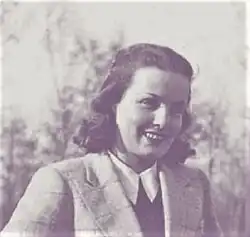 Rolfi during the 1950s | |
| Born | Lidia Beccaria 8 April 1925 |
| Died | 17 January 1996 (aged 70) Mondovì, Italy |
| Education | University of Turin |
| Occupations | |
| Spouse | Giorgio Rolfi |
| Children | 1 |
| Military career | |
| Nickname | Maestrina Rossana |
| Allegiance | Italian resistance |
| Unit | 11th Division Garibaldi, 15th Brigade "Saluzzo" |
Conflict | Italian Civil War |
Lidia Beccaria Rolfi (née Beccaria; 8 April 1925 – 17 January 1996) was an Italian elementary teacher, writer, diarist, partisan and Socialist Party politician.[1][2][3][4] A member of the Italian resistance, Beccaria was arrested by the National Republican Guard (GNR) and later deported to Ravensbrück by the Gestapo.[1][2][3][5] In 1978, Beccaria co-authored the first Italian-language book about the deportation of Italian women to concentration camps in Nazi Germany.[3]
Early life and education
Beccaria was born Lida Beccaria on 8 April 1925 in Mondovì to a peasant farming family.[2][3][4] The youngest of five, Beccaria was the only one of her siblings to continue her education.[2] Completing her teacher training in 1943, Beccaria began teaching at an elementary school in the village of Torrette di Casteldelfino in the Varaita Valley.[2][3][6]
Italian resistance
By the time of the Armistice of Cassibile, Beccaria had made contact with the Italian resistance.[3][6][7] On 3 December 1943, Beccaria joined the 15th Brigade "Saluzzo" of the 11th Division Garibaldi as a partisan courier.[3][6][7] Adopting the nom de guerre "Maestrina Rossana", Beccaria worked to maintain contact between the "Saluzzo" and the Varaita Valley, collected money for Jewish families in hiding and made grenades.[2][3][4][6][7]
On 13 March 1944,[a] Beccaria was arrested in Torrette di Casteldelfino by the GNR and taken to the “Hotel zum Engel” in Sampeyre.[1][2][3][6] Beccaria was interrogated and tortured for a day and a night, before being handed over to the Gestapo in Cuneo.[2][3] Initially held in Saluzzo, Beccaria was soon transferred to the New Prison in Turin.[2][3][6] Held there for two months, Beccaria shared a prison cell with Anna Segre Levi, the grandmother of her fellow partisan Isacco Levi.[2][3][6]
Ravensbrück
On 27 June,[b] Beccaria and 13 other female prisoners were loaded into a cattle wagon under the pretense of being sent to "work" in Germany.[2][3][6] Travelling via Bolzano, the train arrived at Fürstenberg station on the evening of 30 June.[2][3][7] Forced to march the four kilometers to Ravensbrück by the SS, Beccaria and the 13 other prisoners were the first group of Italian political deportees to be interned at the camp.[2][3] In October, Beccaria Rolfi was assigned to carry out forced labour at the neighboring Siemens & Halske factory.[2][3][4] Managing to steal paper from the factory, as well as sourcing a pencil stub through her fellow prisoners, Beccaria fashioned a small notebooks she named "my diary" (Italian: il mio diario).[2][3][4]
Beccaria recorded her own personal experiences, as well as poems by Dante, Carducci, Gozzano, and Pascoli which she wrote from memory.[4] The diaries also served a communal aspect, with basic glossaries of German and French words and French-language poems by inmates, including Charlotte Delbo, used to teach Beccaria French.[4] On the 26 April 1945, the SS forced the prisoners at Ravensbrück on a death march.[2][3][6] Liberated by the Red Army on 30 April 1945, Beccaria was later sent to a displaced persons camp in Lübeck.[2][3][6] Beccaria, as a former political deportee, was viewed with contempt and denied access to Red Cross parcels.[2]
Post-war
Repatriated on 1 September 1945, Beccaria faced discrimination from both her fellow partisans and wider Italy society.[2][3][6] As a former political deportee Beccaria faced suspicion of being a collaborator, the stereotype of having been sexually exploited by her Nazi captors, and her contribution to the resistance ignored.[2][5] Prevented from returning to her former school by a superintendent with a fascist sympathies, Beccaria earned a teaching degree from the University of Turin and was later able to return to teaching.[2][3][4]
Public testimony
On 4 and 5 December 1959, Beccaria spoke publicly about Ravensbrück for the first time at a touring exhibition by the Museo della Deportazione in Turin.[4] By the end of the month Beccaria published her first testimony in Il Giorno.[4] During the 1960s, Beccaria began working with the Institute of the History of Resistance in Cuneo, the National Association Partisans of Italy' and the International Ravensbrück Committee.[2][3][4] Beccaria also gave educational tours of concentration camps, and worked to bring the experiences of survivors into the public consciousness.[3][4] A member of the Socialist Party, Beccaria served as the deputy mayor and councilor for Mondovì.[2][4]
In 1964, Beccaria was interviewed by Liliana Cavani, who later released the 1974 film The Night Porter, for the 1965 documentary Women in the Resistance (Italian: La donna nella Resistenza).[4] In multiple interviews and the preface to the The Night Porter screenplay, Cavani detailed how she had taken inspiration for the film from an unnamed concentration camp survivor.[4] The scholar Giovanni Miglianti posits that the film was greatly inspired by Beccaria's testimony, particulaty Cavani's interpretation of Beccaria's annual visit to Ravensbrück as being sexual in nature.[4] Miglianti further posits that Beccaria's 1978 work Le donne di Ravensbrück. Testimonianze di deportate politiche Italiane, co-written with Anna Maria Bruzzone and the first Italian-language book about the deportation of Italian women to concentration camps, could be interpreted as an attempt by Beccaria to both reclaim her story and to disavow the sexual stereotypes of former female political deportees.[3][4]
In 2021, the Saluzzo civil library was renamed after Beccaria.[8]
Personal life
Upon her return to Italy, Beccaria married Giorgio Rolfi with whom she had one son.[2][4]
Publications
- Rolfi, Lidia Beccaria; Bruzzone, Anna Maria (1978). Le donne di Ravensbrück. Testimonianze di deportate politiche Italiane [Women of Ravensbrück. Testimonies of Italian Political Deportees]. Torino: Einaudi.
- Rolfi, Lidia Beccaria (1996). L’esile filo della memoria. Ravensbrück, 1945: un drammatico ritorno alla libertà [The Thin Thread of Memory. Ravensbrück, 1945: A dramatic return to freedom]. Torino: Einaudi. ISBN 9788806139575.
Notes
References
- 1 2 3 "BOOKS – Lidia Rolfi, partisan teacher". Pagine Ebraiche. Translated by Tona, Chiara. Rome: Union of Italian Jewish Communities. 22 July 2025. Retrieved 13 June 2026.
- 1 2 3 4 5 6 7 8 9 10 11 12 13 14 15 16 17 18 19 20 21 22 23 24 25 26 Coscia, Gianfranco; Lepri Scritture, Laura (2023). "Beccari Rolfi Lidia: Mondovì (CN) 1925 – Mondovì (CN) 1996". Enciclopedia delle donne (in Italian). Milan: Società per l'enciclopedia delle donne. Retrieved 14 June 2026.
- 1 2 3 4 5 6 7 8 9 10 11 12 13 14 15 16 17 18 19 20 21 22 23 24 25 26 "Lidia Rolfi". IRK–CIR. International Ravensbrück Committee. Retrieved 13 June 2026.
- 1 2 3 4 5 6 7 8 9 10 11 12 13 14 15 16 17 18 Miglianti, Giovanni (2026). Josi, Mara; Taddei, Valeria (eds.). "Threads of Memory: Lidia Beccaria Rolfi's Ravensbrück Testimony". Life Writing. 23 (1): 103–112. doi:10.1080/14484528.2025.2587673.
- 1 2 Grazia Battistoni, Maria; Giomprini, Rita; Moretti, Anna Paola; Moretti, Mirella, eds. (2010). "Le memoire femminili. Vissuto e pensiero dall'esperienza dei lager nazisti". La deportazione femminile. Incontro con Irene Kriwcenko. Da Kharkov a Pesaro: una storia in relazione. pp. 23–28. Retrieved 15 June 2026.
- 1 2 3 4 5 6 7 8 9 10 11 "Lidia Beccaria Rolfi". BeWeB (in Italian). Rome: Episcopal Conference of Italy. 20 November 2021. Retrieved 13 June 2026.
- 1 2 3 4 "Lidia Beccaria Rolfi". ANPI (in Italian). Rome: Associazione Nazionale Partigiani d'Italia. Retrieved 13 June 2026.
- ↑ "SALUZZO/ Inaugurata la nuova biblioteca intitolata a Lidia Beccaria Rolfi alla ex "Musso"". Cuneocronaca (in Italian). Cuneo. 28 June 2021. Retrieved 15 June 2026.