Lestaillats Marls Formation
| Lestaillats Marls Formation | |
|---|---|
| Stratigraphic range: Late Cretaceous (early Late Maastrichtian ~ | |
| Type | Geological formation |
| Unit of | Ausseing Group |
| Underlies | Calcarenites du Jadet Formation |
| Overlies | Nankin 2 Limestones Formation |
| Thickness | ~ 20 m (66 ft) |
| Lithology | |
| Primary | Marls |
| Location | |
| Coordinates | 43°11′N 1°01′E |
| Region | Occitania |
| Country |  France |
  Lestaillats Marls Formation (France)  Lestaillats Marls Formation (Occitanie)  Lestaillats Marls Formation (Haute-Garonne) | |
The Lestaillats Marls Formation (Formation des marnes de Lestaillats) is a geological formation in southwestern France whose layers date back to the early late Maastrichtian, approximately 69 to 68 million years ago. It consists of dark marls deposited in a coastal marsh area. Dinosaur remains are among the fossils that have been recovered from the formation, although none have yet been referred to a specific genus.
Location

The Lestaillats Marls Formation first appeared in the scientific literature in 1999.[1] This formation had not been distinguished in earlier studies,[2][3] and the vertebrate fossils discovered there in the early 1990s were initially attributed to the Marnes d'Auzas Formation.[4]
The Lestaillats Marls Formation is located in the Plagne anticline in the central part of the Haute-Garonne department (Petites Pyrénées) in Occitania region.[5] As this region is covered with very dense vegetation, outcrops of this formation have mainly been studied in active or abandoned quarries located in particular near the villages of Mauran and Ausseing.
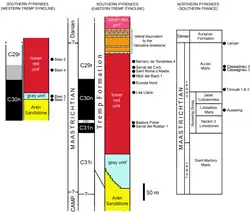
The Lestaillats Marls Formation is the second of the three formations of the Ausseing Group. It overlies conformably the Nankin 2 Limestones Formation and is overlain conformably by the Calcarenites du Jadet Formation. The Lestaillats Marls Formation corresponds to a more continental environment (estuarine marsh) than that of the two underlying and overlying formations deposited in a shallow marine environment[6][7].This tripartite subdivision is only present in the Plagne and Saint-Martory anticlines. In the Aurignac anticline, located to the north of the two previous ones, the Lestaillats marls are absent and the layers equivalent to the Ausseing Group are designated as Nankin limestones facies.[8][7]
Lithostratigraphy and depositional environment
The Lestaillats Marls Formation reaches approximately 20 m (66 ft) in thickness and is composed solely of gray to black marls, rich in organic matter, and highly bioturbated. These marls can be more or less indurated and contain lignites. The richness of organic matter (indicating a reducing environment), the overabundance of cynenid bivalves (indicator of an environment with variable salinity), the joint presence of euryhaline marine and freshwater fish, plant remains and terrestrial reptiles, make it possible to reconstruct a depositional environment corresponding to an estuarine marsh area.[6][7]
The Lestaillats Marls Formation was deposited on the west coast of the former Ibero-Armorican island, which included a large part of France and the Iberian Peninsula.[9]. The rocks of the Ausseing Group and the overlying Marnes d'Auzas Formation show the alternation of shallow marine sediments and coastal continental deposits (estuarine and fluvial) corresponding to sea level fluctuations and shoreline shifts during the Late Maastrichtian in this part of the Ibero-Armorican island.[7]
Fossil content
The first vertebrate fossils from the Lestaillats Marls Formation were discovered in 1993 at the Lestaillats 1 site near the village of Mauran in the basal part of the formation.[10] Two excavation campaigns carried out in 1994 and 1997 by a team of the Musée des dinosaures d’Espéraza unearthed numerous vertebrate remains.[10] Other specimens come from the Lestaillats 2 site discovered in 1994.[11] Another site located in the middle part of the formation was discovered in 1997 near the village of Ausseing and excavated in 2000 by the same team. It also yielded a diverse fauna.[12]
The most common vertebrate fossils from the formation belong to undetermined hadrosaurid dinosaurs. Most of the available hadrosaur bones do not allow their definitive attribution to a particular hadrosaur clade, with the exception of an ischium from the Ausseing site which shows characteristics of Lambeosaurinae.[13] Lambeosaurines are the only known Hadrosaurids from the Ibero-Armorican domain and it is likely that the other hadrosaur remains from the Lestaillats Marls Formation belong to this clade. The very good state of preservation of their bones reveals that they did not undergo significant transport before their burial, which indicates that these hadrosaurs probably lived in the tidal plain in which their remains were found.[14][15] Most of the hadrosaur bones unearthed show bite marks, particularly on the neural spines of several dorsal vertebrae, ischia, as well as on one femur, revealing that the bodies of these specimens were consumed by crocodiles or theropod dinosaurs.[16][17]
Color key
|
Notes Uncertain or tentative taxa are in small text; |
Dinosaurs
Ornithischians
Ankylosaurs
| Ankylosaurs of the Lestaillats Marls Formation | ||||||
|---|---|---|---|---|---|---|
| Genus | Species | Location | Stratigraphic position | Material | Notes | Image |
| Struthiosaurini indet. | Indeterminate | Lestaillats 1 | Lower | A struthiosaurin nodosauridae | ||
Hadrosaurs
| Hadrosaurs of the Lestaillats Marls Formation | ||||||
|---|---|---|---|---|---|---|
| Genus | Species | Location | Stratigraphic position | Material | Notes | Image |
| Hadrosauridae indet. | Indeterminate | Lestaillats 1 | Lower |
A squamosal and an anterior fragment of a maxilla are cited (but not figured) by Laurent and colleagues.[38] |
The slender shape of the scapula, with its two extremities of equal width (a dominant morphology in Hadrosaurinae, although there are exceptions),[16][39] suggests a different taxon from the lambeosaurine Canardia found in the same region in the younger strata of the Marnes d'Auzas Formation. In the latter, the scapular blade is shorter, its distal end being wider dorsoventrally than its proximal end, a typical characteristic of most lambeosaurines, although there are also exceptions.[40][nb 1] The dorsal and caudal vertebrae have very tall neural spines,[nb 2] a feature more common (but not exclusive) in lambeosaurines.[42] A dentary tooth of the Lestaillats hadrosaurid has a crown with a median carina but without a secondary carina.[16][43]. This tooth therefore differs from the dentary teeth of Canardia which have a main carina slightly offset posteriorly relative to the axis of the tooth (asymmetrical position) and which are equipped with a thin secondary carina located anterior to the main carina.[44][nb 3] |      |
| Indeterminate | Lestaillats 2 | Lower | Shows numerous bite marks | |||
| Indeterminate | Ausseing | Middle |
Fragmentary teeth and lower jaw are also cited but not figured.[53] |
|||
| Lambeosaurinae indet. | Indeterminate | Ausseing | Middle | In 2013, Prieto-Márquez et al. identified diagnostic lambeosaurines features in the left ischium MDE-Aus-185 (iliac process with dorsal margin caudally recurved producing a “thumb-like” lateral profile).[13][nb 4]. The other hadrosaur remains from the Ausseing site reported by Yves Laurent in 2003 may belong to the same taxon. |  | |
Saurischians
Sauropods
| Sauropods of the Lestaillats Marls Formation | ||||||
|---|---|---|---|---|---|---|
| Genus | Species | Location | Stratigraphic position | Material | Notes | Image |
| Titanosauria indet. | Indeterminate | Ausseing | Middle |
|
||
Theropods
| Theropods of the Lestaillats Marls Formation | ||||||
|---|---|---|---|---|---|---|
| Genus | Species | Location | Stratigraphic position | Material | Notes | Image |
| Theropoda indet.[38] | Indeterminate | Lestaillats 1 | Lower | MDE-Les-76, an incomplete tooth | Possibly an indeterminate dromaeosaurid | |
Crocodilians
| Crocodilians of the Lestaillats Marls Formation | ||||||
|---|---|---|---|---|---|---|
| Genus | Species | Location | Stratigraphic position | Material | Notes | Image |
| Crocodyliformes indet. | Indeterminate | Lestaillats 1 and 2, Ausseing | Lower and Middle | Teeth (including MDE-Aus-187[59], osteoderms (including MDE-Aus-06 and 112)[60] | ||
| Thoracosaurus | Indeterminate | Ausseing | Middle | Teeth[61] | ||
| Musturzabalsuchus?[62] | Indeterminate | Ausseing | Middle | MDE-Aus-230 and 124, teeth[63] | A probable Allodaposuchidae eusuchian | |
| Acynodon | A. cf. iberoccitanus[64] | Ausseing | Middle | A hylaeochampsid eusuchian | ||
Squamates
| Squamates of the Lestaillats Marls Formation | ||||||
|---|---|---|---|---|---|---|
| Genus | Species | Location | Stratigraphic position | Material | Notes | Image |
| Lacertilia indet. | Indeterminate | Ausseing | Middle | Vertebrae (including MDE-Aus-254)[68] | ||
| Scincomorpha indet. | Indeterminate | Ausseing | Middle | MDE-Aus-255, a dentary bearing teeth[69] | ||
Turtles
| Turtles of the Lestaillats Marls Formation | ||||||
|---|---|---|---|---|---|---|
| Genus | Species | Location | Stratigraphic position | Material | Notes | Image |
| Pleurodira indet. | Indeterminate | Lestaillats 1 and 2 | Lower | MDE-Les-15, xiphiplastron[70] ; dermal plates[71] | ||
| Indeterminate | Ausseing | Middle |
|
|||
| Foxemys? | Indeterminate | Ausseing | Middle | MDE-Aus-18, entoplastron[81] | A bothremydid turtle | |
| Solemys? | Indeterminate | Ausseing | Middle | MDE-Aus-16 and 183, dermal plates[82] | A helochelydrid turtle | |
Amphibians
| Amphibians of the Lestaillats Marls Formation | ||||||
|---|---|---|---|---|---|---|
| Genus | Species | Location | Stratigraphic position | Material | Notes | Image |
| Albanerpetontidae indet. | Indeterminate | Ausseing | Middle | MDE-Aus-251, a dentary fragment bearing seven teeth[83] | ||
| Discoglossidae indet.[84] | Indeterminate | Ausseing | Middle | |||
Fish
| Fish of the Lestaillats Marls Formation | ||||||
|---|---|---|---|---|---|---|
| Genus | Species | Location | Stratigraphic position | Material | Notes | Image |
| Chondrichthyes indet.[87][88] | Indeterminate | Lestaillats 1 and 2 | Lower | Teeth (including MDE-Les2-09)[89] | ||
| Osteichthyes indet.[90] | Indeterminate | Ausseing | Middle | Vertebrae | ||
| Lepisosteidae indet.[87][91] | Indeterminate | Lestaillats 1, Ausseing | Lower and Middle | |||
| cf. Lepisosteus? | Indeterminate | Ausseing | Middle | Teeth (including MDE-Aus-243)[95] | ||
| cf. Atractosteus? | Indeterminate | Ausseing | Middle | Teeth (including MDE-Aus-244)[96] | ||
| Phyllodontidae indet. | Indeterminate | Lestaillats 1 and 2, Ausseing | Lower and Middle | Teeth (including MDE-Aus-245)[97] | ||
| Phyllodontinae indet. | Indeterminate | Lestaillats 2 | Lower | MDE-Les2-06, a partial tooth plate[98][99] | ||
| Amiidae indet.[91] | Indeterminate | Ausseing | Middle | Tooth plates (including MDE-Aus-246)[100] ; vertebrae (including MDE-Aus-247)[101] | ||
| cf. Palaeolabrus? | Indeterminate | Ausseing | Middle | MDE-Aus-248, a tooth plate[102] | ||
| Sparidae? indet.[87][84] | Indeterminate | Lestaillats 1 and 2, Ausseing | Lower and Middle | Teeth (including MDE-Aus-249)[103] | ||
Notes
- ↑ The lambeosaurine Lambeosaurus lambei has a scapula more similar to that of the Hadrosaurinae.[39] Among the Ibero-Armorican lambeosaurines, a scapular blade distally not enlarged has been reported in 2019 in Adynomosaurus.[41]
- ↑ In the caudal vertebra MDE-Les-04, whose neural spine measures 20.5 centimetres (8 in), the heigh/width ratio of the neural spine is 6.4, a condition closer to that of the lambeosaurine Hypacrosaurus (which is 7) than that of the hadrosaurine Edmontosaurus (which is 2). In the caudal vertebra MDE-Les-20, this ratio is 5.6.[42]
- ↑ However, Prieto-Márquez et al. demonstrated that although most lambeosaurines had teeth bearing an accessory ridge in addition to the median carina, as in Corythosaurus casuarius, C. intermedius and Lambeosaurus lambei, at least one individual of each of these three well-known species has teeth lacking accessory ridges and teeth with less pronounced ridges than in other known specimens of the species (irregularly developed ridges along the entire apicobasal length and with very little relief).[45]
- ↑ The iliac process of the three ischial bones from the Lestaillats 1 site is incomplete, which prevents any attributing to either of the two main clades of hadrosaurids.[56].
References
- ↑ Laurent, Cavin & Bilotte 1999, p. 783 (text and fig.1).
- ↑ Bilotte 1985, pp. 1–438.
- ↑ Lepicard 1985, pp. 1–276.
- ↑ Buffetaut 1995, p. 129 ; 131 (photo of a hadrosaur vertebra from Lestaillats).
- ↑ Laurent 2003, p. 30.
- 1 2 Laurent, Cavin & Bilotte 1999, p. 783.
- 1 2 3 4 Laurent 2003, p. 30-31, 31 (fig. 7).
- ↑ Laurent, Bilotte & Le Loeuff 2002, p. 123 (fig. 2).
- ↑ Csiki-Sava et al. 2015, p. 9 ; 40.
- 1 2 Laurent 2003, p. 18.
- ↑ Laurent 2003, p. 19.
- ↑ Laurent 2003, p. 20-21.
- 1 2 Prieto-Márquez et al. 2013, p. 30-31, 32 (fig. 23A).
- ↑ Laurent, Cavin & Bilotte 1999, p. 786.
- ↑ Laurent 2003, p. 69.
- 1 2 3 Laurent, Cavin & Bilotte 1999, p. 785.
- ↑ Laurent 2003, p. 51 ; 54-55 ; 69.
- ↑ Laurent, Cavin & Bilotte 1999, p. 785 (fig.3e).
- ↑ Laurent 2003, p. 60-61 ; plate 54 (fig.159).
- ↑ Laurent, Cavin & Bilotte 1999, p. 785 (fig.3f).
- ↑ Laurent 2003, p. 60-61 ; plate 54 (fig.160).
- ↑ Laurent 2003, p. 60-61 ; plate 54 (fig.161).
- ↑ Laurent, Cavin & Bilotte 1999, p. 782 ; 785 (fig.3c).
- ↑ Laurent 2003, p. 49-50 ; plate 29 (fig.90).
- ↑ Laurent 2003, p. 50 ; plate 33 (fig.103).
- ↑ Laurent 2003, p. 51 ; plate 33 (fig.104).
- ↑ Laurent 2003, p. 51 ; plate 33 (fig.105).
- ↑ Laurent 2003, p. 53 ; plate 36 (fig.113).
- ↑ Laurent, Cavin & Bilotte 1999, p. 782 ; 785 (fig.3b).
- ↑ Laurent 2003, p. 53 ; plate 37 (fig.115).
- ↑ Laurent, Cavin & Bilotte 1999, p. 782 ; 785 (fig.3d).
- ↑ Laurent 2003, p. 52-53 ; plate 35 (fig.109).
- ↑ Laurent 2003, p. 51-52 ; plate 34 (fig.108).
- ↑ Laurent 2003, p. 52-53 ; plate 35 (fig.110).
- ↑ Laurent 2003, p. 54 ; plate 39 (fig.119).
- ↑ Laurent 2003, p. 54 ; plate 40 (fig.121-122).
- ↑ Laurent 2003, p. 54 ; plate 40 (fig.123).
- 1 2 Laurent, Cavin & Bilotte 1999, p. 782 ; 785.
- 1 2 Laurent 2003, p. 53.
- ↑ Prieto-Márquez et al. 2013, p. 11 (fig.9A and C) ; 17.
- ↑ Prieto-Márquez et al. 2019, p. 21 ; 23-34 ; 26 (fig.A-B) ; 34 (fig.12).
- 1 2 Laurent 2003, p. 52-53.
- ↑ Laurent 2003, p. 49.
- ↑ Prieto-Márquez et al. 2013, p. 13.
- ↑ Prieto-Márquez et al. 2013, p. 20-21.
- ↑ Laurent 2003, p. 55 ; plate 42 (fig.127).
- ↑ Laurent 2003, p. 53 ; plate 36 (fig.111).
- ↑ Laurent 2003, p. 55 ; plate 43 (fig.130).
- ↑ Laurent 2003, p. 56 ; plate 46 (fig.135).
- ↑ Laurent 2003, p. 56 ; plate 47 (fig.138).
- ↑ Laurent 2003, p. 56 ; plate 48 (fig.141).
- ↑ Laurent 2003, p. 57 ; plate 49 (fig.147).
- ↑ Laurent 2003, p. 48-49.
- ↑ Laurent 2003, p. 54-55 ; plate 41 (fig.124).
- ↑ Prieto-Márquez et al. 2013, p. 30-31 ; 32 (fig.23A).
- ↑ Laurent 2003, p. 48-50 ; 53-57 ; plate 40.
- ↑ Laurent 2003, p. 47 ; plate 26 (fig.81).
- ↑ Laurent 2003, p. 47 ; plate 25 (fig.80).
- ↑ Laurent 2003, p. 41-42 ; plate 12 (fig.40).
- ↑ Laurent 2003, p. 41-42 ; plate 14 (fig.50-51).
- ↑ Laurent 2003, p. 43.
- ↑ Laurent 2003, p. 45.
- ↑ Laurent 2003, p. 45 ; plate 21 (fig.65-66).
- ↑ Laurent 2003, p. 45-46.
- ↑ Laurent 2003, p. 45-46 ; plate 21 (fig.67).
- ↑ Laurent 2003, p. 45-46 ; plate 21 (fig.68).
- ↑ Laurent 2003, p. 45-46 ; plate 21 (fig.69).
- ↑ Laurent 2003, p. 41 ; plate 11 (fig.37).
- ↑ Laurent 2003, p. 41 ; plate 11 (fig.38).
- ↑ Laurent, Cavin & Bilotte 1999, p. 784 ; 785 (fig.3a).
- ↑ Laurent 2003, p. 38.
- ↑ Laurent 2003, p. 38 ; plate 7 (fig.26).
- ↑ Laurent 2003, p. 38 ; plate 7 (fig.27).
- ↑ Laurent 2003, p. 38 ; plate 7 (fig.28).
- ↑ Laurent 2003, p. 38 ; plate 7 (fig.29).
- ↑ Laurent 2003, p. 38 ; plate 8 (fig.30).
- ↑ Laurent 2003, p. 38 ; plate 8 (fig.31).
- ↑ Laurent 2003, p. 38 ; plate 6 (fig.20-21).
- ↑ Laurent 2003, p. 38 ; plate 6 (fig.22-23).
- ↑ Laurent 2003, p. 38 ; plate 6 (fig.24-25).
- ↑ Laurent 2003, p. 40 ; plate 10 (fig.34).
- ↑ Laurent 2003, p. 40 ; plate 10 (fig.35-36).
- ↑ Laurent 2003, p. 37 ; plate 5 (fig.17).
- 1 2 Laurent 2003, p. 37.
- ↑ Laurent 2003, p. 37 ; plate 5 (fig.18).
- ↑ Laurent 2003, p. 37 ; plate 5 (fig.19).
- 1 2 3 Laurent, Cavin & Bilotte 1999, p. 784.
- ↑ Laurent 2003, p. 35.
- ↑ Laurent 2003, p. 35 ; plate 1 (fig.1).
- ↑ Laurent 2003, p. 35-36.
- 1 2 Laurent 2003, p. 36.
- ↑ Laurent, Cavin & Bilotte 1999, p. 782 ; 784.
- ↑ Laurent 2003, p. 36 ; plate 2 (fig.4).
- ↑ Laurent 2003, p. 36 ; plate 2 (fig.6).
- ↑ Laurent 2003, p. 36 ; plate 2 (fig.7).
- ↑ Laurent 2003, p. 36 ; plate 2 (fig.8).
- ↑ Laurent 2003, p. 36 ; plate 3 (fig.12).
- ↑ Laurent, Cavin & Bilotte 1999, p. 782 ; 784 (fig.2).
- ↑ Laurent 2003, p. 36 ; plate 3 (fig.13).
- ↑ Laurent 2003, p. 36 ; plate 3 (fig.9).
- ↑ Laurent 2003, p. 36 ; plate 3 (fig.10).
- ↑ Laurent 2003, p. 36 ; plate 3 (fig.11).
- ↑ Laurent 2003, p. 37 ; plate 4 (fig.15).
Bibliography
- Bilotte, M. (1985). "Le Crétacé supérieur des plates-formes est-pyrénéennes". Strata. 5: 1–438.
- Csiki-Sava, Z.; Buffetaut, E.; Ősi, A.; Pereda-Suberbiola, X.; Brusatte, S.L. (2015). "Island life in the Cretaceous-faunal composition, biostratigraphy, evolution, and extinction of land-living vertebrates on the Late Cretaceous European archipelago". ZooKeys (469): 1–161. doi:10.3897/zookeys.469.8439. PMC 4296572. PMID 25610343.
- Laurent, Y. (2003). "Les faunes de vertébrés continentaux du Maastrichtien supérieur d'Europe : systématique et biodiversité". Strata. 41: 1–81.
- Laurent, Y.; Bilotte, M.; Le Loeuff, J. (2002). "Late Maastrichtian continental vertebrates from southwestern France: correlation with marine fauna". Palaeogeography, Palaeoclimatology, Palaeoecology. 187 (1–2): 121–135. Bibcode:2002PPP...187..121L. doi:10.1016/S0031-0182(02)00512-6.
- Laurent, Y.; Cavin, L.; Bilotte, M. (1999). "Découverte d'un gisement à vertébrés dans le Maastrichtien supérieur des Petites-Pyrénées". Comptes Rendus de l’Académie des Sciences. 328: 781–787. doi:10.1016/S1251-8050(99)80171-2.
- Lepicard, Béatrice (1985). "Le Crétacé terminal et le Paléocène basal dans les Petites-Pyrénées et les Dômes annexes. Biostratigraphie-Sédimentologie". Strata. Série 2. 4: 1–276.
- Prieto-Márquez, A.; Dalla Vecchia, F.M.; Gaete, R.; Galobart, À. (2013). "Diversity, Relationships, and Biogeography of the Lambeosaurine Dinosaurs from the European Archipelago, with Description of the New Aralosaurin Canardia garonnensis". PLOS ONE. 8 (7) e69835. Bibcode:2013PLoSO...869835P. doi:10.1371/journal.pone.0069835. PMC 3724916. PMID 23922815.
- Prieto-Márquez, A.; Fondevilla, V.; Sellés, A.G.; Wagner, J.R.; Galobart, Á. (2019). "Adynomosaurus arcanus, a new lambeosaurine dinosaur from the Late Cretaceous Ibero-Armorican Island of the European Archipelago". Cretaceous Research. 96: 19–37. doi:10.1016/j.cretres.2018.12.002.