Leioproctus philonesus
| Leioproctus philonesus | |
|---|---|
Scientific classification  | |
| Kingdom: | Animalia |
| Phylum: | Arthropoda |
| Clade: | Pancrustacea |
| Class: | Insecta |
| Order: | Hymenoptera |
| Family: | Colletidae |
| Genus: | Leioproctus |
| Species: | L. philonesus |
| Binomial name | |
| Leioproctus philonesus | |
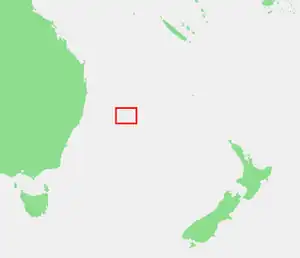 | |
| Location of Lord Howe Island | |
| Synonyms | |
| |
Leioproctus philonesus, or Leioproctus (Leioproctus) philonesus, is a species of bee in the family Colletidae and subfamily Colletinae. It is endemic to Australia. It was described by British-American entomologist Theodore Dru Alison Cockerell in 1929.[1][2]
Description
Female body length is about 9.5 mm. Colouration is mainly black; the hair white to grey-black and reddish.[1]
Distribution and habitat
The species only occurs on Australia's Lord Howe Island in the Tasman Sea. The type locality is Mount Gower.[2]
Behaviour
The adults are flying mellivores.[2]
References
- 1 2 3 Cockerell, TDA (1929). "Bees in the Australian Museum collection" (PDF). Records of the Australian Museum. 17: 199–243 [201]. Retrieved 2026-07-13.
- 1 2 3 4 "Species Leioproctus (Leioproctus) philonesus (Cockerell, 1929)". Australian Faunal Directory. Dept of Climate Change, Energy, the Environment and Water, Australia. 2026. Retrieved 2026-07-13.