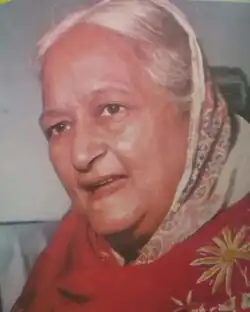
Leela Mishra
Leela Mishra | |
|---|---|
 | |
| Born | 1 January 1908 |
| Died | 17 January 1988 (aged 80) |
| Other name | Leela Misra |
| Occupation | actress |
| Years active | 1936–1986 |
| Known for | Mausi in Sholay (1975) |
| Spouse | Ram Prasad Misra |
| Children | 3 |
Leela Mishra (1 January 1908[1] – 17 January 1988) was an Indian actress. She worked as a character actor in over 200 Hindi films for five decades, and is best remembered for playing stock characters such as aunts (Chachi or Mausi). She is best known for her role of "mausi" in the blockbuster Sholay (1975), Dil Se Mile Dil (1978), Baton Baton Mein (1979), Rajesh Khanna films such as Palkon Ki Chhaon Mein, Aanchal, Mehbooba, Amar Prem and Rajshri Productions hits such as Geet Gaata Chal (1975), Nadiya Ke Paar (1982) and Abodh (1984).[2][3][4] Her career's best performance was in Naani Maa in 1981, for which she received Best Actress award at the age of 73.
Personal life
Leela Mishra was married to Ram Prasad Mishra, who was a character artist, then working in silent films. She got married at the very young age of 12. By the time she was 17, she had two daughters. She hailed from Jais, Raebareli, and she and her husband were from zamindar (landowners) families.[5]
Career
Leela Mishra was discovered by a man called Mama Shinde, who was working for Dadasaheb Phalke's Nasik Cinetone. He persuaded her husband to make her work in films. During those days there was a severe scarcity of women actors in films; this was evident in the paychecks that the Mishras received when they went to Nasik for the shooting. While Ram Prasad Mishra was hired on a salary of Rs. 150 per month, Leela Mishra was offered Rs. 500 per month. However, as they fared poorly in front of the camera, their contracts were cancelled.
The next opportunity that came their way was an offer to work in the movie Bhikarin, which was being produced by a company owned by the Maharaja of Kolhapur. However, Leela Mishra lost out on this opportunity too, as the role required her to put her arms round the actor (who was not her husband) while delivering a dialogue, which she flatly refused to do.
She faced a similar problem while working in another film titled Honhaar. She was cast opposite Shahu Modak as a heroine, and was supposed to hug and embrace him, which she again refused steadfastly. Since the company was legally in a weak position, they couldn't turn her out of the film, which proved to be a blessing in disguise for her. She was offered the role of Modak's mother in the film and it clicked instantly. This opened the doors for her to play mother roles at the young age of 18.[5]
Notable works
Early on in her career she acted in films such as the musical hit Anmol Ghadi (1946), Raj Kapoor's Awaara (1951) and the Nargis-Balraj Sahni starrer Lajwanti (1958), which was nominated for the Palme d'Or for Best Film at the 1959 Cannes Film Festival.[6]
She acted in the first Bhojpuri film, Ganga Maiyya Tohe Piyari Chadhaibo (1962), which also starred Kumkum, Helen and Nazir Hussain.[7][8]
Her roles varied from mothers, benign or evil aunts, to comic roles.
Death
She died of a heart attack in Bombay on 17 January 1988 at the age of 80.
Partial filmography
References
- ↑ "Лила Мишра".
- ↑ Vishwas Kulkarni (19 April 2010). "10 things we miss in Bollywood". Mumbai Mirror. Retrieved 10 September 2011.
- ↑ "A dekho at the Iconic ads over the years". The Economic Times. 22 April 2009. Archived from the original on 23 May 2012. Retrieved 10 September 2011.
- ↑ S. Brent Plate (2003). Representing religion in world cinema: filmmaking, mythmaking, culture making. Palgrave Macmillan. p. 28. ISBN 1-4039-6051-8.
- 1 2 "Leela Mishra interview on Cineplot.com". Retrieved 26 March 2014.
- ↑ "Festival de Cannes: Lajwanti". festival-cannes.com. Retrieved 14 February 2009.
- ↑ "Strong at 50, Bhojpuri cinema celebrates". The Indian Express. 14 February 2011. Retrieved 10 September 2011.
- ↑ "First Bhojpuri Film To Be Screened During Bihar Divas". NDTV Movies. 17 March 2011. Archived from the original on 20 April 2016. Retrieved 3 April 2016.
- ↑ "Leela Mishra". Movies & TV Dept. The New York Times. 2014. Archived from the original on 6 May 2014. Retrieved 10 September 2011.
External links
- Leela Mishra at IMDb
- Leela Mishra at Bollywood Hungama
- Leela Mishra Filmography at Upperstall