Laevicaulis alte
| Laevicaulis alte | |
|---|---|
 | |
Scientific classification  | |
| Kingdom: | Animalia |
| Phylum: | Mollusca |
| Class: | Gastropoda |
| Order: | Systellommatophora |
| Family: | Veronicellidae |
| Genus: | Laevicaulis |
| Species: | L. alte |
| Binomial name | |
| Laevicaulis alte Férussac, 1822) | |
| Synonyms[2] | |
| |

Laevicaulis alte, or the tropical leatherleaf, is a species of tropical land slug, a terrestrial pulmonate gastropod mollusk in the family Veronicellidae, the leatherleaf slugs.
Description
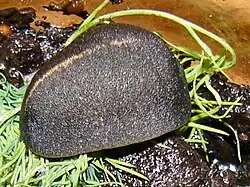
Laevicaulis alte is a round, dark-coloured slug with no shell, 7 or 8 cm (2.8 or 3.1 in) long. Its skin is slightly tuberculated. The central keel is beige in colour.
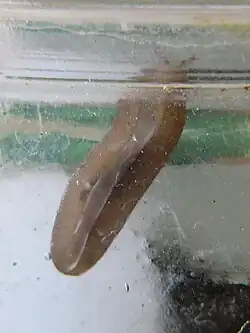
This slug has a unique, very narrow foot; juvenile specimens have a foot 1 mm (0.039 in) wide and adult specimens have a foot that is only 4 or 5 mm (0.16 or 0.20 in) wide.
The tentacles are small, 2 or 3 mm (0.079 or 0.118 in) long, and they are only rarely extended beyond the edge of the mantle.
Parasites
This slug is an intermediate host for Angiostrongylus cantonensis, the rat lungworm, a round worm, the most common cause of eosinophilic meningoencephalitis.[3]
Predators
Laevicaulis alte is eaten by the frog Rana tigrina.[3]
Distribution

The species is probably indigenous to sub-Saharan Africa, including Tanzania,[4] Botswana[5] and South Africa[6]
It has been introduced and has become an invasive species[7] in the following areas:
- Southern Asia
- Taiwan[8][9]
- China[10]
- Ryukyu Islands, Japan[11]
- United States (Hawaii)[12]
- Islands in the Indian Ocean
- Australia (since 1889)
- Samoa
The species is already established in the USA, and is considered to represent a potentially serious threat as a pest, an invasive species which could negatively affect agriculture, natural ecosystems, human health or commerce. Therefore, it has been suggested that this species be given top national quarantine significance in the USA.[13]
Habitat
Laevicaulis alte lives in dry areas, mostly at lower altitudes.[14]
Life cycle
The slug hatches from eggs. Laevicaulis alte has several adaptations for living in dry conditions: a rounded shape with as small as possible surface area, and a narrow foot to reduce evaporation.
Juvenile specimens search for food nearly always at night, and stay buried in the soil during the day. Larger specimens are active during the day sometimes. The slug can grow up from 0.5 cm (0.20 in) to approximately 4 cm (1.6 in) in length in 7 months.[14]
References
- ↑ NatureServe. "Laevicaulis alte". NatureServe Explorer. Arlington, Virginia. Retrieved 10 April 2026.
- ↑ "Laevicaulis alte". Global Biodiversity Information Facility. Retrieved 30 June 2021.
- 1 2 "Christoph Högger - Antagonists of Slugs and Snails". Archived from the original on 2007-12-14. Retrieved 2016-10-05.
- ↑ Rowson B., Warren B. H. & Ngereza C. F. (2010). "Terrestrial molluscs of Pemba Island, Zanzibar, Tanzania, and its status as an "oceanic" island". ZooKeys 70: 1-39. doi:10.3897/zookeys.70.762
- ↑ Rapalai, B.L. (2024). "An annotated checklist of molluscs recorded from Botswana". Indago. 41: 15–44. doi:10.5281/zenodo.13132605.
- ↑ Herbert, Dai; Kilburn, Dick (2004). Field guide to the land snails and slugs of eastern South Africa. Pietermaritzburg: Natal Museum. p. 336. ISBN 0-620-32415-5.
- ↑ "Laevicaulis alte Laevicaulis alte (Ferussac)".
- ↑ Wu S.-P., Hwang C.-C., Huang H.-M., Chang H.-W., Lin Y.-S. & Lee P.-F. (2007). "Land Molluscan Fauna of the Dongsha Island with Twenty New Recorded Species". Taiwania 52(2): 145–151. Original.
- ↑ 蔡奇立 (2024-12-01). "毛毛蟲蛞蝓,你怎麼了?". 自然保育季刊 (28): 94–101.
- ↑ Chen, De-niu; Gao, Jia-xiang (1987). 中国经济动物志 陆生软体动物 (in Simplified Chinese). Vol. 陆生软体动物. 科学出版社. pp. 186页.
- ↑ Hirano, Takahiro; Kagawa, Osamu; Fujimoto, Masanori; Saito, Takumi; Uchida, Shota; Yamazaki, Daishi; Ito, Shun; Shariar, Shovon Mohammad; Sawahata, Takuo; Chiba, Satoshi (2022-04-22). "Species identification of introduced veronicellid slugs in Japan". PeerJ. 10 e13197. doi:10.7717/peerj.13197. ISSN 2167-8359. PMC 9037128. PMID 35480566.
- ↑ "Comprehensive Report Species - Laevicaulis alte". www.natureserve.org. Archived from the original on 2007-09-26.
- ↑ Cowie R. H., Dillon R. T., Robinson D. G. & Smith J. W. (2009). "Alien non-marine snails and slugs of priority quarantine importance in the United States: A preliminary risk assessment". American Malacological Bulletin 27: 113–132. PDF Archived 2016-06-16 at the Wayback Machine
- 1 2 "Laevicaulis alte (Férussac, 1822)". www.gbif.org. Retrieved 2024-08-01.
External links

- articles at PubMed
- Distribution in Australia
- Distribution in United States Archived 2008-10-11 at the Wayback Machine
- In English and in Chinese
Images
- Drawing of ventral part of body, photo (In Japanese)
- Laevicaulis alte at Samoan Snail Project
- Photo (Japanese)
- Photo (Japanese)
- Photo (Japanese)
- Photo (Japanese)