Lipase A, lysosomal acid type


Lipase A, lysosomal acid type is a protein that in humans is encoded by the LIPA gene.[5]
Gene
This gene encodes lipase A, the lysosomal acid lipase (also known as cholesterol ester hydrolase or LAL).
Alternatively spliced transcript variants have been found for this gene. [provided by RefSeq, Jan 2014].
Function
This enzyme functions in the lysosome to catalyze the hydrolysis of cholesteryl esters and triglycerides, leading to the production of free cholesterol and fatty acids.[6] Notably, LAL is the only known acid lipase that hydrolyzes cholesteryl esters and triglycerides within the lysosomal environment.[6]
LAL is essential to intracellular lipid metabolism in macrophages and hepatocytes. Upon uptake of LDL by endocytosis, cholesteryl esters and triglycerides are transported to lysosomes where they are hydrolyzed by LAL.[7] The resulting free cholesterol either exits the lysosome for future use in membrane synthesis or is re-esterified in the endoplasmic reticulum by ACAT to form lipid droplets.[7] This process is important for foam cell formation during atherogenesis.[8]
Clinical significance
The importance of LAL in cardiovascular disease has been highlighted by GWAS studies, which have identified variants in the LIPA locus that are associated with coronary artery disease.[9] LAL was found to have high expression in macrophages located in atherosclerotic plaques, where its activity contributes to the accumulation of lipid droplets and the progression of plaque development.[6][8]
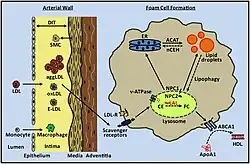
Mutations in the LIPA gene that cause loss-of-function can result in infant-onset Wolman disease, caused by a complete lack of LAL production, or a later-onset Cholesterol ester storage disease (CESD), caused by a 5-10% reduction in LAL production.[6]
References
- 1 2 3 GRCh38: Ensembl release 89: ENSG00000107798 – Ensembl, May 2017
- 1 2 3 GRCm38: Ensembl release 89: ENSMUSG00000024781 – Ensembl, May 2017
- ↑ "Human PubMed Reference:". National Center for Biotechnology Information, U.S. National Library of Medicine.
- ↑ "Mouse PubMed Reference:". National Center for Biotechnology Information, U.S. National Library of Medicine.
- ↑ "Entrez Gene: Lipase A, lysosomal acid type". Retrieved 2018-08-22.
- 1 2 3 4 Li F, Zhang H (May 2019). "Lysosomal Acid Lipase in Lipid Metabolism and Beyond". Arteriosclerosis, Thrombosis, and Vascular Biology. 39 (5): 850–856. doi:10.1161/atvbaha.119.312136. PMC 6482091. PMID 30866656.
- 1 2 3 Dubland JA, Francis GA (2015). "Lysosomal acid lipase: at the crossroads of normal and atherogenic cholesterol metabolism". Frontiers in Cell and Developmental Biology. 3 3. doi:10.3389/fcell.2015.00003. PMC 4313778. PMID 25699256.
- 1 2 Bobryshev YV, Ivanova EA, Chistiakov DA, Nikiforov NG, Orekhov AN (2016). "Macrophages and Their Role in Atherosclerosis: Pathophysiology and Transcriptome Analysis". BioMed Research International. 2016 9582430. doi:10.1155/2016/9582430. PMC 4967433. PMID 27493969.
- ↑ Butterworth AS, Braund PS, Farrall M, Hardwick RJ, Saleheen D, Peden JF, et al. (IBC 50K CAD Consortium) (September 2011). "Large-scale gene-centric analysis identifies novel variants for coronary artery disease". PLoS Genetics. 7 (9) e1002260. doi:10.1371/journal.pgen.1002260. hdl:2434/211014. PMC 3178591. PMID 21966275.
Further reading
- Riemenschneider M, Mahmoodzadeh S, Eisele T, Klopp N, Schwarz S, Wagenpfeil S, et al. (2004). "Association analysis of genes involved in cholesterol metabolism located within the linkage region on chromosome 10 and Alzheimer's disease". Neurobiology of Aging. 25 (10): 1305–1308. doi:10.1016/j.neurobiolaging.2004.01.001. PMID 15465627. S2CID 43039824.
- Papassotiropoulos A, Wollmer MA, Tsolaki M, Brunner F, Molyva D, Lütjohann D, et al. (July 2005). "A cluster of cholesterol-related genes confers susceptibility for Alzheimer's disease". The Journal of Clinical Psychiatry. 66 (7): 940–947. doi:10.4088/JCP.v66n0720. PMID 16013913.
- Zhao B, Fisher BJ, St Clair RW, Rudel LL, Ghosh S (October 2005). "Redistribution of macrophage cholesteryl ester hydrolase from cytoplasm to lipid droplets upon lipid loading". Journal of Lipid Research. 46 (10): 2114–2121. doi:10.1194/jlr.M500207-JLR200. PMID 16024911.
- Zhao B, Natarajan R, Ghosh S (November 2005). "Human liver cholesteryl ester hydrolase: cloning, molecular characterization, and role in cellular cholesterol homeostasis". Physiological Genomics. 23 (3): 304–310. CiteSeerX 10.1.1.861.6660. doi:10.1152/physiolgenomics.00187.2005. PMID 16131527.
{{cite journal}}: Cite uses deprecated parameter|citeseerx=(help) - Grupe A, Li Y, Rowland C, Nowotny P, Hinrichs AL, Smemo S, et al. (January 2006). "A scan of chromosome 10 identifies a novel locus showing strong association with late-onset Alzheimer disease". American Journal of Human Genetics. 78 (1): 78–88. doi:10.1086/498851. PMC 1380225. PMID 16385451.
- von Trotha KT, Heun R, Schmitz S, Lütjohann D, Maier W, Kölsch H (July 2006). "Influence of lysosomal acid lipase polymorphisms on chromosome 10 on the risk of Alzheimer's disease and cholesterol metabolism". Neuroscience Letters. 402 (3): 262–266. doi:10.1016/j.neulet.2006.04.009. PMID 16730122. S2CID 8354106.
- Wang F, Wang W, Wähälä K, Adlercreutz H, Ikonen E, Tikkanen MJ (December 2008). "Role of lysosomal acid lipase in the intracellular metabolism of LDL-transported dehydroepiandrosterone-fatty acyl esters" (PDF). American Journal of Physiology. Endocrinology and Metabolism. 295 (6): E1455–61. doi:10.1152/ajpendo.90527.2008. PMID 18796546. S2CID 18294238. Archived from the original (PDF) on 2019-02-28.
- Ruaño G, Bernene J, Windemuth A, Bower B, Wencker D, Seip RL, et al. (February 2009). "Physiogenomic comparison of edema and BMI in patients receiving rosiglitazone or pioglitazone". Clinica Chimica Acta; International Journal of Clinical Chemistry. 400 (1–2): 48–55. doi:10.1016/j.cca.2008.10.009. PMID 18996102.
- Pisciotta L, Fresa R, Bellocchio A, Pino E, Guido V, Cantafora A, et al. (June 2009). "Cholesteryl Ester Storage Disease (CESD) due to novel mutations in the LIPA gene". Molecular Genetics and Metabolism. 97 (2): 143–148. doi:10.1016/j.ymgme.2009.02.007. hdl:11380/636658. PMID 19307143.
This article incorporates text from the United States National Library of Medicine, which is in the public domain.