Doraemon: Nobita's Secret Gadget Museum
| Doraemon: Nobita's Secret Gadget Museum | |||||
|---|---|---|---|---|---|
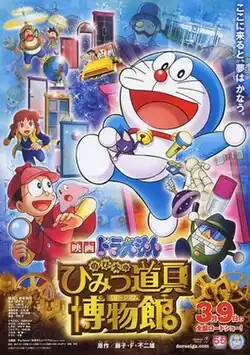 Theatrical release poster | |||||
| Japanese name | |||||
| Kanji | 映画ドラえもん のび太のひみつ道具博物館 | ||||
| Literal meaning | Doraemon the Movie: Nobita's Secret Gadget Museum | ||||
| |||||
| Directed by | Yukiyo Teramoto | ||||
| Screenplay by | Higashi Shimizu | ||||
| Based on | |||||
| Starring | |||||
| Music by | Kan Sawada | ||||
Production company | |||||
| Distributed by | Toho | ||||
Release date |
| ||||
Running time | 104 minutes | ||||
| Country | Japan | ||||
| Language | Japanese | ||||
| Box office | ¥3.98 billion (Japan) | ||||
Doraemon: Nobita's Secret Gadget Museum (Japanese: 映画ドラえもん のび太のひみつ道具博物館, Hepburn: Eiga Doraemon: Nobita no Himitsu Dōgu Museum) is a 2013 Japanese anime mystery adventure film and the 33rd installment of the Doraemon film series. Directed by Yukiyo Teramoto and written by Higashi Shimizu, the screenplay follows Doraemon as he travels with Nobita, Shizuka, Gian, and Suneo to the Secret Gadget Museum in the future to retrieve his stolen bell, a premise supplied by Shimizu that Teramoto broadened to highlight themes of friendship. To portray the bond between Doraemon and Nobita, the script incorporates various Sherlock Holmes homages.
The film was animated by Shin-Ei Animation. Kan Sawada composed the soundtrack, with Perfume's "Mirai no Museum" serving as the theme song. Distributed by Toho, it was released in Japan on March 9, 2013, and grossed ¥3.98 billion. Adaptations include a manga, an anime comic, and a novelization, all of which were published by Shogakukan, as well as a Nintendo 3DS video game by FuRyu. Critics praised it for its gadget museum theme and its emotional depiction of the friendship between Doraemon and Nobita. It won the Silver Prize at the 31st Golden Gross Awards, presented by the Japan Association of Theatre Owners.
Plot
Doraemon is sleeping in his closet as a robotic hand emerges, reaches for his bell, and absconds with it. In a panic, he consults Nobita, who points out that the bell is broken and asks why it matters. Without telling the truth, Doraemon claims it is valuable to him and recalls a time when he asked the factory where he was made if they could repair the bell. A manufacturer explained that it is an obsolete model and too expensive to fix, but Doraemon insisted on having it repaired. He pulls out the Sherlock Holmes Set (シャーロック·ホームズセット) and gives it to Nobita, who uses it to discover the name of the culprit: Kaitō DX, a well-known gadget thief in the 22nd century.
After discussing the incident with Dorami, Doraemon and Nobita—along with Shizuka, Gian, and Suneo—travel to the 22nd century to visit the Secret Gadget Museum, where they meet Director Fiks and Kurt, a young museum guide giving the group a tour. Doraemon and Nobita search for the lost bell and meet Inspector Mustard, who is investigating a strange case involving the relationship between Kaitō DX and the museum. Gian and Suneo unknowingly pass through the Gulliver Tunnel (ガリバートンネル), shrinking to a tiny size. Nobita, Doraemon, and Shizuka get lost in a tunnel leading to the Sun-Manufacturing Machine Floor that powers the museum. Professor Peppler's past negligence caused a freak accident that made the artificial sun gradually expand into a giant star and endanger the world, leading to his dismissal. During that incident, his colleague Harutoman discovered "Fullmetal", which enabled him to stabilize the sun's core and subsequently manufacture secret gadgets.
Doraemon begins acting more and more like a feral cat. The group spends the night at Kurt's home, where they meet his gelatinous robot pet, Popon. The next day, the museum receives a threat from Kaitō DX, who vows to steal four gadgets at noon. Kaitō defeats the group and steals the listed items. Using the Holmes gadget, Nobita discovers that the targeted security gadgets were all repaired on the exact day Peppler was captured. The group searches for him, leading them to a secret passage. When Kaitō intercepts them, Nobita uncovers his real identity: Kurt himself. Kurt explains the invention he and Peppler were trying to complete. Converting Fullmetal into "Peppler-Metal" requires six hidden chips that Peppler stashed inside various gadgets, including Doraemon's bell. To retrieve these items, they created the persona of Kaitō DX.
Still shrunken, Gian and Suneo retrieve the Big Light (ビッグライト), restoring themselves to normal size. Peppler recovers the chips and begins the conversion. This causes all Fullmetal gadgets to disappear and destabilizes the artificial sun, releasing a monstrous protector that attacks the group. After transforming into Kaitō Dora DX by putting on Kaitō's Bow, Doraemon defeats the monster but accidentally destroys the mainframe controlling the sun. Nobita orders Popon to swallow the sun, making it disappear. As the museum collapses around them, Peppler reverses the conversion to restore the gadgets, allowing Doraemon to use the Restoring Beam (復元光線) to repair the building and save the team. Kurt helps search for the bell and returns half of it to Doraemon. In the end, Nobita finds the other half, realizes why Doraemon cherishes it—because it holds the memory of when their friendship began—and brings it to him.
Voice cast
Voice cast is adapted from the Toho website.[1]
- Wasabi Mizuta as Doraemon
- Megumi Ōhara as Nobita Nobi
- Yumi Kakazu as Shizuka Minamoto
- Subaru Kimura as Takeshi "Gian" Gōda
- Tomokazu Seki as Suneo Honekawa
- Chiaki as Dorami
- Ken Matsudaira as Inspector Mustard
- Yūko Sanpei as Kurt
- Takaya Hashi as Director Fiks
- Shigeru Chiba as Professor Peppler
- Yui Horie as Ginger
- Rikako Aikawa as Popon
Production
Development and writing

Yukiyo Teramoto has storyboarded and directed multiple episodes for the Doraemon series since its premiere on TV Asahi in 2005.[2][3] The 33rd installment, Nobita's Secret Gadget Museum, was her third Doraemon film as director, following New Great Adventure into the Underworld (2007) and New Steel Troops—Winged Angels (2011), both of which are remakes.[2][4] Structured as a mystery adventure[5] written by Higashi Shimizu,[1] the screenplay treats Doraemon as the primary focus, using his relationship with Nobita as the structural pillar.[6] Shimizu provided the core plot point of searching for Doraemon's bell, which Teramoto expanded to emphasize the emotional bond of friendship.[2]
Since her previous 2011 film was a serious drama, Teramoto and the production staff wanted to create a more lighthearted film. Although the script review stage initially leaned toward a more serious tone, the story shifted toward comedy according to Teramoto's preference; her goal was to create a film that left the audience laughing. As her previous two films were remakes, this was her first time tackling an original storyline. Developing an original concept required more effort than working on remakes, although she found the process of independently conceiving the setting and details engaging.[6] To keep the story uplifting and compelling, all characters were designed with inherently cheerful and positive personalities.[2]
The concept of the Secret Gadget Museum setting originated from a proposal co-created by Fujiko Pro and Shintaro Mugiwara,[2] who serialized Dorabase, a baseball-themed manga spin-off of Doraemon.[7] To develop the premise, Teramoto thoroughly read the original manga to capture Fujiko F. Fujio's world. She frequently consulted the Latest Secret Gadget Encyclopedia (最新ひみつ道具大事典), a Doraemon manga guide published by Shogakukan.[2] She felt a strong attachment to secret gadgets she had handled in the television series, including the Milky Way Railroad (天の川鉄道), Wrestling Killer (ころばし屋), and the Woodcutter's Spring (きこりの泉).[6]
The decision to focus on Doraemon's bell was motivated by Teramoto's desire to showcase the friendship between Doraemon and Nobita. A fan of the original Sherlock Holmes stories, she believed the series remained popular due to its depiction of the friendship between Holmes and Dr. Watson.[2] Teramoto embedded multiple references to the series because the stories function as both mysteries and narratives about partnership. She adapted this dynamic to Nobita and Doraemon to highlight their strong bond. When brainstorming dialogue to express Nobita's positive traits, Teramoto settled on the phrase "good guy" (いいヤツ), feeling it had a distinctly boyish quality that naturally conveyed their close relationship, which mirrored the language Nobita occasionally uses in the original manga.[6]
Pre-production


The film was produced by a committee consisting of Fujiko Pro, Shogakukan, TV Asahi, Shin-Ei Animation, Asatsu-DK (ADK), and Shogakukan-Shueisha Productions (ShoPro), with Shin-Ei handling the animation production.[8] Minoru Yamaoka was hired as an assistant director, with Koichi Maruyama taking charge of character design and Makoto Dobashi serving as art director, while Akiyoshi Tanaka rounded out the production team as recording director.[1] The regular voice cast included Wasabi Mizuta (Doraemon), Megumi Ōhara (Nobita), Yumi Kakazu (Shizuka), Subaru Kimura (Gian), Tomokazu Seki (Suneo), and Chiaki (Dorami).[9] Ken Matsudaira joined the voice cast for Inspector Mustard.[10] Teramoto once attended a live stage performance starring Matsudaira. She was impressed by his voice acting after he was cast in the film, noting that it matched Mustard's image perfectly.[2] Other supporting voice actors included Yūko Sanpei (Kurt), Takaya Hashi (Director Fiks), Shigeru Chiba (Professor Peppler), Yui Horie (Ginger), and Rikako Aikawa (Popon).[1]
The museum setting project was conceived partly to commemorate the opening of the Fujiko F. Fujio Museum in September 2011.[2] Teramoto and the art director expanded the concepts and visuals for the Secret Gadget Museum, designing it for both adults and children to enjoy. They incorporated elements from a visit to the Fujiko F. Fujio Museum, where Teramoto had observed interesting signs and gimmicks. The Secret Gadget Museum was designed with a palace-like exterior and an interior space that could be expanded infinitely using a gadget called the Dimension Roller (次元ローラー). Rather than using traditional doors, the exhibition rooms were designed to connect in various layouts. The Robot Hall was chosen as the first exhibition room Nobita and his friends entered to dynamically showcase the large volume of secret gadgets.[6] The setting of the museum's island was inspired by a note in Fujiko Pro's initial planning document referencing Mont-Saint-Michel in France.[2]
Teramoto drew characters while considering their backstories and emotional states, focusing on developing the fine details of their personal lives. A specific background detail revealed that Dr. Peppler switched to drinking black tea because of a major past failure involving coffee, though several of these hidden background settings could not be fully depicted in the final film. Numerous Sherlock Holmes parodies were integrated. The art pieces The Dancing Dog of Bohemia (ボヘミアの踊る犬) and The Devil's Foot Sole Massage (悪魔の足ツボマッサージ) that appeared at the beginning were parodies of Holmes stories: "A Scandal in Bohemia" (1891), "The Adventure of the Dancing Men" (1903), The Hound of the Baskervilles (1902), and "The Adventure of the Devil's Foot" (1910). The inclusion of machine components placed inside a butter dish in Dr. Peppler's laboratory was inspired by "The Adventure of the Musgrave Ritual" (1893), while the plot detail of Dr. Peppler installing microchips into six gadgets parodied "The Adventure of the Six Napoleons" (1904).[6]
Animation
Despite the challenge of depicting the cluttered Anything Hall, where objects were piled to the ceiling, Teramoto believed the animation and background staff successfully brought out a futuristic feel. She found comedy difficult, noting that while movies that evoke tears rely on fixed patterns, laughter is unpredictable, leading to instances where intended comedic scenes miss the mark or unexpected ones elicit laughter. Teramoto preferred humor that induces a quiet smirk over broad gags, such as having replacement items for Doraemon's bell change without anyone noticing. The action sequences, like the battle between Kaitō DX and Inspector Mustard, were depicted with the idea of two conflicting gadgets fighting like a spear and a shield.[6]
In addition to mystery elements and detective themes never before seen in the film franchise,[5] the animation incorporates emotional depth; the scene where Nobita cleans a ditch was drawn to highlight his bond with Doraemon and illustrate why Doraemon treasures his bell. Another scene set in the Matsushiba Repair Service Center, where a character tells Doraemon, "It's cheaper to buy a new one" (買い直したほうが安いよ), was based on Teramoto's personal experience. In her youth, her father had attached an Anglepoise lamp to her desk; when it broke and a shopkeeper suggested a replacement, she refused for sentimental reasons and instead sent it to the manufacturer for repair.[6]
The production includes several homages to Sherlock Holmes; Doraemon references actor William Gillette's catchphrase, "elementary, my dear Watson", while Nobita mutters "baritsu" (バリツ), a fictional martial art associated with Holmes, when chasing the Wrestling Killer in the Anything Hall. Throughout production, Teramoto prioritized the gentle tone characteristic of Fujiko F. Fujio's creations, ensuring that even an angry character's facial expressions were balanced to avoid appearing overly harsh. She stated her intention to maintain this core gentleness, which she viewed as a reflection of Fujiko F. Fujio's personality.[6]
Music
Kan Sawada produced the soundtrack,[1] which was released by Nippon Columbia on June 24, 2015, as part of the two-disc compilation album Doraemon: Nobita's Space Heroes Original Soundtrack & More ~ Doraemon Soundtrack History 3 Music by Kan Sawada ~ (映画ドラえもん のび太の宇宙英雄記 オリジナル・サウンドトラック&モア 〜映画ドラえもんサウンドトラックヒストリー3 Music by 沢田完〜), covering music from the 2011–2015 Doraemon films. The Secret Gadget Museum soundtrack occupies tracks 49–60 of disc one and tracks 1–9 of disc two.[11] "Yume wo Kanaete Doraemon", performed by mao, was featured as the opening theme, while Chiaki's "Egao wa Himitsu Dōgu" was included as an insert song.[12] On November 24, 2012, during the final performance of Perfume's first overseas tour, Perfume World Tour 1st, the group announced that their new song, "Mirai no Museum", would serve as the film's theme.[13] Described as a pop tune with a transparent melody expressing the worldview of the story,[14] the song was released as a single on February 27, 2013, by Universal Music Japan.[15]
| No. | Title | Length |
|---|---|---|
| 49. | "Kaitō Lupin VS Meitantei Nobita, no Yume" (怪盗ルパンVS名探偵のび太、の夢) | 1:37 |
| 50. | "Suzu ga Nusumareta!" (鈴が盗まれた!) | 0:45 |
| 51. | "Kisekae Camera" (きせかえカメラ) | 0:47 |
| 52. | "Dōgu Dashi Fanfare (Tantei Ver.)" (道具出しファンファーレ(探偵Ver.)) | 0:08 |
| 53. | "Nobibibi~n! ~ Nobita Holmes no Theme" (のびびび〜ん!〜のび太ホームズのテーマ) | 1:02 |
| 54. | "Himitsu Dōgu Museum e no Shōtaijō" (ひみつ道具ミュージアムへの招待状) | 2:03 |
| 55. | "Hartman Hakase no Dōzō ~ Kiseki no Museum" (ハルトマン博士の銅像〜奇跡のミュージアム) | 1:21 |
| 56. | "Kyūgata Guard Robot" (旧型ガードロボ) | 1:01 |
| 57. | "Egao wa Himitsu Dōgu (Uta/Chiaki)" (笑顔はひみつ道具 (歌/千秋)) | 1:07 |
| 58. | "Peppler Hakase no Yume" (ペプラー博士の夢) | 1:46 |
| 59. | "Hakase no Ōkina Miss" (博士の大きなミス) | 0:54 |
| 60. | "Heikan Jikan" (閉館時間) | 0:53 |
| No. | Title | Length |
|---|---|---|
| 1. | "Popon" (ポポン) | 0:57 |
| 2. | "Nobita to Doraemon no Omoide" (のび太とドラえもんの思い出) | 1:14 |
| 3. | "Kaitō DX Tōjō! ~ Museum o Mamore" (怪盗DX登場!〜ミュージアムを守れ) | 3:10 |
| 4. | "Gorgon no Kubi" (ゴルゴンの首) | 1:08 |
| 5. | "Kanchō no Hesokuri" (館長のへそくり) | 2:23 |
| 6. | "Jinkō Taiyō no Bōsō ~ Kurt no Yūki" (人工太陽の暴走〜クルトの勇気) | 1:35 |
| 7. | "Chikara o Awasete ~ Kaitō Deluxe VS Guard Robot" (力を合わせて〜怪盗ドラックスVSガードロボ) | 2:58 |
| 8. | "Ganbare Popon! ~ Kiseki no Hikari" (がんばれポポン!〜奇跡の光) | 1:24 |
| 9. | "Oboete Iru yo, Doraemon!" (おぼえているよ、ドラえもん!) | 0:54 |
Release
Marketing

The trailer was released on November 30, 2012, at 7:00 pm (JST) on TV Asahi during the Doraemon anime broadcast and subsequently on the film's official website.[14] "Mirai no Museum" was broadcast weekly as the ending theme of Doraemon starting from January 11, 2013, alongside comments from Perfume.[16] A special episode titled "Strongest! Wrestling Killer Z" (最強!ころばし屋Z), which includes the Secret Gadget Museum, the main setting of the film, aired on March 1, 2013.[17]
Former professional tennis player and TV personality Shuzo Matsuoka led the cheerleading team, with Fuku Suzuki and his younger sister Yume joining as members. Starting from February 1, 2013, the cheering squad appeared within the broadcast slot of the Doraemon series to promote the film. A Doraemon support group called Dora-Ana Dan (ドラアナ団), composed of announcers from five TV Asahi network stations, was formed to build anticipation on their respective programs along with the cheering squad.[18] On February 15, 2013, TV Asahi Douga introduced a Doraemon monthly unlimited viewing pack to commemorate the movie, marking the platform's first-ever monthly flat-rate service.[19]
Between December 12, 2012 and March 24, 2013, Japan Airlines operated a custom-themed Doraemon Jet (ドラえもん ジェット) on domestic routes across Japan to drive awareness for the release.[20] The Chez Madu cafe located in the atrium on the first floor of the TV Asahi Headquarters in Roppongi, Tokyo, was transformed into the Doraemon Secret Gadget Cafe from February 1 to April 14, 2013, featuring an entrance designed like the Anywhere Door (どこでもドア) and replicas of secret gadgets exhibited at various places throughout the venue.[21] The completion preview screening was held on February 24 at the Tokyo Dome City Hall in Koraku, Tokyo,[22] while the opening day stage greeting was held at Toho Cinemas Nichigeki in Yurakucho, Tokyo on March 9, 2013.[23]
Box office
Distributed by Toho,[1] Secret Gadget Museum was released in Japan on March 9, 2013, ranking first in box office revenue for its first two weeks. Prior to its release, advance sales exceeded 250,000 tickets. Within 16 days of its release, it drew over 1.8 million moviegoers and achieved a massive box office revenue of ¥2 billion.[24] On March 22, 2013, the film helped the Doraemon film franchise surpass a milestone of 100 million cumulative attendees, setting a record for a Japanese film series,[25] outpacing the 28 films of the Godzilla series, which had 99 million viewers.[24] The film grossed ¥3.98 billion in Japan and became the country's 6th highest-grossing film of the year.[26] Internationally, it debuted on July 25, 2013, in South Korea (grossing ₩781,495,500)[27] and Hong Kong (US$542,068).[28] Subsequent releases followed in Taiwan on August 2,[29] Thailand on October 17 (US$377,659), and Spain on October 31 (US$1,249,437).[28] In Vietnam, it was released in theaters on December 27, 2013, becoming the first Doraemon film to do so in the country.[30]
Other media
On August 9, 2013, Shogakukan released Secret Gadget Museum on DVD and Blu-ray for rental, distributed by Toho.[31][32] A retail home media version was released on December 4 via Pony Canyon, with the Blu-ray available in standard and special editions. The special edition includes bonus videos and a booklet featuring an exclusive short story illustrated by Teramoto.[33] It was broadcast on March 7, 2014, via TV Asahi, as part of a three-hour anime festival special featuring Doraemon and Crayon Shin-chan.[34] On March 8, 2015, the film began streaming as part of an exclusive streaming release of all 35 Doraemon films on au's video service "Video Pass" under their "All-you-can-watch plan" to commemorate the 35th anniversary of the Doraemon film franchise.[35] A Nintendo 3DS video game adaptation by FuRyu, featuring five mini-games and over 190 collectible secret gadgets, was released on March 7, 2013.[36] Shogakukan subsequently published several print adaptations: a manga illustrated by Mugiwara on March 30, 2013,[37] an anime comic on July 26, 2013,[38] and a novelization written by Naohiro Fukushima and Azuma Shimizu on October 25, 2024.[39]
Reception
According to Anime! Anime!, Secret Gadget Museum received acclaim for featuring numerous gadgets, its museum setting, mystery-solving elements, as well as the strong bond between Doraemon and Nobita that drew emotional responses. The publication ranked it as the top favorite Doraemon film in 2023.[40] In 2024, Eiga.com chose the film as one of its 20 recommended Doraemon films.[41] It won the Silver Prize at the 31st Golden Gross Awards, presented by the Japan Association of Theatre Owners.[42]
Takahiro Ozawa of Excite News praised the film for breaking from formulaic conventions through innovative storytelling, impressive physical action, and thoughtful sci-fi lore expansion, opining that it was "deeply touching longtime fans".[43] Misaki Koyama of Wowow called it "a must-see for mystery lovers", highlighting its Sherlock Holmes-inspired elements and direction.[44] Another reviewer from Anime! Anime! noted that the film successfully tackled an original story, attributing its success to a focus on long-familiar gadgets that heightened children's excitement.[24] Writing in 2026, Kasa Kiki of Aniru! commended the film as a triumphant return to form for the franchise, pointing out its high-quality animation, refreshing futuristic setting, nostalgic elements, and blend of classic comedic tropes with serious social themes.[45]
South Korean critic Lee Ji-hyun of Cine21 lauded the film as a heartwarming and educational experience for all ages, celebrating its charmingly "cat-like" main character, well-motivated antagonists, and touching emotional scenes.[46] Despite its less-than-ideal box office performance in Hong Kong and a lack of flashy visual effects or bold storylines, a writer for Tencent Entertainment emphasized that the film "could still evoke so much resonance", providing a glimpse into the success of the Japanese anime industry.[47] In Vietnam, Thịnh Joey of VietnamPlus praised the film for its universally appealing experience that delivers wholesome family values.[48] Hoàng Lâm of Doanh Nhân Sài Gòn applauded Teramoto's direction, citing its engaging storyline, entertaining adventures for children, and thematic emphasis on friendship and courage.[49]
References
- 1 2 3 4 5 6 映画ドラえもん のび太のひみつ道具博物館(ミュージアム)製作情報・クレジット [Doraemon: Nobita's Secret Gadget Museum: Production information & credits] (in Japanese). Toho. Archived from the original on April 20, 2019. Retrieved August 4, 2026.
- 1 2 3 4 5 6 7 8 9 10 アニメ監督 寺本幸代 [Anime director Yukiyo Teramoto]. OKWave (in Japanese). Vol. 242. Archived from the original on April 9, 2013. Retrieved August 4, 2026.
- ↑ アニメーション監督 寺本 幸代 [Animation director: Yukiyo Teramoto]. Face to Face (in Japanese). Vol. 113. April 22, 2016. Retrieved July 30, 2026.
- ↑ 映画ドラえもん のび太のひみつ道具博物館(ミュージアム) イントロダクション [Doraemon: Nobita's Secret Gadget Museum: Introduction] (in Japanese). Toho. Archived from the original on April 20, 2019. Retrieved August 5, 2026.
- 1 2 Ahn, Ha-na (June 10, 2013). 애니메이션 '극장판 도라에몽' 7월 25일 개봉확정 [Animation 'Doraemon the Movie' release confirmed for July 25]. MBN Star (in Korean). Retrieved August 3, 2026.
- 1 2 3 4 5 6 7 8 9 寺本幸代監督 DXロングインタビュー [Director Yukiyo Teramoto DX Long Interview]. doraeiga.com (in Japanese). Toho. Retrieved July 30, 2026.
- ↑ Komoriya, Kiyomitsu; Kojima, Yasuo (February 4, 2011). 【ゆめのとびらをあけて 藤子・F・不二雄】上・むぎわらさん 師匠の姿 今も支えに [[Opening the door to dreams: Fujiko F. Fujio] Part 1: Mr. Mugiwara – My master's presence still supports me today]. The Asahi Shimbun (in Japanese). Archived from the original on May 21, 2011. Retrieved August 4, 2026.
- ↑ 映画 ドラえもん のび太のひみつ道具博物館(ミュージアム) [Doraemon: Nobita's Secret Gadget Museum] (in Japanese). Japanese Film Database. Retrieved August 7, 2026.
- ↑ Perfume、『映画ドラえもん』主題歌をライブで初披露!振付には"ひみつ道具"も [Perfume performs the "Doraemon the Movie" theme song live for the first time! Choreography also features "secret gadgets"]. Cinema Cafe (in Japanese). February 24, 2013. Retrieved August 4, 2026.
- ↑ 松平健「ドラえもん」最新作で22世紀の刑事に!「声優がんばりマスタード!!」 [Ken Matsudaira to play a 22nd-century detective in the latest Doraemon film! 'I'll do my best-ard as a voice actor!!] (in Japanese). Eiga.com. January 11, 2013. Retrieved August 1, 2026.
- 1 2 3 Kan Sawada (June 24, 2015). 映画ドラえもん のび太の宇宙英雄記(スペースヒーローズ) オリジナル・サウンドトラック&モア 〜映画ドラえもんサウンドトラックヒストリー3 Music by 沢田完〜 [Doraemon: Nobita's Space Heroes Original Soundtrack & More ~ Doraemon Soundtrack History 3 Music by Kan Sawada ~] (Media notes) (in Japanese). Nippon Columbia. ASIN B00W5YLM4W. COCX-39131-2. Retrieved August 4, 2026.
- ↑ 映画ドラえもん のび太のひみつ道具博物館 [Doraemon: Nobita's Secret Gadget Museum] (Closing credits) (in Japanese). Fujiko Pro; Shogakukan; TV Asahi; Shin-Ei Animation; ADK; ShoPro.
- ↑ Perfume新曲が「映画ドラえもん」主題歌に 海外ツアーでサプライズ発表 [Perfume's new song to be the theme song for 'Doraemon the Movie'; surprise announcement made during overseas tour] (in Japanese). Eiga.com. November 27, 2012. Retrieved August 1, 2026.
- 1 2 明日放送「ドラえもん」でPerfumeニューシングル解禁 [Perfume's new single to be unveiled on tomorrow's broadcast of 'Doraemon']. Natalie (in Japanese). November 29, 2012. Retrieved August 1, 2026.
- ↑ Perfume、新作ジャケットは「ドラえもん」風イラスト [Perfume's new cover art features a 'Doraemon'-style illustration]. Natalie (in Japanese). January 17, 2013. Retrieved August 1, 2026.
- ↑ Perfume新曲が「ドラえもん」エンディングで毎週放送 [Perfume's new song is being broadcast every week as the ending theme for 'Doraemon']. Natalie (in Japanese). December 31, 2012. Retrieved August 1, 2026.
- ↑ 来週は映画公開直前スペシャル!最強のころばし屋Zが登場! [Next week is a special right before the movie release! The strongest wrestling killer Z makes an appearance!] (in Japanese). TV Asahi. February 22, 2013. Archived from the original on July 18, 2013. Retrieved July 31, 2026.
- ↑ 日本一熱い男・松岡修造が「ドラえもん」応援団長 鈴木福くん&夢ちゃんが団員に [Shuzo Matsuoka, Japan's most passionate man, named 'Doraemon' cheering squad leader; Fuku Suzuki & Yume-chan join as members] (in Japanese). Eiga.com. February 2, 2013. Retrieved August 1, 2026.
- ↑ テレ朝動画に、ドラえもん月額見ほうだいパックが登場! [Doraemon Monthly Unlimited Pack now available on TV Asahi Douga!] (in Japanese). TV Asahi. February 15, 2013. Archived from the original on April 17, 2013. Retrieved July 31, 2026.
- ↑ ドラえもん ジェット [Doraemon Jet] (in Japanese). Japan Airlines. Archived from the original on January 17, 2013. Retrieved August 1, 2026.
- ↑ テレビ朝日本社1階に『ドラえもん ひみつ道具カフェ』が期間限定オープン!! [TV Asahi headquarters opens limited-time "Doraemon Secret Gadget Cafe" on the first floor!!] (in Japanese). TV Asahi. February 1, 2013. Archived from the original on April 11, 2015. Retrieved July 29, 2026.
- ↑ Perfume、探偵風コスチュームで「ドラえもん」主題歌を披露 [Perfume performs the "Doraemon" theme song in detective-style costumes] (in Japanese). Eiga.com. February 24, 2013. Retrieved August 1, 2026.
- ↑ 日劇にて『映画ドラえもん のび太のひみつ道具博物館』初日舞台挨拶実施決定! [Opening day stage greeting for Doraemon: Nobita's Secret Gadget Museum confirmed to be held at Nichigeki!] (in Japanese). Toho Cinemas. February 27, 2013. Archived from the original on March 3, 2013. Retrieved July 31, 2026.
- 1 2 3 国内映画初 「映画ドラえもん」シリーズ累計動員数1億人突破 [A first for domestic cinema: 'Doraemon' film series surpasses 100 million cumulative admissions]. Anime! Anime! (in Japanese). March 26, 2013. Retrieved August 1, 2026.
- ↑ 「映画ドラえもん」シリーズ累計動員数1億人を突破! [The Doraemon the Movie series has surpassed a cumulative total of 100 million admissions!] (in Japanese). TV Asahi. March 26, 2013. Archived from the original on April 14, 2013. Retrieved July 31, 2026.
- ↑ Ma, Kevin (January 1, 2014). "The Wind Rises tops 2013 Japan B.O." Film Business Asia. Archived from the original on January 2, 2014. Retrieved January 1, 2014.
- ↑ "영화정보" [Movie Information] (in Korean). Korean Film Council. Retrieved February 17, 2019.
Enter 극장판 도라에몽: 진구의 비밀도구 박물관 and click 조회
- 1 2 "Doraemon: Nobita's Secret Gadget Museum". Box Office Mojo. Retrieved May 1, 2017.
- ↑ 哆啦A夢新片展示歷代道具 勾起影迷兒時回憶 [New Doraemon movie showcases classic gadgets, evoking fans' childhood memories]. Star ETtoday (in Chinese). July 16, 2013. Retrieved August 4, 2026.
- ↑ Nguyên Minh (December 7, 2013). "Doraemon sắp trở lại Việt Nam qua màn ảnh rộng" [Doraemon is set to return to Vietnam on the big screen]. VnExpress (in Vietnamese). Retrieved August 4, 2026.
- ↑ 映画ドラえもん のび太のひみつ道具博物館 [Doraemon: Nobita's Secret Gadget Museum] (in Japanese). Shogakukan; Toho. SDV23186R. Retrieved August 7, 2026.
- ↑ 映画ドラえもん のび太のひみつ道具博物館 Blu-ray [Doraemon: Nobita's Secret Gadget Museum Blu-ray] (in Japanese). Shogakukan; Toho. SBR23185R. Retrieved August 7, 2026.
- ↑ 映画ドラえもん のび太のひみつ道具博物館 ブルーレイスペシャル版 [Doraemon: Nobita's Secret Gadget Museum Blu-ray Special Edition] (in Japanese). Shogakukan; Pony Canyon. December 4, 2013. PCXE.50314. Retrieved August 5, 2026.
- ↑ ドラえもん クレヨンしんちゃん 春だ!映画だ!3時間アニメ祭り2013年春公開「映画ドラえもん のび太のひみつ道具博物館(ミュージアム)」 [Doraemon & Crayon Shin-chan: It's spring! It's movies! 3-Hour anime festival - Spring 2013 release "Doraemon: Nobita's Secret Gadget Museum"] (in Japanese). TV Asahi. March 7, 2014. Retrieved August 3, 2026.
- ↑ 「映画ドラえもん」全35作品が見放題!ビデオパスで一挙配信 [All 35 Doraemon films are now available for unlimited viewing! Streaming all at once on Video Pass]. Natalie (in Japanese). February 25, 2015. Retrieved August 1, 2026.
- ↑ Aono, Sugiura (March 7, 2013). 「ドラえもん のび太のひみつ道具博物館」が本日発売。ドラえもんと一緒に190種類以上のひみつ道具を探し出そう ["Doraemon: Nobita's Secret Gadget Museum" goes on sale today. Let's search for over 190 types of secret gadgets together with Doraemon]. 4Gamer.net (in Japanese). Retrieved August 4, 2026.
- ↑ Mugiwara, Shintaro. 映画ストーリー ドラえもん のび太のひみつ道具博物館 [Movie Story Doraemon: Nobita's Secret Gadget Museum] (in Japanese). Shogakukan. ISBN 978-4-09-141640-7. Retrieved August 4, 2026.
- ↑ 映画ドラえもん のび太のひみつ道具博物館(ミュージアム) [Doraemon: Nobita's Secret Gadget Museum] (in Japanese). Shogakukan. ISBN 978-4-09-141687-2. Retrieved August 4, 2026.
- ↑ Fukushima, Naohiro; Shimizu, Azuma. 小説 映画ドラえもん のび太のひみつ道具博物館 [Novelization: Doraemon: Nobita's Secret Gadget Museum] (in Japanese). Shogakukan. ISBN 978-4-09-231497-9. Retrieved August 4, 2026.
- ↑ 「ドラえもん」映画で一番好きな作品は? 3位「のび太のワンニャン時空伝」、2位「新・のび太と鉄人兵団」、1位は…【最新作「のび太と空の理想郷」公開記念】 [What is your favorite "Doraemon" film? 3rd place: "Nobita in the Wan-Nyan Spacetime Odyssey", 2nd place: "Nobita and the New Steel Troops", 1st place is... [Commemorating the release of the latest film "Nobita's Sky Utopia"]]. Anime! Anime! (in Japanese). March 4, 2023. Retrieved August 3, 2026.
- ↑ あなたが好きなドラえもん映画は? 映画.com&ユーザーおすすめ20選 [What is your favorite Doraemon film? 20 recommendations from Eiga.com & users] (in Japanese). Eiga.com. September 15, 2024. Retrieved August 1, 2026.
- ↑ 第31回ゴールデングロス賞受賞作品 [31st Golden Gross Award-winning work] (in Japanese). Japan Association of Theatre Owners. Retrieved August 4, 2026.
- ↑ Ozawa, Takahiro (March 19, 2013). 必見、ドラえもん史に残る勝負作。映画「のび太のひみつ道具博物館」 [A must-see, make-or-break work that will go down in Doraemon history: Doraemon: Nobita's Secret Gadget Museum]. Excite News (in Japanese). Retrieved August 3, 2026.
- ↑ Koyama, Misaki (March 2, 2018). 映画好きに薦めるドラえもん映画はコレ!ジャンル別で観てみた [These are the Doraemon films recommended for movie lovers! I watched them by genre] (in Japanese). Wowow. Retrieved August 3, 2026 – via Cinema Today.
- ↑ Kasa Kiki (March 12, 2026). これが新しいドラえもんだ「ドラえもん のび太のひみつ道具博物館」レビュー [This is the new Doraemon: "Doraemon: Nobita's Secret Gadget Museum" review]. Aniru! (in Japanese). Retrieved August 3, 2026.
- ↑ Lee, Ji-hyun (July 24, 2013). '고양이스러운 도라에몽'의 발견 <극장판 도라에몽: 진구의 비밀도구 박물관> [Discovery of 'cat-like Doraemon' <Doraemon: Nobita's Secret Gadget Museum>]. Cine21 (in Korean). Archived from the original on August 20, 2013. Retrieved August 3, 2026.
- ↑ 香港票房:暑期热延烧 首位《怪兽大学》势头强 [Hong Kong Box Office: Summer heat continues, "Monsters University" takes the top spot with strong momentum] (in Chinese). Tencent Entertainment. August 6, 2013. Archived from the original on September 23, 2013. Retrieved August 3, 2026.
- ↑ Thịnh Joey (December 29, 2013). "Thông điệp tình bạn trong "Doraemon: Viện bảo tàng bảo bối"" [The message of friendship in "Doraemon: Gadget Museum"]. VietnamPlus (in Vietnamese). Retrieved August 3, 2026.
- ↑ Hoàng Lâm (January 7, 2014). "Cho một tình bạn tròn đầy" [To a complete and fulfilling friendship]. Doanh Nhân Sài Gòn (in Vietnamese). Archived from the original on January 22, 2014. Retrieved August 8, 2026.
External links
- Official website
 (in Japanese)
- Doraemon: Nobita's Secret Gadget Museum (film) at Anime News Network's encyclopedia
- Doraemon: Nobita's Secret Gadget Museum at IMDb

Shin-Ei Animation theatrical features | |
|---|---|
| 1980s |
|
| 1990s |
|
| 2000s |
|
| 2010s |
|
| 2020s |
|