Technique
Let
 be an infinite sum whose value we wish to compute, and let
 be an infinite sum with comparable terms whose value is known.
If the limit
:=\lim _{n\to \infty }{\frac {a_{n}}{b_{n}}}}
 exists, then
 is always also a sequence going to zero and the series given by the difference,
 , converges.
If
 , this new series differs from the original
 and, under broad conditions, converges more rapidly.[1]
We may then compute
 as
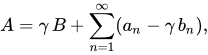
where  is a constant. Where
 , the terms can be written as the product
 .
If for all
 , the sum is over a component-wise product of two sequences going to zero,
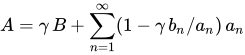 .
Example
Consider the Leibniz formula for π:
 We group terms in pairs as
 where we identify
 We apply Kummer's method to accelerate , which will give an accelerated sum for computing
 .
Let
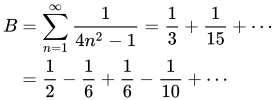 This is a telescoping series with sum value 1⁄2.
In this case
:=\lim _{n\to \infty }{\frac {\frac {1}{16n^{2}-1}}{\frac {1}{4n^{2}-1}}}=\lim _{n\to \infty }{\frac {4n^{2}-1}{16n^{2}-1}}={\frac {1}{4}}}
 and so Kummer's transformation formula above gives
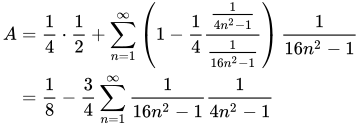 which converges much faster than the original series.
Coming back to Leibniz formula, we obtain a representation of  that separates
 and involves a fastly converging sum over just the squared even numbers
 ,
