Kirkland Bushwhackers
The Kirkland Bushwhackers, also known as the Kirkland Raiders, were an irregular armed band led by former Confederate officer John Jackson Kirkland during the American Civil War. The band operated chiefly in the southern Appalachian mountain country of present-day Monroe County, Tennessee, and Graham County, North Carolina.[1][2]
The surviving record of the band is drawn from military rosters, Confederate parole records, court proceedings, pension testimony, regional histories, archival research collections, newspapers, and traditions handed down in local families. These sources differ greatly in evidentiary weight. Contemporary military and legal records establish the service of several men connected with the Kirkland family and record criminal accusations involving John Kirkland and certain associates, while some of the fullest stories concerning the band survive only in later regional accounts and family tradition.
Origins and leadership

John Jackson Kirkland was born in 1827. He served in Company B of the Confederate 3rd Tennessee, commonly known as Lillard's or Vaughn's regiment. A surviving Monroe County roster lists him among the men of Company B.[3]
The regiment drew heavily from East Tennessee and included a sizeable number of men from Monroe County. Company B contained several men bearing the Kirkland name, showing the participation of members of the wider family in Confederate service.
Kirkland's documented service with the regiment ended well before the Vicksburg campaign. Confederate service material identifies him as a junior second lieutenant in Company B, 3rd (Lillard's/Vaughn's) Tennessee Mounted Infantry, and a surviving service-record image analysis from 2018 records that he was "dropped" from the rolls on May 12, 1862. The surviving record does not describe his removal as AWOL or desertion.[4] His Compiled Military Service Record is contained in the National Archives microfilm repository, NARA M231, Roll 24.
The regiment had originally been organized in May 1861 and included recruits from Monroe, Polk, Blount, McMinn, and other East Tennessee counties.[5]
Kirkland’s removal came only two days before the regiment’s formal reorganization on May 14, 1862. The surviving record gives no reason why he was dropped. The timing is notable because Company B’s commissioned leadership was changing during the reorganization; John Edgar McElrath, who had previously served as a junior officer along side Kirkland in the company, received his captain’s commission on May 14 and became’s its overall commander. This raises the possibility that Kirkland’s departure was connected with the reorganization or accompanying changes in the officer structure, although no surviving evidence presently located establishes the cause.
His documented departure came more than a year before the regiment's capture during the Vicksburg campaign. National Park Service records confirm that the 3rd Tennessee subsequently served in Mississippi and was captured with the Vicksburg garrison in July 1863.[5] Kirkland's later pension material describes his earlier Confederate service, but no evidence presently identified places John Jackson Kirkland with the regiment at Vicksburg.
The Kirkland gristmill
A later reconstruction connects Kirkland's hostility toward Union forces with the destruction of his family's gristmill on Lower Turkey Creek Falls, locally known as "Kirkland Mill Falls," above Tellico Plains, Tennessee.[6]
The Kirkland family gristmill stood on Turkey Creek above Tellico Plains, Monroe County, Tennessee, at or near the place now locally known as Lower Turkey Creek Falls or Kirkland Mill Falls. The site is approximately 35°20′39″N 84°11′35″W / 35.344290°N 84.192990°W, as shown on the USGS Bald River Falls 7.5-minute topographic map.
Burning of the Kirkland gristmill
Later regional accounts state that the Kirkland family's gristmill on Turkey Creek, near Tellico Plains, Tennessee, was burned by Union troops during Federal movements through Monroe County in December 1863. The loss of the mill was afterward incorporated into accounts attempting to explain John Jackson Kirkland's hostility toward Union forces.[6]
The broader Federal movement through Monroe County can be documented with considerably greater precision. After the Confederate defeat at Chattanooga and the end of the siege of Knoxville, Major General William Tecumseh Sherman began moving his forces south from Knoxville toward the Hiwassee River. On December 8, 1863, Sherman informed Ulysses S. Grant that he intended to leave Knoxville the following day with his command for the Hiwassee.[7]
Sherman's columns then moved through the Little Tennessee River country and across Monroe County. Baker's reconstruction places Federal forces at Sweetwater and Madisonville while Sherman himself rode toward Tellico. The same account states that the Tellico Iron Works was destroyed during the Federal movement and that Union cavalry pursued a Confederate supply train toward Murphy, North Carolina.[7]
Sherman's own wartime correspondence confirms his presence at the Tellico Iron Works. At 3 p.m. on December 9, 1863, he sent a dispatch from Tellico Iron Works to Major General Oliver O. Howard concerning Federal movements toward Athens, Charleston, Madisonville, and the Hiwassee River. Sherman stated that provisions would be sent to Cotton Port and instructed Howard to keep him informed of military developments along the Hiwassee.[7] Cotton Port was located at the site of the present Bowater Paper Mill.
A separate Sherman dispatch dated December 9 from near Athens stated that he would send forces toward Madisonville and that reports indicated Longstreet might be retreating by way of Tellico Plains.[7]
On the morning of December 10, Sherman wrote from the road between Tellico and Athens to General Jefferson Columbus Davis. His letter shows that Federal troops operating in the district were expected to subsist substantially from local resources. Sherman described the surrounding country as providing abundant forage, meat, and meal, and instructed Davis to grind available meal and collect hogs, sheep, and beef while maintaining his command.[7]
These orders provide contemporary evidence that Sherman's forces were actively obtaining food, forage, and livestock from the countryside during their movement through the Tellico–Madisonville–Hiwassee region. Baker's later account likewise describes extensive Federal foraging in Monroe County and preserves a local Stephens family tradition concerning Union soldiers searching a household near the old Unicoi Turnpike for food and taking a sidesaddle, which was later found discarded nearby.[7]
The Tellico Iron Works was a military and industrial target, and Baker states that Federal troops destroyed it while Sherman directed operations from Tellico.[7] Sherman's December 9 dispatch establishes his presence at the iron works but does not itself explicitly state that he had ordered its destruction. The destruction of the iron works therefore provides important context for Federal operations in the immediate Tellico area, but Baker's reconstruction and Sherman's contemporary correspondence should be distinguished from one another.
The documented movement places a substantial Federal force in Monroe County and Sherman himself at Tellico Iron Works on December 9, 1863. It also establishes active Federal foraging and the collection of livestock and meal during the same operation. These facts provide a stronger historical setting for the later tradition that the Kirkland gristmill was destroyed by Union forces.
No contemporary military report has yet been identified, however, that names the Kirkland mill itself, records an order to burn it, identifies the Federal soldiers responsible, or fixes the precise date of its destruction. The documented presence and activities of Sherman's forces therefore corroborate the military context in which the reported burning could have occurred, but they do not independently prove that Sherman's troops destroyed the Kirkland mill.
Later accounts sometimes describe the loss of the mill as the event that caused Kirkland to abandon Confederate service and turn against Unionists. Contemporary military records, however, show that Kirkland had already left regular service with his Confederate regiment in May 1862, more than a year before Sherman's December 1863 movement through Monroe County. The destruction of the mill may have deepened later hostility, but the surviving evidence does not establish that it caused Kirkland's departure from regular Confederate commissioned service.
The exact date when Kirkland's followers became a distinct armed band is unknown. Their emergence took place amid the wider conditions of military desertion, divided loyalties, retaliation, property loss, military foraging, and irregular warfare that marked parts of East Tennessee and western North Carolina during the later years of the war.
Confederate and Union military networks
Vicksburg and the Kirkland family
The Confederate 3rd Tennessee later took part in the Vicksburg campaign. The National Park Service's Confederate parole index records several men named Kirkland among those paroled following the surrender, including James Kirkland, a corporal in Company B of the 3rd Tennessee; William Kirkland, a private in the same company; and Jesse "Kirkling," a sergeant in Company B of the 59th Tennessee Infantry who was paroled from a hospital.[8]
John Jackson Kirkland was no longer documented with the 3rd Tennessee by the time of the Vicksburg campaign. Other Kirklands of Company B, including James and William, do appear in the Vicksburg parole records.[8]
These records demonstrate Confederate service by several members of the wider Kirkland family, but they do not establish that every Kirkland who served in Company B later participated in John Kirkland's irregular band.
Unionist opposition and the 3rd Tennessee Mounted Infantry
By the latter half of 1864, the Kirklands operated amid a growing network of Unionist military companies raised from East Tennessee and adjoining parts of western North Carolina.
The Union 3rd Tennessee Mounted Infantry Regiment was organized during the latter half of 1864 at Loudon, Strawberry Plains, Knoxville, and other East Tennessee locations. Its companies included substantial numbers of men from Monroe, Blount, and neighboring counties.[9]
Among its officers were Captain Timothy Lyon of Company C and Captain Joseph C. Gray of Company H. Company C was mustered at Loudon on August 10, 1864 and included many men from western North Carolina as well as Blount and Monroe counties. Company H was recruited chiefly around Madisonville in September and October 1864 and was mustered at Knoxville and Loudon late that year.[9]
The regiment was a short-term organization and was never fully completed as a conventional field regiment. A later Tennessee adjutant general's summary characterized the regiment as having performed no service, an assessment difficult to reconcile with surviving evidence showing active company-level operations by Companies C, G, and H. The discrepancy illustrates the limitations of relying solely on later regimental summaries when reconstructing locally organized operations.[9]
The regiment nevertheless gave an organized military framework to armed Unionists moving through the same mountain country where the Kirklands and other irregular bands were active.
The overlap between locally recruited Union companies, Confederate troops, deserters, and irregular bands helps explain why many encounters tied to the Kirklands had the appearance of feud and personal fighting as much as conventional military action.
Membership and associates
No contemporary membership roster of the Kirkland Bushwhackers is known to survive. Membership must therefore be reconstructed with care from military records, court proceedings, contemporary or near-contemporary accounts, and later regional histories.
James and William Kirkland
John's brothers, James Kirkland and William Kirkland, served in Company B of the Confederate 3rd Tennessee. The National Park Service Vicksburg parole index identifies James as a corporal and William as a private among the Confederate soldiers paroled following the surrender of Vicksburg.[8]
William has a particularly strong documentary connection with John Kirkland in later events. Original Monroe County Circuit Court material concerning the March 12, 1865 killing of Anna Rodgers names William together with John Kirkland, Samuel Rodgers, Joseph Phillips, and Gale Roberts as defendants in a first-degree murder indictment returned during the January 1866 term.[10]
The surviving case papers include later court process extending into 1867, demonstrating that efforts to proceed against the accused continued for more than a year after the indictment.[10]
James's Confederate service and Vicksburg parole are established, but his exact post-Vicksburg relationship with John's irregular band is less clearly documented.
The Jesse Kirkland identity problem
Particular care is needed with the name Jesse Kirkland because the surviving record contains several references that appear to have been combined or confused in later accounts.
The Vicksburg parole index records a Jesse "Kirkling" as a sergeant in Company B of the Confederate 59th Tennessee Infantry and identifies him as a hospital parolee.[8]
John Preston Arthur's 1914 Western North Carolina: A History (1730-1913) describes a Jesse Kirkland killed by Captain Timothy Lyon's Union force near Isaac Carringer's Creek. Arthur did not identify the dead Jesse specifically as John Jackson Kirkland's brother. Instead, he described him as a "kinsman" of two Kirkland figures whom he called "Bushwhacker" Kirkland and "Turkey-Trot John."[11]
Arthur's wording itself presents an identification problem. His account appears to distinguish "Bushwhacker" Kirkland from another man called "Turkey-Trot John," whereas later regional narratives have often treated John Jackson Kirkland as the principal or sole "Bushwhacking John." The identities intended by Arthur are therefore not entirely clear.
Marshall McClung preserved a materially different account of Jesse Kirkland's death. In McClung's reconstruction, a "Jesse Kirkland Jr." associated with the Kirkland Bushwhackers was surprised near the Ground Squirrel–Cross Creek area while visiting or courting a young woman. According to that version, members of Captain W. R. Abbott's Confederate command wounded Kirkland and killed him while he attempted to escape.[1]
The McClung account is difficult to reconcile with Arthur's description of Jesse being killed by Captain Lyon's Union troops near Carringer's Creek. Later regional reconstructions have sometimes combined Jesse's Confederate service, the Vicksburg parole entry, and the Lyon expedition into a single narrative, but the presently available evidence does not establish that all of these references concern the same man.
A different Jesse Kirkland remained alive in the Ball Play country after the war. The 1890 Union veterans census for Monroe County lists a Jesse Kirkland of Ball Play as a private in Company D of the Union 3rd Tennessee Mounted Infantry, serving from July 25 through November 30, 1864.[12]
The Ball Play veteran therefore cannot have been the same Jesse Kirkland reported killed during the wartime operations described by Arthur or McClung.
The surviving evidence consequently supports the existence of more than one Jesse Kirkland in the regional record and preserves competing traditions concerning the identity and death of the Jesse associated with the bushwhackers. The evidence does not securely establish that the dead Jesse was John Jackson Kirkland's brother, nor does it securely establish the precise date, place, or military force responsible for his death.
Other documented associates
The strongest documentary connection for several additional associates comes from the Monroe County Circuit Court prosecution concerning the killing of Anna Rodgers on March 12, 1865. The surviving indictment names John Kirkland, William Kirkland, Samuel Rodgers, Joseph Phillips, and Gale Roberts as defendants.[10]
The original court papers are important because later retellings have sometimes corrupted the defendant list, particularly by treating Joseph Phillips as though he were another Roberts. The surviving legal record identifies Joseph Phillips and Gale Roberts as separate defendants.[10]
Their appearance together in a murder indictment establishes an association in connection with the alleged offense, but an indictment is an accusation rather than proof of guilt, and it does not establish that every defendant was a permanent member of the Kirkland band.
| Name | Life | Connection | Evidence |
|---|---|---|---|
| John Jackson Kirkland | 1827–1902 | Leader | Confederate second lieutenant; later identified in regional and institutional accounts as leader of the Kirkland Bushwhackers; indicted in the Anna Rodgers case. |
| Benjamin William Kirkland | 1835–1918 | Brother; documented associate | Private, Company B, Confederate 3rd Tennessee; Vicksburg parolee; later named with John in the Anna Rodgers murder indictment. |
| James Kirkland | c. 1830–1886 | Brother; possible later associate | Corporal, Company B, Confederate 3rd Tennessee; Vicksburg parolee. Later participation in the irregular band remains less clearly established. |
| Jesse Kirkland | Unknown | Kirkland kinsman; reported irregular associate | A Confederate sergeant named Jesse "Kirkling" appears in the 59th Tennessee Vicksburg parole record. Arthur reported a Kirkland kinsman named Jesse killed by Lyon's Union force, while McClung preserved a different tradition in which a Jesse Kirkland was killed by Confederate troops associated with W. R. Abbott. The available evidence does not establish that these references concern the same individual. |
| Samuel Rodgers | Unknown | Defendant; possible associate | Named with John and William Kirkland, Joseph Phillips, and Gale Roberts in the January 1866 first-degree murder indictment concerning Anna Rodgers. His relationship to Anna and his ultimate disposition in the case remain unresolved. |
| Joseph Phillips | Unknown | Defendant; possible associate | Named as Joseph Phillips, not "Joe Roberts," in the original Anna Rodgers court proceedings. His ultimate disposition in the case remains unresolved. |
| Gale Roberts | c. 1830–c. 1880 | Defendant; possible associate | Named with John and William Kirkland, Samuel Rodgers, and Joseph Phillips in the Anna Rodgers murder proceedings. His ultimate disposition in the case remains unresolved. |
Activities and wartime violence
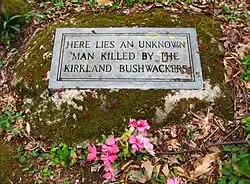
Citico Creek ambush
A later account preserved in Kirkland family tradition describes an ambush involving the Kirkland Bushwhackers and the Union-aligned Laney group at a ford where the Buck Highway crossed Citico Creek in Citico Creek Wilderness. The account was attributed to a descendant who said the story had been handed down from John Kirkland himself.[1]
According to the account, seven members of Kirkland's group allegedly hid near the crossing while eight members of the Laney party approached on horseback. The Kirkland men opened fire while the riders were in the creek. The account states that seven men were killed and one escaped and names Randolph Laney and James Elliot among the dead.[1]
The place was well suited to the kind of irregular fighting found in the district. Citico Creek formed one of the natural passages between the isolated settlements of the Little Tennessee River country and the higher ground toward the North Carolina line. Fords, gaps, and narrow mountain roads gave small parties familiar with the country natural places from which to lay an ambush.
Because the detailed numbers and tactical reconstruction come from later family tradition rather than a known contemporary military report, they are best treated as a reported account rather than independently verified battlefield detail. The exact date of the incident has not been established, though regional and family tradition connects it with the events of autumn 1864.
Ambush of Robert Stratton and Jack Roberts

Later Graham County historical material dates the killing of Robert "Bob" Stratton and Jack Roberts to September 2, 1864 and attributes their deaths to the Kirkland Bushwhackers.[13]
Stratton was associated with the Santeetlah country along the Tennessee–North Carolina line, where his family lived in the highlands later known as Bob Stratton Bald or Stratton Meadows.
More detailed regional accounts state that Stratton and Roberts were looking for stray livestock when members of the Kirkland band learned where they were. According to those accounts, Stratton was carrying a valuable Spencer repeating rifle, and the bushwhackers concealed themselves near the road and used a piece of paper to draw the men's attention before opening fire. Stratton was reportedly killed at the scene and Roberts mortally wounded.[1]
Because these tactical details survive in later regional reconstruction rather than a presently identified contemporary military report, they should be distinguished from the more securely preserved date and identification of the victims.
The ambush formed part of the wider pattern of irregular violence that troubled the mountain corridor between Monroe County, Tennessee, and Graham County, North Carolina, during the closing months of the war.
Regional historical material separately dates an incident involving seventeen-year-old John Stratton and Thomas "Tom" Mashburn to October 3, 1864. Men identified with Captain Timothy Lyon's Company C of the 3rd Tennessee Mounted Infantry were operating in the Goldmine Branch–Rock Creek area when Stratton and Mashburn reportedly attempted to flee and were shot and killed.[13]
This dated episode should not automatically be identified with the broader expedition described by John Preston Arthur. Arthur's account includes Jesse Kirkland, Mashburn, Hamilton, Carringer's Creek, Robbinsville, Santeetlah, and Bob Stratton Meadow but supplies no exact date. The two accounts may describe overlapping events, separate expeditions, or a later recollection in which details from more than one operation were combined.
Deals Gap incident
A later account preserved in the Peter H. Prince research collection attributes the killing of an infant near Deals Gap to John Kirkland. According to the story, Kirkland's party lay in wait to ambush Union soldiers believed to be carrying military payroll funds when a civilian family came into the area. The crying infant was said to have threatened to reveal the band's position, and Kirkland allegedly killed the child and hid the body in a hollow log.[14]
Deals Gap was an important mountain passage between the Little Tennessee River country and the settlements of western North Carolina. Small armed parties moving through the region depended heavily upon such gaps, trails, and river crossings.
No contemporary military or court record has been identified that independently verifies the story. It is therefore best treated as a later regional tradition. The surviving accounts do not identify the family, provide a precise date, or cite contemporary documentation for the alleged event.
Union operations toward Robbinsville, October–November 1864
During the autumn of 1864, elements of the 3rd Tennessee Mounted Infantry carried out repeated operations across the Tennessee–North Carolina line into the area of present-day Graham County, North Carolina, which was then part of Cherokee County, North Carolina. Captain Timothy Lyon commanded Company C, a unit containing men from western North Carolina as well as Unionist recruits from East Tennessee.[9]
One documented episode occurred on October 3, 1864, when men identified with Lyon's Company C encountered seventeen-year-old John Stratton and Thomas "Tom" Mashburn in the Goldmine Branch–Rock Creek area. Later Graham County historical accounts state that Stratton and Mashburn tried to flee and were shot and killed by members of the company.[13]
A separate account was published by historian John Preston Arthur. Arthur described an expedition in which Lyon's men killed Jesse Kirkland, whom he identified as a relative of two Kirkland figures he called "Bushwhacker" Kirkland and "Turkey-Trot John," together with men named Mashburn and Hamilton and perhaps several others near Isaac Carringer's Creek. According to Arthur, Lyon's party then passed through Robbinsville, where an unidentified Cherokee man was killed, continued through the Santeetlah country, camped there overnight, and returned toward Tennessee by way of Bob Stratton Meadow.[11]
Arthur gave no exact date for the expedition. Although some details resemble the October 3 event, the surviving accounts differ in the victims named, the places described, and the order of events. The evidence therefore does not securely establish whether Arthur was describing the October 3 incident, a separate expedition, or a later recollection that had combined parts of more than one movement.
The identification of Jesse also remains unsettled. Marshall McClung preserved a separate tradition in which Jesse Kirkland was killed not by Lyon's Union troops but by Confederate soldiers associated with Captain W. R. Abbott near Ground Squirrel or Cross Creek.[1]
Union military activity around Robbinsville continued into November 1864. Graham County historical material, drawing upon North Carolina historical sources, identifies Camp Cheoah on Rhea Hill near present-day Robbinsville as a position held by Captain J. W. Cooper's Company H, 69th North Carolina Infantry, of Thomas' Legion. It records an engagement there in November 1864 between Cherokee soldiers of Thomas's Legion and Companies C and G of the Union 3rd Tennessee Mounted Infantry.[13]
The separately dated October and November accounts demonstrate that Union troops entered the Robbinsville–Santeetlah country on more than one occasion. Arthur's undated account may describe one of those movements or a different one, but the evidence now available does not allow a certain identification.
Some later summaries of the fighting have ambiguously suggested that Kirkland family members served in the Union 3rd Tennessee Mounted Infantry before becoming bushwhackers. The surviving military record requires greater precision. John Jackson Kirkland and his brothers James and William had documented Confederate service, while a separate Jesse Kirkland of Ball Play served in the Union regiment.
Regional tradition also places Bas Shaw among Union-aligned men associated with Lyon's operations across the mountains. Shaw and other participants came from the same close-knit communities and family networks as many of the Confederate soldiers and irregular fighters they opposed.
These operations show the unusually fluid nature of the war along the Tennessee–North Carolina line. Union troops, Confederate detachments, Cherokee soldiers of Thomas's Legion, deserters, home guards, and local irregular bands moved through the same roads, gaps, and river country.
The Shaw family and the local conflict
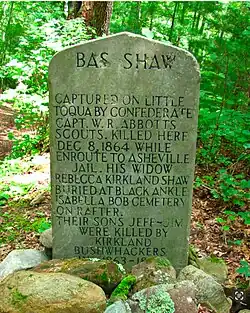
George Bazel "Bas" Shaw was related to the Kirkland family by marriage. Later regional and genealogical accounts identify him as an uncle of John Jackson Kirkland by marriage. A Tennessee educational study of Monroe County's Civil War traditions likewise identifies Bas Shaw within the extended Kirkland family conflict.[15]
Two of Shaw's sons, James Wiley "Jim" Shaw and Jefferson Andrew "Jeff" Shaw, are identified in later regional accounts as Union-aligned men killed during the local irregular conflict. The same tradition associates both men with the 11th Tennessee Cavalry.[15]
The Union 11th Tennessee Cavalry was organized between May and October 1863 and served principally in the Cumberland Gap, Clinch Valley, and East Tennessee theater before being consolidated with the 9th Tennessee Cavalry in January 1865.[16]
The presently available published sources do not independently establish the complete service histories of both Shaw brothers. Their identification with the Union regiment and the attribution of their deaths to Kirkland therefore remain dependent in part upon later regional and family accounts.[15]
Later regional tradition attributes the killings of Jim and Jeff Shaw to John Jackson Kirkland or members of the Kirkland group. A Tennessee educational resource based partly upon local family tradition likewise recounts that Kirkland killed Shaw's two sons, but notes that the story circulated through oral history before appearing in later published accounts.[15]
Because no contemporary court proceeding, military report, or other primary record has yet been identified that independently documents the killings of both Shaw brothers, the fact of their deaths must be kept separate from later claims about who killed them.
Bas Shaw's capture and death
The circumstances surrounding Bas Shaw's death are preserved through a combination of cemetery documentation and later regional accounts.
Later reconstructions place Shaw's death amid Confederate operations through the Little Tennessee River and Ball Play country in December 1864. They associate these operations with Captain W. R. Abbott and describe Shaw as having been taken into Confederate custody before his death. Because the presently available accounts are retrospective, details concerning the exact circumstances of his capture should be treated cautiously.[1]
Shaw's death date is independently supported by cemetery documentation. The Friends of the Blount County Cemetery identifies the Bas Shaw Cemetery, also known as the Big Poplar Curve Cemetery, along present-day U.S. 129 and records Bazel Shaw's death as December 8, 1864.[17]
Later accounts have differed over responsibility for Shaw's death. Some traditions attribute the killing personally to John Jackson Kirkland, while others place Shaw in the custody of Confederate soldiers at the time he was killed.
The presently available evidence establishes the date and approximate location of Shaw's death more securely than it establishes the identity of the person who fired the fatal shot. Accordingly, the surviving published evidence does not justify stating as fact that Kirkland personally killed Shaw.
Killing of Captain Joseph C. Gray
Captain Joseph C. Gray was an officer of Company H of the Union 3rd Tennessee Mounted Infantry. Later Monroe County historical accounts identify him as one of the locally recruited Union officers killed during the irregular conflict and attribute his death to members of the Kirkland group.[15]
A Monroe County educational study by Traci Freeman traced the Gray story to local genealogical material and to Robert A. Barker's research on the 3rd Tennessee Mounted Infantry. Freeman also noted that the killing and its aftermath survived prominently in local oral and newspaper tradition.[15]
Later accounts commonly give Gray's death as occurring in January 1865. They also preserve a story that members of the Kirkland group celebrated afterward and that women associated with the group danced while wearing Gray's captured cavalry boots. Freeman traced this detail to a Graham Star account.[15]
Another later tradition concerns Gray's widow, Rachel McCall Gray. According to the account preserved in Monroe County family-history material, a man believed to have participated in Gray's killing later sought her forgiveness. The story states that she heard his apology but refused to forgive him.[15]
These details are significant elements of the regional memory of Gray's death, but no contemporary military or court record presently identified independently confirms the celebration, the cavalry-boots story, or the later deathbed encounter. They should therefore remain explicitly attributed to later tradition.
Gray's killing also illustrates how local the conflict had become. He commanded a locally recruited Union company operating among communities containing Confederate soldiers, Unionists, deserters, and irregular fighters drawn from overlapping family and neighborhood networks.
Killing of Anna Rodgers
The strongest surviving contemporary legal evidence connecting John Kirkland with an alleged act of wartime violence concerns the killing of Anna Rodgers in Monroe County on March 12, 1865. Original Monroe County Circuit Court papers preserved by the Tennessee State Library and Archives identify the case as State v. John Kirkland, William Kirkland, Samuel Rodgers, Joseph Phillips & Gale Roberts, docketed as No. 75. The indictment was returned during the January 1866 term of the Monroe County Circuit Court at Madisonville.[10]
The surviving indictment names the five defendants repeatedly. Its handwritten factual allegations state that the men assaulted Anna Rodgers on March 12, 1865 using pistols and guns loaded with lead balls and shot. The indictment alleges that the projectiles struck Rodgers in the head, breast, and body, penetrating and wounding her, and that she "instantly died." The grand jury charged the five defendants with murder in the first degree.[10]
The manuscript is particularly important because some later retellings have misstated the defendant list. The original court record identifies Joseph Phillips and Gale Roberts as separate men; Joseph Phillips should not be rendered as "Joe Roberts."[10]
The surviving file also documents a prosecution that continued beyond the original indictment. The Tennessee Virtual Archive describes the packet as containing the indictment and several warrants directing the Monroe County sheriff to bring in the accused.[10] Surviving process papers show continued court activity during 1866 and 1867.
One surviving subpoena associated with Case No. 75 bears a sheriff's or deputy sheriff's handwritten return stating that it was "Executed in full" in August 1866. Because the document is a subpoena rather than a capias for arrest, the endorsement is evidence of successful execution of witness process and should not be interpreted as proof that John Kirkland or another defendant had been arrested.
A later alias capias was issued in May 1867 under the style State v. John & Wm Kirkland and others, again directing the sheriff to bring the accused before the Monroe County Circuit Court to answer the murder indictment. The surviving return records receipt of the writ in June 1867 and appears to indicate that no arrest was made. Because portions of the return are faded and difficult to decipher, only the clearly legible procedural information should be treated as secure.[10]
The Tennessee Virtual Archive's modern catalog description states specifically that "the Kirklands" fled into the mountains and were never apprehended for the crime.[10] That description should not automatically be extended to Samuel Rodgers, Joseph Phillips, or Gale Roberts. The ultimate procedural dispositions of those three defendants have not yet been established from the legible portions of the surviving papers.
The original court documents therefore establish a first-degree murder accusation and a continuing prosecution, but they do not establish a conviction. An indictment records the accusation of a grand jury rather than a judicial finding of guilt, and the surviving evidence should not be used to state that each defendant was proven to have murdered Anna Rodgers.
The shared Rodgers surname also raises the possibility that Anna Rodgers and defendant Samuel Rodgers were related. The Tennessee Virtual Archive notes that Anna may have been related to one of the accused, but the surviving court papers presently examined do not establish the exact relationship.[10]
Area of operations
The Kirkland Bushwhackers operated in the rough Unicoi mountain country along the Tennessee–North Carolina line, especially between Monroe County and the portion of Cherokee County, North Carolina, that later became Graham County.
During the Civil War, Graham County did not yet exist as a separate county. The country around present-day Robbinsville, Yellow Creek, Santeetlah, and the upper Little Tennessee remained part of Cherokee County. Graham County was created in 1872.
Regional accounts associate the band with the unincorporated community of Ball Play in Monroe County, Tennessee, near the Citico Creek Wilderness, the Little Tennessee River valley, the Unicoi Mountains, and the old mountain roads and trails linking settlements on either side of the state line.[1]
These places were not merely hiding places. The old roads and trails through the Unicoi Mountains connected farms and settlements in Monroe County with communities around Murphy, Robbinsville, and the Little Tennessee watershed. Control of gaps, fords, and narrow roads therefore mattered to regular troops and small irregular bands alike.
Mountain routes and hiding places
Later regional histories associate Kirkland and other irregular fighters with secluded locations along the Tennessee–North Carolina borderlands, including places near Citico Creek, the Little Tennessee River corridor, and mountain gaps and trails leading toward western North Carolina.[1]
Modern local accounts also identify places such as Kirkland Springs, Big Fat Gap, and Yellowhammer Gap with the band's movements or hiding places. Because these identifications derive principally from regional historical tradition rather than contemporary military maps or reports, they are best presented as locally associated sites rather than documented permanent camps.
The rough country itself helps explain why small armed bands were difficult to suppress. Men raised in the region possessed detailed knowledge of trails, creeks, gaps, farms, and river crossings that could make pursuit by forces unfamiliar with the terrain difficult.
The surviving legal papers in the Anna Rodgers case provide a postwar example of this problem. Court process continued into 1867, while the Tennessee Virtual Archive states that John and William Kirkland had fled into the mountains and were never apprehended for the offense.[10]
Nature of the conflict
The Kirkland Bushwhackers operated in a region marked by overlapping Union and Confederate military activity, divided civilian loyalties, desertion, guerrilla warfare, retaliation, and deeply local political and personal violence.
The December 1863 movement of Sherman's army through Monroe County provides an example of the disruptive presence of large conventional armies in the same countryside where irregular warfare subsequently intensified. Sherman's contemporary correspondence shows Federal forces obtaining forage, meal, and livestock while maneuvering between Tellico, Madisonville, Athens, and the Hiwassee River.[7] Baker's reconstruction additionally preserves local traditions of soldiers searching homes and taking property during the passage of the army.[7]
Such military requisitioning and foraging formed part of a broader breakdown of civil order and control over property in the district. The surviving evidence does not justify treating every act of military foraging as unauthorized plunder, but the distinction between formal requisition, military necessity, and theft could be difficult for civilians whose food, animals, or property were taken.
Contemporary East Tennessee newspapers were already describing bushwhacking, guerrilla activity, and armed political violence during the war. Later regional writers also attempted to place these activities within the broader political division of the southern Appalachian mountain communities.
Sandra Ratledge's study "Confederate Dissension in the Unakas," for example, discussed divided loyalties, desertion, isolation, and the emergence of bushwhacking in the mountain country of East Tennessee and western North Carolina. The study is independently identified and discussed in Traci Freeman's Tennessee historical-education unit, which cited Ratledge's original online version and recorded its retrieval in August 2006.[15]
Ratledge's work provides useful regional interpretation but does not by itself document specific acts attributed to the Kirkland Bushwhackers.
Historian Noel C. Fisher has described East Tennessee as one of the most politically divided regions of the Confederacy and has emphasized the extent to which Unionist resistance, Confederate repression, and guerrilla warfare transformed the region during the Civil War and early Reconstruction.[18]
John C. Inscoe and Gordon B. McKinney likewise describe western North Carolina as a region where conventional military operations increasingly mixed with desertion, divided loyalties, bushwhacking, home-guard activity, and highly localized violence.[19]
The border country between Monroe County and western North Carolina was especially suited to this kind of warfare. Union units such as Timothy Lyon's Company C and Joseph Gray's Company H of the 3rd Tennessee Mounted Infantry were themselves recruited largely from local men. Their opponents might include Confederate regulars, deserters, or irregular bands containing relatives and former neighbors.
The 11th Tennessee Cavalry provides another example of the substantial Union military participation of East Tennesseans. Organized in 1863, the regiment served in the East Tennessee and Clinch Valley theater before consolidation late in the war.[16]
John Kirkland began the war in Confederate service before later becoming associated with an independent irregular band. Other men in the region likewise moved between regular military service, irregular armed activity, desertion, and civilian life.
The history of the Kirkland band therefore forms part of the wider pattern of localized guerrilla conflict in the southern Appalachian borderlands, where military allegiance could become intertwined with family relationships, revenge, criminal accusations, property losses, and local political divisions.
The Anna Rodgers prosecution is particularly significant in this context because it shows that violence attributed to men associated with the Kirkland group continued to be treated as a criminal matter after organized Confederate resistance had collapsed. The surviving indictment and later process papers document an attempt by restored civil courts to prosecute a wartime killing rather than treating it solely as a military incident.[10]
Postwar life and legal consequences
John Jackson Kirkland survived the Civil War. The most substantial surviving legal proceeding presently identified is the Monroe County prosecution arising from the March 12, 1865 killing of Anna Rodgers.
During the January 1866 term, a Monroe County grand jury indicted John Kirkland, William Kirkland, Samuel Rodgers, Joseph Phillips, and Gale Roberts for first-degree murder. The indictment alleged that the five men shot Anna Rodgers with pistols and guns, striking her in the head, breast, and body and causing her immediate death.[10]
The case did not end with the indictment. Surviving papers show repeated judicial process during 1866 and 1867. A subpoena associated with the prosecution bears an August 1866 return stating that it was "Executed in full." This endorsement refers to execution of the subpoena and is not evidence that any defendant was arrested.
An alias capias issued in May 1867 continued to seek John and William Kirkland and the other accused for the murder charge. Its reverse records receipt by the executing officer in June 1867 and appears to indicate that the writ did not result in an arrest. Portions of the handwritten return remain difficult to decipher and should not be expanded beyond what the surviving image clearly supports.[10]
The Tennessee Virtual Archive's catalog description states that "the Kirklands had fled into the mountains and were never apprehended for the crime."[10] The wording is significant because it identifies the Kirklands specifically. The presently legible court papers do not establish that Samuel Rodgers, Joseph Phillips, and Gale Roberts shared precisely the same procedural fate.
The ultimate disposition of the prosecution against Rodgers, Phillips, and Roberts therefore remains unresolved. Likewise, no conviction of John or William Kirkland in the Anna Rodgers case has been identified. The surviving record establishes the indictment, continued attempts at judicial process, and the failure to apprehend the Kirklands rather than a completed murder trial.
Later regional accounts state that additional indictments for robbery and murder were returned against Kirkland and associates in the Circuit Court at Madisonville and that Kirkland was never successfully served with process.[6]
These later accounts describe Kirkland as using the mountain country along the Tennessee–North Carolina line to avoid arrest. They further state that he eventually moved to Polk County, Tennessee, where he died in 1902.[6]
The distinction is important: the Anna Rodgers indictment and continuing process are supported by surviving Monroe County legal material, while broader claims of additional robbery and murder indictments presently depend principally upon later regional reconstruction.
Memory and commemoration
In 1958, John Kirkland was commemorated at his grave in Polk County, Tennessee. A contemporary newspaper report described a ceremony involving historian Zella Armstrong, who was associated with the Tennessee Historical Commission and Confederate memorial organizations.[20]
Historiography and sources
The surviving evidence for the activities of the Kirkland Bushwhackers is uneven.
Contemporary and official records
Military rosters and National Park Service parole records provide comparatively firm evidence concerning the regular military service of several Kirklands.
Sherman's December 1863 correspondence provides similarly strong chronological evidence for Federal operations in Monroe County. The December 8, 9, and 10 dispatches reproduced by Bill Baker place Sherman and elements of his army between Knoxville, Tellico Iron Works, Madisonville, Athens, and the Hiwassee and show explicit orders concerning the acquisition of forage, meal, hogs, sheep, and cattle.[7] These records establish the presence and logistical practices of Federal troops in the immediate district but do not identify the Kirkland mill or document its destruction.
The Anna Rodgers case is especially significant because surviving Monroe County Circuit Court papers preserve contemporary legal evidence rather than only a later account. The January 1866 indictment names John Kirkland, William Kirkland, Samuel Rodgers, Joseph Phillips, and Gale Roberts and alleges that they murdered Anna Rodgers on March 12, 1865.[10]
The handwritten factual portions of the indictment identify pistols and guns as the weapons and describe wounds to Rodgers's head, breast, and body. The document states that she died immediately and records a charge of murder in the first degree.[10]
The later process papers add another evidentiary layer. They demonstrate that the prosecution remained active during 1866 and 1867 rather than ending with the original indictment. A subpoena return stating "Executed in full" documents successful execution of witness process, while later capias material shows that attempts to bring the accused before the court continued. The Tennessee Virtual Archive states that John and William Kirkland fled into the mountains and were never apprehended.[10]
These distinctions are important because different kinds of nineteenth-century process had different legal meanings. Execution of a subpoena ordinarily indicates service of witness process; it does not establish that an accused person was arrested. Conversely, a capias was process directed toward taking an accused into custody.
The Rodgers papers also illustrate the importance of consulting original documents rather than relying entirely upon later summaries. Some later retellings have conflated Joseph Phillips with Gale Roberts or have implied that all five defendants shared the same post-indictment fate. The original case identifies Phillips and Roberts separately, while the archival catalog specifically describes the "Kirklands" as the men who fled and were never apprehended.[10]
The precise identities of witnesses appearing on the surviving subpoena and the ultimate disposition of Samuel Rodgers, Joseph Phillips, and Gale Roberts remain unresolved from the presently legible material. Faint or uncertain nineteenth-century handwriting should therefore not be converted into definite names or procedural outcomes without additional corroboration.
Military records also provide firmer context for several of the group's opponents. Timothy Lyon commanded Company C and Joseph C. Gray commanded Company H of the Union 3rd Tennessee Mounted Infantry, whose companies included significant numbers of men from Monroe and Blount counties and western North Carolina.[9]
The Union 11th Tennessee Cavalry likewise served in the wider East Tennessee theater and is associated in later accounts with members of the Shaw family.[16]
The surviving evidence for the 3rd Tennessee Mounted Infantry also demonstrates the difficulty of relying upon later regimental summaries. Although a postwar Tennessee adjutant general's account characterized the regiment as having performed no service, surviving company-level evidence and regional accounts document operations by individual companies in East Tennessee and western North Carolina.[9]
Regional histories and oral tradition
Regional histories and oral traditions remain essential to reconstructing the Kirkland Bushwhackers because many incidents are not presently documented in surviving military reports or court proceedings. Their evidentiary value nevertheless varies according to the underlying source from which each account was derived.
Marshall McClung's writings in the Graham Star preserved numerous local traditions concerning the Kirklands, the Strattons, the Shaws, and other participants. Traci Freeman's later educational study provides a useful source trail for some of this material, identifying McClung's article, Robert A. Barker's research on the 3rd Tennessee Mounted Infantry, Sandra Ratledge's "Confederate Dissension in the Unakas," Monroe County family-history material concerning Joseph Gray, and oral-history research conducted among local families.[15]
Bill Baker's "Sherman Moves Through Monroe County" is useful in a somewhat different way. Baker combined regional interpretation and oral tradition with transcriptions of wartime correspondence involving Sherman, Grant, Howard, and Jefferson C. Davis. His account therefore contains both primary-source material and later interpretation, which should not be treated as evidentially equivalent.[7] Sherman's dated dispatches strongly establish Federal movements and foraging practices in December 1863, while Baker's claims about the effects of those movements on individual Monroe County households and his broader interpretation of the campaign remain secondary or oral-history evidence.
A modern account published by the North Carolina Civil War & Reconstruction History Center identifies John Jackson Kirkland as a former Confederate officer and later western North Carolina bushwhacker. The center characterizes his departure from Confederate service as desertion; the surviving service record itself, however, records only that he was "dropped" from the rolls and gives no reason.[2]
Other incidents survive chiefly through later regional histories, archival research files, and family traditions. These include the detailed tactical account of the Citico Creek ambush, the alleged Deals Gap infant killing, the stories concerning the Shaw family and Joseph Gray, and other episodes preserved through the Peter H. Prince Papers and later regional reconstruction.
The Peter H. Prince Papers at the University of Tennessee contain a substantial body of research concerning Kirkland and the Little Tennessee River country, but an archival research collection must itself be judged according to the underlying evidence it preserves.
Marshall McClung's regional reconstruction is especially important because it preserves numerous local traditions and named participants, but those traditions sometimes conflict with earlier published sources. His account of Jesse Kirkland's death, for example, places Jesse's killing at the hands of Confederate troops associated with Captain W. R. Abbott, while John Preston Arthur attributed the death of a Kirkland kinsman named Jesse to Captain Timothy Lyon's Union force.[1][11]
Problems of identification and chronology
The Bas Shaw case shows the difficulty of relying on later compressed narratives. Some accounts attribute his death directly to John Kirkland, while other reconstructions place Shaw in Confederate custody immediately before he was killed.
The conflicting Jesse Kirkland records present an even more complex problem. A Jesse Kirkland served in the Union 3rd Tennessee Mounted Infantry during 1864 and was alive when the 1890 veterans census was compiled. A Confederate sergeant named Jesse "Kirkling" appears in the Vicksburg parole records. Arthur separately reported that a Kirkland kinsman named Jesse was killed by Lyon's Union troops near Carringer's Creek, while McClung preserved a different tradition in which Jesse Kirkland was killed by Confederate troops connected with W. R. Abbott.
Arthur's terminology creates an additional difficulty because he appears to distinguish a figure he called "Bushwhacker" Kirkland from another man called "Turkey-Trot John." Later regional histories have not consistently maintained that distinction, making it unsafe to assume without corroborating evidence that every reference to "Bushwhacker" Kirkland or "John Kirkland" concerns the same individual.
The Graham County Historical Association material is particularly useful in separating two episodes that later narratives have sometimes blurred. It dates the deaths of John Stratton and Tom Mashburn to October 3, 1864, while separately identifying an engagement at Camp Cheoah between Companies C and G of the Union 3rd Tennessee Mounted Infantry and Cherokee soldiers of Thomas's Legion in November 1864.[13] Arthur's expedition remains undated and therefore should not be assigned automatically to either event.
The chronology of the Kirkland mill tradition likewise requires caution. Sherman's December 1863 correspondence establishes his presence at Tellico Iron Works and active Federal foraging in Monroe County.[7] John Jackson Kirkland, however, had been dropped from Confederate service in May 1862. Thus, even if later evidence ultimately establishes that Sherman's forces destroyed the Kirkland mill, that event could not have caused Kirkland's departure from the 3rd Tennessee more than a year earlier.
The Anna Rodgers case presents a different type of identification problem. The original indictment securely distinguishes Samuel Rodgers, Joseph Phillips, and Gale Roberts. Later summaries that compress the names into "Sam Rodgers, Joe and Gale Roberts" should not override the original court record. Likewise, the archival statement that the "Kirklands" escaped apprehension should not be expanded to all five accused unless additional documentation establishes that conclusion.[10]
The case also demonstrates the need to distinguish allegations from adjudicated facts. The surviving indictment strongly documents what the Monroe County grand jury accused the five men of doing, but no surviving conviction has presently been identified. Statements concerning the alleged killing should therefore retain the legal distinction between indictment and conviction.
Some later historical summaries also blur the distinction between Kirklands who served the Confederacy and Kirklands who served the Union. The available military records demonstrate Confederate service by John Jackson Kirkland, James Kirkland, and William Kirkland, while a separate Jesse Kirkland of Ball Play served in the Union 3rd Tennessee Mounted Infantry.
The presence of members of the extended family on opposing sides reflects the divided character of the region rather than a single military affiliation.
Modern scholarship on the Civil War in East Tennessee and western North Carolina provides the broader setting for these records. Fisher emphasizes the political fragmentation and guerrilla violence of wartime East Tennessee, while Inscoe and McKinney describe the increasingly local and personal nature of warfare in western North Carolina.
Neither work is a dedicated study of the Kirkland Bushwhackers, whose history remains dependent on combining military and legal records with later regional sources.
For these reasons, any reconstruction of the Kirkland Bushwhackers requires a clear distinction between contemporary documentation, later testimony, regional historical interpretation, archival research collections, and oral or family tradition. Where the surviving reconstructions conflict, the disagreement itself forms part of the historiography and should not be resolved by combining incompatible accounts without independent evidence.
References
- 1 2 3 4 5 6 7 8 9 10 McClung, Marshall. "The Kirkland Bushwhackers." Graham Star.
- 1 2 "Bushwhackers Terrorize the North Carolina Mountains". North Carolina Civil War & Reconstruction History Center. Retrieved 19 August 2026.
- ↑ "Monroe County Civil War Rosters". TNGenWeb. Retrieved 17 August 2026.
- ↑ "John Jackson Kirkland Confederate service record". CivilWarTalk. Retrieved 18 August 2026.
- 1 2 "3rd Regiment, Tennessee Mounted Infantry (Lillard's)". The Civil War. National Park Service. Retrieved 24 August 2026.
- 1 2 3 4 "The Unicoi Turnpike". Tellico Times. Retrieved 24 August 2026.
- 1 2 3 4 5 6 7 8 9 10 11 12 Baker, Bill. "Sherman Moves Through Monroe County". Telliquah. Retrieved 24 August 2026.
- 1 2 3 4 "Confederate Parole Records - K". Vicksburg National Military Park. National Park Service. Retrieved 17 August 2026.
- 1 2 3 4 5 6 "3rd Tennessee Mounted Infantry Regiment". Tennessee & the Civil War. Retrieved 19 August 2026.
- 1 2 3 4 5 6 7 8 9 10 11 12 13 14 15 16 17 18 19 20 21 "Monroe County court case involving the murder of Anna Rodgers by Kirkland gang bushwhackers". Tennessee Virtual Archive. Tennessee State Library and Archives. January 1866. Retrieved 24 August 2026.
- 1 2 3 Arthur, John Preston (1914). Western North Carolina: A History (1730-1913). Asheville, North Carolina: Edward Buncombe Chapter, Daughters of the American Revolution.
- ↑ "1890 Civil War Union Veterans Census, Monroe County, Tennessee". TNGenWeb. Retrieved 17 August 2026.
- 1 2 3 4 5 "Graham County Historical Association Newsletter" (PDF). Graham County Historical Association. July 2021. Retrieved 24 August 2026.
- ↑ Kirkland Bushwhackers vicious, bloody outlaws; Civil War deserters, 2004, Box 4, Folder 10, Peter H. Prince Papers, MS-2921, Betsey B. Creekmore Special Collections and University Archives, University of Tennessee, Knoxville.
- 1 2 3 4 5 6 7 8 9 10 Traci Freeman. "Local Stories Tell the Real Story" (PDF). Tennessee History for Kids / Teaching Tennessee History. Retrieved 24 August 2026.
- 1 2 3 "11th Regiment, Tennessee Cavalry". The Civil War. National Park Service. Retrieved 24 August 2026.
- ↑ "Remembering Those Who Served, Now Beyond the Sunset" (PDF). Friends of the Blount County Cemetery. AC07 Bas Shaw Cemetery. Retrieved 24 August 2026.
- ↑ Fisher, Noel C. (1997). War at Every Door: Partisan Politics and Guerrilla Violence in East Tennessee, 1860–1869. Chapel Hill: University of North Carolina Press.
- ↑ Inscoe, John C.; McKinney, Gordon B. (2003). The Heart of Confederate Appalachia: Western North Carolina in the Civil War. Chapel Hill: University of North Carolina Press.
- ↑ "Confederate Officer to Get Honor at Polk". Chattanooga Daily Times. 29 May 1958 – via Newspapers.com.
Bibliography
- Arthur, John Preston. Western North Carolina: A History (1730-1913). Asheville, North Carolina: Edward Buncombe Chapter, Daughters of the American Revolution, 1914.
- Baker, Bill. "Sherman Moves Through Monroe County." Telliquah. Includes transcriptions of December 1863 correspondence concerning William T. Sherman's movement through Monroe County, Tellico, Madisonville, Athens, and the Hiwassee Valley.
- Barker, Robert A. "A History of the Third Tennessee Mounted Infantry Regiment, USA." Research formerly published through the Ratledge Civil War and genealogy website; bibliographic information preserved in Traci Freeman, Local Stories Tell the Real Story.
- Civil War Centennial Commission of Tennessee. Tennesseans in the Civil War: A Military History of Confederate and Union Units with Available Rosters of Personnel. Vol. 1. Nashville: Civil War Centennial Commission of Tennessee, 1964.
- Fisher, Noel C. War at Every Door: Partisan Politics and Guerrilla Violence in East Tennessee, 1860–1869. Chapel Hill: University of North Carolina Press, 1997.
- Freeman, Traci. Local Stories Tell the Real Story. Tennessee History for Kids / Teaching Tennessee History. Rural Vale School, Tellico Plains, Tennessee.
- Friends of the Blount County Cemetery. Remembering Those Who Served, Now Beyond the Sunset. Entry AC07, Bas Shaw Cemetery.
- Graham County Historical Association. "History of Graham County – Part IV." GCHA Newsletter, vol. 5, no. 3, July 2021.
- Inscoe, John C., and Gordon B. McKinney. The Heart of Confederate Appalachia: Western North Carolina in the Civil War. Chapel Hill: University of North Carolina Press, 2003.
- McClung, Marshall. "The Kirkland Bushwhackers." Graham Star. Robbinsville, North Carolina.
- National Park Service. "3rd Regiment, Tennessee Mounted Infantry (Lillard's)." The Civil War.
- National Park Service. "11th Regiment, Tennessee Cavalry." The Civil War.
- National Park Service. "Confederate Parole Records - K." Vicksburg National Military Park.
- North Carolina Civil War & Reconstruction History Center. "Bushwhackers Terrorize the North Carolina Mountains."
- Prince, Peter H. Papers. "Kirkland Bushwhackers vicious, bloody outlaws; Civil War deserters," 2004. Box 4, Folder 10. Peter H. Prince Papers, MS-2921. Betsey B. Creekmore Special Collections and University Archives, University of Tennessee, Knoxville.
- Ratledge, Sandra. "Confederate Dissension in the Unakas." Originally published online through the Ratledge East Tennessee/Western North Carolina Civil War research site; cited and described in Traci Freeman, Local Stories Tell the Real Story, accessed by Freeman 15 August 2006.
- Tennessee State Library and Archives. "Monroe County court case involving the murder of Anna Rodgers by Kirkland gang bushwhackers." January 1866. ID monr048. Tennessee Virtual Archive. Includes indictment and associated judicial process in State v. John Kirkland, William Kirkland, Samuel Rodgers, Joseph Phillips & Gale Roberts, Monroe County Circuit Court.
- TNGenWeb. "1890 Civil War Union Veterans Census, Monroe County, Tennessee."
- TNGenWeb. "3rd Tennessee Mounted Infantry Regiment."
- TNGenWeb. "Monroe County Civil War Rosters."
- "The Unicoi Turnpike." Tellico Times.
- "Confederate Officer to Get Honor at Polk." Chattanooga Daily Times, 29 May 1958.
Further reading
- Arthur, John Preston. Western North Carolina: A History (1730-1913). Asheville, North Carolina, 1914.
- Baker, Bill. "Sherman Moves Through Monroe County." Telliquah.
- Fisher, Noel C. War at Every Door: Partisan Politics and Guerrilla Violence in East Tennessee, 1860–1869. Chapel Hill: University of North Carolina Press, 1997.
- Freeman, Traci. Local Stories Tell the Real Story. Tennessee History for Kids / Teaching Tennessee History.
- Graham County Historical Association. "History of Graham County – Part IV." GCHA Newsletter, July 2021.
- Inscoe, John C., and Gordon B. McKinney. The Heart of Confederate Appalachia: Western North Carolina in the Civil War. Chapel Hill: University of North Carolina Press, 2003.
- McClung, Marshall. "The Kirkland Bushwhackers." Graham Star.
- Peter H. Prince Papers, MS-2921. Betsey B. Creekmore Special Collections and University Archives, University of Tennessee, Knoxville.
- Tennessee State Library and Archives, Monroe County Circuit Court records, State v. John Kirkland, William Kirkland, Samuel Rodgers, Joseph Phillips & Gale Roberts, No. 75, concerning the March 12, 1865 killing of Anna Rodgers.