Kirin (Dungeons & Dragons monster)
| Kirin | |
|---|---|
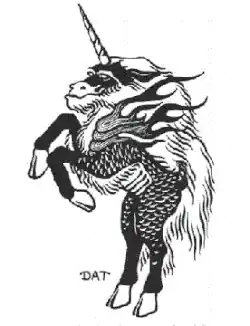 Monster Manual kirin illustration by David A. Trampier | |
| First appearance | 1976 |
| Based on | Qilin, unicorn |
| In-universe information | |
| Alignment | Lawful good |
Kirin, in the Dungeons & Dragons (D&D) role-playing game, are magical beasts similar to unicorns. They are based on the mythological Chinese qilin or kirin in Korean and Japanese.
Publication history
The kirin first appeared in the original Dungeons & Dragons game supplement Eldritch Wizardry (1976).[1]
The kirin appeared in the first edition in the original Monster Manual (1977).[2]
Kirin appeared in the second edition in the Monstrous Compendium Volume Two (1989),[3] and reprinted in the Monstrous Manual (1993).[4] The psionic variant of the kirin appeared in The Complete Psionics Handbook (1991).[5]
Kirin appeared in the third edition Oriental Adventures (2001).[6]
Description
Kirin are always lawful good and worship Koriel.
Kirin resemble unicorns. They are powerful spellcasters, and roam the skies looking for good deeds to reward, and malefactors to punish.
Kirin are a race of aerial creatures whose hooves rarely touch the earth, for they dwell amid the clouds and behind the winds. Females are never encountered and Ki-rin are always solitary. They sometimes aid humans if the need to combat evil is great. The coat of the kirin is luminous gold, much as a sunrise on a clear day.
Influence
An obituary to Gary Gygax specifically highlights kirin as an example of the way in which D&D embraces world culture and folklore.[7]
References
- ↑ Gygax, Gary; Blume, Brian (1976), Eldritch Wizardry (1 ed.), Lake Geneva, Wisconsin: TSR
- ↑ Gygax, Gary. Monster Manual (TSR, 1977)
- ↑ Cook, David, et al. Monstrous Compendium Volume Two (TSR, 1989)
- ↑ Stewart, Doug, ed. Monstrous Manual (TSR, 1993)
- ↑ Winter, Steve. The Complete Psionics Handbook (TSR, 1991)
- ↑ Wyatt, James. Oriental Adventures (Wizards of the Coast, 2001)
- ↑ Jonathan Rubin, "Farewell to the Dungeon Master: How D&D creator Gary Gygax changed geekdom forever," Slate (March 6, 2008).
- Chinese legendary creatures
- Four Holy Beasts
- Japanese legendary creatures
- Korean legendary creatures
- Mythological deer
- Unicorns
- Dungeons & Dragons
- Dungeons & Dragons creatures from folklore and mythology
- Mythological creatures
- Fictional characters introduced in 1976
- Mythological horses
- Dungeons & Dragons stubs