Kho Ping Hoo
Kho Ping Hoo | |||||||||||
|---|---|---|---|---|---|---|---|---|---|---|---|
 | |||||||||||
| Born | 1926[a] | ||||||||||
| Died | 22 July 1994 (aged 67–68) Surakarta, Central Java, Indonesia | ||||||||||
| Other name | Asmaraman Sukowati | ||||||||||
| Occupation | Writer | ||||||||||
| Years active | 1950s–1994 | ||||||||||
| Known for | Martial arts novels | ||||||||||
| Chinese name | |||||||||||
| Chinese | 許平和 | ||||||||||
| |||||||||||
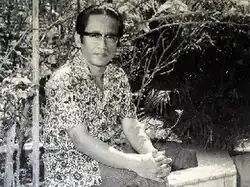
Kho Ping Hoo (1926[a] – 22 July 1994), also known by his pen name Asmaraman Sukowati, was a Chinese Indonesian author of fiction. He mostly wrote martial arts stories inspired by the wuxia genre and set in historical China and Indonesia, but also produced romances and disaster stories.
Born in Sragen to a sugar broker, Kho spent much of his early life as an itinerant worker. In the 1950s, following some time at a refugee camp, Kho settled in Tasikmalaya. Having read extensively, he began writing short stories and established a literary magazine. For the latter, he began work on his first serial, Pek Liong Po Kiam ('The Heirloom Sword White Dragon', 1959). As Kho continued to write, he purchased a printing press and, after moving to Surakarta in 1963, established the Gema Publishing House. Having experienced racially motivated violence on several occasions, he promoted the assimilation of Chinese Indonesians and their intermarriage with the indigenous population.
By the time of his death, Kho had produced more than 130 titles.[b] Most were published in monthly installments, with an average of thirty-five volumes per title. Kho wrote almost exclusively in Indonesian, though he used Hokkien loan words and published one title in Javanese. Aside from one, his stories were original works that drew on the corpus of Indonesian-language translations of Chinese wuxia novels. In his martial arts fiction, his characters were primarily ksatria (warrior aristocrats) who left the court in search of excitement, knowledge, or vengeance. His novels were adapted to stage, radio, and film.
Early life
Kho was born in Sragen, Dutch East Indies, in 1926 to a peranakan Chinese family.[a][1] He was one of twelve children born to Kho Kiem Po, a sugar broker, and Sri Welas Asih.[c][2] Several of his ancestors, including his maternal great-grandmother and paternal grandmother, were of Javanese heritage. He thus learned the Javanese language and script from a young age, and was exposed to Javanese mysticism.[3] His father practised the martial arts in his spare time.[4]
Kho attended a Dutch-run school for his first years of education. However, his family was not wealthy, and thus could not afford further schooling.[5] At the age of fourteen, Kho left school and became an itinerant worker.[6] He travelled to several cities, including Kudus and Surabaya, and was in the latter city selling medicines when the Empire of Japan invaded the Dutch East Indies in 1941. During the Indonesian National Revolution, Kho was again in Kudus and Sragen, where he sold cigarettes.[4]
After Operation Kraai resulted in Sragen falling to the returning Dutch forces, in 1949 Kho evacuated to a refugee camp near Surakarta.[4] After the war, Kho settled in Tasikmalaya, West Java. There, he worked for a transportation company,[3] and eventually led the local council governing truck transportation.[7] He also began learning Mandarin Chinese to converse with his ethnic Chinese peers, many of whom remained culturally closer to China.[3] By this point, he was also fluent in Dutch and Malay.[8]
Following the ratification of the Sino-Indonesian Dual Nationality Treaty in 1955, Kho was required to choose between Chinese and Indonesian citizenship. Kho chose Chinese citizenship and, after a law passed in 1959 prohibited merchants of Chinese heritage from working in rural areas, made plans to leave the archipelago. His travel arrangements fell through, and he remained in Indonesia.[3] Around this time, he began to study English. He received certification from the British Council, and spent some time as a teacher.[9]
Literary career
In 1956, Kho began writing, publishing short stories in such magazines as Selecta, Pancawarna, and Star Weekly.[10] He was primarily self-taught, learning how to write from his reading.[4] In 1959, Kho established the literary magazine Teratai (lit. ''Lotus'') with some friends.[11] They initially sought to have Oey Kim Tiang, a popular translator of Chinese stories, become a regular contributor,[12] but Oey refused.[11] Kho thus began work on a martial arts story. In 1959, he began serializing his first novel, Pek Liong Po Kiam ('The Heirloom Sword White Dragon'),[13] in Teratai. When the magazine collapsed after four issues, the serial was picked up by the Jakarta-based Analisa.[4] Four of his stories were included in Pertemuan ('Meeting'), a collection published by Djelita c. 1960.[d][14]
During a wave of violence against Chinese Indonesians in West Java in 1963,[7] Kho's home was razed and his printing press destroyed.[9] He relocated to Surakarta in 1964,[15] where he settled in the district of Surodiprajan.[16] As he continued writing, Kho established the Gema Publishing House to publish his works, as well as a printing house to handle printing.[17] Further violence against Chinese Indonesians erupted in Surakarta during the widespread violence that followed the failed 30 September Movement coup in 1965, and Kho again considered moving to China.[13] Ultimately, as his children were still young, he remained.[8]
In the 1970s, Kho renounced his Chinese citizenship and became an Indonesian citizen. He began to promote the assimilation of Chinese Indonesians, arguing that intermarriage between persons of Chinese and indigenous heritage would facilitate racial harmony;[13] by 1980, two of his daughters had married indigenous men. When racialized violence erupted in Surakarta in November 1980, Kho's printing press and home were defended by his predominantly indigenous staff, citing their need for continued employment. Covering the incident, the magazine Tempo cited it as evidence that Kho had successfully integrated himself into indigenous society.[16]
Kho continued to write, publishing variously under the names Kho Ping Hoo, Asmaraman S., and Asmaraman S. Kho Ping Hoo.[8] He produced numerous works in the silat genre (derived from the wuxia genre of Chinese literature), including Darah Mengalir di Borobudur ('Blood Flows in Borobudur', 1960), Kilat Pedang Membela Cinta ('The Flashing Sword Defends Love', 1982), and Sang Megatantra ('Megatantra, the Legendary Sword').[13] Many of these works were serialized in magazines, with stories found in Selecta, Roman Detektip, and Monalisa.[18] Meanwhile, his publishing house Gema employed approximately 100 people in 1980.[16]
Reader interest in Kho's stories had dwindled by the 1990s, partly due to the proliferation of television.[19] First-run printings of novels decreased from a peak of 15,000 copies in the 1970s to 5,000.[20] For additional income, Kho began printing tickets and invitations,[21] though he continued to write. By 1981, he was spending five days per week at his villa in Tawangmangu, a village on the slopes of Mount Lawu approximately 40 kilometres (25 mi) east of Surakarta.[22] He produced two to three manuscripts per month,[4] working on up to four texts simultaneously.[23] Mostly his novels were made available to readers through lending libraries and small bookstalls; only in the 1990s did Gramedia, the largest book retailer in Indonesia, stock Kho's works.[12]
In 1985, Kho was diagnosed with a heart condition. On 21 July 1994, he complained of chest pain and collapsed at his villa. Kho was brought to Surakarta, where he was treated at Kasih Ibu Hospital. He died the following morning.[24] After a period of lying in state, during which his body was viewed by thousands,[25] Kho was cremated at the Tiong Ting Crematorium.[24] His ashes were scattered in the Indian Ocean.[21] He left behind two wives, Rosita (born Ong Ros Hwa) and Hartini, and thirteen children.[22]
Legacy
By the time of his death, Kho had written more than 130 stories.[b] One historical drama, Hancurnya Kerajaan Han ('The Fall of the Han Dynasty'), was left incomplete.[26] Most of these were issued in monthly volumes of pocket size, averaging 35 per title.[27] Of Kho's stories, according to Achmad Ghiffary Mannan of Tempo magazine, the best known were Pendekar Baju Putih ('The White-Shirted Warrior', 1959), Darah Mengalir di Borobudur (1960), and Keris Pusaka Nogopasung ('The Heirloom Kris Nogopasung', 1980).[7]
According to the sinologist Leo Suryadinata, Kho popularized the martial arts genre amongst Indonesians,[7] and the anthropologist Bill Watson describes Kho as the first name to come into Indonesians' minds when discussing the genre.[19] Kho had thousands of readers, with the poet Emha Ainun Nadjib, Sultan Hamengkubuwono IX, politicians Soeharto and Joko Widodo, and religious leaders Abdurrahman Wahid and Ma'ruf Amin identifying themselves as fans of his work.[28] In its obituary, the newspaper Kompas wrote that Kho was better known to readers than most members of the Indonesian literary canon, and many youths sought to emulate Kho's heroes.[24]
Many of Kho's works were adapted to the stage, the Siswo Budoyo group being one of the most frequent performers. Adaptations were also broadcast by Radio Republik Indonesia. By 1981, three of Kho's novels—Dendam Si Anak Haram ('The Bastard's Revenge'), Darah Daging ('Blood and Flesh'), and Buaian Asmara ('Drunk on Love', adapted as Cintaku Tergadai ['My Love, Sold'])}—had been adapted to film.[29] Kho was displeased with these adaptations, feeling that they had distorted his vision and become almost pornographic.[30] Iwan Fals's song "Teman Kawanku Punya Teman" ('My Friend's Friend Has a Friend') references Kho Ping Hoo when describing the titular youth's reading habits.[7]
Kho was posthumously granted several awards for his contributions to Indonesian literature, including from the regent of Sragen in 2005 and the Surakartan People's Association in 2012.[7] In 2014, he was awarded the Satya Lencana Kebudayaan by the Indonesian government.[26] In December 2013, the first volume of Kho's Suling Emas ('The Golden Whistle') was translated into Mandarin; sponsored by Imron Cotan, Indonesia's ambassador to China, this translation was handled by an Indonesian before being edited by a Chinese expert in wuxia stories.[31] A museum dedicated to Kho has been planned for Sragen, though as of 2005 it had not been realized.[7]
Analysis
Setting and characterization
The majority of Kho's works were set in China and used Chinese names.[32] Having only travelled to mainland China in 1985, he drew his inspiration predominantly from maps of the country,[24] English- and Dutch-language texts on its history,[4] and imported works of Hong Kong and Taiwanese cinema.[7] Kho was meticulous in detailing fashions and hairstyles, which were used as markers of social position.[30] For many readers, Kho's novels were their primary source of information on Chinese culture, geography, and values.[31]
More than thirty of Kho's stories were set in the Malay Archipelago,[32] including not only his silat stories but also works of realist fiction.[33] In accordance with genre conventions, his martial arts stories were primarily set in historical times, prior to the arrival of European colonialism. Where stories were set during the colonial era, they were mostly in its early years.[34] The author Eka Kurniawan, exploring Kho's use of history in Kompas, notes that the novelist drew from diverse areas and eras in Indonesian history, including the Mataram and Singhasari Kingdoms.[35] Settings varied, including the building of Borobudur Temple or the arrival of Admiral Zheng He,[13] with these well-known events providing a context for fictional deeds.[34]
Generally, Kho's silat stories dealt with members of the nobility, ksatria (warrior aristocrats) who leave the comforts of their palaces in search of excitement, knowledge, or vengeance.[34] A minority of characters were religious leaders, with the main character of Darah Mengalir di Borobudur being a Buddhist monk. Kurniawan argues that, despite this emphasis on the elites of society, Kho drew his characters into the realms of the lower classes, be they rural communities or natural environments, and thus associated his historical fiction with the common people.[34]
Themes
Buddhism and Hinduism, which were the primary religions of pre-colonial Indonesia, are prominent in Kho's archipelago-set silat stories. Several used religious themes as part of their conflict. In Sepasang Garuda Putih ('A Pair of White Garuda'), for instance, a village's temple to the Trimurti is replaced by the Shivite antagonist with individual temples to Shiva, Durga, and Kala. Kurniawan notes that, despite these conflicts, Kho was careful to attribute the misdeeds of antagonists to their abuse of power rather than religious teachings.[34] Confucian values are incorporated into works set in China.[7]
Kho used several of his novels to emphasize that the ethnic Chinese have long been part of Indonesian society and that intermarriages with the indigenous elites were common. His Kilat Pedang Membela Cinta, which featured Admiral Zheng He and his companion Ma Huan, showed that the Chinese were familiar with Islam – the majority religion of the modern archipelago. Through his writings, Kho sought to challenge stereotypes that Chinese Indonesians were dishonest brokers seeking only self-enrichment.[25] Meanwhile, Kilat Pedang Membela Cinta concluded with a discussion of love-based intermarriage.[26]
Although Kho was best known for his martial arts stories, some of his works deal with other themes. His early short stories such as "Sociawan" ('Philanthropist') highlighted the injustices of 1950s Indonesia and provided social criticism.[36] Meanwhile, his Geger Solo ('The Solo Incident') is set during the flooding of the Solo River on 16 March 1966 and explores the disaster's repercussions for its characters.[8] Several of Kho's stories depicted romantic relationships between Chinese and non-Chinese characters.[13] Siane (1981), for example, was a romance following a peranakan girl and Javanese boy in contemporary Indonesia.[37] According to Kho's daughter Tina Asmaraman, he believed that love conquered all, and thus could provide a solution to many of society's woes.[8]
Language
Aside from the Javanese-language Lintang-Lintang Dadi Seksi ('The Stars Bear Witness', 1961),[12] all of Kho's works were written in Indonesian.[8] His early silat publications, including the aforementioned Pek Liong Po Kiam and Ang Coa Kiam ('Sword of the Red Snake', 1962), were given Hokkien titles and Indonesian subtitles; later works solely carried Indonesian-language titles.[26] Watson writes that, in his early works, Kho used a mainstream style similar to indigenous writers such as M. Balfas and Idrus.[38] The author Seno Gumira Ajidarma describes Kho's language in later works as fluent, easily creating strong plots and characters through his simple language.[8] Hokkien loanwords were sometimes used, but limited to those commonly understood by readers.[39]
Mostly, Kho did not translate existing works of wuxia. He had a limited command of oral Mandarin[18] and he could not read the script.[24] His Si Teratai Emas ('The Golden Lotus', 1980), a translation of Jin Ping Mei, was the sole exception;[40] it was not translated directly from the original, but from an extant English-language translation.[8] Nonetheless, according to Suryadinata, Kho showed great familiarity with the wuxia genre. Many such works were available in Indonesian translations,[26] with noted examples by Oey Kim Tiang and Gan KL.[24]
Notes
- 1 2 3 Kho's date of birth is not recorded. Later in life, based on the memory that he was born sometime in August, he chose 17 August 1926 as his official date of birth (Pattisina 2021, p. 2).
- 1 2 Safutra (2019) writes that Kho completed 133 stories. Pattisina (2021, p. 2) gives 143 stories, Sidharta (2012, p. 406) gives 145, and Mannan (2025) gives 148. A 1981 profile by Kompas claims that he had published more than 200 titles by that point.
- ↑ Sidharta (2012, p. 406) gives fifteen.
- ↑ The collection does not include a date of publication. Based on textual references to certain products and political events, Watson (2017, p. 541) dates it to 1960–1963.
References
- ↑ Salmon 1981, p. 192.
- ↑ Safutra 2019; Kompas 1981, p. 1
- 1 2 3 4 Sidharta 2012, p. 406.
- 1 2 3 4 5 6 7 Kompas 1981, p. 1.
- ↑ Sawega 1994, p. 20; Sidharta 2012, p. 406
- ↑ Sidharta 2012, p. 406; Mannan 2025
- 1 2 3 4 5 6 7 8 9 Mannan 2025.
- 1 2 3 4 5 6 7 8 Pattisina 2021, p. 2.
- 1 2 Sidharta 1994, p. 158.
- ↑ Salmon 1981, p. 192; Safutra 2019
- 1 2 Safutra 2019.
- 1 2 3 Sidharta 1994, p. 157.
- 1 2 3 4 5 6 Sidharta 2012, p. 407.
- ↑ Watson 2017, p. 541.
- ↑ Watson 2017, p. 550.
- 1 2 3 Tempo 1980, p. 13.
- ↑ Salmon 1981, p. 192; Rejeki 2008, p. 1
- 1 2 Suryadinata 2015, p. 94.
- 1 2 Watson 2017, p. 540.
- ↑ Sidharta 1994, p. 159.
- 1 2 Sidharta 2012, p. 408.
- 1 2 Kompas 1981, p. 1; Sawega 1994, p. 20
- ↑ Sidharta 1994, p. 160.
- 1 2 3 4 5 6 Sawega 1994, p. 20.
- 1 2 Sidharta 1994, p. 168.
- 1 2 3 4 5 Suryadinata 2015, p. 95.
- ↑ Sawega 1994, p. 20; Sidharta 1994, p. 162
- ↑ Sawega 1994, p. 20; Safutra 2019; Pattisina 2021, p. 2
- ↑ Kompas 1981, p. 10.
- 1 2 Sidharta 1994, p. 163.
- 1 2 Wresti 2014, p. 41.
- 1 2 Rejeki 2008, p. 1.
- ↑ Kurniawan 2006, p. 38; Watson 2017, p. 552
- 1 2 3 4 5 Kurniawan 2006, p. 38.
- ↑ Salmon 1981, p. 86; Kurniawan 2006, p. 38
- ↑ Watson 2017, pp. 552–53.
- ↑ Sidharta 1994, p. 164.
- ↑ Watson 2017, p. 553.
- ↑ Hoogervorst 2017, p. 296.
- ↑ Sidharta 2012, p. 408; Suryadinata 2015, p. 94
Works cited
- "Asmaraman Kho Ping Hoo". Kompas (in Indonesian). Jakarta. 12 April 1981. pp. 1, 10.
- Hoogervorst, Tom G. (2017). "What Kind of Language was 'Chinese Malay' in Late Colonial Java?". Indonesia and the Malay World. 45 (133): 294–314. doi:10.1080/13639811.2017.1340030.
- "Kisah Kho Ping Hoo" [The Story of Kho Ping Hoo]. Tempo (in Indonesian). Vol. 10, no. 41. 6 December 1980. p. 13.
- Kurniawan, Eka (1 December 2006). "Sejarah dalam Cerita Silat Kho Ping Hoo" [History in the Silat Stories of Kho Ping Hoo]. Kompas (in Indonesian). Jakarta. p. 38.
- Mannan, Achmad Ghiffary (24 July 2025). "31 Tahun Kepergian Kho Ping Hoo: Penulis Cerita Silat Populer yang Tak Bisa Silat" [31st Anniversary of the Death of Kho Ping Hoo: The Popular Silat Writer who Knew No Martial Arts]. Tempo. Archived from the original on 29 August 2026. Retrieved 29 August 2026.
- Pattisina, Edna C. (20 March 2021). "Kebangsaan: Mencintai Indonesia seperti Kho Ping Hoo" [Nationhood: Loving Indonesia like Kho Ping Hoo]. Kompas (in Indonesian). p. 2.
- Rejeki, Sri (31 January 2008). "Bunawan, Melestarikan Legenda Kho Ping Hoo" [Bunawan, Preserving the Legend of Kho Ping Hoo]. Kompas (in Indonesian). Jakarta. p. 1.
- Safutra, Ilham (17 August 2019). "Mengenang Penulis Cerita Silat Legendaris Asmaraman Kho Ping Hoo (1)" [In Memoriam: Legendary Silat Story Author Kho Ping Hoo (1)]. Jawa Pos (in Indonesian). Surabaya. Archived from the original on 17 June 2024. Retrieved 17 June 2024.
- Salmon, Claudine (1981). Literature in Malay by the Chinese of Indonesia: A Provisional Annotated Bibliography. Paris: Editions de la Maison des sciences de l'homme. ISBN 9780835705929.
- Sawega, Ardus M. (22 July 1994). "Asmaraman Kho Ping Hoo: "Saya Telah Iklas Pergi ..."" [Asmaraman Kho Ping Hoo: "I've Accepted My Departure ..."]. Kompas (in Indonesian). Jakarta. p. 20.
- Sidharta, Myra (1994). "Asmaraman Sukowati Kho Ping Hoo (b. 1926): Writer of Cloak-and-dagger Stories in Indonesia". Archipel. 48: 157–176. doi:10.3406/arch.1994.3007.
- Sidharta, Myra (2012). "Kho Ping Hoo". In Suryadinata, Leo (ed.). Southeast Asian Personalities of Chinese Descent: A Biographical Dictionary. Institute of Southeast Asian Studies. pp. 406–408. ISBN 978-981-4345-21-7.
- Suryadinata, Leo, ed. (2015). "Kho Ping Hoo". Prominent Indonesian Chinese: Biographical Sketches (4th ed.). Singapore: Institute of Southeast Asian Studies. pp. 94–96. ISBN 9789814345217.
- Watson, C.W. (2017). "An Early Story of Kho Ping Hoo" (PDF). Wacana. 18 (2): 540–555. doi:10.17510/wacana.v18i2.595. Archived from the original on 29 August 2026.
- Wresti, M. Clara (29 January 2014). "Kho Ping Hoo Satukan Indonesia dan China" [Kho Ping Hoo United Indonesia and China]. Kompas (in Indonesian). Jakarta. p. 41.