Kansuke Yamamoto (artist)
Kansuke Yamamoto 山本 悍右 | |
|---|---|
 | |
| Born | Kansuke Yamamoto[1] 30 March 1914 |
| Died | 2 April 1987 (aged 73) Nagoya, Japan |
| Known for | Poet-photographer; editor and publisher |
| Movement | Surrealism |
Kansuke Yamamoto (Japanese: 山本 悍右, 30 March 1914 – 2 April 1987) was a Japanese avant-garde photographer, poet, editor, and publisher based in Nagoya, whose work brought photography into sustained contact with poetry, publishing, and Surrealism.[2][3] His 1932 photocollage The Developing Thought of a Human... Mist and Bedroom and was later described by photography historian Ryūichi Kaneko as a landmark in the formation of modern Japanese photography.[4] Drawing on French Surrealist literature and periodicals, Yamamoto developed a practice that John Solt and Amanda Maddox have described in terms of translation and dialogue rather than belated imitation of European models.[5][6]
In 1938, Yamamoto founded and edited the Surrealist journal Yoru no Funsui, which combined poems, photographs, translations of French Surrealist writing, and reproduced drawings.[7][8][5] The journal ceased publication in 1939 under pressure from the Special Higher Police (Tokkō), and Yamamoto was questioned about the political implications of Surrealist photography and about lines in his poems.[9][10][11] Maddox argues that Yamamoto resisted pressure to strip Surrealism of provocation, politics, and thought, and describes Surrealism for him as an attitude and a way of life.[5][12] His Buddhist Temple's Birdcage (1940), which pairs a telephone with a birdcage, has been read by Maddox and Majella Munro in relation to silencing and restrictions on communication under wartime policing.[13][14]
Yamamoto continued his experimental practice after the war, co-founding VIVI in 1947 in what Maddox describes as an effort to keep the spirit of Surrealist ideology alive in the postwar period.[15][12] Across his career he worked with photomontage, photograms and combination printing, and later extended his practice into photographic sequences, three-dimensional works and experimental film.[16][17] Kōtarō Iizawa has singled out My Thin-Aired Room (1956) as an unusually early constructed photographic sequence in Japan.[18][19] Jelena Stojković argues that Yamamoto's postwar photographic narratives, including staged sequences in which he appeared as both actor and director, linked his Surrealist background with emerging conceptual and performative uses of photography.[20] Stojković also describes Yamamoto's work as a point of reference for histories of the prewar Japanese avant-garde and for the development of contemporary art and photography in Japan.[20] Kaneko likewise argues that Yamamoto's career cannot be understood through a simple prewar-postwar divide, and uses his case to question the same division in histories of modern Japanese photography.[21]
A major retrospective at Tokyo Station Gallery in 2001 brought together Yamamoto's prewar and postwar work, and Iizawa later identified it as a turning point in his reception.[22] His work was subsequently featured in Japan's Modern Divide at the J. Paul Getty Museum in 2013 and Surrealism Beyond Borders at the Metropolitan Museum of Art and Tate Modern in 2021–2022.[15][23] In Surrealism Beyond Borders, Yamamoto is discussed in relation to Nagoya's avant-garde photography circles, while the catalogue places Japan's interwar photo clubs alongside Paris's Bureau de recherches surréalistes.[9][24]
Early life and background (1914–1930)
Birth and early life
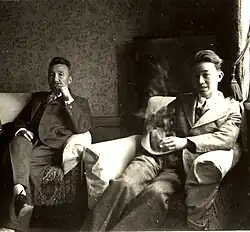
Yamamoto was born on 30 March 1914 in Teppōmachi, Naka-ku, Nagoya, Aichi Prefecture, as the eldest son of Gorō Yamamoto and Tsū Yamamoto.[25] His given name at birth was Kansuke (勘助).[25] The family business, Yamamoto Gorō Shoten, is described as a pioneering photographic-equipment shop in Nagoya.[25] His father was a founding member of the Aiyū Photo Club (Aiyū Shashin Kurabu) in 1912 and served as its representative during the Taishō period.[25]
The Aiyū Photo Club was planned in 1911 and formally established in January 1912, and its monthly meetings were sometimes held at the family camera shop.[26] This placed Yamamoto in close contact with photographic materials and amateur club culture from an early age.[25][26] Kaneko notes that the annual Kenten competitions organized by the Tokyo Photographic Research Society attracted submissions from across Japan, including Nagoya.[27]
Early exposure to photography
Biographical accounts describe Yamamoto Gorō Shōten as combining a photography supply shop with a studio environment that exposed Yamamoto early to photographic materials and processes.[25] Nonaka-Hill likewise describes Gorō as the owner of Nagoya's first photography supply store and states that Yamamoto "naturally absorbed the mechanics of photography" in this environment.[28]
A Nagoya City Art Museum catalogue discusses the Aiyū Photo Club's pigment-printing practices, including gum bichromate printing (often referred to as "Aiyū no gomu").[29] The same catalogue presents the club's exhibition and salon activities as a framework that sustained local photographic production in Nagoya.[29] A Nagoya City Art Museum publication notes that the club's secretariat was located at Yamamoto Gorō Shōten on Hirokoji-dori in Naka-ku, placing day-to-day administration at the family business.[30] An exhibition text by Taka Ishii Gallery describes the Aiyū Photo Club as the largest amateur photo club in Nagoya and credits Gorō's shop with giving Yamamoto early exposure to photography.[31]
Nagoya photographic networks
Yamamoto's early career in Nagoya developed through interconnected clubs, journals, and small-press activity that provided a practical infrastructure for experimentation and exchange.[32][33] In accounts of Surrealism and photography in 1930s Japan, Nagoya is described as one of the movement's liveliest centers, where amateur photo clubs and magazine culture supported the development and circulation of experimental work under growing wartime pressure.[9]
In this milieu, Yamamoto joined the Dokuritsu Shashin Kenkyūkai in 1931 at the age of seventeen, and the group's bulletin Dokuritsu provided one of his earliest forums for publishing photographs and participating in collective print culture.[33][4][34]
Museum and critical accounts likewise describe Nagoya's journals, bulletins, and photobooks as practical conditions for the circulation of avant-garde photography, linking Yamamoto's early activity to the networks that later supported his work as an editor and publisher.[35][36][37][9]
Prewar avant-garde practice (1931–1937)
Encounter with Surrealism and the French transmission
Francophone channels and Surrealism's literary transmission
Aoki writes that Yamamoto's first sustained encounter with Surrealism was mediated through channels that were explicitly Francophone and broadly European in intellectual scope.[38] She notes that Chirū (Tiroux) Yamanaka corresponded with Paul Éluard and André Breton and translated Surrealist writings as part of the channels through which French Surrealist ideas entered Japan's literary and artistic spheres.[38] She further identifies Yamanaka's poetry magazine CINÉ (also styled cine) as one conduit within that transmission.[38]
Munro writes that Yamamoto first encountered Surrealism through reading Yamanaka's journal CINÉ.[39] She adds that Yamamoto later collaborated with Yamanaka when the title re-emerged as Yoru no Funsui from 1938.[39] Tani likewise argues that Yamamoto's discovery of Surrealism was mediated by literary magazines, citing titles such as Shi to shiron and CINÉ (published by Yamanaka).[40]
Iizawa notes that Yamamoto began writing poems around 1930, at the age of sixteen.[41] He adds that, through the Surrealist poetry circle surrounding CINÉ, Yamamoto established early connections with figures such as Shūzō Takiguchi and Yamanaka, who are often credited with fostering Surrealism in Japan.[41] A chronology compiled by Toshio Yamamoto records that between 1930 and 1932 Yamamoto wrote 44 poems in a cycle titled The Revelation of Nonsense (Japanese: 南仙子黙示録).[7] The same chronology notes that a final poem was added to the cycle in 1936.[7]
Tokyo study, return to Nagoya, and Surrealism as method
According to the J. Paul Getty Museum, Yamamoto left Nagoya around 1929 to study French poetry and literature in Tokyo and, after returning, began writing poems and making collages before taking up photography as a Surrealist instrument.[42] Iizawa notes that after graduating from the Nagoya City Commercial School in 1929, Yamamoto studied French at the Athénée Français in Tokyo, entered Meiji University to read French literature and French poetry, and then left the university without completing his studies.[41]
Aoki and a published biography describe his Tokyo study as the context in which he encountered Western modernist movements and theories before returning to Nagoya in 1931 and committing himself to a Surrealist vocabulary across poetry and photography.[38][43] A Getty chronology derived from the chronology published by the Tokyo Station Gallery further records that in 1935 Yamamoto established the A.B.C. Photo Club with Mitsuya Okonogi and held its meetings at his father's photo supply shop, Yamamoto Gorō Shoten, placing this episode within the same practical environment of the family shop and studio through which he became familiar with photographic materials and processes.[25][28][44] In an interview recorded in the chronology compiled by Toshio Yamamoto, he recalled turning seriously to photography in the early 1930s because Surrealism had already entered Japan and "it might be possible to do it with photography as well," treating the medium not as reportage but as a method for constructing thought through images.[7] Masachika Tani similarly argues that Yamamoto's early-1930s turn to photography extended his avant-garde poetry practice and pursued Surrealism as a visual method rather than as a separate, purely photographic interest.[45]
Formation of an avant-garde practice

Dokuritsu and Yamamoto's critique of New Photography
Photography critic Kōtarō Iizawa places Yamamoto's emergence in the early-1930s shift from pictorialist "art photography" (geijutsu shashin) toward shinkō shashin (New Photography), as photographers sought new ways of responding to Japan's changing urban environment after the 1923 Great Kantō earthquake.[41] Iizawa identifies the 1931 German International Traveling Photography Exhibition in Tokyo and Osaka, drawn from Stuttgart's 1929 Film und Foto, as an important stimulus for New Photography through its display of photograms, photomontage, small-camera photographs of cityscapes, X-ray images, and microscopic photography.[41] Iizawa describes Yamamoto as aligning himself with New Photography while using photographic modernism to pursue an avant-garde form of expression rather than pictorialist salon aesthetics.[41]
Yamamoto took up photography around 1931 as part of his attempt to pursue Surrealist expression through the medium, entering photographic activity through small-press work as well as exhibitions.[4] In October 1931, at the age of seventeen, he became a founding member of the Dokuritsu Shashin Kenkyūkai, which published the bulletin Dokuritsu as a forum for members' photographs and writing.[4] Takeba records that the association was established in Nagoya by Shimizu Kentarō (志水賢太郎), Tomita Hachirō (富多八郎), and Okonogi Mitsuya (小此木光也), began with sixteen members, and issued four known numbers of Dokuritsu through B.2 in April 1932.[46][34] Takeba places the run of Dokuritsu between the end of the Tokyo journal Shinkō Shashin Kenkyū in July 1931 and the launch of the monthly magazine Kōga in May 1932.[46] Fujimura notes that accounts of New Photography centered on Tokyo also intersected with activity in Kansai and Nagoya, including the Dokuritsu Shashin Kenkyūkai.[47]
Takeba notes that early statements on New Photography by writers including Nobuo Ina and Shigemine Kanamaru emphasized objective depiction and the discovery of "new beauty", photography as record and report, and form created through light.[46] In B.1 of Dokuritsu, Yamamoto published the essay Dai to shudai ("Title and Subject"), in which he argued that a photograph should express the content of an "ism" and the artist's conscious intention rather than depend on its title for meaning.[46] Takeba quotes Yamamoto's statement that "it is necessary to express the theme of our ideology and the content of our consciousness" and reads the essay as an early criticism of tendencies that became visible as New Photography spread through photographic magazines.[48][46] Yamamoto also contributed photographs and other short theoretical texts to Dokuritsu during this period.[7] In an English-language history of Japanese photography, Takeba describes Yamamoto as a young poet in Nagoya who began photographing in 1931 and whose photocollages published in a small magazine the following year received critical praise.[48]
Between 1933 and 1935, Yamamoto also participated in book and limited-edition print circles, joining the Nihon Genteiban Club in 1933 and the Shunchōkai Genteiban Kurabu and the Book Club in 1934, while also becoming involved with Mazu, the Nihon Aishokai, and Kogei.[49]
The 1932 photocollages

Kaneko records that works from Yamamoto's early series The Developing Thought of a Human appeared in Dokuritsu B.1 on 1 January 1932 and B.2 on 5 April 1932.[4] Kaneko notes that the two works reproduced in B.1 are no longer extant but suggests that they were also photocollages.[4] The surviving The Developing Thought of a Human... Mist and Bedroom is a hand-colored collage incorporating newspaper and magazine material and a gelatin silver print, and is held by the Nagoya City Art Museum.[50][51] It is among Yamamoto's earliest surviving experiments with photomontage.[51][52]
The date of the work had long been uncertain, but research for the 2001 retrospective Surrealist Yamamoto Kansuke established that Yamamoto made it in 1932, when he was eighteen.[51]: 166 Kaneko regards the confirmation of its 1932 date as a landmark for understanding the formation and development of modern Japanese photography in the 1930s.[51]: 166–167 Kaneko also considers the work's level of artistic expression to be on a par with that of contemporary European artists.[51]: 166
Iizawa describes the work as juxtaposing an image of lips with fragments cut from contemporary newspapers and argues that it shows that Yamamoto had acquired an avant-garde idiom by the age of eighteen.[41] Tani notes that the collage includes newspaper fragments referring to the 1932 Geneva disarmament conference and to the economic crisis following the 1929 New York stock-market crash, together with sensual cut-out imagery.[40] Yamamoto tore open the black photographic surface of the collage to expose newspaper clippings beneath it and combined them with photographs of lips, a woman's face, and a woman's leg.[51]: 166 The visible newspaper reports concern arms reduction and movements in the yen, including reports on the Geneva disarmament conference and the economic crisis associated with the Great Depression.[51]: 166–167
Kaneko argues that Yamamoto did not adopt collage from the European avant-garde only for its aesthetic or stylistic qualities.[51]: 167 Kaneko instead reads the work as using collage for social criticism in the specific conditions of Japan.[51]: 167 He relates the newspaper material to Japan's movement from peace toward war between the Manchurian Incident of 1931 and its withdrawal from the League of Nations in 1933.[51]: 167
Takeba draws attention to Yamamoto's use of bodily fragments, revue imagery, pen nibs, buildings, and contemporary newspaper reports in the works published in Dokuritsu.[53] Takeba argues that the photocollages do more than present disconnected fragments of reality because their arrangement leads the viewer to imagine time and narrative.[53] Takeba reads the works as evidence that Yamamoto had already recognized limits within New Photography and was beginning to move beyond them.[53]
Stojković notes that Yamamoto was already experimenting with collage and photomontage in Surrealist circles in Nagoya in the early 1930s.[52]: 49 She places these printed experiments within a wider Surrealist "constellation" that connected photographers, poets, critics, and artistic groups across institutional boundaries.[52]: 49–50 Stojković argues that this network is relevant not only to the international character of Surrealism but also to its continuation after the war.[52]: 50 She also notes that these exchanges came under increasingly difficult political conditions, particularly after the outbreak of the Second Sino-Japanese War in 1937.[52]: 50
The J. Paul Getty Museum describes Yamamoto as reworking European-inspired Surrealist imagery through Japanese settings, materials, motifs, and concerns.[54] Taka Ishii Gallery describes Yamamoto as one of the leading figures of Surrealist photography in Japan and highlights his social criticism and poetic sensibility.[55] The Getty places Yamamoto among the photographers who developed progressive photography in 1930s Japan through engagement with Surrealism.[42] Eiko Aoki describes Yamamoto as a driving force in Japan's avant-garde movement and notes the uncompromising character of his photography.[38]
Name change and first solo exhibition (1936)
In 1936, Yamamoto altered the written characters of his given name from 勘助 to 悍右 while keeping the reading "Kansuke".[7] Art historian John Solt, drawing on testimony from the photographer Katsuhiko Okazaki, interpreted the change as a deliberately charged gesture aimed at the "violent right".[56] Solt treats the change as a political use of written language rather than a neutral change of name.[56] A chronology compiled by Yamamoto Toshio records that Yamamoto held his first solo exhibition at Maruzen Gallery in Nagoya in 1936.[7]
Surrealist networks and publishing (1936–1937)
French-language reading and Nagoya networks
A chronology compiled by Toshio Yamamoto records that Yamamoto began ordering overseas publications in 1936, including Cahiers d'Art and books issued by G.L.M.[7] Maddox notes that Yamamoto built a substantial personal library of French Surrealist writing that included works by André Breton, Paul Éluard, Louis Aragon, Benjamin Péret, and Philippe Soupault, and that he also read Sigmund Freud.[57] Munro records that Yamamoto was fluent in French and maintained an extensive Surrealist library that included periodicals such as Acéphale and Cahiers d'Art.[58]
Hanako Takayama argues that the reception of Surrealism in Nagoya cannot be explained as a simple one-way diffusion from Tokyo.[59] Munro notes that Yamamoto's close collaborator Chirū Yamanaka was interested in dissident forms of Surrealism associated with Georges Bataille, in contrast with the more Breton-centered line associated with Shūzō Takiguchi in Tokyo.[58] Maddox presents Yamamoto's work as a case that complicates accounts of Surrealism in Japan as a simple importation or belated imitation of European models.[60] Maddox and Solt describe Yamamoto's engagement with Surrealism in terms of translation and dialogue shaped by the conditions in which he worked in Japan.[60][61]
The 1937 exhibition and the move into publishing
The touring Kaigai Chōgenjitsushugi Sakuhinten (Exhibition of Overseas Surrealist Works) was shown in Nagoya in 1937.[62] Yūko Ishii places the exhibition within the international exhibition history of Surrealism in the 1930s and argues that it should not be understood only as an introduction of European Surrealism to Japan.[63] An exhibition catalogue records that Yamamoto repeatedly visited the Nagoya presentation and came to see the need for a periodical that could communicate Surrealist ideas.[62] A chronology compiled by Toshio Yamamoto records that he later discussed with Chirū Yamanaka the need to promote Surrealism through publishing.[7] The same chronology records that this initiative became a catalyst for Yoru no Funsui, which Yamamoto began editing and publishing in 1938.[7][64]
Editing, publishing, and wartime constraints (1938–1945)

Art criticism has described Nagoya as one of the centers of Surrealism in Japan, a context in which Yamamoto and his peers sustained avant-garde photographic activity across the prewar and postwar decades.[66]
Editorial platforms under wartime pressure
From 1938, editing and publishing became central to Yamamoto's Surrealist practice, and museum and gallery accounts describe these activities as integral to his role in Nagoya's avant-garde.[67][68] Yamamoto's participation in bibliophile circles and his editorial work for small-print journals show him not only as a maker of photographs and poems but also as an editor and publisher whose work took shape through projects such as Yoru no Funsui and, later, Carnet Bleu.[69][64][70]
Kurosawa cites a document from G.L.M. dated 21 November 1938 acknowledging an order from Yamamoto.[71] In a letter to Yamamoto dated 19 January 1939, José Corti mentioned Benjamin Péret's Dormir dormir dans les pierres.[71] Kurosawa also notes that Yamamoto used catalogues issued by G.L.M. and José Corti to order books and periodicals from France.[71]
Yoru no Funsui: editing, translation, and Tokkō scrutiny

In November 1938, Yamamoto launched Yoru no Funsui as a Surrealist poetry and art journal.[7] A 1990 exhibition catalogue edited by the Nagoya City Art Museum described it as the last poetry journal in Japanese Surrealism to present itself explicitly as a purely Surrealist journal.[72] Four issues appeared through October 1939, all in small editions.[73]
Yamamoto also gave close attention to the journal's paper, typography, and layout, and Kinoshita describes Yoru no Funsui as a carefully designed avant-garde poetry journal produced as wartime restrictions were tightening.[7][74][75] Its pages brought together Yamamoto's prose, poetry, and photographs with work by other writers and artists, including drawings by Yoshio Shimozato and poems by Chirū Yamanaka.[20] Maddox notes that it also combined translations of French Surrealist poetry and Yamamoto's own poems with reproduced drawings by Yves Tanguy.[5]
The journal was also an outlet for French Surrealist writing in Japan. Yoshiteru Kurosawa notes that the first three issues included Japanese translations of texts from the French journal Cahiers G.L.M..[76] Surrealist visual art was already being introduced through publications drawing on journals such as Cahiers d'Art and Minotaure, but Kurosawa notes that there were far fewer outlets for French Surrealist poetry and prose and describes Yoru no Funsui as virtually the only one in Japan at the time.[76] With Yamanaka's help, copies were also sent to Paul Éluard in France.[5] D'Alessandro and Gale identify periodicals as an important means by which Surrealist texts and images circulated between different communities through exchange and translation.[77]
Police scrutiny brought Yoru no Funsui to an end in 1939.[75][67][8] Stojković reports that Yamamoto was interrogated about the political implications of Surrealist photography.[52] Munro writes that he was asked how his "surreal photography" contributed to Japan's war effort, while Tani reports that he was also pressed to explain lines from his poems.[10][11] Maddox, citing John Solt, describes an interrogation in which Tokkō officers demanded an explanation of "the third line of the second stanza" of a Surrealist poem.[5] In Solt's account, Yamamoto later described the interrogation as "a frightening experience" and recalled having to evade the officers' questions without saying anything that the police could interpret as incriminating.[61] Solt reports that Yamamoto was released on the condition that he cease publication of Yoru no Funsui.[61]
A fifth issue was in preparation but never appeared.[75][78] Yamamoto subsequently planned another Surrealist journal, Brille, with the stated aim of introducing the "Surrealist spirit".[79] In 1940, he drafted "Notes on the Trends of Surrealism and Photography" for its projected first issue, but the journal remained unpublished.[79]
Seidōsha and Carnet Bleu: a French title in wartime Nagoya

In 1938, Yamamoto helped establish the photographers' group Seidōsha (Blue Admiration Society).[64][70] A 1989 Nagoya City Art Museum exhibition catalogue notes that around the same time he became acquainted with photographer Keiichiro Goto through the Seidōsha circle and that the two remained close thereafter.[80] After Yoru no Funsui had ceased publication and the planned journal Brille remained unrealized, Yamamoto continued small-scale publishing under wartime constraints through Seidōsha's bulletin Carnet Bleu.[74][70][51] He edited and published the bulletin beginning with its first issue on 25 March 1941.[7][81] Five issues appeared between 25 March 1941 and 10 August 1942, with the fifth issue serving as the final issue.[7]
The bulletin retained its French title through the final issue, while Yamamoto continued to engage with Francophone avant-garde writing during a period of intensifying cultural nationalism and wartime pressure in Japan.[64][70][7][51] Takeba describes Yamamoto's contribution to the first issue as a “poet's monologue” on the contemporary development of “avant-garde photography” and “constructive photography.”[81]
The fifth and final issue, dated 10 August 1942, carried Yamamoto's Japanese translation of Philippe Soupault's essay État de la photographie ("The Present State of Photography").[7][51] Kaneko places the translation within Yamamoto's continuing engagement with Francophone writing during the war years.[51] Takeba reads Yamamoto's added note to the translation as an expression of his determination to develop his own mode of expression despite wartime conditions.[82] In a later account, Takeba notes that Yamamoto's comment described Soupault's words as standing at “a certain distance” from the wartime rhetoric of “national mission,” which Takeba connects to Minoru Sakata's position at the end of the Nagoya Photo Avant-Garde.[83] Takeba relates this context to wartime pressure on photographers to align their practice with national objectives.[83] Takeba further sees Yamamoto's postwar return to Soupault's anti-fascist words as reflecting the unresolved legacy of his prewar experience.[83]
Nagoya avant-garde networks and wartime divergence
Scholars and institutional accounts describe Nagoya's club-and-magazine networks as major channels through which Surrealist-leaning photography circulated in interwar Japan, and they place Yamamoto's early public activity within that milieu.[84][85][9][39]
Stojković writes that the 1937 Kaigai Chōgenjitsushugi Sakuhinten (Exhibition of Foreign Surrealist Works), shown in Nagoya at Maruzen gallery, helped stimulate reorganizations and new collectives with explicitly Surrealist agendas in the city.[9] Later accounts also describe the Nagoya Avant-Garde Club as a cross-disciplinary group from which the photo section later split off as the Nagoya Photo Avant-Garde.[86][9]
Yamamoto participated in the establishment of the Nagoya Photo Avant-Garde in 1939, but he withdrew later that year as the group moved toward a more nationalist and propagandistic position under wartime pressure.[87][88][38]
Contemporary institutional accounts also point to magazine and exhibition circuits as key amplifiers of Nagoya's prewar avant-garde visibility, via outlets such as Photo Times and Camera Art that gave experimental work a national profile.[89][90] Kaneko notes that a review by Sakata in the July 1940 issue of Photo Times praised Yamamoto's ability to "sublimate ... poetic sentiments in silver bromide," characterizing him as a "poet of silver bromide," and a Nagoya City Art Museum chronology records that the same issue carried a profile of Yamamoto and reproduced three of his works.[91][92]
Later accounts note that growing suspicion surrounding the term “avant-garde” encouraged euphemistic renaming under wartime conditions.[93][38] The Nagoya group adopted the name Nagoya Shashin Bunka Kyōkai (Nagoya Photography Culture Association) around November 1939 and dissolved in 1941.[7][93]
VOU and a long-running cross-media axis

Yamamoto became a member of the avant-garde poetry group VOU in 1939.[94] The Taka Ishii Gallery CV records that he remained associated with VOU until the group's dissolution in 1978, and it also lists his participation in VOU exhibitions across the prewar and postwar decades.[94] In John Solt's account, VOU (led by poet Katué Kitasono) was active from 1935 to 1978, with an interruption during the Pacific War.[95] Solt states that the group typically comprised about twenty-five to thirty-five members at a time.[95] Solt adds that VOU included musicians, architects, technologists, and visual artists, while noting that all members wrote poetry and that the group held a prewar conviction that poetry was "the fountain of all the arts".[95] Solt also notes that Yamamoto published poems in the group's magazine as well as in other venues.[95]
Kaneko, Toda, and Vartanian note that VOU members began submitting photographs in the late 1950s.[96] They add that Kitasono began making photographs under Yamamoto's instruction, identifying Yamamoto as a prewar VOU member who remained a reference point for the group's later photographic activity.[96] In a 2024 monograph on VOU and Kitasono, Bory and Donguy describe Yamamoto as the group's most experimental photographer, and they write that he exhibited regularly while rarely publishing photographs in the journal itself.[97] Bory and Donguy further report that in VOU no. 53 (1956), Kitasono praised Yamamoto's photographic series as "poetic".[98]
Lucy Fleming-Brown describes a 1941 still-life composition published in VOU in which a disconnected telephone receiver is staged as an offering on a plate at the end of a staircase descending toward the sea.[99] Fleming-Brown treats the image as characteristic of Yamamoto's practice of placing everyday objects into symbolically charged constellations, and she notes that his accompanying text stresses photography's mechanical organization and its capacity to disclose objects in unforeseen relations.[99] Fleming-Brown also notes that the 1941 issue was prefaced by a coerced declaration of support for Japan's war effort, and she reads the telephone image within Yamamoto's wartime motif of disrupted communication under authoritarian repression.[99] The International Encyclopedia of Surrealism notes that Yamamoto's work was prominently published in Kitasono's VOU and other Japanese photography magazines, producing an unusually extensive published Surrealist portfolio for a Japanese practitioner of the period.[100]
Surveillance, nonconformity, and imagery of silencing
Accounts of Yamamoto's wartime work emphasize the effects of surveillance and censorship on avant-garde publishing and photography.[5][9] Maddox reads Buddhist Temple's Birdcage (1940), which pairs a telephone with a birdcage, as an image of silencing and constrained communication under ideological control.[13] Munro likewise discusses the work in relation to censorship and restrictions on speech and print.[14] A Nagoya City Art Museum collection catalogue interprets the related 1940 variation of Buddhist Temple's Birdcage, in which a telephone receiver is placed outside the cage, as a Surrealist image of voicelessness that registers silent resistance to the suppression of speech at the time.[101] Stojković regards some photographs Yamamoto made after leaving the Nagoya club as among the strongest examples of Surrealist photography produced in Japan in the 1930s; two were published in the second issue of Kōkaku in August 1940.[102]
Stojković reads Yamamoto's 1940 sequence in the context of contemporary Surrealist debates about the "object".[103] She connects its disconnected telephone receiver with imagery associated with Salvador Dalí in the late 1930s, which was discussed in Japan by Shūzō Takiguchi in 1939.[103] Rather than treating Yamamoto's use of the motif as simple imitation, Stojković places it within a local response to an international Surrealist visual language.[103]
Maddox situates Yamamoto's late-1930s and wartime activity in a climate shaped by the Peace Preservation Law (1925) and policing by the Tokkō, under which avant-garde circles could be monitored and nonconformity treated as grounds for suspicion.[12] The Metropolitan Museum of Art's wall text for Surrealism Beyond Borders notes that, as preparations for the Pacific War mounted, Surrealist activity was increasingly masked under state disapproval and arrests expanded by 1941.[104] Munro argues that wartime cultural policing targeted ideology and perceived political content rather than "Western style" as such.[105] Munro adds that Western-influenced idioms could also be mobilized for state propaganda.[105] Munro writes that as Tokkō enforcement intensified in the 1930s, the threat of persecution pushed many avant-garde writers and artists to "strip their work of any liberal, potentially subversive content".[106] Against this background, Maddox writes that Yamamoto "quietly challenged the idea that Surrealist work needed to be devoid of provocation, politics, or thought".[12] In Surrealism Beyond Borders, D'Alessandro and Gale note that under rising militarism in late-1930s Japan, Surrealists such as Yamamoto (figs. 65, 66), Shūzō Takiguchi, and Ichirō Fukuzawa were suspected of communist sympathies and arrested by the Tokkō, commonly described as the "thought police".[107]
Munro documents that state pressure operated not only through censorship but also through surveillance of avant-garde social space, including plain-clothes police attending Surrealist meetings from 1940.[108] Munro also records a case of a Surrealist photographer agreeing to report on meetings on behalf of the police.[108] Munro further notes that as groups recalibrated toward patriotic aims, a Nagoya photography organization adopted the stated goal of a "union, through photography, of reform and nationalism".[108] Munro writes that Yamamoto resigned in protest and that the group later dissolved in 1941.[108] The Getty Museum's exhibition text describes Yamamoto as an "ardent nonconformist" who favored avant-garde modes of expression as a way of engaging modern Japanese life obliquely rather than through documentary realism.[109] Munro cautions against treating repression as a simple function of Surrealism's "Western" style and stresses that enforcers could distinguish style from ideology.[106] Munro observes that scholarship has alternated between describing Japanese Surrealism as apolitical and as politically radical enough to warrant systematic suppression, arguing that its political character is best assessed through practitioner-specific analysis rather than a single overarching narrative.[106] Maddox reports that in a 1941 diary entry Yamamoto described art as arising from a "disobedient spirit against ready-made things of society".[12]
Munro notes that Yamamoto had expressed interest in Communism in diary entries from 1933–1934, showing that this interest preceded his 1940 discussion of the relationship between Surrealism and Communism.[110] She reports that a 1940 manuscript by Yamamoto, "Surrealism and Photography", quotes Breton's Communicating Vessels and discusses Surrealism's tense relation to Communism.[111] Munro notes that Yamamoto complained of increasing totalitarianism in Japan and questioned how the Surrealist notion of "compulsive beauty" could be reconciled with Communist aims.[111] She further reports that Yamamoto regarded Surrealism's inherent liberalism as an obstacle to any stable rapprochement with Communism, while continuing to insist on the revolutionary potential of his photographic practice.[111] Munro links the manuscript to Yamamoto's earlier diary entries and sees both as evidence of his engagement, from Japan, with wider Surrealist debates over whether revolutionary politics could be reconciled with Surrealist aesthetics and its notion of "compulsive beauty".[111]
Stojković notes that in 1940, in his essay "A Concise Vilification with Regard to Photography", Yamamoto described the photographic act as a process in which, once the shutter is released, "all things within a chosen angle fly into a fixed mask".[112] Stojković adds that Yamamoto framed his practice as a search for objects and for new correlations between them that could "symbolize living content".[112] Munro further notes that during the police investigation surrounding Yoru no Funsui (closed in 1939), Yamamoto was pressed to explain how his Surreal photography contributed to Japan's war effort.[111] Maddox discusses the closure of Yoru no Funsui under Tokkō scrutiny as more than an episode in publishing history, emphasizing how avant-garde publication itself could become a site of surveillance and enforcement.[12] Taka Ishii Gallery's biography emphasizes Yamamoto's recurring use of charged everyday objects and images of enclosure as a means of registering pressure and constraint without direct declaration.[113] Maddox identifies a recurring vocabulary of suppression in Yamamoto's wartime-era imagery, including a barred window as an emblem of imprisonment under the Peace Preservation Law, hats clipped with clothespins or punctured by straight pins as metaphors for constrained thought, and a telephone trapped inside a birdcage as an image of enforced silence.[12]
Postwar work and networks (1945-1960)

Japanese photographic historiography notes that around 1950, still under Allied occupation, photographers and critics began to articulate efforts to revive a prewar current often described as "avant-garde photography".[114] The same account characterizes this current as rooted in amateur circles, including Osaka's Avant-Garde Zōei Shūdan and Nagoya's Nagoya Foto Avant-Garde.[114] It also describes the revived tendency as drawing on Surrealism-inflected techniques and debates associated with interwar Shinkō shashin.[114]
A chronology compiled by Toshio Yamamoto records that Yamamoto married Hisae Hirai in 1942.[7] The same chronology notes that she later served as a model for a number of Yamamoto's postwar photographs.[7]
After the war, the same chronology presents Yamamoto as a key organizer of Nagoya's experimental scene.[7] It records that he co-founded the photographers' collective VIVI-sha in 1947 and exhibited in its early shows.[7] It also records that he participated in the Bijutsu Bunka Kyōkai (Art and Culture Association) as a member of its photography section, and it characterizes his postwar work there as treating the photograph as a constructed object rather than a transparent document.[7]
Kaneko, Toda, and Vartanian describe the Bijutsu Bunka Kyōkai as founded in 1939 by Surrealism-oriented avant-garde artists.[114] The same account notes that the association was curtailed after the 1941 arrests of leading figures and was reactivated in 1946.[114] They further frame it as a key postwar base for cross-media avant-garde revival, highlighting how photography could align with contemporary art networks beyond the camera press.[114]
Organizing the postwar avant-garde: Nagoya as an alternative center
A review of Takeba Jō's movement-history of Nagoya photography describes the postwar field as one in which realist and subjective approaches "vied closely", alongside renewed currents of abstract and Surrealist expression in the region.[115] The Nagoya City Art Museum similarly frames modern photographic expression in Nagoya as a field shaped by both abstract/Surrealist tendencies and the postwar contest between "objective" documentary impulses and "subjective" approaches.[89]
Institutional summaries of Yamamoto's career note that he co-founded VIVI in 1947 with figures including Minayoshi Takada, Keiichirō Gotō, and Yoshifumi Hattori.[15][116][117] The Yamamoto chronology records that at VIVI's second exhibition at Maruzen Gallery in 1949 he exhibited works including Yūutsu na sanpo (憂鬱な散歩), Jiikufurīdo gensō (ジイクフリイド幻想), A Chronicle of Drifting (漂流記), and Icarus's Episode (イカルス挿話).[7] A CV published by Taka Ishii Gallery also lists Yamamoto's participation in early VIVI exhibitions in this period.[118]
Two works associated with this moment, Icarus's Episode (1949) and A Chronicle of Drifting (1949), are held by the Museum of Modern Art and the J. Paul Getty Museum respectively.[119][120] Amanda Maddox writes that Yamamoto helped found VIVI in order to keep the spirit of Surrealist ideology alive in the postwar period.[12] A 2025 collection note from the Metropolitan Museum of Art, written for Keiichiro Goto's Memorandum (1947), likewise describes wartime-censured experimental activity in Nagoya as resurfacing in the mid-1940s and frames VIVI as part of that revival.[121]
Takeba remarks that postwar Surrealist work has often been comparatively overlooked in accounts privileging prewar avant-garde production, and he situates Yamamoto's postwar activity with the VIVI circle in tension with contemporaneous realist currents.[122] Takeba also notes that VIVI disseminated its postwar program through its bulletin CARNET DE VIVI, whose first issue (printed June 1948) paired members' photographs with short programmatic statements and framed the collective as a renewed avant-garde after the wartime rupture.[122] The Nagoya City Art Museum's annual report likewise lists CARNET DE VIVI no. 1 (June 1948) among relevant materials, supporting its documentary presence within institutional archives.[123]
In Takeba's reading, Yamamoto's contribution links postwar rhetoric of photographic trust to an awareness of the medium's risks, explicitly reconnecting VIVI practice to ethical problems he had posed through wartime publishing and translation work.[122] Takeba further places this local contest within a broader postwar polarization between socially oriented documentary realism and a renewed, formally constructed "subjective" photography, and he frames Yamamoto's Surrealist revival as a third position grounded in montage, emblematic objects, and oblique critique.[122]
Yoshiteru Kurosawa similarly argues that accounts treating avant-garde photography as a prewar movement brought to an end by the war obscure important continuities into the postwar period.[124] In his account of Nagoya, Yamamoto continued to engage with the avant-garde across the wartime divide, while postwar avant-garde photographic activity in the city developed around Yamamoto and Keiichirō Gotō.[124]
Staged photography and narrative sequences
Stojković traces Yamamoto's postwar use of photographic narrative to a pair of self-portraits made in 1949.[20] In 1956, he made staged sequences including It Is Raining In Town, My Room Is, Full of Fragments and My Thin-Aired Room, appearing in the photographs as both actor and director.[20]
Amanda Maddox identifies René Magritte's Man with a Newspaper (1928) as a model for My Thin-Aired Room.[87] She describes Yamamoto's four-part sequence as a reworking of Magritte's composition, with the seated figure and then the furniture disappearing from one photograph to the next.[87] Katsue Kitasono also singled out the work in 1956, describing it in VOU as Yamamoto's most original achievement and a "revelation" for avant-garde photography.[125]
The sequences also appeared in print. VOU no. 58 published My Thin-Aired Room as a four-photograph "photo-story" in November 1957, while no. 59 published It Is Raining In Town, My Room Is, Full of Fragments as a three-photograph "photo-story" in 1958.[7]
Yamamoto used the sequence form in other works as well. Masachika Tani dates A Forgotten Person to 1957 and describes it as a five-image sequence in which a female figure gradually changes and disappears.[126] Kōtarō Iizawa distinguishes Yamamoto's sequences from the journalistic photo-essay, describing them instead as constructed situations that unfold across successive photographs.[18] Iizawa also compares Yamamoto's use of photographic sequences with the later work of Duane Michals.[18]
A 2024 history of Japanese photography identifies Yamamoto, a member of the Bijutsu Bunka Kyōkai in Nagoya, as a photographer who also worked with staged photography.[127]
Stojković argues that Yamamoto's postwar photographic narratives linked his Surrealist background with emerging conceptual and performative uses of photography.[20] She also describes his work as a point of reference both for the prewar Japanese avant-garde and for the development of contemporary art and photography in Japan.[20]
Public-sector commissions and a dual register of practice
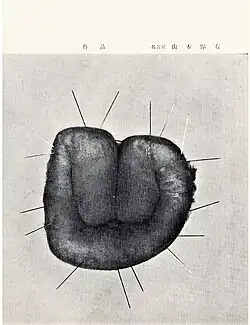
Alongside his renewed activity in postwar artist-run and experimental circles in Nagoya, the Yamamoto chronology records that from April 1949 he produced publicity photographs as a contracted contributor for Aichi Prefecture's public relations office.[7] The same chronology records additional examples of Yamamoto's media-facing work in 1950, including reproduction of a photograph in Shashin Techō (vol. 2, no. 5) as part of the roundtable "Zen'ei shashin o kataru zadankai" ("Roundtable on avant-garde photography") on 1 January 1950.[7] It also records publication of his photograph Idō shinzō-kōfuku no kage ("Heart in Motion-Shadow of Happiness"), now in the collection of the Art Institute of Chicago, in the Shintōkai Shimbun on 25 January 1950, accompanied by a short thriller by mystery writer Motomasa Hattori.[7][128] The chronology further records that a portrait photograph of Isamu Noguchi by Yamamoto was published in the Shintōkai Shimbun on 15 July 1950.[7] It additionally records that from 13–26 September 1950 he contributed a 13-part newspaper series titled Kōhī no hanashi ("Coffee talk") to the Shintōkai Shimbun.[7]
Postwar subject matter
Maddox argues that Yamamoto's Surrealist vocabulary remained politically charged after the war and that photography continued to serve as a means of critical inquiry.[87]
In Sleepy Sea (1953), she reads a toy gun marked "Japan" and a compass without a needle as a commentary on Japan's lack of direction after the war and on the acceptance of the U.S. military presence.[87]
The Yamamoto chronology records that in 1954 Yamamoto visited Hiroshima and Nagasaki and made photographs titled Hiroshima (1954) and Nagasaki (1954).[7] The Getty Museum's Japan's Modern Divide exhibition presented Yamamoto's postwar photographs within a broader institutional narrative of postwar photographic debates and the afterlives of war.[15]
Munro notes that Yamamoto returned to the birdcage motif after the war, with later images placing frail human figures inside the cages; she discusses these works in terms of postwar confinement and vulnerability.[129]
Artist-run groups and durable networks
The selected chronology in Japan's Modern Divide records that Yamamoto joined the Bijutsu Bunka Kyokai in 1949 and left the association in 1954.[130] It also records a dense sequence of artist-run activity in the 1950s, including the founding of the photo group Mado ("Window") in 1953; the formation in Nagoya of Hono'o ("Flame") in 1955 (with Yamamoto continuing to participate in Hono'o exhibitions through 1961); and the formation of the experimental group ESPACE in 1956, with an ESPACE exhibition appearance recorded in 1958.[130] The same chronology records that he participated in the formation of Nihon Shukanshugi Shashin Renmei (Japanese Subjectivism Photography Federation) in 1956, and that in 1958 he participated in the formation of Zen'ei Shijin Kyokai (Avant-Garde Poetry Association) and formed Arukishine, an 8mm filmmaking group.[130] It further records that he formed the group NAGOYA 5 in 1963 and that the group organized exhibitions in 1963 and 1964.[130]
Curatorial and institutional accounts of postwar photography in Nagoya describe the period as one in which realist and subjective approaches "vied closely," and they situate the city's experimental circles as a continuing arena for exhibition-making and debate rather than activity confined to Tokyo-centered camera-press networks.[115][89]
Majella Munro reproduces a copy of the Paris Surrealist bulletin BIEF (no. 5, 15 March 1959) sent to Yamamoto that bears the dedication "Pour Yamamoto, ses amis" ("For Yamamoto, his friends") together with signatures including André Breton, Radovan Ivšić, Jean Schuster, Benjamin Péret, José Pierre, Joyce Mansour, Robert Benayoun, Toyen, Jean-Louis Bédouin, Mimi Benoît, Jean Benoît, and Gérard Legrand.[131] Munro presents this item as concrete evidence of Yamamoto's contact with postwar European Surrealists through the circulation of publications and reproductions across national groups.[131] In the same context, Munro describes postwar attempts to rebuild Surrealism's international links via intermediaries such as Simon Watson Taylor, who worked to re-establish contacts and circulate materials across borders in the late 1950s.[132]
Dialogue with Europe: Subjektive Fotografie and Otto Steinert
A chronology compiled by Toshio Yamamoto records that in May 1956 Yamamoto joined the formation of the Japan Subjective Photography League (日本主観写真連盟), a group that Japanese reference works describe as having been organized by the critic Shūzō Takiguchi and the photographer Kōrō Honjō.[133][134] The same chronology records that in December 1956 Yamamoto exhibited in the First International Subjective Photography Exhibition (第一回国際主観主義写真展), held at Nihonbashi Takashimaya and organized in connection with the magazine Sankei Camera, with selection credited to Otto Steinert and additional Japanese curatorial involvement noted in the record.[134] Jelena Stojković situates such postwar debates over "subjective photography" within broader arguments about whether photography should be treated primarily as documentary testimony or as an intentionally constructed art, and she notes that the Steinert-linked discourse of Subjektive Fotografie became one of the internationally circulating frameworks for that claim in the 1950s.[52]
In Japanese critical commentary, "subjective photography" has often been framed as a backward-looking nostalgia for prewar avant-garde experimentation, while alternative readings have treated it as a route toward new postwar photographic expression tied to Nagoya-linked photographers and exhibitions.[117] Ryūichi Kaneko notes that a May 1957 special issue of Atelier devoted to subjective photography brought together prewar experimental photographers such as Kansuke Yamamoto and Kōrō Honjō with a newer postwar generation, including Kiyoji Ōtsuji, Ikkō Narahara, Hisae Imai, and Yasuhiro Ishimoto, assembling a substantial body of work in order to argue for a reevaluation of the trajectory of modern Japanese photography.[135] Kaneko adds that this moment of juxtaposition did not prevent prewar figures from being increasingly overshadowed in later accounts of postwar photographic development, even when their work aligned closely with debates about formal construction and sequencing.[135] A later movement-history similarly observes that early criticism of the 1956 international exhibition tended to focus on postwar professionals while giving limited attention to Surrealism-linked prewar amateurs, and it describes Yamamoto's contribution there as multiple-exposure nude imagery treated as an abstract, erotic form.[136] In Stojković's analysis, Yamamoto's prewar and wartime Surrealist procedures—especially his insistence on the photograph as a constructed object and on meaning produced through sequencing—help explain why his work can be read coherently within postwar "subjective" framings of experimental photography.[52]
Cross-media practice: poetry, photography, publishing, and exhibition-making
Yamamoto sustained an interlinked practice across poetry, photography, and editorial work, treating printed matter (journals, newsletters, and layouts) as part of avant-garde production.[95][43] In discussion of his 1960s films, Munro links their formal emphasis to Kitasono's contemporary "plastic poems" and notes that interdisciplinary exchange between poetry and film remained active in the VOU milieu.[137]
Institutional biographies emphasize that Yamamoto sustained a cross-media practice across photography, poetry, and publishing, including long-running ties to the avant-garde poetry group VOU led by poet Katsue Kitasono and participation in artist-run circles such as VIVI.[2][3] John Solt describes Yamamoto's poetry as minimalist, Surreal, and witty, emphasizing short, sonorous lines and unexpected images rather than sustained narrative, and he links this poetic method to the juxtaposition and recombination that structure Yamamoto's photographic practice.[138] Munro reproduces Yamamoto's poem "Temple Address" (Kōkaku; published in Wide Angle, August 1940) and situates his photographic and poetic production within a shared Surrealist lexicon of objects, ritual, and heresy.[139]
Darkroom experimentation and the expanded photographic medium
The Getty Museum's exhibition biography summarizes Yamamoto's postwar production as technically and formally wide-ranging, noting sustained use of collage and photomontage alongside photograms, experiments with color processes, combination printing, sequential photographic narratives, and three-dimensional works.[16] The Getty Museum further frames Yamamoto as consistently favoring avant-garde forms of expression as a way to engage modern Japanese life obliquely rather than through realist reportage, positioning experimentation as a through-line that connects his prewar publishing activity with postwar work.[16][2] The Yamamoto Toshio chronology records that in the mid-1950s Yamamoto helped form ESPACE and began producing three-dimensional works, including objects and mobiles, alongside photographic experimentation.[134] Kōtarō Iizawa argues that Yamamoto carried the experimental impetus of the late-1930s Nagoya avant-garde into the postwar period, and he highlights Yamamoto's willingness to combine eroticism and humor with Surrealist construction as a distinctive idiom within Japanese avant-garde photography.[140]
Film, teaching, and later work (1960s–1980s)
A later multi-image work, My Bench, was shown as a twelve-part photo story in a NAGOYA 5 exhibition in Tokyo in November 1963. It was published, with commentary, as a twelve-photograph sequence in the April 1964 issue of Camera Geijutsu.[134]
Experimental film and cine-poetic practice (1960s)
In the exhibition catalogue Surrealism Beyond Borders, Stephanie D'Alessandro and Matthew Gale discuss film (alongside journals and radio) as a key channel through which Surrealism reached new audiences, emphasizing how montage and the cut enabled abrupt juxtapositions beyond the printed page.[141] Munro notes that during the 1960s Yamamoto also made experimental films using domestic 8 mm cameras, extending Surrealist procedures of montage and associative juxtaposition into moving image.[137] Munro records that in January 1963 the VOU Club screened Yamamoto's Comme un cordon alongside works by Osabe Gyōyū and Katsue Kitasono.[137] In Munro's discussion of Yamamoto's surviving cine-poetic practice, two titled films from 1965 are noted: La valse noble and Miroir de la tauromachie.[137] A selected chronology in Japan's Modern Divide records that in June 1965 Yamamoto presented three 8 mm "cine poems" at the VOU Club's Keishō ("Form") exhibition, including La valse noble (5:33) and Miroir de la tauromachie (2:16), and notes that one film is now lost.[17]
Mentoring student photographers
Beginning in 1966, Yamamoto served for about a decade as an adviser to the Chubu Student Photography Federation, mentoring younger photographers.[142]
In 1967, he contributed two pieces to Photo Opinion (フォト・オピニオン), the bulletin of the federation's high-school section. "On High School Photography—What Does Technique Mean to You?" (高校生写真のこと――技術は君たちにとって何か) appeared in the first issue in February, and "Two Certificates in the Dark" (闇の中の二枚の証明書) in the third issue in July.[142]
Hideaki Sugiura later recalled that Yamamoto was particularly dedicated to working with students. He also noted that members of the Aichi University photography club looked up to Yamamoto and Keiichirō Gotō.[143]
Critical engagement: the VERB exhibition (1968)
The selected chronology in Japan's Modern Divide records that in 1968 Yamamoto contributed a manifesto to the VERB exhibition and presented the photo series Asa totsuzen ni (朝突然に; "Suddenly, in the Morning"), I–VI.[17] The chronology specifies that the series took the Vietnam War as its subject.[17] The Getty Museum describes Yamamoto's later work more broadly in terms of criticism and rebellion, including works that protested war, promoted liberty, and responded to current events.[16]
Late work across media and an anti-promotional stance
Yamamoto continued to work across photography, poetry, and related media into his later decades, and a later biography notes that he was "never self-promoting" even when corresponding with French Surrealists to publish their work.[144] The same source adds that he maintained a commitment to Surrealism while other photographic trends formed in Japan and were later historicized, and it points to the 2001 Tokyo Station Gallery retrospective as a key moment in bringing new audiences to his lifelong work.[144] Munro argues that Occupation-era and Cold War frameworks shaped later historiography of Japan's prewar avant-garde and affected how Surrealism's political stakes were narrated after 1945, while also noting that public discourse on Shōwa history in Japan shifted notably after 1989.[145] The J. Paul Getty Museum states that Yamamoto published his only book in 1970 and continued to write poetry thereafter.[16] The Getty further describes him as an "ardent nonconformist" who framed art as criticism, dialogue, and rebellion.[16]
Death and final instructions
In 1985 the photographer Tsugio Tajima (田島二男) made a rare late photograph of Yamamoto, and Yoshiteru Kurosawa later cited Yamamoto's diary entry dated 28 June written upon the photograph's arrival.[146] In that entry Yamamoto records that the photograph made him sharply aware of being seventy-one, that looking at it filled him with aversion and a sense of physical decline, and that he resolved he would not want to be photographed again.[146] Yamamoto died in Nagoya on 2 April 1987, reportedly of lung cancer.[147] Solt writes that Yamamoto asked in his will to have nothing to do with the customary Buddhist funeral and instead donated his body for medical research at Nagoya University's School of Medicine.[148]
Reception and legacy
Stojković notes that scholarship on Surrealist photography in 1930s Japan developed unevenly: individual photographers and works were discussed, but the field as a whole received little sustained treatment in either histories of photography or histories of Surrealism.[149]
Domestic reassessment and retrospectives
Early posthumous reassessment (1988–1990)
Gallery CVs list a posthumous solo exhibition in Tokyo in 1988 (IMAGINATION MARKET Q & P) as an early marker in the domestic rediscovery of Yamamoto's work.[150] The estate chronology reproduced in the 2001 Tokyo Station Gallery catalogue notes that the 1988 Tokyo exhibition was covered by Asahi Shimbun (14 April 1988) and Tokyo Journal, with both pieces reproducing Yamamoto's work.[151] A later gallery biography describes the 2001 Tokyo Station Gallery retrospective Surrealist Yamamoto Kansuke, co-curated by John Solt and Ryuichi Kaneko, as a major reintroduction of Yamamoto's career-spanning practice to new audiences.[152]
The Nagoya City Art Museum's 1990 exhibition Surrealism in Japan: 1925–1945 surveyed prewar Japanese Surrealism across poetry, painting, prints, design, and photography, placing Yamamoto within a broader account of the movement.[153][154]
Retrospective turning point: Tokyo Station Gallery (2001)
Later accounts describe the 2001 Tokyo Station Gallery retrospective, Kansuke Yamamoto: Conveyor of the Impossible, co-curated by John Solt and Ryūichi Kaneko, as a turning point in Yamamoto's reception in Japan.[155] In an interview published in Kyoto Journal, Getty curator Amanda Maddox said that Yamamoto became much more widely known in Japan after the exhibition, which attracted about 9,000 visitors.[156]
Writing in 2006, art critic Kōtarō Iizawa recalled that the retrospective had completely changed his view of Yamamoto.[157] He had previously thought of Yamamoto mainly as a Surrealist from the Nagoya scene, but came to see an originality that went beyond the local context and a pioneering quality that could not be contained within the groups to which he belonged.[157] Iizawa also argued that Yamamoto's influence and the wider scope of his work deserved further study.[157]
In 2012, Iizawa again described the 2001 retrospective as a major turning point. He noted that it revealed a much broader picture of Yamamoto as a poet and painter as well as a photographer, and brought his postwar work into clearer view.[22] Iizawa also discusses Solt's description of Yamamoto as an "ephemeralist", relating it to a concern with fragile and transient beauty.[22]
Reassessment of prewar–postwar continuity
In 2001, Jō Takeba described Yamamoto as a “rare poet” (稀有な詩人), and also a photographer, who had sustained Surrealist poetic experimentation in Nagoya across the prewar and postwar periods.[158] In Takeba's account, Yamamoto's Surrealist poetic experimentation is not confined to his prewar photography but continues into the postwar period.[158]
Writing in the catalogue for the 2001 Tokyo Station Gallery retrospective, Ryūichi Kaneko argues that Yamamoto's postwar avant-garde photography was largely overlooked in the 1950s, when the Realism in Photography movement dominated Japanese photographic culture.[21] He stresses the breadth and variety of Yamamoto's postwar career and argues that his work should not be divided into separate prewar and postwar histories.[21] Kaneko also presents Yamamoto's place within the development of Japanese photography in the 1930s and 1940s as a subject requiring further study.[21]
In the English version of the essay published in Japan's Modern Divide in 2013, Kaneko makes the historiographical problem more explicit. He notes that postwar Japanese photography has often been narrated as beginning with the Realism in Photography movement of the 1950s, followed by the rise in the 1960s of photographers such as Shōmei Tōmatsu, Ikkō Narahara, Eikoh Hosoe and Kikuji Kawada, whom he describes as the “VIVO generation.”[4] Within this account, Kaneko argues, Yamamoto's work was pushed to the margins and treated mainly within the limited contexts of Nagoya and the avant-garde associated with VOU.[4] He points instead to the richness and variety of Yamamoto's postwar work, as well as its increased complexity and strength, and rejects the accepted division of his career into prewar and postwar periods.[4] Kaneko extends the same argument to modern Japanese photography as a whole, calling for its history, despite the interruption of war, to be reconsidered as continuous and interconnected.[4]
Writing in 2006, Yoshiteru Kurosawa likewise argued that accounts treating avant-garde photography as a prewar movement brought to an end by the war obscure important continuities into the postwar period. He characterized Yamamoto as a photographer who had continued to question the avant-garde consistently from before the war, and identified Yamamoto and Keiichirō Gotō as central figures in the development of postwar avant-garde photography in Nagoya.[124]
International reception and major survey exhibitions
Press materials for the international survey exhibition Surrealism Beyond Borders (co-organized by The Metropolitan Museum of Art and Tate Modern in 2021–2022) presented Surrealism through transnational networks beyond a primarily Western European focus.[23] The accompanying catalogue likewise frames the movement in terms of international circulation and multiple local contexts rather than a single center-to-periphery narrative.[159]
In the Getty's Japan's Modern Divide exhibition materials, Yamamoto is presented as a Surrealist who worked "under pressure" in late-1930s Japan, when avant-garde art could attract ideological suspicion and police attention.[19] The Getty's educational handout on Yamamoto similarly emphasizes that his practice linked Surrealist procedures to critique and nonconformism rather than to documentary reportage.[160] In an interview about Japan's Modern Divide, writer Eiko Aoki reported that most writing on Yamamoto had been in Japanese and that John Solt was among the few authors to have treated him in English.[161]
Even while English-language discussion remained comparatively limited, Yamamoto appeared in broader Anglophone survey frameworks, including The History of Japanese Photography (organized by the Museum of Fine Arts, Houston; published by Yale University Press in 2003).[162] In 2024, Yamamoto's work was also included in Foreign Exchange: Photography between Chicago, Japan, and Germany, 1920–1960 at the Art Institute of Chicago, a comparative exhibition on photography in Chicago, Japan, and Germany from 1920 to 1960.[163] A 2018 feature in IMA noted that Japanese avant-garde photographic collectives active from around 1930 to the early 1940s were beginning to be reassessed in Europe and the United States.[164] Francophone Surrealism scholarship has also addressed Surrealism in Japan in dedicated venues, including Mélusine no. 36 (2016), which includes a dossier titled "Le surréalisme au Japon".[165]
In the same Kyoto Journal interview, Aoki reported that the Getty presentation of Japan's Modern Divide drew more than 200,000 visitors in its first four months, compared with about 9,000 visitors to the Tokyo Station Gallery retrospective in 2001, underscoring the expanded scale of Yamamoto's recent international visibility.[161] The Getty further presents Yamamoto as an artist whose Surrealist practice extended across media and decades, including postwar work that treated art as criticism, dialogue, and rebellion while responding to contemporary social and political realities.[19] The Getty handout similarly characterizes him as an "ardent nonconformist" who used Surrealist strategies to resist conformity and register pressures on imagination and expression in modern Japan.[160]
In 2025–2026, the National Museum of Asian Art included a section titled "Wake Up and Dream" on Yamamoto in Cut + Paste: Experimental Japanese Prints and Photographs.[166] The exhibition text described him as a poet and artist rooted in Surrealism who, over more than four decades, explored the "subversive potential of language and imagery" from the repressive policies of late-1930s Japan through the turbulent postwar years.[166] It also noted his use of photography and collage to place familiar objects in dreamlike settings and suggest hidden meanings.[166]
Teaching and curricula
In the Getty classroom curriculum Surrealism in Poetry and Art, lesson 8 reproduces Yamamoto's photograph I'd Like to Think While inside the Body of a Horse (1964) and uses it to prompt close looking and discussion of Surrealist juxtaposition.[167] The same lesson then asks students to create a digitally manipulated photograph through a collage-like process combining their own images.[167] A University of Florida course syllabus for "ARH 4XXX - Global Surrealisms" includes a session titled "Japan: Kansuke Yamamoto, Yamanaka Tiroux" and assigns Amanda Maddox's chapter on Yamamoto from the Getty publication Japan's Modern Divide.[168] In Japan, a Rikkyo University English-taught seminar syllabus (Humanities Study 6) includes "Poem with Photograph, Yamamoto Kansuke" within its unit on VOU and postwar visual poetry.[169] A Tel Aviv University graduate seminar syllabus on Japanese photography (A Short History of Japanese Photography: Imported Technology, Local Images) lists Japan's Modern Divide: The Photographs of Hiroshi Hamaya and Kansuke Yamamoto among its assigned readings for the period.[170]
Museum surveys and transnational Surrealism
Recent museum scholarship has increasingly reframed Surrealism in transnational terms, prompting renewed attention to artists who translated its procedures under distinct local conditions.[171] Introducing the catalogue, D'Alessandro and Gale describe the project as a deliberate step back from Surrealism's canonical Paris-centered narrative, tracing overlapping routes of convergence, exchange, travel, and translation in order to "redraw a map" of the movement as an interrelated network rather than a single line of diffusion.[172] In their "Points of Convergence" framing, they further emphasize that Surrealism did not adhere to a single, static definition, but took shape through locally inflected practices that repeatedly coalesced at specific sites of encounter; these include not only canonical Parisian infrastructures but also the meeting places of amateur photo clubs in prewar Nagoya and Osaka, and relay cities such as Tokyo through which ideas were transmitted onward across East Asia.[173] They further propose a model of "rhizomatic connectivity" that emphasizes adjacency and exchange over hierarchical center–periphery accounts, using "transnational" (rather than merely "international") to name the catalogue's present-day analytic perspective.[174] The catalogue frames Surrealism Beyond Borders as a move away from a Paris-centered account, presenting Surrealism as a dynamic, internationally networked set of practices adapted to local artistic, cultural, and political conditions.[175] Museum surveys have approached Yamamoto through a consistent set of coordinates: Surrealism understood as a transnational network of exchange; photographic experimentation that treats the print as a constructed object and develops meaning through serial sequencing; and the specific pressures of militarism and censorship in prewar Japan, including scrutiny by the Tokkō.[176][177] This connective frame links his inclusion in Surrealism Beyond Borders to the Getty's Japan's Modern Divide and to Drawing Surrealism (Morgan/LACMA), where his work appears within a broader account of Surrealist experimentation across media.[176][177] The exhibition was accompanied by an illustrated catalogue (published by The Met and distributed by Yale University Press) with contributions from dozens of international scholars.[171] In a related methodological essay in the catalogue, Harney cautions that diffusion-style narratives of "modernism radiating outward" can inadvertently reinstate European primacy, and proposes media metaphors—broadcasting, selective tuning in and out, feedback, and static—to foreground multidirectional exchange and reception.[178]
Yamamoto's work has been pivotal in recent museum-defined accounts of Surrealism's global networks and their local transformations, moving beyond narratives confined to the movement's Parisian origins. His inclusion in ''Surrealism Beyond Borders''—organized by The Metropolitan Museum of Art and Tate Modern (2021–2022)—situates his practice within the movement's transnational network in the context of World War II and Japanese militarism.[179][180][181] Writing about Drawing Surrealism at the Morgan Library & Museum, The New York Times critic Roberta Smith noted that Yamamoto's photographs from around 1938 "combine drawing, collage and rephotography," describing them as a creative "riff" on Salvador Dalí rather than a straightforward imitation.[182] Institutional descriptions of the project further underscore its scale and transnational framing. At the Morgan, Drawing Surrealism was presented as the first major exhibition to examine drawing's central role within Surrealism, bringing together more than 160 works on paper and surveying the movement's international impact through works by over seventy artists from fifteen nations, including Japan; the exhibition was co-organized by the Morgan and LACMA.[183] At LACMA, the survey assembled nearly 200 works by some ninety artists from sixteen countries, tracing Surrealist drawing from its early development through postwar and later adaptations.[184]
This curatorial framing has been reinforced at the institutional level through Yamamoto's inclusion in the exhibition and catalogue Surrealism Beyond Borders (The Metropolitan Museum of Art; Tate Modern, 2021–2022), a major survey—spanning almost eight decades of work produced across 45 countries—that reconsiders Surrealism as a transnational movement beyond a Western European focus.[181][185]
Photography and abstraction in international frameworks (Tate)
Institutional survey exhibitions also placed Yamamoto's work within broader histories of photographic experimentation and abstraction.[186][187] In 2018, Yamamoto's work was included in Shape of Light: 100 Years of Photography and Abstract Art at Tate Modern, where darkroom-based procedures central to his practice—photomontage, photograms, and combination printing—were presented within a longer history of photographic abstraction and medium-specific experimentation.[186][187] Tate described the exhibition as the first major exhibition to explore the relationship between photography and abstract art across the century from the 1910s to the present day.[186][187] In Tate's large-print guide for the exhibition, Yamamoto was represented by Title Unknown (1940)[188] and the object-photograph The Thrilling Game Related to Photography (1956), the latter described as a gelatin silver print work on paper and glass; both were listed as loans from the Jack Kirkland Collection (Nottingham).[189]
In a review of Shape of Light for Felix, Fred S. Fyles picked out The Thrilling Game Related to Photography as a work that captured the exhibition as a whole.[190] He described it as a small boxed piece combining a photograph of glass shards with actual shards, and wrote that it collapsed distinctions between sculpture, art, and photography while retaining a sharp sense of play.[190] He added that works of this kind were among the exhibition's most compelling features precisely because they lay outside the dominant photographic canon.[190]
Curatorial juxtaposition: experimental modernism and documentary realism (Getty)

In North America, the J. Paul Getty Museum's exhibition Japan's Modern Divide: The Photographs of Hiroshi Hamaya and Kansuke Yamamoto (Getty Center, Los Angeles, March 26–August 25, 2013) placed Kansuke Yamamoto's Surrealist and experimental practice in direct dialogue with Hiroshi Hamaya's documentary tradition, a pairing that helped raise the profile of mid-twentieth-century (and more broadly pre-1960s) Japanese photography in major U.S. museum contexts.[192][193] In the museum's framing, Hamaya "pursued objective documentation," while Yamamoto "favored avant-garde forms of expression," and together they were presented as embodying two divergent visions of modern Japan—"the traditional and the forward looking, the rural and the urban, the Eastern and the Western."[194] Reviewing the exhibition for the Los Angeles Times, Leah Ollman described the show as a compare-and-contrast study in "Subject and Subjectivity," contrasting Hamaya's realism with Yamamoto's work as "fueled by intense subjectivity."[195]
In the foreword to the Getty Museum's catalogue Japan's Modern Divide, museum director Timothy Potts situates the accompanying exhibition within the uneven history of Western engagement with Japanese photography, noting that early U.S. introductions in the 1970s had limited impact and that sustained institutional attention accelerated mainly around the turn of the millennium. Potts identifies Yamamoto as one of the "major talents" of the era, crucially, he also defines Yamamoto as bearing the "expressive" and "modern" thread of twentieth-century Japanese photography—an artist able to think and work "globally" and express "provocative ideas"—in counterpoint to Hiroshi Hamaya's "objective" and "traditional" documentary orientation.[196] Potts further records—according to his account of the Getty's expanded collecting of Japanese photography in the 2000s and early 2010s—that the museum's collecting initiatives enabled the acquisition of rare prints by Kansuke Yamamoto, supported by and informed through advisors and supporters who underscored the artist's importance and helped identify the location of extant prints, including Maya Ishiwata, John Solt, Stephen Wirtz, and Toshio Yamamoto.[196] In the accompanying catalogue, Iizawa opens by noting that Hamaya and Yamamoto can appear almost "oil and water" stylistically, yet argues that their near-identical generational timing and early adoption of the camera in 1930–31 make them an illuminating pair for tracing how 1930s New Photography could branch into divergent paths—documentary realism on the one hand and Surrealist/avant-garde experimentation on the other.[41]
Reflecting on Yamamoto's ambition to provoke imaginative and political awakening, Sotheby's quoted curator Amanda Maddox's assessment that Yamamoto was "trying to wake up Japan in order to encourage it to dream."[197] In curatorial terms, Japan's Modern Divide thus framed Yamamoto and Hamaya as representing contrasting strands of modern Japanese photography—Surrealist experimentation set against documentary realism.[194][193] Aoki discusses this museum-defined juxtaposition as a trans-Pacific reframing of mid-twentieth-century Japanese photography: she characterizes the show as a landmark step toward visibility on the American side of the Pacific Rim, argues that its reception contributed to a wider "critical mass" of renewed attention to Japanese avant-garde art beyond Japan, and notes that such a pairing also cuts across the genre constraints by which Japanese institutions often categorize artists and movements.[192] Set against scholarship that notes the centrality of documentary "realism" (and related human-interest modes) in postwar Japanese photographic discourse, this framework has been taken to broaden the comparative field for studying photographic modernism across the Pacific Rim, including East Asia.[198] The Getty presentation was published as Japan's Modern Divide: The Photographs of Hiroshi Hamaya and Kansuke Yamamoto, edited by Judith Keller and Amanda Maddox.[15]
Collections, market signals, and institutional holdings
His work has also been presented through major international art fairs, including Paris Photo and Art Basel, typically via gallery presentations.[199]
In 2017, Yamamoto's Icarus's Episode (1949, now held by The Museum of Modern Art; MoMA) was selected by Karl Lagerfeld for his personal curation at Paris Photo, published as Paris Photo by Karl Lagerfeld (Steidl, 2017).[200][201]
Yamamoto's work has also appeared in fashion media; My Thin-Aired Room (1956, now held by The J. Paul Getty Museum) was featured in Vogue Japan.[202][203]
Yamamoto's imagery has also circulated in contemporary design contexts: in January 2021, the apparel brand Graniph introduced a collaboration T-shirt with the Nagoya City Art Museum featuring his photograph Untitled ("Variation of ‘Buddhist Temple's Birdcage'", 1940).[204][205][206]
A photograph by Yamamoto (Untitled, ca. 1949) was reproduced in Aperture no. 247, "Sleepwalking" (Summer 2022).[207]
In 2022, works by Yamamoto were presented by Taka Ishii Gallery at the inaugural Paris+ par Art Basel; speaking to The New York Times, gallerist Taka Ishii said that Yamamoto's historical works "don't look old" but can look "very fresh," and remarked that "Surrealism is very popular right now."[208][209]
Market interest has tracked these curatorial developments. In 2019, a vintage print of Reminiscence (1953) sold at Sotheby's for US$50,000—surpassing its high estimate of $30,000 and establishing a new auction record for the artist.[210][211] Sotheby's subsequently included the sale in its year-end feature "Sotheby's Most Memorable Photographs Sold in 2019."[212]
Yamamoto's work has been framed by major institutions as a key avant-garde counterpart within modern Japanese photography, distinct from documentary realism.[15] His work is held in major museum collections in Japan and abroad. Published collection and CV materials list holdings including the J. Paul Getty Museum; the Art Institute of Chicago; the Smithsonian's National Museum of Asian Art (Freer and Sackler); the Tokyo Photographic Art Museum; the Nagoya City Art Museum; and the Museum of Modern Art (MoMA), among others.[213][214] MoMA's collection includes works by Yamamoto such as Icarus's Episode (1949), a gelatin silver print acquired in 2025.[200][215][216] Similarly, regarding the collage The Developing Thought of a Human … Mist and Bedroom (held by the Nagoya City Art Museum), photography historian Ryūichi Kaneko reports that the work's date was established as 1932 during research for the 2001 retrospective Surrealist Yamamoto Kansuke, arguing that this redating repositions it as a landmark for understanding the formation of modern Japanese photography in the 1930s.[91]
Works and style
Recurring motifs of enclosure and communication
Maddox identifies a recurring vocabulary of suppression in Yamamoto's wartime photographs, including barred windows, hats clipped with clothespins or pierced with pins, and a telephone trapped inside a birdcage.[12] In Buddhist Temple's Birdcage (1940), she reads the pairing of the birdcage and telephone as an image of enforced silence and restricted communication, while Munro similarly relates the work to wartime restrictions on speech and print.[13][14]
The birdcage continued to appear in Yamamoto's work after the war. Munro notes that later images place frail human figures inside cages and discusses them in terms of confinement and vulnerability.[129] In Reminiscence (1953), an empty birdcage appears over a city view; a Sotheby's catalogue note reads the work as evoking war and its aftermath, while finding a note of hope in the absence of a trapped bird.[197]
Translation, intermedia practice, and critical positions
The J. Paul Getty Museum describes Yamamoto as an innovative artist who advanced the avant-garde movement in Japan, developing a signature style that merged European-inspired Surrealist iconography with distinctly Japanese motifs and concerns. His early engagement with both photography and poetry also informed his self-published journal Yoru no Funsui (The Night's Fountain, 1938–39), which featured poems, texts, drawings, and photographs by Yamamoto himself, underscoring the inseparability of text and image in his Surrealist practice.[176]
Masachika Tani, a professor at Waseda University, similarly concludes that poetry and photography functioned as a single practice for Yamamoto, with writing and image-making pursued together rather than as separate disciplines.[217]
Maddox further argues that Yamamoto conveyed his political concerns through photographic compositions and poems, as well as through translations, newspaper articles, and teaching.[87]
Discussing Yamamoto's bilingual reading and literary formation, Solt describes his work as a translation of international Modernist idioms into a Japanese linguistic framework rather than a belated imitation of Parisian Surrealism.[6]
Tani argues that Iwata Nakayama, Yamamoto, and Kiyoji Ōtsuji each developed distinct possibilities suggested by Surrealist photography in Japan, adapting the movement to local conditions.[218]
A critical essay in the Nagoya City Art Museum News characterizes Nagoya's photo avant-garde as developing in a hybrid formation between Surrealism and abstract art, defined by two contrasting poles: Minoru Sakata and Yamamoto. While Sakata pursued "photographic automatism" through close-up "object photographs" of natural forms, Yamamoto is described as rejecting surrealist chance. Instead, he constructed "poetic imagery" through the intentional arrangement of readymade objects imbued with specific meanings, establishing a style defined by intellectual composition.[219]
The same essay situates the late-1930s vogue for Surrealism among art students and young artists in the context of Japan's turn toward totalitarianism, noting that the movement was valued as a means of articulating private reverie and lyricism even as Surrealism's promised "liberation of sensibility" often remained unrealized and circulated merely as a "style."[219]
In an encyclopedia overview of surrealist photography in Japan, Michael Richardson suggests that across Yamamoto's diverse modes a recurring concern is a confrontation with time and space, challenging everyday assumptions about their interrelation.[220]
Technique and the expanded photographic medium
Munro situates Yamamoto within a broader Surrealist "discourse on the object" in Japan that drew on vernacular precedents—such as the tokonoma alcove and the elevation of everyday things through display—while remaining oriented toward avant-garde critique. She argues that object-making was not separate from two-dimensional media but often integrated with them; in Yamamoto's case, the photograph can function as the record of a constructed object, blurring the boundary between staged object and image. The birdcage-and-telephone work of 1940 (discussed in the literature as Temple Speech / Buddhist Speech) is emblematic of this logic, in which a constructed object is "fixed" through photographic presentation.[221]
Jō Takeba identifies this use of objects as one of Yamamoto's most noteworthy modes of expression around 1940, singling out works in which everyday ready-made objects were deliberately “composed and staged” (構成・演出).[222] Takeba argues that Yamamoto used these objects not as visual jokes but as symbolic metaphors, forming what he describes as an already autonomous expressive world.[222]
Yamamoto also set out this concern with objects in his own writing.[223] In “Shashin ni kansuru kanketsu na zatsugen” (“Brief Notes on Photography”), published in VOU in October 1940, he described contemporary photography as involving “the exploration of objects and the pursuit of materiality.”[223] In the same text, Yamamoto wrote of “new combinations of objects that symbolize the content of life.”[223] Takeba relates this formulation to Yamamoto's method of bringing things into unexpected encounters and creating a poetic space that could be understood as an “event.”[223]
Construction in the print: montage, photograms, combination printing
Institutional accounts emphasize that Yamamoto treated photography as an experimental medium and a material object rather than a purely representational one, manipulating the photographic print through physical intervention and emphasizing its materiality. Alongside photomontage and collage, he pursued camera-less and hybrid procedures—including photograms, combination printing, and experiments with color.[176][91][224][64][225]
Maddox highlights Yamamoto's use of physical cut-outs and apertures in View with a Ship Passing Through: rectangular holes are cut through layered paper, creating a literal "window" that activates negative space as a compositional force. She connects this emphasis on absence and interval to the Japanese concept of ma—a spatial and temporal "between"—framing Yamamoto's Surrealist construction as both materially interventionist and culturally situated.[87]
In a close reading of The Developing Thought of a Human … Mist and Bedroom, a hand-colored photocollage held by the Nagoya City Art Museum, Kaneko describes how Yamamoto tore open the black photographic surface to reveal newspaper clippings beneath it and pasted three cut-out photographs of lips alongside cut-outs of a woman's face and a leg in a high-heeled shoe, leaving the work's construction visible on the surface of the print.[50][91] In his account, Yamamoto did more than adopt collage as a formal device associated with Dada and Surrealism; he used it for sharp social criticism in the specific context of early-1930s Japan.[91] The visible headlines concern disarmament and a sharp fall in the yen.[91] Kaneko identifies the clippings as reports on the Geneva Disarmament Conference (1932) and the Great Depression.[91] The articles, in his reading, anticipate Japan's path from peace to war, marked by its expansion on the Asian continent after the Manchurian Incident (1931) and its withdrawal from the League of Nations (1933).[91] The work had long been undated, but research for the 2001 retrospective Surrealist Yamamoto Kansuke established that it was made in 1932, when Yamamoto was eighteen.[91] Kaneko regards this discovery as a landmark for understanding the formation and development of modern Japanese photography in the 1930s.[91] He also writes that the work's "level of artistic expression" is "on a par with that of any contemporaneous European artists."[91]
Writing about Drawing Surrealism at the Morgan Library & Museum, The New York Times critic Roberta Smith noted that Yamamoto's photographs from around 1938 "combine drawing, collage and rephotography," describing them as a creative "riff" on Salvador Dalí rather than a straightforward imitation.[182]
Staging, seriality, and narrative
Staging and sequencing became important elements of Yamamoto's postwar photographic narratives. In It Is Raining In Town, My Room Is, Full of Fragments and My Thin-Aired Room, he used three or more staged photographs to create dreamlike narratives, appearing in the images as both actor and director.[20]
Maddox identifies Magritte's Man with a Newspaper (1928) as a model for My Thin-Aired Room.[87] She describes Yamamoto's work as a variation on Magritte's four-part composition, recast as a staged photographic sequence in which disappearance unfolds from one image to the next.[87][20]
Kōtarō Iizawa distinguishes Yamamoto's sequences from the journalistic photo-essay, describing them instead as constructions of impossible situations through successive photographs.[18] Masachika Tani discusses The Forgotten Person, which he dates to 1957, as a five-image sequence in which a female figure gradually disappears and changes form.[126] Iizawa also compares Yamamoto's use of photographic sequences with the later work of Duane Michals, noting that Yamamoto was working in this form more than a decade earlier.[18]
In 1956, Kitasono praised My Thin-Aired Room in VOU as Yamamoto's most original achievement and as a "revelation" for avant-garde photography.[125] Stojković argues that Yamamoto's postwar photographic narratives linked his Surrealist background to emerging conceptual and performative uses of photography.[20] She also describes his work as a point of reference both for histories of the Japanese prewar avant-garde and for the development of contemporary art and photography in Japan.[20]
Subject matter and indigenization
Art historian John Solt emphasizes that Yamamoto's originality is inseparable from his choice of subject matter. Rather than relying only on the familiar European repertoire of Surrealist objects, Yamamoto applied Surrealist procedures to vernacular fixtures of Japanese daily life—such as a futon piled high in an open field, the torn paper panels of a shōji (sliding screen), and the numbered lockers of a public bathhouse.[224] Even in ostensibly direct photographs, Masachika Tani, a professor at Waseda University, notes that Yamamoto selected ordinary Japanese interiors and objects—such as torn shoji screens, gloves on tatami, or futon bedding displaced into open fields—to produce an estranging effect akin to Surrealist "dépaysement".[226][227] Tani further notes that Yamamoto often juxtaposed such culturally specific fixtures with a Jungian "archetypal landscape"—most often dunes or the sea—so that viewers confront not only unlikely conjunctions of objects but also an encounter between distinct cultural registers.[228] By locating estrangement within domestic and urban materials that would have been immediately legible to Japanese viewers, Yamamoto's photographs have been discussed as an indigenized Surrealism: the "surreal" is discovered inside the textures of everyday life rather than imported as an external iconography.[224]
Maddox likewise emphasizes that Yamamoto's estrangements frequently depend on specifically Japanese fixtures—such as shikibuton (futon mattresses) and shōji sliding screens—objects that had no direct referents within the canonical iconography of Surrealism in the West.[87] In the collage View with a Ship Passing Through (c. 1940), she further argues that the work's punctures and broad blank interval can be read through the aesthetics of ma (meaningful interval or rhythmic pause), grounding Surrealist montage in a local visual logic rather than in stylistic quotation alone.[87]
Comparative dialogues with European Surrealism

In her essay for Japan's Modern Divide, Amanda Maddox emphasizes that seemingly "derivative" elements in Yamamoto's work should not be taken as evidence of mere formal imitation; rather, she frames him as an interpreter who engaged Surrealism abroad in order to expand its visual lexicon within the conditions of modern Japan.[87] More generally, hats recur in Surrealist art and film as standardized accessories that can be displaced into uncanny or subversive forms.[229]
Maddox also highlights View with a Ship Passing Through (1940) as referencing works by Lee Miller and Dora Maar, while distinguishing Yamamoto's work through its use of empty space, which she relates to the Japanese concept of ma (a rhythmic pause or gap).[87]
She further reads Sleepy Sea (1953) as a direct response to Magritte's The Reckless Sleeper (1928), arguing that Yamamoto replaces Magritte's stone form with a silhouetted profile and introduces personally and socially charged symbols, including a toy gun marked "Japan", into the image.[87]
As another comparison, Maddox calls Yamamoto's Madam Q (1950) a "direct corollary" of Man Ray's La tête (1931), noting the shared device of a floating female head against a blank ground and Yamamoto's transformation of the motif through graphic, fan-like patterns of hair and compressed theatrical staging.[87]
Experimental film and cine-poetic practice (1960s)
Munro notes that, during the 1960s, Yamamoto and Kitasono Katsue produced experimental short films using domestic 8mm cameras, a practice facilitated by the expanded availability of consumer recording equipment in Japan from 1959 onward.[230] In January 1963, the VOU Club screened Yamamoto's Comme un cordon alongside Osabe Gyōyū's Fixed Eye and Kitasono's Un corps à corps.[230][231] Munro adds that Osabe's contribution—described by contemporary coverage as a humorous drama concerning an umbrella and linked to theories of the object—together with Yamamoto's films from this screening are presumed lost, while select works by Kitasono and Yamamoto were later re-issued under the title Glass Wind (1998).[230]
The surviving material circulated in a black-and-white, silent VHS release produced for highmoonoon by John Solt—Glass Wind: Kansuke, Kit Kat, and Kazuo: Three Avant-garde Japanese Masters (1998)—which presents Yamamoto's two extant 8mm films (La valse noble and Miroir de la tauromachie, both 1965) alongside three shorts by Kitasono Katsue and an additional filmed photo session of the butō dancer Kazuo Ohno shot by Laura Davidson during Ohno's 1993 U.S. tour; the compilation runs approximately 41 minutes.[232][233][234] The release credits graphic design to Kenjirō Yamaguchi and notes that the cover sheet was printed in Japan, while the video itself was made in the United States.[232]
Among the films preserved in that re-issuing, Yamamoto's La valse noble (1965) presents a western-looking woman in a white dress dancing against a black background; the footage is shot and replayed at varying speeds, at times inverted, and shifts from an uncanny, erotically charged figurative sequence toward abstraction, as white forms rhythmically disperse across the screen.[230] Munro reads the film's emphasis on formal properties in relation to Kitasono's contemporaneous "plastic poems" and to the continuing, interdisciplinary traffic between poetry and film within the VOU milieu.[230] She further describes Yamamoto's Miroir de la tauromachie (Mirror of the Bullfighter, 1965) as a rapid montage that alternates a reclining woman (repeatedly obscuring her face with her hands) with close-ups and textures—fallen leaves, wave-like organic lines, surf, a tortoiseshell-like pattern, and a pendulum—before fading to black.[230] Contemporary critics, Munro notes, were ambivalent toward Kitasono's drift into abstraction, and in comparative remarks found Yamamoto's "photographic technique more fresh and dynamic."[230][231]
Film (selected)
Position within histories of photographic abstraction
Abstraction as method: darkroom-based experimentation in museum surveys
Yamamoto's technical experimentation has also been legible within international frameworks devoted to photographic abstraction. In 2018 his work was included in Shape of Light: 100 Years of Photography and Abstract Art at Tate Modern, London—an exhibition that surveyed the relationship between photography and abstraction across the twentieth century and beyond.[235][236]
Philosophy and methodology
Stojković emphasizes that Yamamoto was a rigorous theorist of photographic practice, formulating in aphoristic prose an account of photography as an encounter in which the world "leaps" into a fixed mask—framing his Surrealism as a method of perception and construction rather than an iconographic style.[52]
Solt argues that, in the Japanese prewar context, Surrealist imagery could function not merely as a fashionable style but as a charged mode of perception. Even works that might appear "purely aesthetic" by European standards were treated as politically suspect by the Tokkō (Special Higher Police), suggesting that the aesthetic itself could become a contested ground.[224]
Solt notes that Yamamoto was called in by the Tokkō after the suppression of Yoru no Funsui, and was pressed to explain specific lines of his Surrealist poems alongside demands that he justify how such work could "aid" Japan's war effort—an episode that clarifies how ambiguity itself could be treated as incriminating.[224]
In this sense, Yamamoto's practice has been framed as a sustained effort to secure latitude for imagination and to protect the autonomy of artistic inquiry under conditions of ideological scrutiny.[224] In Japanese literary aesthetics, a related vocabulary for transformative reworking is honkadori (allusive variation), the practice of drawing on a prior, culturally legible source while producing a new work through displacement and recontextualization.[237]
A 1940 essay excerpt preserved in his chronology similarly frames constraint as inescapable yet internally negotiable, insisting that "even within the dark stone walls of a prison there is freedom"—a formulation that casts artistic autonomy less as escape from power than as a hard-won latitude secured within it.[238]
Solt also cites Yamamoto's later claim that photography's "superiority" lay in its lack of purpose, and that "good photos" aim at revolution, underscoring experimentation as an ethical reorientation of perception rather than a merely stylistic choice.[224]
Amateurism, autonomy, and anti-commercial stance
Solt further characterizes Yamamoto as committed to avant-garde principles and "pure experimentation," sustained by outlets that allowed him to ignore the commercial establishment and to remain at a deliberate remove from mainstream cultural economies.[224] This posture—closer to an ethos of autonomy than to professional self-promotion—helped preserve the conditions for long-term formal and conceptual experimentation across photography, collage, and visual-poetic work.[224]
In a 1939 questionnaire response, Yamamoto cautioned that it was "dangerous" to entrust oneself to hurried excitement in an era shaped by war, arguing that "time is needed" for the judgment and inquiry required to leave works of lasting value.[239] In an editorial note for the wartime newsletter Carnet Bleu, he went further, dismissing much contemporary photographic production as "boring" and calling instead for sustained attention to the specific means and methods extracted from photography as an unavoidable instrument.[240]
A later newspaper essay on "plagiarism" extends this anti-commodifying stance into cultural critique: Yamamoto suggests that even remarkably "pure" creation is largely imitation, and that the policing of "originality" becomes most urgent when originality is treated like money—an argument that aligns with his long refusal to tether experiment to the marketplace.[241]
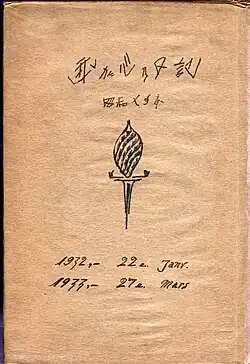
Maddox stresses that Yamamoto framed political engagement as a matter of personal freedom rather than programmatic activism: in a 1932 diary entry he wrote that he was "not the kind of person who can be a social activist," and turned instead to art as his mode of resistance.[242] During the war he severed ties with the Nagoya Photo Avant-Garde when it shifted toward propagandistic production, later defining artistic creation as arising from a "disobedient spirit" against society's ready-made realities—an autonomy Maddox characterizes as that of a "solitary photographer."[242]
In a 1941 diary entry, Yamamoto defined artistic creation as a rebellion against social ready-mades and as a prophetic force capable of setting a new era in motion:
"A work of art is born from a spirit of rebellion against something ready-made in society. That spirit should be capable of pointing toward—and setting in motion—the next new era. A pure spirit ought to be a prophetic spirit that calls in a new age. Can we still expect such intense will today—rebellion against the times, and a transformation of the will of the age?"[243]
Maddox notes that in this 1941 entry Yamamoto links this disobedience to a broader, future-oriented claim for art's intensity under social pressure, using the diary as a site to articulate Surrealism as lived conviction rather than a fashionable idiom.[87]
Character and personality
- Yoshio Shimozato described him as "a man who was, in many respects, nihilistic, tenacious, and in love with books."[244]
- He was a bibliophile and a devoted smoker, and throughout his life was rarely without books, records, and a pipe.[245]
- He received a gift of issue no. 5 of BIEF from André Breton.[131]
- In 1939, he joined the avant-garde poet group ''VOU'' led by Katsue Kitasono, and continued to publish work in ''VOU'' and participate in its exhibitions until the group dissolved in 1978.[239][246]
Collections
In the foreword to the Getty Museum's catalogue Japan's Modern Divide, museum director Timothy Potts frames Kansuke Yamamoto not as a peripheral or merely "rare" figure but as a representative of a defining, "expressive" and "modern" thread in twentieth-century Japanese photography—an artist able to think and work "globally"—set in deliberate counterpoint to Hiroshi Hamaya's "objective" and "traditional" documentary realism.[196] Potts further records that the Getty's expanded collecting of Japanese photography in the 2000s and early 2010s enabled the acquisition of rare prints by Yamamoto, and credits supporters and advisors—including Maya Ishiwata, John Solt, Stephen Wirtz, and Toshio Yamamoto—for underscoring the artist's importance and helping to identify the location of extant prints.[196] These institutional holdings provide a basis for study of Yamamoto's work across collections, spanning both Japanese and international repositories.
- Nagoya City Art Museum[247]
- Tokyo Photographic Art Museum[248]
- Santa Barbara Museum of Art[249]
- The J. Paul Getty Museum(J. Paul Getty Trust)[250][251]
- The Art Institute of Chicago[252]
- National Museum of Asian Art, Smithsonian Institution(Smithsonian's Freer | Sackler), Washington DC[253]
- Aichi Prefectural Museum of Art[254]
- The Morgan Library & Museum, New York.
- Museum of Modern Art, New York City (MoMA)[255]
Selected works in public collections
MoMA's online collection records list two works by Yamamoto available to view online.[255]
- Museum of Modern Art (MoMA)
- Icarus's Episode, 1949, Gelatin silver print, Object number 310.2025
- Oval Landscape, 1963, Gelatin silver print, Object number 311.2025
- Art Institute of Chicago
- Buddhist Temple's Birdcage, 1940, Gelatin silver print, 25.7 × 17.9 cm.[181][256]
- Heart in Motion - Shadow of Happiness, 1950, Gelatin silver print, Reference Number 2017.158
- Giving Birth to a Joke, 1956, Gelatin silver print, Credit Line: Gift of Helen and Sam Zell, Reference Number 2024.1163[257]
- J. Paul Getty Museum
- My Thin-Aired Room (空気のうすいぼくの部屋) (sequence), 1956, gelatin silver print; J. Paul Getty Museum (Los Angeles), accession no. 2009.17.12, 2009.17.13, 2009.17.14.; Maddox notes that the series presents a four-frame narrative variation on René Magritte's Man with a Newspaper (1928), which Yamamoto copied (under Julien Levy's alternate title "Now You Don't") from Levy's 1936 book Surrealism.[87]
- My Thin-aired Room(Sequence), 1956, Gelatin silver print, Object Number 2009.17.14
- My Thin-aired Room(Sequence), 1956, Gelatin silver print, Object Number 2009.17.13
- My Thin-aired Room(Sequence), 1956, Gelatin silver print, Object Number 2009.17.12
- Untitled, about 1930s, Gelatin silver print Object Number 2019.184.5
- Untitled, about 1930s, Gelatin silver print Object Number 2019.184.1
- Untitled, about 1930s, Gelatin silver print, Object Number 2019.184.6
- (Untitled) [Snow scene], 1930s, Gelatin silver print, Object Number 2009.17.1
- (Untitled) [Side of Building], 1930s, Gelatin silver print, Object Number 2009.17.2
- Untitled, about 1935, Gelatin silver print, Object Number 2014.21.1
- Untitled, 1939, Gelatin silver print, Object Number 2019.184.4
- (Untitled) [Footprint in sand], 1939, Gelatin silver print, Object Number 2009.17.3
- (Untitled) [String shapes in grass], 1939, Gelatin silver print, Object Number 2009.17.4
- Untitled, about 1940, Gelatin silver print, Object Number 2019.184.3
- (Untitled)[Hat with string], 1940, Gelatin silver print, Object Number 2009.17.5
- (Untitled) [Abstract architectural view], about 1940, Gelatin silver print, Object Number 2009.17.7
- (Untitled) [Shadow on side of building], about 1940, Sepia toned gelatin silver print, Object Number 2009.17.6
- (Untitled) [Abstract wall with hole], about 1940, Gelatin silver print, Object Number 2009.17.8
- A Chronicle of Drifting, 1949, Gelatin silver print collage, Object Number 2014.21.2
- A Certain Female Image, 1955, Gelatin silver print, Object Number 2009.17.9
- Those Who Do Not Return, 1956, Gelatin silver print, Object Number 2009.17.11
- The Origin of History, 1956, Chromogenic print, Object Number 2009.17.10
- A Forgotten Person, 1957, Gelatin silver print, Object Number 2009.17.15
- A Forgotten Person, 1958, Chromogenic print, Object Number 2009.17.16
- Requiem, 1958, Gelatin silver print, Object Number 2009.17.17
- I'd Like to Think While inside the Body of a Horse, 1964, Gelatin silver print, Object Number 2009.17.18
- Magnifying Glass, Rendez-vous, 1970, Gelatin silver print with string, Object Number 2009.17.19
- The silver platter and the pigeon in the cage, We suddenly have spring rain like typefaces today. Cioran, I may talk to you again someday., 1979, Hand-colored ferrotyped gelatin silver print collage, Object Number 2009.17.20
- My Thin-Aired Room (空気のうすいぼくの部屋) (sequence), 1956, gelatin silver print; J. Paul Getty Museum (Los Angeles), accession no. 2009.17.12, 2009.17.13, 2009.17.14.; Maddox notes that the series presents a four-frame narrative variation on René Magritte's Man with a Newspaper (1928), which Yamamoto copied (under Julien Levy's alternate title "Now You Don't") from Levy's 1936 book Surrealism.[87]
- National Museum of Asian Art, Smithsonian Institution[253]
- Untitled (little man collage), 1932-1933, Gelatin silver print collage, Accession Number S2018.2.329
- Untitled (sea egg/distant horizon), 1938, Gelatin silver print, Accession Number S2018.2.330
- Stapled Flesh, 1949, Gelatin silver print, Credit Line: Purchase and partial gift from the Gloria Katz and Willard Huyck Collection — Acquisition fund in honor of Julian Raby, director emeritus of the National Museum of Asian Art,[258] Accession Number S2018.2.331
- Cold Person (torso with extrusions), 1956, Gelatin silver print, Accession Number S2018.2.332
- Magnifying Glass, Rendez-vous (clouds and thread), 1970, Gelatin silver print with cotton thread, Accession Number S2018.2.333
- Santa Barbara Museum of Art
- Untitled (fence and wall), ca. 1930s, gelatin silver print, Credit Line: SBMA, Museum Purchase with funds provided by the Wallis Foundation , Object number 2006.57.4
- Untitled (wall with window), 1940, gelatin silver print, Object number 2006.61.3
- Untitled (fields and sewing machine), ca. 1950, gelatin silver print, Object number 2006.57.8
- Nagoya City Art Museum
- Development of a Man's Thought…Mist and Bed Room, 1932, gelatin silver print, Reference Number 2009.08.056.001
- [Shadow], 1932–33, gelatin silver print, Reference Number 2009.08.049.001
- [Nude on the Beach], 1938, gelatin silver print, Reference Number 2009.08.053.001
- [Variation of "Buddhist Tempie's Bird cage"], 1940, gelatin silver print, Reference Number 2009.08.052.001
- [Bed Seats], 1940, gelatin silver print, Reference Number 2009.08.050.001
- [Hat], 1940, gelatin silver print, Reference Number 2009.08.051.001
- Work, 1950, gelatin silver print, Reference Number 2009.08.055.001
- Work, 1956, gelatin silver print, Reference Number 2009.08.054.001
- Aichi Prefectural Museum of Art
- Gentle Resource (やさしい回帰), 1948, gelatin silver print, Accession number JF201900001000
- Tokyo Photographic Art Museum
- (Object of Hat), 1930, gelatin silver print, Accession number 10113557
- (Bathroom Shelf and Chair) , 1935, gelatin silver print, Accession number 10113562
- (Soil wall), 1935-1944, gelatin silver print, Accession number 10113555
- (Glassy plain and cloth), 1940, gelatin silver print, Accession number 10113556
- (Art object of lattice), 1950, gelatin silver print, Accession number 10113559
- Photogram, 1950, gelatin silver print, Accession number 10113563
- (Portrait of wife), 1950, gelatin silver print, Accession number 10113561
- Madam Q, 1950, gelatin silver print, Accession number 10113554
- (Nude), 1954, gelatin silver print, Accession number 10113560
- (Art object of circle), 1954, gelatin silver print, Accession number 10113558
Archival and related materials
In addition to photographs held in museum collections, materials related to Yamamoto are preserved in literary, library, and municipal repositories. Original issues 1–4 of Yoru no Funsui, the Surrealist journal edited and published by Yamamoto, are held by the Museum of Modern Japanese Literature.[259] Nagoya City also holds Yamamoto-related materials, including Yoru no Funsui, postcards by Yamamoto, and the Nagoya mamehon series Butterfly; the listed storage location for these materials is the Cultural Path Futaba Museum in Nagoya.[73] The National Diet Library holds Yamamoto's book Butterfly as well as periodicals and related publications associated with his activities, including VOU.[260][261]
Exhibitions

Selected major museum and survey exhibitions
Yamamoto's work has been included in major museum survey exhibitions in the United States, Europe, and Japan, including:
- 2021–2022 Surrealism Beyond Borders — The Metropolitan Museum of Art, New York (11 Oct 2021–30 Jan 2022);[185] Tate Modern, London (24 Feb–29 Aug 2022).[171]
- 1960 The Sense of Abstraction — The Museum of Modern Art (MoMA), New York, United States.
- 2018 Shape of Light: 100 Years of Photography and Abstract Art — Tate Modern, London, United Kingdom.[262]
- 2013 Japan's Modern Divide: The Photographs of Hiroshi Hamaya and Kansuke Yamamoto — J. Paul Getty Museum, Los Angeles, United States.[262]
- 2012–2013 Drawing Surrealism — Los Angeles County Museum of Art (LACMA); The Morgan Library & Museum.[263][264][265]
- 2003 The History of Japanese Photography — The Museum of Fine Arts, Houston, U.S.A.[266]
- 2007 Living in the Material World -'Things' in Art of the 20th Century and Beyond — The National Art Center, Tokyo, Japan[266]
- 2025–2026 Cut + Paste: Experimental Japanese Prints and Photographs — National Museum of Asian Art, Smithsonian Institution, United States.[267][268][269]
Exhibitions (chronological)
- 1936 Personal Exhibition / Maruzen Gallery, Nagoya, Japan[7]
- 1939 "The Blue Wonder Association Exhibition" / Maruzen Gallery, Nagoya, Japan[7]
- 1948 – 1950 "VIVI" / Maruzen Gallery, Nagoya, Japan[7]
- 1949 "Modern Art" / Mitsukoshi Gallery, Nihonbashi, Japan[7]
- 1949 – 1954 "Bijyutsu Bunka Art Association Exhibition" / Tokyo Metropolitan Art Museum etc.[7]
- 1952 "Photographers of Figurative art" / Aoyanagi-Hirokoji-Ten, Nagoya, Japan[7]
- 1953 "Mado(Windows)" / Nagoya, Kobe, Japan[7]
- 1953 "Abstraction and Fantasy: How to Understand Non-figurative (Non-realistic) Painting" / National Museum of Modern Art, Tokyo[7]
- 1956 – 1961 "Honoo(Flame)" / Konica Gallery(Konica Minolta Plaza), Tokyo, Osaka, and Nagoya, Japan[7]
- 1956 "International Subjective Photography" / Takashimaya Gallery, Nihonbashi, Japan[7]
- 1956 Personal Exhibition / Matsushima Gallery, Ginza, Japan[7]
- 1956 Personal Exhibition / Maruzen Gallery, Nagoya, Japan[7]
- 1957 Personal Exhibition / Konica Gallery(Konica Minolta Plaza), Fukuoka, Japan[7]
- 1957 – 1976 "VOU Exhibition" / Kunugi Gallery, Ginza, Tokyo, Japan etc.[7]
- 1957 "Modern Art Photography Group" / Kunugi Gallery, Ginza, Tokyo, Japan[7]
- 1958 "ESPACE" / Maruzen Gallery, Nagoya, Japan[7]
- 1958 "Exhibition of Japan Subjective Photography" / Fuji Photo Salon(FUJIFILM Photo Salon), Tokyo, Japan[7]
- 1958 Acute Angle Black Button (16–20 December), galerie-librairie Mimatsu (Mimatsu Shobō Gallery), Tokyo, Japan; advertised in the exhibition leaflet under the title "The Vanguard of Photography and Poetry".[270]
- 1958 "The Vanguard of Photography and Poetry" / Mimatsu Publishing, Inc. Gallery, Tokyo, Japan[7]
- 1960 "The Sense of Abstraction" / The Museum of Modern Art (MoMA), New York CityA.[7]
- 1960 "Subjective Photography" / Konica Gallery(Konica Minolta Plaza), Tokyo, Japan
- 1963 "Shusen Kai"[7]
- 1963 – 1964 "Nagoya Five" / Fuji Photo Salon(FUJIFILM Photo Salon), Tokyo, etc.[7]
- 1968 "VERB" / Aichi Prefectural Museum of Art, Japan[7]
- 1978 – 1982 "The Exhibition of The Committee of The Chubu Headquarter of The All-Japan Association of Photographic Societies" / Aichi Prefectural Museum of Art, Japan[7]
- 1983 "Pictures of Yamamoto Kansuke" / New French School, Nagoya, Japan[7]
- 1986 "Avant-Garde Photography, Italy and Japan / The Contemporary Art Gallery, Seibu Department Stores, Ikebukuro, Tokyo, Japan[7]
- 1986 "VOU" / Rhode Island School of Design Museum[7]
- 1988 "The Art of Modern Japanese Photography" / Two Houston Center[7]
- 1988 "Surrealist Kansuke Yamamoto Exhibition" / IMAGINATION MARKET Q&P, Ginza, Tokyo, Japan[7]
- 1988 "The 150 years of Fine Art Photography – France, Japan, America" / Tsukashin Hall, Amagasaki, Hyogo, Japan[7]
- 1988 "Fine Art Photography in Japan 1920's – 1940's" / Konica Plaza(Konica Minolta Plaza), Shinjuku, Tokyo, Japan[7]
- 1988 "Japanese Photography in 1930s" / The Museum of Modern Art, Kamakura, Japan[7][271]

- 1989 "Avant-Garde Photography of Nagoya" / Nagoya City Art Museum, Japan[7][272]
- 1990 "The Silent Dialogue: Still Life in the West and Japan" / Shizuoka Prefectural Museum of Art, Japan[7]
- 1990 "Surrealism in Japan" / Nagoya City Art Museum, Japan[7]
- 1990 "Modernism in Nagoya 1920's – 1930's" / INAX Gallery, Nagoya, Japan[7]
- 1995 "The Founding and Development of Modern Photography in Japan" / Tokyo Metropolitan Museum of Photography, Japan[7]
- 1995 "The Age of Modernism" / Tokyo Metropolitan Museum of Photography, Japan
- 1995 "Collage, A Method of Contemporary Art" / Nerima Art Museum, Japan[7]
- 2001 "Modern Photography in Japan 1915–1940" / Ansel Adams Gallery, San Francisco, U.S.A.[273]
- 2001 "Yamamoto Kansuke: Conveyor of the Impossible" / Tokyo Station Gallery, Japan[274]

- 2003 "The History of Japanese Photography" / The Museum of Fine Arts, Houston, U.S.A.[275][276]
- 2003 "The History of Japanese Photography" / Cleveland Museum of Art, Ohio, U.S.A.[266]
- 2004 "Provincial Fine Arts" / Nagoya City Art Museum, Aichi, Japan[262]
- 2005 "How Photography changed People's Viewpoints" / Tokyo Metropolitan Museum of Photography, Japan[262]
- 2006" Kansuke Yamamoto" / Stephen Wirtz Gallery、San Francisco, U.S.A.[277]
- 2006 "Curators' Choice from The Collection of Tokyo Metropolitan Museum of Photography" / Tokyo Metropolitan Museum of Photography, Japan[262]
- 2006 "Collage and Photomontage" / Tokyo Metropolitan Museum of Photography, Japan[262]
- 2006 "The Art of ‘Nagoya' – So Far and From Now On" / Nagoya City Art Museum, Aichi, Japan[262]
- 2006 "The World of Yamamoto Kansuke" / Doshisha University, Tokyo office[278]
- 2007 "The New Modern: Pre- and Post-War Japanese Photography" / Santa Barbara Museum of Art, Santa Barbara, U.S.A.[279][280]
- 2007 "Master the Museum's Collection" / Nagoya City Art Museum, Japan[262]
- 2007 "Living in the Material World -'Things' in Art of the 20th Century and Beyond" / The National Art Center, Tokyo, Japan[262]
- 2008 "Surrealism and Photography -BEAUTY CONVULSED-" / Tokyo Metropolitan Museum of Photography, Japan[262]
- 2009 "20 Years of Nagoya City Art Museum" / Nagoya City Art Museum, Japan[262]
- 2010 "Master the Secrets of Museum's Collection" / Nagoya City Art Museum, Japan[262]
- 2012 "Drawing Surrealism" / Los Angeles County Museum of Art (LACMA), Los Angeles, U.S.A.[262][184]
- 2012 "Japan ・ Object 1920's – 70's" / Urawa Art Museum, Saitama, Japan[262]

- 2013 "Drawing Surrealism" / The Morgan Library & Museum, New York CityA.[262][281][183]
- 2013 "Japan's Modern Divide: The Photographs of Hiroshi Hamaya and Kansuke Yamamoto" / The J. Paul Getty Museum, Los Angeles, U.S.A.[273][282]
- 2014 "Enjoy the Art World −with your loved one" / Nagoya City Art Museum, Japan[266]
- 2015 "1940s -Rediscovery of 20th Century Japanese Art" / Mie Prefectural Art Museum, Japan[266]
- 2015 Paris Photo 2015(amanasalto) / Grand Palais, Paris, France[283]

- 2016 Art Central Hong Kong(amanasalto), Hong Kong[284]
- 2016 "Kansuke Yamamoto" / Taka Ishii Gallery New York, New York City[285]
- 2016 Art Basel (Taka Ishii Gallery), Basel, Switzerland[286]
- 2016 Frieze London, Frieze Art Fair (Taka Ishii Gallery), London, England[286]
- 2016 Paris Photo 2016(Taka Ishii Gallery) / Grand Palais, Paris, France[286]
- 2016 "BLACK SUN/RED MOON" / RATIO 3, San Francisco, U.S.A.[287]
- 2016 Japanese Photography from Postwar to Now — San Francisco Museum of Modern Art (SFMOMA), San Francisco (15 Oct 2016–12 Mar 2017; Floor 3). The exhibition highlighted SFMOMA's holdings of Japanese photography, including works associated with the Kurenboh Collection donation.[266][288]
- 2017 "Kansuke Yamamoto" / Taka Ishii Gallery Photography / Film, Roppongi, Tokyo[266]
- 2017 Group Exhibition "Japanese Surrealist Photography" / Taka Ishii Gallery Tokyo, Roppongi, Tokyo[289]
- 2017 Art Basel Hong Kong (Taka Ishii Gallery) / Hong Kong[289]
- 2017 "Kansuke Yamamoto" / Taka Ishii Gallery New York, New York City[290]
- 2017 SP-Arte (Taka Ishii Gallery) / Fundação Bienal de São Paulo, São Paulo, Brazil[291]
- 2017 Art Basel (Taka Ishii Gallery) / Basel, Switzerland[292]
- 2017 Frieze London, Frieze Art Fair (Taka Ishii Gallery), London, England[292]
- 2017 Paris Photo 2017(Taka Ishii Gallery) / Grand Palais, Paris, France[292]
- 2018 "THE MAGAZINE and THE NEW PHOTOGRAPHY: KOGA and JAPANESE MODERNISM." / Tokyo Photographic Art Museum[262]
- 2018 "SHAPE OF LIGHT 100 YEARS OF PHOTOGRAPHY AND ABSTRACT ART" / Tate Modern, London, England[266][293]
- 2018 "Kansuke Yamamoto" / Taka Ishii Gallery New York, New York City[246]
- 2018 "Kansuke Yamamoto" / Nonaka-Hill, Los Angeles[225]
- 2019 Homage to the Bauhaus / Djanogly Gallery, Nottingham Lakeside Arts Centre, Nottingham, England, UK[262]
- 2019 "Aichi Art Chronicle 1919-2019" /Aichi Prefectural Museum of Art, Nagoya, Aichi[294]
- 2019 "Japanese Photography – 1930s - 1970s" / Mai 36 Galerie, Zurich, Switzerland[266]
- 2019 Art Basel Hong Kong 2019[295]
- 2021 "The Movement Of Modern Photography In Nagoya 1911-1972" / Nagoya City Art Museum, Japan[296]
- 2021 "From the museum collection 2021: second period" / Aichi Prefectural Museum of Art[297]
- 2021 "Surrealism Beyond Borders" / Metropolitan Museum of Art, New York[298]
- 2022 "Surrealism Beyond Borders" / Tate Modern, London[299][298]
- 2022 "Going Global: Abstract Art at Mid-Century" / Santa Barbara Museum of Art, Santa Barbara, California, United States.[266]
- 2022 "Avant-Garde Rising: The Photographic Vanguard in Modern Japan" / Tokyo Metropolitan Museum of Photography, Japan[300]
- 2022 Paris+ par Art Basel / Grand Palais, Paris, France[208]
- 2023-'24 Surrealism and Japan / Museum of Kyoto, Itabashi Art Museum, Mie Prefectural Art Museum[301][302]
- 2024 Foreign Exchange: Photography between Chicago, Japan, and Germany, 1920–1960 / Art Institute of Chicago, Chicago, USA[163]
- 2024 Nagoya Modernism Poetry Exhibition II: From Modernism to Surrealism / Cultural Path Futaba Museum, Nagoya, Japan[303]
- 2024 Paris Photo 2024 (Michael Hoppen Gallery booth)[304]
- 2024-'25 KANSUKE YAMAMOTO / Michael Hoppen Gallery, London[305]
- 2025 The Legacy of Avant-garde Photography in Nagoya, 1930s–50s Keiichiro Goto, Minoru Sakata, Minayoshi Takada, Tsugio Tajima, Yoshifumi Hattori, Kansuke Yamamoto 1930s–1950s, MEM, Tokyo[306]
- 2025 BUTSUDORI :The Photographic Expression of "Object" / Shiga Museum of Art[307]
- 2025-2026 "Enduring Visions: From Van Gough to Today" / Ulsan Art Museum, Korea[308]
- 2025-2026 "Cut + Paste: Experimental Japanese Prints and Photographs" / National Museum of Asian Art, Smithsonian Institution, Washington, D.C., USA[267][268][269]
Solo exhibition catalogues
- "YAMAMOTO Kansuke : Conveyor of the Impossible", John Solt and Kaneko Ryuichi, East Japan Railway Culture Foundation, 2001
- "YAMAMOTO KANSUKE" STEPHEN WIRTZ GALLERY SAN FRANCISCO 2006
- Japan's Modern Divide: The Photographs of Hiroshi Hamaya and Kansuke Yamamoto (2013); Edited by Judith Keller & Amanda Maddox, with contributions by Kotaro Iizawa, Ryuichi Kaneko, Jonathan Reynolds, John Solt; published by The J. Paul Getty Museum
- "Kansuke Yamamoto", Ryuichi Kaneko, Taka Ishii Gallery, 2017
- ''Kansuke Yamamoto''. Text by Lucy Fleming-Brown. London: Guiding Light, 2024. Michael Hoppen Gallery.
Publications by Kansuke Yamamoto

Author: Kansuke Yamamoto
In 1970, he published Butterfly, described by Taka Ishii Gallery as his only book-length publication.[290]
- Kansuke Yamamoto, "Yoru no Funsui", 1938–[7]
- Kansuke Yamamoto, "Batafurai (Butterfly)", Nagoya Miniature Books Publishing, 1970[7]
Selected works
Several of Yamamoto's best-known images have been discussed in the literature through explicit one-to-one comparisons with canonical works of European Surrealism, a framing that clarifies how his practice functions through allusive variation rather than stylistic emulation. Maddox, for example, presents My Thin-Aired Room (1956) as a four-image variation on Magritte's Man with a Newspaper (1928), reads Sleepy Sea (1953) in direct dialogue with Magritte's The Reckless Sleeper (1928), and describes Madam Q (1950) as a close compositional analogue to Man Ray's La tête (1931).[87]
- The Developing Thought of a Human... Mist and Bedroom and, 1932, collage, and gelatin silver print. — Collection of Nagoya City Art Museum.[309][278]
- My Thin-Aired Room, 1956, Gelatin silver print, 34.9 × 42.9 cm.[309][278]
- My Thin-Aired Room, 1956, Gelatin silver print, 35.2 × 42.2 cm.[309][278]
- My Thin-Aired Room, 1956, Gelatin silver print, 35.4 × 43 cm.[309][278]
- My Thin-Aired Room, 1956, Gelatin silver print, 35.2 × 42.9 cm.[309][278] — Collection of the J. Paul Getty Museum[310]
- Iizawa highlights the four-image "sequence" as a rare Japanese example of constructed serial narrative, made more than a decade before Duane Michals' late-1960s sequence works.[87][18]
- Maddox argues the suite structurally reworks Magritte's "vanishing figure" logic into a four-part narrative of progressive absence.[87]
- Icarus's Episode, 1949, Gelatin silver print, 9 13/16 × 7 3/8" (24.9 × 18.7 cm)[309][278] — held by the Museum of Modern Art (object no. 310.2025), listed as a 2025 acquisition.[200]
- Buddhist Temple's Birdcage, 1940, Gelatin silver print, 25.7 × 17.9 cm.[309][278] — shown in Surrealism Beyond Borders (The Met / Tate) and held by the Art Institute of Chicago.[181][311]
- Variation of "Buddhist Temple's Birdcage", 1940, Gelatin silver print, 30.2 × 24.8 cm. Collection of Nagoya City Art Museum.[309][278] — exhibited in Surrealism Beyond Borders (The Met / Tate) and held by the Nagoya City Art Museum.[181]
- The Thrilling Game Related to Photography (1956) — presented in Tate's Shape of Light materials as an object-photograph incorporating glass (Jack Kirkland Collection loan).[312]
- Untitled (sea egg/distant horizon), 1938, Gelatin silver print. Collection of National Museum of Asian Art, Smithsonian Institution — reviewing ''Drawing Surrealism'', Roberta Smith notes Yamamoto's works "combine drawing, collage and rephotography," framing them as inventive riffs rather than straightforward imitation.[182][269]
- Sleepy Sea, 1953, Gelatin silver print, 27.6 × 31.0 cm.[309][278]
- Maddox reads the work as a deliberate Surrealist dialogue with René Magritte, adapting the motif within postwar Japanese conditions.[87]
- Madam Q , 1950, Gelatin silver print on developing-out paper, 25.4×22.8 cm — Collection of the Tokyo Photographic Art Museum[313]
- View with a Ship Passing Through, 1940, Collage, 24.5 × 30.3 cm. Private collection.[309][278]
- Maddox emphasizes Yamamoto's physical cut-outs/apertures and reads its interval as resonant with the Japanese concept of ''ma''.[87]
- Title Unknown (c. 1938), 25.2 × 17.7 cm. Collection of the Tokyo Photographic Art Museum — Solt cites Yamamoto's numbered public-bathhouse lockers as a key example of Surrealist technique applied to specifically Japanese subject matter.[224]
- Title Unknown (1940), 24.4 × 29.6 cm — Solt likewise cites the "futon piled ten high" in a field as a vernacular Japanese Surrealist motif.[224]
- Title Unknown (c. 1940), 28.0 × 22.3 cm — Solt cites the torn-paper shōji panels as another emblematic Japanese subject treated through Surrealist procedure.[224]
- Reminiscence, 1953, gelatin silver print. Collection of Anne and David Ruderman.[309][278]— A vintage print was reproduced as pl. 70 in the Getty Museum catalogue Japan's Modern Divide (2013).[197] Sotheby's catalogue note interprets the burned, empty birdcage over a city view as evoking postwar devastation and the atomic aftermath, while suggesting a note of hope because no bird is trapped inside.[197]
- A Forgotten Person, 1957, Kansuke Yamamoto, gelatin silver print. Collection of the J. Paul Getty Museum.[278] — Masachika Tani discusses A Forgotten Person as a five-image sequence in which a female figure gradually changes and disappears.[126]


- A Forgotten Person, 1958, Kansuke Yamamoto, chromogenic print, 46.2 × 33.0 cm. Collection of the J. Paul Getty Museum.[309][278]
- Title Unknown (Hat with string), 1940 — held by the Getty; often situated within Surrealist vocabularies of displaced accessories in museum/survey framings.[176][229]
- Title unknown, 1933, Kansuke Yamamoto, Gelatin silver print, 25.2 × 30.0 cm. Private collection.[309][278]
- Buriru (BRILLE), 1938, Kansuke Yamamoto, gelatin silver print, 29.6 × 24.1 cm. Private collection; entrusted to the Tokyo Photographic Art Museum.[314]
- Title unknown, 1938, Kansuke Yamamoto, Gelatin silver print, 18.7 × 24.5 cm. Collection of Gloria Katz and Willard Huyck.[309][278]
- Title unknown, 1938, Kansuke Yamamoto, Gelatin silver print, 15.9 × 24.6 cm. Collection of Nagoya City Art Museum.[309][278]
- Title unknown, 1939, Kansuke Yamamoto, Gelatin silver print, 24.4 × 29.6 cm.[309][278]
- Untitled, ca. 1930s, Kansuke Yamamoto, Gelatin silver print, 43.8 × 36.2 cm. Collection of Daniel Greenberg and Susan Steinhauser.[309][278]
- Self-Portrait, 1940, Kansuke Yamamoto, Gelatin silver print, 46. × 56.4 cm. Private collection.[309][278]
- Title unknown, ca. 1940s, Kansuke Yamamoto, Gelatin silver print, 25.2 × 17.7 cm.[309][278]
- Stapled Flesh, 1949, Kansuke Yamamoto, gelatin silver print, 31.1 × 24.8 cm. Collection of the National Museum of Asian Art, Smithsonian Institution.[315][309][278]
- A Chronicle of Drifting, 1949, Kansuke Yamamoto, Collage, 30 × 24.8 cm. Collection of The J.P.Getty Museum.[309][278]

- Self-Portrait, 1949, Kansuke Yamamoto, Gelatin silver print, 25.2 × 17.9 cm. Private collection.[309][278]
- Scenery with Ocean, 1949, Kansuke Yamamoto, Gelatin silver print, 27.0 × 18.4 cm.[309][278]
- Dream Passage, 1949, Kansuke Yamamoto, Gelatin silver print, 30.0 × 24.9 cm.[309][278]
- Floating City, 1950, Kansuke Yamamoto, Gollage, 15.7 × 22.4 cm. Private collection.[309][278]
- Isamu Noguchi, 1950, Kansuke Yamamoto, Gelatin silver print, 23.4 × 18.2 cm.[309][278]
- Gorgeous Departure, 1950, Kansuke Yamamoto, 27.8 × 22.7 cm.[309][278]
- Relaxation Season, 1953, Kansuke Yamamoto, Gelatin silver print, 27.5 × 22.9 cm. Private collection.[309][278]
- Giving Birth to a Joke, 1956, Kansuke Yamamoto, Gelatin silver print, 42.5 × 55.6 cm. Private collection.[309][278]
- Rose and Shovel, 1956, Kansuke Yamamoto, Gelatin silver print, 31.9 × 34.9 cm. Private collection.[309][278]
- The Distance between the Landscape and the Dusk, 1956, Kansuke Yamamoto, Chromogenic print, 31.9 × 34.9 cm.[309][278]
- Beautiful Passerby 1956,Kansuke Yamamoto, Chromogenic print[309][278]
- The Man Who Went Too Far, 1956, Kansuke Yamamoto, Gelatin silver print.[309][278]
- Cold Person, 1956, Kansuke Yamamoto, Gelatin silver print, 43.8 × 36.2 cm. Collection of Gloria Katz and Willard Huyck.[309][278]
- From the series of "Obaku", 1956, Kansuke Yamamoto.[309][278]
- The Origin of History, 1956, Kansuke Yamamoto, Chromogenic print, 52.5 × 47.8 cm.Collection of J. Paul Getty Museum.[309][278]
- The Closed Room, 1958, Kansuke Yamamoto, Gelatin silver print, 35.9 × 45.0 cm.[309][278]
- (The hard, cobalt desert...), 1958, Kansuke Yamamoto.[309][278]
- My Bench, 1963, Kansuke Yamamoto.[309][278]
- I'd Like to Think While in the Body of a Horse, 1964, Kansuke Yamamoto, Gelatin silver print, 22.7 × 18.1 cm. Collection of J. Paul Getty Museum.[309][278]
- Suddenly in the Morning, 1968, Kansuke Yamamoto.[309][278]
- Magnifying Glass, Rendezvous, 1970, Kansuke Yamamoto.[309][278]
- Butterfly, 1970, Kansuke Yamamoto.[309][278]
- The silver platter and the pigeon in the cage, / We suddenly have spring rain like typefaces today. / Cioran, / I may talk to you again someday, 1979, Kansuke Yamamoto.[309][278]
- Under rose flowers of exploding black gunpowder / Girl flutters her braided hair running to the plaza / Dawn laughs out loud swaying its shoulders, 1983, Kansuke Yamamoto.[309][278]
Lineage
The Yamamoto family is said to trace its ancestry to Ōe no Sadaoku (died 1334), a chūnagon (middle counselor) who was exiled to Kire-no-shō in Mino Province in 1332, described as a descendant of Ōe no Otodo and Ōe no Hiromoto, when Emperor Go-Daigo's plot to overthrow the Kamakura shogunate was exposed and the emperor was banished to Oki Island. His descendants are said to have adopted the surname Yamamoto.[316]
According to tradition, Yamamoto Kansuke(general), the military strategist of Takeda Shingen, was an eleventh-generation descendant of Sadaoku. He is said to have been the younger brother of Yamamoto Kazuma Sadamasa, a close retainer of Toki Yorinari, Governor of Mino Province, and the son of Yamamoto Kojirō Sadamitsu, who was reportedly adopted for a time by Fuwa Mitsuharu, lord of Kawaushi Castle.[316]
Sadaoku's son, Ōe no Sadamoto—also known as Yamamoto Hangan Sakuramachi Chūnagon—is mentioned in the Taiheiki in connection with the Battle of Yoshino. Kire-no-shō is located in present-day Ibigawa, Gifu Prefecture, and the family is said to have lived there until the mid-Meiji period, up to the generation of Yamamoto's grandfather. Kansuke Yamamoto is described as the 25th head of the main Yamamoto line descending from Sadaoku.[316][317][318][319][320]
Bibliography
Exhibition catalogues
- "The Founding and Development of Modern Photography in Japan", Tokyo Metropolitan Museum of Photography, 1995
- "Surrealism in Japan", Nagoya City Art Museum, 1990
- "Avant-Garde Photography of Nagoya", Nagoya City Art Museum, 1989
- "Yamamoto Kansuke: Conveyor of the Impossible", John Solt and Kaneko Ryuichi, East Japan Railway Culture Foundation, 2001
- "The History of Japanese Photography", Anne Wilkes Tucker, Dana Frs-Hansen II, Dana Friis-Hansen, Kaneko Ryuichi, Takeba Joe, Kotaro Iizawa, Kinoshita Naoyuki, Yale University Press, 2003
- "Drawing Surrealism", Leslie Jones, Isabelle Dervaux, Susan Laxton, Prestel Pub, 2012
- Japan's Modern Divide: The Photographs of Hiroshi Hamaya and Kansuke Yamamoto (2013); Edited by Judith Keller & Amanda Maddox, with contributions by Kotaro Iizawa, Ryuichi Kaneko, Jonathan Reynolds; published by The J. Paul Getty Museum
- "Kansuke Yamamoto", Ryuichi Kaneko, Taka Ishii Gallery, 2017
- Surrealism Beyond Borders. New York: The Metropolitan Museum of Art; distributed by Yale University Press, 2021.[181]
- ''Kansuke Yamamoto''. Text by Lucy Fleming-Brown. London: Guiding Light, 2024. Michael Hoppen Gallery.
Books
- Nagoya City Art Museum, Supervised by Hiroshi Kamiya and Minako Tsunoda, Edited by Kazuo Yamawaki, Toshihide Yoshida, Katsunori Fukaya, Satoshi Yamada, Joe Takeba, Minako Tsunoda, Akiko Harasawa and Yuko Ito, "Selected Works from the Collection of Nagoya City Art Museum", Nagoya City Art Museum, 1998
- Shigeichi Nagano, Kōtarō Iizawa, and Naoyuki Kinoshita, "Japanese Photographers Vol.15 Kiyoshi Koishi And Avant-garde Photographs", Iwanami Shoten, Publishers, 1999
- John Solt, Shredding the Tapestry of Meaning: The Poetry and Poetics of Kitasono Katue (1901–1978), Harvard University Press, 1999
- Tokyo Metropolitan Museum of Photography, "328 Outstanding Japanese Photographers", Tankosha, 2000
- John Solt(Translator: Tetsuya Taguchi)Edited by: Shūji Takashina, Takayuki Kojima, Ryōsuke Ōhashi, Yūko Tanaka, Noriko Hashimoto, 'On Kansuke Yamamoto', "The Aesthetics of Japan", Vol.35, Toei-sha,2002
- Kazumiki Chiba, ‘YAMAMOTO Kansuke : Conveyor of the Impossible',"Exhibition Catalogues in the Age of Cross – Cultural and Cross-Genre Studies", Edited by Eiko Imahashi, 2003
- Kotaro Iizawa, "From Eyes to Eyes, Walking Through Photo Exhibitions, 2001–2003", Misuzu Shobo, 2004
- Tetsuya Taguchi, "World of Kansuke Yamamoto, A World-class Photographer", Doshisha, 2005
- Satomi Fujimura, "An Introduction to the History of Photography, Section Two: CREATION, The Opening of Modern Age", Shinchosha, 2005
- Teruo Ishihara, "RAVINE – Poem & Prose Little Anthology", Silver Paper Pub. Kyoto, 2011
- Kotaro Iizawa, Nobuo Ina, John Szarkowski and Etsuro Ishihara, "The Tales of Syashin (the first volume):Words by Japanese Photographers 1889–1989", aurastudio, 2012
- Kotaro Iizawa, "Deep Insight! 100 Super Masterpieces of Japanese Photographs", Pie Books, 2012
- Majella Munro, "Communicating Vessels: The Surrealist Movement in Japan 1925–70", Enzo Arts and Publishing Limited, 2012
- Nobuzo Kinoshita, "The Lives of Prodigy of Tokai", Edited by Shoko Komatsu, Fubaisha, 2013
- Melusine n.36, Editions L'Age d'Homme, 2016 Paris.
- PARIS PHOTO BY KARL LAGERFELD. Production and printing: Steidl, 2017
- 『Kansuke Yamamoto』 Photographs and texts. Published by : Fine-Art Photography Association Tokyo 2017
- Takeba, Jō (ed.). ''"Shashin no miyako" monogatari: Nagoya shashin undōshi 1911–1972'' (「「写真の都」物語 名古屋写真運動史 1911-1972」). Tokyo: Kokusho Kankōkai, 2021. ISBN 978-4-336-07198-9.
Articles
- Taylor Mignon, "A ‘subversive' finally brought in from the cold", The Japan Times, 15 August 2001
- John Solt, "Perception, Misperception, Nonperception", Milk Magazine, 2005
- REAR, 'Rediscovery:The History of Photograph of Nagoya', Rear, Vol.14, 2006
- Alissa J. Anderson, "Before and After the Bomb", Santa Barbara Independent, 1 February 2007
- Suzanne Muchnic, "At the Getty, a focus on Asian photographs", Los Angeles Times, 15 April 2009
- Roberta Smith, "Squiggles From the Id or Straight From the Brain", The New York Times, 24 January 2013
- Ánxel Grove, "Exhiben a Hamaya y Yamamoto, dos deslumbrantes fotógrafos japoneses de principios del XX", 20 minutos, 2013
- "Why Japanese Art Shows Are Taking Over New York Right Now", Vougue Japan. Feb. p. 281.
- Claire O'neill, "Japanese Photography: A Tale Of Two Artists", National Public Radio, 12 March 2013
- Marc Haefele, "PHOTOS: Realism meets Surrealism in Getty Japanese photography exhibit", Southern California Public Radio, 27 March 2013
- Richard B. Woodward, "The Realist and the Surrealist", The Wall Street Journal, 3 April 2013
- Meher McArthur, "Japan's Photographer Reflect the Realities of a Changing World", Southern California Cultural Journal, KCET, 18 April 2013
- Lauren Russell, "A surreal take on 20th-century Japan", CNN Photos – CNN.com blogs, 6 May 2013
- Danielle Sommer, "From Los Angeles: Japan's Modern Divide" Archived 8 August 2020 at the Wayback Machine, Art Practical, 6 May 2013
- Bondo Wyszpolski, "Japan's Modern Divide: the Photographs of Hiroshi Hamaya and Kansuke Yamamoto", Easy Reader, 12 May 2013
- Catherine Wagley, "Japan's Modern Divide: the Photographs of Hiroshi Hamaya and Kansuke Yamamoto", photograph, 28 May 2013
- Smith, Douglas F., "Japan's Modern Divide: The Photographs of Hiroshi Hamaya and Kansuke Yamamoto", Library Journal;15 June 2013, Vol. 138 Issue 11, p88, 2013
- Leah Ollman, "2 Japanese photographers, 2 cultural camps at Getty Museum", Los Angeles Times, 22 June 2013
- Colin Pantall, "Japan's Modern Divide: the Photographs of Hiroshi Hamaya and Kansuke Yamamoto" Archived 2 November 2023 at the Wayback Machine, photo-eye Blog, 18 July 2013
- Akiko Horiyama, "Salad Bowl: Surreal Japan", Mainichi Shimbun, 19 August 2013
- Eiko Aoki, "The Pacific Rim Divide of "Japan's Modern Divide", Trans-Asia Photography Review, Hampshire College, Volume 4, Issue 1: Archives, Fall 2013
- Eiko Aoki, "Behind the Folding Screen of "Japan's Modern Divide" An interview with the curators of the Getty Museum's Hiroshi Hamaya and Kansuke Yamamoto Photo Exhibit", Kyoto Journal, vol.79, 23 February 2014
- Montse Álvarez, "Con Kansuke Yamamoto en la penumbra de lo real", ABC Color, 11 May 2014
- David Belcher "A Prehistoric Sculpture Inspires a Tokyo Gallery". The New York Times., 2022-10-19
Television and Videos
- Sunday Museum(Nichiyo Bijutsukan), NHK
- SoCal Japan News Digest[link removed], 6 April 2013, UTB Hollywood
See also
- History of photography/Japanese photographers
- List of Japanese photographers
References
- ↑ "山本悍右 年譜" [Yamamoto Kansuke Chronology]. 写真展 シュルレアリスト 山本悍右 不可能の伝達者 [Kansuke Yamamoto: Surrealist, Conveyor of the Impossible] (in Japanese). Tokyo: Tokyo Station Gallery. 2001. p. 198.
- 1 2 3 "Kansuke Yamamoto". J. Paul Getty Museum. Retrieved 14 February 2026.
- 1 2 "Kansuke YAMAMOTO". Taka Ishii Gallery. Retrieved 14 February 2026.
- 1 2 3 4 5 6 7 8 9 10 11 Kaneko, Ryūichi (2013). "The Position of Kansuke Yamamoto: Reexamining Japan's Modern Photography". In Keller, Judith; Maddox, Amanda (eds.). Japan's Modern Divide: The Photographs of Hiroshi Hamaya and Kansuke Yamamoto. Los Angeles: Getty Publications. pp. 166–173. ISBN 9781606061329.
- 1 2 3 4 5 6 7 Maddox, Amanda (2013). "Disobedient Spirit: Kansuke Yamamoto and His Engagement with Surrealism". In Keller, Judith; Maddox, Amanda (eds.). Japan's Modern Divide: The Photographs of Hiroshi Hamaya and Kansuke Yamamoto. The J. Paul Getty Museum. pp. 180–203. ISBN 9781606061329.
- 1 2 Solt, John (2013). "Translator's Note". In Keller, Judith; Maddox, Amanda (eds.). Japan's Modern Divide: The Photographs of Hiroshi Hamaya and Kansuke Yamamoto. Getty Publications. p. 175. ISBN 978-1606061329.
- 1 2 3 4 5 6 7 8 9 10 11 12 13 14 15 16 17 18 19 20 21 22 23 24 25 26 27 28 29 30 31 32 33 34 35 36 37 38 39 40 41 42 43 44 45 46 47 48 49 50 51 52 53 54 55 56 57 58 59 60 61 62 63 64 65 66 67 68 69 Yamamoto, Toshio (2001). 写真展 シュルレアリスト山本悍右:不可能の伝達者 [Surrealist Kansuke Yamamoto: Conveyor of the Impossible] (in Japanese). compiled by. Tokyo: 東日本鉄道文化財団. pp. 198–227.
- 1 2 "Biography (Kansuke Yamamoto)" (PDF). Nonaka-Hill. Retrieved 20 January 2026.
- 1 2 3 4 5 6 7 8 Stojković, Jelena (2021). "Osaka and Nagoya Photo Clubs". In D'Alessandro, Stephanie; Gale, Matthew (eds.). Surrealism Beyond Borders. New York: The Metropolitan Museum of Art. pp. 80–83. ISBN 9781588397270.
- 1 2 Munro, Majella (2012). Communicating Vessels: The Surrealist Movement in Japan, 1923–70. Cambridge: Enzo Arts and Publishing Limited. p. 193. ISBN 9781909046030.
- 1 2 Tani, Masachika (2016). "A la recherche de la surreality par la photographie : Trois photographes japonais dans la lignee surrealiste". Melusine: Cahiers du Centre de recherche sur le surrealisme (in French). XXXVI: 237. ISSN 0252-2810.
- 1 2 3 4 5 6 7 8 9 Maddox, Amanda (2013). "Disobedient Spirit: Kansuke Yamamoto and His Engagement with Surrealism". In Keller, Judith; Maddox, Amanda (eds.). Japan's Modern Divide: The Photographs of Hiroshi Hamaya and Kansuke Yamamoto. The J. Paul Getty Museum. pp. 180–203. ISBN 9781606061329.
- 1 2 3 Maddox, Amanda (2013). "Disobedient Spirit: Kansuke Yamamoto and His Engagement with Surrealism". In Keller, Judith; Maddox, Amanda (eds.). Japan's Modern Divide: The Photographs of Hiroshi Hamaya and Kansuke Yamamoto. Los Angeles: Getty Publications. pp. 200–201. ISBN 978-1-60606-132-9.
- 1 2 3 Munro, Majella (2012). Communicating Vessels: The Surrealist Movement in Japan, 1923-70. Cambridge, United Kingdom: Enzo Arts and Publishing. pp. 154–155. ISBN 978-1-909046-03-0.
- 1 2 3 4 5 6 7 "Japan's Modern Divide: The Photographs of Hiroshi Hamaya and Kansuke Yamamoto". J. Paul Getty Museum. Retrieved 14 February 2026.
- 1 2 3 4 5 6 "Kansuke Yamamoto". J. Paul Getty Museum. Retrieved 15 February 2026.
- 1 2 3 4 Keller, Judith; Maddox, Amanda, eds. (2013). "Selected chronology of Kansuke Yamamoto (Japanese, 1914–1987)". Japan's Modern Divide: The Photographs of Hiroshi Hamaya and Kansuke Yamamoto. Los Angeles: Getty Publications. pp. 214–217. ISBN 9781606061329.
- 1 2 3 4 5 6 Iizawa, Kohtaro (2012). 深読み! 日本写真の超名作100 [Deep Reading! 100 Masterpieces of Japanese Photography] (in Japanese). PIE International. p. 118. ISBN 978-4-7562-4181-8.
- 1 2 3 "Kansuke Yamamoto (section within Japan's Modern Divide)". J. Paul Getty Museum. Retrieved 15 February 2026.
- 1 2 3 4 5 6 7 8 9 10 11 Stojković, Jelena (2019). "Kansuke Yamamoto". The International Encyclopedia of Surrealism. Bloomsbury Visual Arts. pp. 387–390. ISBN 978-1-4742-2693-6.
- 1 2 3 4 Kaneko, Ryūichi (2001). "山本悍右の位置―日本近代写真を読み換えるために―". In 山本俶生; 稲田威郎; 田中晴子 (eds.). 写真展 シュルレアリスト 山本悍右 不可能の伝達者 (in Japanese). 監修: ジョン・ソルト、金子隆一. Tokyo: East Japan Railway Culture Foundation; Shukosha. pp. 15–17.
- 1 2 3 Iizawa, Kōtarō (2012). 深読み! 日本写真の超名作100 [Deep Reading! 100 Masterpieces of Japanese Photography] (in Japanese). PIE International. p. 118. ISBN 978-4-7562-4181-8.
- 1 2 "New Way of Looking at Surrealism Focusing on the Worldwide Sweep of the Movement Presented in Groundbreaking Exhibition at The Met Opening October 11". The Metropolitan Museum of Art. 28 September 2021. Retrieved 15 February 2026.
- ↑ D'Alessandro, Stephanie; Gale, Matthew (2021). "The World in the Time of the Surrealists". Surrealism Beyond Borders. New York: The Metropolitan Museum of Art. p. 26. ISBN 9781588397270.
- 1 2 3 4 5 6 7 "山本悍右 年譜" [Yamamoto Kansuke Chronology]. 写真展 シュルレアリスト 山本悍右 不可能の伝達者 [Kansuke Yamamoto: Surrealist, Conveyor of the Impossible] (in Japanese). Tokyo: Tokyo Station Gallery. 2001. p. 198.
- 1 2 名古屋市美術館, ed. (1990). 日高長太郎と愛友写真倶楽部 : 芸術写真の黄金期 (in Japanese). 名古屋: 名古屋市美術館. pp. 4, 6, 82–84. NCID BA34617934.
- ↑ Kaneko, Ryūichi (2003). "The origins and development of Japanese art photography". In Tucker, Anne Wilkes (ed.). The History of Japanese Photography. New Haven: Yale University Press in association with the Museum of Fine Arts, Houston. p. 107. ISBN 9780300099256.
- 1 2 "Biography (Kansuke Yamamoto)" (PDF). Nonaka-Hill. Retrieved 20 January 2026.
- 1 2 名古屋市美術館, ed. (1990). 日高長太郎と愛友写真倶楽部 : 芸術写真の黄金期 (in Japanese). 名古屋: 名古屋市美術館. NCID BA34617934.
- ↑ Takeba, Jō (2008). 郷土の作家たち [Local artists] (PDF). Art Paper (in Japanese). Nagoya City Art Museum: 3. Retrieved 14 February 2026.
- ↑ "Kansuke Yamamoto (Apr 14–May 14, 2016)". Taka Ishii Gallery. Retrieved 20 January 2026.
- ↑ Takeba, Jō (8 February 2021). 『「写真の都」物語 名古屋写真運動史 1911-1972』 [The "Photography Capital" Story: The Movement of Modern Photography in Nagoya, 1911–1972] (in Japanese). 国書刊行会. pp. 2–3. ISBN 978-4-336-07198-9.
- 1 2 Takeba, Jō (8 February 2021). 『「写真の都」物語 名古屋写真運動史 1911-1972』 [The "Photography Capital" Story: The Movement of Modern Photography in Nagoya, 1911–1972] (in Japanese). 国書刊行会. pp. 28–31. ISBN 978-4-336-07198-9.
- 1 2 3 4 5 "2020年度年報(令和2年度)" (PDF) (in Japanese). 名古屋市美術館. p. 15. Retrieved 25 January 2026.
- ↑ "「写真の都」物語 —名古屋写真運動史:1911-1972—:artscapeレビュー|美術館・アート情報 artscape". 美術館・アート情報 artscape (in Japanese). Retrieved 20 January 2026.
- ↑ "Art Paper (Nagoya City Art Museum), no. 114" (PDF). Art Paper (in Japanese). Nagoya City Art Museum. Retrieved 20 January 2026.
- ↑ "主観主義写真における後藤敬一郎:artscapeレビュー|美術館・アート情報 artscape". 美術館・アート情報 artscape (in Japanese). Retrieved 20 January 2026.
- 1 2 3 4 5 6 7 Aoki, Eiko (2013). "The Pacific Rim Divide of "Japan's Modern Divide"". Trans Asia Photography Review. 4. doi:10.1215/215820251_4-1-108. Retrieved 20 January 2026.
- 1 2 3 Munro, Majella (2012). Communicating Vessels: The Surrealist Movement in Japan, 1923–70. Enzo Arts and Publishing Limited. pp. 90–93. ISBN 9781909046030.
- 1 2 Tani, Masachika (2016). "À la recherche de la surréalité par la photographie : Trois photographes japonais dans la lignée surréaliste". Mélusine: Cahiers du Centre de recherche sur le surréalisme (in French). XXXVI: 234. ISSN 0252-2810.
- 1 2 3 4 5 6 7 8 Iizawa, Kōtarō (2013). "Innovation in the 1930s: The Early Works of Hiroshi Hamaya and Kansuke Yamamoto". In Keller, Judith; Maddox, Amanda (eds.). Japan's Modern Divide: The Photographs of Hiroshi Hamaya and Kansuke Yamamoto. Los Angeles: Getty Publications. pp. 12–16. ISBN 978-1-60606-132-9.
- 1 2 3 "Kansuke Yamamoto". J. Paul Getty Museum. Retrieved 20 January 2026.
- 1 2 "Biography (Kansuke Yamamoto)" (PDF). Nonaka-Hill. Retrieved 20 January 2026.
- ↑ Keller, Judith; Maddox, Amanda, eds. (2013). Japan's Modern Divide: The Photographs of Hiroshi Hamaya and Kansuke Yamamoto. Los Angeles: Getty Publications. p. 214. ISBN 978-1-60606-132-9.
- ↑ Tani, Masachika (2016). "À la recherche de la surréalité par la photographie : Trois photographes japonais dans la lignée surréaliste". Mélusine: Cahiers du Centre de recherche sur le surréalisme (in French). XXXVI: 234–235. ISSN 0252-2810.
- 1 2 3 4 5 Takeba, Jō (2021). 『「写真の都」物語 名古屋写真運動史 1911-1972』. Tokyo: Kokusho Kankōkai. pp. 28–31. ISBN 978-4-336-07198-9.
- ↑ Fujimura, Satomi (7 March 2018). "新興写真とはなんだったのか" [What was Shinkō Shashin?]. In 東京都写真美術館 (ed.). 「光画」と新興写真:モダニズムの日本 [Kōga and Shinkō Shashin: Modernism in Japan] (in Japanese). 国書刊行会. pp. 198–201. ISBN 978-4-336-06252-9.
- 1 2 Takeba, Joe (2003). "The Age of Modernism: From Visualization to Socialization". The History of Japanese Photography. New Haven: Yale University Press. p. 149. ISBN 0300099258.
- ↑ Yamamoto, Toshio (2001). 写真展 シュルレアリスト山本悍右:不可能の伝達者 [Surrealist Kansuke Yamamoto: Conveyor of the Impossible] (in Japanese). Tokyo: 東日本鉄道文化財団. pp. 200–201.
- 1 2 "[ID:4930] 或る人間の思想の発展…靄と寝室と:作品情報". 名古屋市美術館 - 収蔵品データベース (in Japanese). Retrieved 23 January 2026.
- 1 2 3 4 5 6 7 8 9 10 11 12 13 14 Kaneko, Ryūichi (2013). "The Position of Kansuke Yamamoto: Reexamining Japan's Modern Photography". In Keller, Judith; Maddox, Amanda (eds.). Japan's Modern Divide: The Photographs of Hiroshi Hamaya and Kansuke Yamamoto. Los Angeles: Getty Publications. pp. 166–173. ISBN 9781606061329.
- 1 2 3 4 5 6 7 8 9 Stojković, Jelena (2020). Surrealism and Photography in 1930s Japan: The Impossible Avant-Garde. Routledge. ISBN 9781032238395.
- 1 2 3 Takeba, Jō (2021). 『「写真の都」物語 名古屋写真運動史 1911-1972』 (in Japanese). 国書刊行会. pp. 28–31. ISBN 978-4-336-07198-9.
- ↑ "Japan's Modern Divide: The Photographs of Hiroshi Hamaya and Kansuke Yamamoto". J. Paul Getty Museum. Retrieved 20 January 2026.
- ↑ "Kansuke Yamamoto". Taka Ishii Gallery. Retrieved 22 January 2026.
- 1 2 Solt, John (18 June 2013). "PERCEPTION MISPERCEPTION NONPERCEPTION". milk magazine. Retrieved 20 January 2026.
- ↑ Maddox, Amanda (2013). "Disobedient Spirit: Kansuke Yamamoto and His Engagement with Surrealism". In Keller, Judith; Maddox, Amanda (eds.). Japan's Modern Divide: The Photographs of Hiroshi Hamaya and Kansuke Yamamoto. Getty Publications. pp. 180–203. ISBN 9781606061329.
- 1 2 Munro, Majella (2012). Communicating Vessels: The Surrealist Movement in Japan 1925–70. Cambridge: Enzo Arts and Publishing Limited. pp. 90–93. ISBN 9781909046030.
- ↑ Takayama, Hanako (2016). "L'accueil du surréalisme en région – l'exemple de Nagoya". Mélusine (in French) (XXXVI). Lausanne: L'Age d'Homme: 247–253.
- 1 2 Maddox, Amanda (2013). "Disobedient Spirit: Kansuke Yamamoto and His Engagement with Surrealism". In Keller, Judith; Maddox, Amanda (eds.). Japan's Modern Divide: The Photographs of Hiroshi Hamaya and Kansuke Yamamoto. Los Angeles: Getty Publications. pp. 180–203. ISBN 9781606061329.
- 1 2 3 Solt, John (18 June 2013). "PERCEPTION MISPERCEPTION NONPERCEPTION". milk magazine. Retrieved 20 January 2026.
- 1 2 『シュルレアリスム宣言』100年 シュルレアリスムと日本 (in Japanese). 青幻舎. 2024. pp. 186–187. ISBN 978-4-86152-941-2.
- ↑ Ishii, Yūko (2020). 「海外超現実主義作品展」(一九三七年)における複製写真展示の意義――シュルレアリスム「国際」展の観点から――. 藝術研究 (in Japanese) (33): 1–16.
- 1 2 3 4 5 "Kansuke YAMAMOTO". Taka Ishii Gallery. Retrieved 20 January 2026.
- ↑ "[ID:4927] [砂浜の裸婦]:作品情報". 名古屋市美術館 - 収蔵品データベース (in Japanese). Retrieved 4 February 2026.
- ↑ "主観主義写真における後藤敬一郎:artscapeレビュー|美術館・アート情報 artscape". 美術館・アート情報 artscape (in Japanese). Retrieved 20 January 2026.
- 1 2 "Kansuke Yamamoto". J. Paul Getty Museum. Retrieved 21 January 2026.
- ↑ "Kansuke Yamamoto". Taka Ishii Gallery. Retrieved 22 January 2026.
- ↑ D'Alessandro, Stephanie; Gale, Matthew (2021). "Thoughts in Transmission". Surrealism Beyond Borders. New York: The Metropolitan Museum of Art. pp. 43–44. ISBN 9781588397270.
- 1 2 3 4 5 東京都写真美術館, ed. (7 March 2018). 「光画」と新興写真:モダニズムの日本 [Kōga and Shinkō Shashin: Modernism in Japan] (in Japanese). 国書刊行会. p. 210. ISBN 978-4-336-06252-9.
- 1 2 3 Kurosawa, Yoshiteru (25 October 2005). 山中散生書誌年譜 (in Japanese). Tanseisha. p. 116. ISBN 978-4-8391-1013-0.
- ↑ Nagoya City Art Museum, ed. (1990). 日本のシュールレアリスム : 1925~1945 [Surrealism in Japan: 1925–1945] (in Japanese). Nagoya: 日本のシュールレアリスム展実行委員会. p. 26.
- 1 2 "Webなごやゆかりの歌人・詩人 令和7年度基準:4.山本悍右(やまもとかんすけ)" (PDF) (in Japanese). 名古屋市. Retrieved 2 February 2026.
- 1 2 "Kansuke Yamamoto". Nonaka-Hill. Retrieved 20 January 2026.
- 1 2 3 Kinoshita, Shinzo (1 April 2013). "山本 悍右(1914―1987) 戦時下にも瀟洒な前衛詩誌を発刊". In Komatsu, Shikiko (ed.). 東海の異才・奇人列伝 [Eccentrics and Originals of Tokai] (in Japanese). 風媒社. pp. 184–185. ISBN 978-4-8331-0561-3.
- 1 2 Kurosawa, Yoshiteru (25 October 2005). 山中散生書誌年譜 (in Japanese). Tanseisha. pp. 110–115. ISBN 978-4-8391-1013-0.
- ↑ D'Alessandro, Stephanie; Gale, Matthew (2021). "The World in the Time of the Surrealists". Surrealism Beyond Borders. New York: The Metropolitan Museum of Art. p. 28. ISBN 9781588397270.
- ↑ Kurosawa, Yoshiteru (25 October 2005). 山中散生書誌年譜 (in Japanese). Tanseisha. p. 171. ISBN 978-4-8391-1013-0.
- 1 2 Takeba, Jō (2001). "解題" [Commentary]. コレクション・日本シュールレアリスム 3 シュールレアリスムの写真と批評 [Collection: Japanese Surrealism 3: Surrealist Photography and Criticism] (in Japanese). 本の友社. pp. 631–632. ISBN 4-89439-283-6.
- ↑ 名古屋市美術館, ed. (1989). 名古屋のフォト・アヴァンギャルド : 名古屋市美術館常設企画展 (in Japanese). 名古屋市美術館. p. 13.
- 1 2 Takeba, Jō (2001). "解題" [Commentary]. コレクション・日本シュールレアリスム 3 シュールレアリスムの写真と批評 [Collection: Japanese Surrealism 3: Surrealist Photography and Criticism] (in Japanese). 本の友社. p. 634. ISBN 4-89439-283-6.
- ↑ Takeba, Jō (2001). "解題" [Commentary]. コレクション・日本シュールレアリスム 3 シュールレアリスムの写真と批評 [Collection: Japanese Surrealism 3: Surrealist Photography and Criticism] (in Japanese). 本の友社. p. 635. ISBN 4-89439-283-6.
- 1 2 3 Takeba, Jō (8 February 2021). 「写真の都」物語:名古屋写真運動史 1911-1972 [The Story of the "Photography Capital": Nagoya Photography Movement History, 1911–1972] (in Japanese). 国書刊行会. pp. 98–171. ISBN 978-4-336-07198-9.
- ↑ "Surrealism Beyond Borders: Wall Text & Object Labels" (PDF). The Metropolitan Museum of Art (Thomas J. Watson Library). Retrieved 12 March 2026.
- ↑ "Kansuke Yamamoto". Taka Ishii Gallery. Retrieved 12 March 2026.
- ↑ Wakayama, Mitsuhiro (Winter 2018). "日本の前衛写真コレクティブ7組(ナゴヤ・フォトアヴァンガルド解説)". IMA (in Japanese). No. 26. p. 134.
- 1 2 3 4 5 6 7 8 9 10 11 12 13 14 15 16 17 18 19 20 21 22 23 Maddox, Amanda (2013). "Disobedient Spirit: Kansuke Yamamoto and His Engagement with Surrealism". In Keller, Judith; Maddox, Amanda (eds.). Japan's Modern Divide: The Photographs of Hiroshi Hamaya and Kansuke Yamamoto. Los Angeles: Getty Publications. pp. 180–203. ISBN 9781606061329.
- ↑ Munro, Majella (2012). Communicating Vessels: The Surrealist Movement in Japan, 1923-70. Enzo Arts and Publishing Limited. pp. 193–194. ISBN 9781909046030.
- 1 2 3 "Art Paper No. 114 (Nagoya City Art Museum)" (PDF). Nagoya City Art Museum. Retrieved 14 February 2026.
- ↑ Takeba, Jō, ed. (8 February 2021). "坂田稔――前衛の論客". 「写真の都」物語: 名古屋写真運動史 1911-1972 (in Japanese). Kokusho Kankōkai. pp. 60–63. ISBN 978-4-336-07198-9.
- 1 2 3 4 5 6 7 8 9 10 11 12 Kaneko, Ryūichi (2013). "The Position of Kansuke Yamamoto: Reexamining Japan's Modern Photography". In Keller, Judith; Maddox, Amanda (eds.). Japan's Modern Divide: The Photographs of Hiroshi Hamaya and Kansuke Yamamoto. Los Angeles: Getty Publications. pp. 166–173. ISBN 978-1-60606-132-9.
- ↑ 名古屋市美術館, ed. (1989). 名古屋のフォト・アヴァンギャルド : 名古屋市美術館常設企画展 (in Japanese). 名古屋市美術館. p. 57. Retrieved 9 February 2026.
- 1 2 Iizawa, Kōtarō (2013). "Innovation in the 1930s: The Early Works of Hiroshi Hamaya and Kansuke Yamamoto". In Keller, Judith; Maddox, Amanda (eds.). Japan's Modern Divide: The Photographs of Hiroshi Hamaya and Kansuke Yamamoto. Los Angeles: Getty Publications. pp. 12–16. ISBN 978-1-60606-132-9.
- 1 2 "Kansuke Yamamoto: CV" (PDF). Taka Ishii Gallery. Retrieved 14 February 2026.
- 1 2 3 4 5 Solt, John (2013). "Translator's Note". In Keller, Judith; Maddox, Amanda (eds.). Japan's Modern Divide: The Photographs of Hiroshi Hamaya and Kansuke Yamamoto, 1914-1987. Getty Publications. p. 175. ISBN 978-1606061329.
- 1 2 Kaneko, Ryūichi; Toda, Masako; Vartanian, Ivan, eds. (26 February 2024). 日本写真史 写真雑誌1874-1985 (in Japanese). Tokyo: Heibonsha. p. 171. ISBN 9784582231335.
- ↑ Bory, Jean-François; Donguy, Jacques, eds. (January 2024). Kitasono Katué 1902-1978 (in French). Les Presses du Réel. p. 228. ISBN 978-2-37896-281-4.
- ↑ Bory, Jean-François; Donguy, Jacques, eds. (January 2024). Kitasono Katué 1902-1978 (in French). Les Presses du Réel. p. 229. ISBN 978-2-37896-281-4.
- 1 2 3 Fleming-Brown, Lucy (2024). Kansuke Yamamoto. Guiding Light. pp. 2–4.
- ↑ Ishii, Yuko; Richardson, Michael (2019). "Japan". In Richardson, Michael; Ades, Dawn; Fijalkowski, Krzysztof; Harris, Steven; Sebbag, Georges (eds.). The International Encyclopedia of Surrealism. Bloomsbury Visual Arts. pp. 89–91. ISBN 978-1474226936.
- ↑ Nagoya City Art Museum, ed. (1998). 名古屋市美術館コレクション選 [Selected Works from the Collection of Nagoya City Art Museum] (in Japanese and English). Nagoya: Nagoya City Art Museum. p. 115.
- ↑ Stojković, Jelena (2020). Surrealism and Photography in 1930s Japan: The Impossible Avant-Garde. Routledge. p. 160. ISBN 978-1-78831-405-3.
- 1 2 3 Stojković, Jelena (2020). Surrealism and Photography in 1930s Japan: The Impossible Avant-Garde. Routledge. pp. 161–164. ISBN 978-1-78831-405-3.
- ↑ "Surrealism Beyond Borders: Wall Text and Object Labels" (PDF). The Metropolitan Museum of Art (Thomas J. Watson Library). Retrieved 14 February 2026.
- 1 2 Munro, Majella (2012). Communicating Vessels: The Surrealist Movement in Japan, 1923-1970. Cambridge: Enzo Arts and Publishing. p. 23. ISBN 978-1-909046-03-0.
- 1 2 3 Munro, Majella (2012). Communicating Vessels: The Surrealist Movement in Japan, 1923-1970. Cambridge: Enzo Arts and Publishing. pp. 23–25. ISBN 978-1-909046-03-0.
- ↑ D'Alessandro, Stephanie; Gale, Matthew (2021). "Under Pressure". Surrealism Beyond Borders. New York: The Metropolitan Museum of Art. pp. 187–188. ISBN 9781588397270.
- 1 2 3 4 Munro, Majella (2012). Communicating Vessels: The Surrealist Movement in Japan, 1923-1970. Cambridge: Enzo Arts and Publishing. pp. 193–194. ISBN 978-1-909046-03-0.
- ↑ "Kansuke Yamamoto". J. Paul Getty Museum. Retrieved 14 February 2026.
- ↑ Munro, Majella (2012). Communicating Vessels: The Surrealist Movement in Japan 1925–70. Cambridge: Enzo Arts and Publishing Limited. p. 193. ISBN 978-1-909046-03-0.
- 1 2 3 4 5 Munro, Majella (2012). Communicating Vessels: The Surrealist Movement in Japan, 1923-1970. Cambridge: Enzo Arts and Publishing. p. 193. ISBN 978-1-909046-03-0.
- 1 2 Stojković, Jelena (2020). Surrealism and Photography in 1930s Japan: The Impossible Avant-Garde. Routledge. pp. 161–162. ISBN 9781032238395.
- ↑ "Kansuke YAMAMOTO". Taka Ishii Gallery. Retrieved 14 February 2026.
- 1 2 3 4 5 6 Kaneko, Ryūichi; Toda, Masako; Vartanian, Ivan, eds. (26 February 2024). 日本写真史 写真雑誌1874-1985 (in Japanese). Tokyo: Heibonsha. p. 164. ISBN 9784582231335.
- 1 2 "「写真の都」物語 —名古屋写真運動史:1911-1972—:artscapeレビュー". artscape (in Japanese). Retrieved 14 February 2026.
- ↑ "Kansuke YAMAMOTO". Taka Ishii Gallery. Retrieved 14 February 2026.
- 1 2 "主観主義写真における後藤敬一郎:artscapeレビュー". artscape (in Japanese). Retrieved 14 February 2026.
- ↑ "Kansuke Yamamoto: CV" (PDF). Taka Ishii Gallery. Retrieved 14 February 2026.
- ↑ "Kansuke Yamamoto. Icarus's Episode. 1949". Museum of Modern Art. Retrieved 14 February 2026.
- ↑ "A Chronicle of Drifting". The J. Paul Getty Museum. Retrieved 14 February 2026.
- ↑ "Memorandum". The Metropolitan Museum of Art. Retrieved 26 March 2026.
- 1 2 3 4 Takeba, Jō (8 February 2021). 『「写真の都」物語:名古屋写真運動史 1911-1972』 [The movement of modern photography in Nagoya, 1911-1972] (in Japanese). Kokushokankōkai. pp. 98–171. ISBN 978-4-336-07198-9.
- ↑ 名古屋市美術館 年報 令和2年度 (PDF) (Report) (in Japanese). 名古屋市美術館. p. 18. Retrieved 14 February 2026.
- 1 2 3 Kurosawa, Yoshiteru (20 July 2006). 名古屋前衛写真の戦後. REAR (in Japanese) (14): 24–25.
- 1 2 Solt, John (1 December 2010). 北園克衛の詩と詩学: 意味のタペストリーを細断する (in Japanese). Translated by 田口哲也. 思潮社. pp. 392–393. ISBN 978-4783716594.
- 1 2 3 Tani, Masachika (2016). "À la recherche de la surréalité par la photographie : Trois photographes japonais dans la lignée surréaliste". Mélusine: Cahiers du Centre de recherche sur le surréalisme (in French). XXXVI: 239. ISSN 0252-2810.
- ↑ Kaneko, Ryūichi; Toda, Masako; Vartanian, Ivan, eds. (26 February 2024). 日本写真史 写真雑誌1874-1985 (in Japanese). Tokyo: Heibonsha. pp. 164–167. ISBN 9784582231335.
- ↑ "Heart in Motion - Shadow of Happiness". The Art Institute of Chicago. Retrieved 14 February 2026.
- 1 2 Munro, Majella (2012). Communicating Vessels: The Surrealist Movement in Japan, 1923-70. Cambridge, United Kingdom: Enzo Arts and Publishing. p. 200. ISBN 978-1-909046-03-0.
- 1 2 3 4 Keller, Judith; Maddox, Amanda, eds. (2013). "Selected chronology of Kansuke Yamamoto (Japanese, 1914-1987)". Japan's Modern Divide: The Photographs of Hiroshi Hamaya and Kansuke Yamamoto, 1914-1987. Getty Publications. pp. 215–216. ISBN 978-1606061329.
- 1 2 3 Munro, Majella (2012). Communicating Vessels: The Surrealist Movement in Japan, 1923–70. Cambridge: Enzo Arts and Publishing. p. 207. ISBN 9781909046030.
- ↑ Munro, Majella (2012). Communicating Vessels: The Surrealist Movement in Japan, 1923–70. Cambridge: Enzo Arts and Publishing. pp. 208–209. ISBN 9781909046030.
- ↑ "シュタイナート". Kotobank (in Japanese). Shogakukan, Nipponica. Retrieved 27 March 2026.
- 1 2 3 4 Yamamoto, Toshio (2001). 写真展 シュルレアリスト山本悍右:不可能の伝達者 [Surrealist Kansuke Yamamoto: Conveyor of the Impossible] (in Japanese). compiled by. Tokyo: Tokyo Station Gallery. pp. 198–227.
- 1 2 Kaneko, Ryūichi (2013). "The Position of Kansuke Yamamoto: Reexamining Japan's Modern Photography". In Keller, Judith; Maddox, Amanda (eds.). Japan's Modern Divide: The Photographs of Hiroshi Hamaya and Kansuke Yamamoto, 1914–1987. Getty Publications. ISBN 9781606061329.
- ↑ Kaneko, Ryūichi; Toda, Masako; Vartanian, Ivan, eds. (26 February 2024). 日本写真史 写真雑誌1874-1985 (in Japanese). Tokyo: Heibonsha. p. 172. ISBN 9784582231335.
- 1 2 3 4 Munro, Majella (2012). Communicating Vessels: The Surrealist Movement in Japan, 1923–70. Cambridge, United Kingdom: Enzo Arts and Publishing. pp. 230–231. ISBN 9781909046030.
- ↑ Solt, John (2001). "Perception/Misperception/Nonperception". 写真展 シュルレアリスト山本悍右:不可能の伝達者 [Surrealist Kansuke Yamamoto: Conveyor of the Impossible] (in Japanese). Tokyo: Tokyo Station Gallery.
- ↑ Munro, Majella (2012). Communicating Vessels: The Surrealist Movement in Japan, 1923–70. Cambridge: Enzo Arts and Publishing. p. 155. ISBN 9781909046030.
- ↑ Iizawa, Kōtarō (2013). "Innovation in the 1930s: The Early Works of Hiroshi Hamaya and Kansuke Yamamoto". In Keller, Judith; Maddox, Amanda (eds.). Japan's Modern Divide: The Photographs of Hiroshi Hamaya and Kansuke Yamamoto, 1914–1987. Getty Publications. pp. 12–16. ISBN 9781606061329.
- ↑ D'Alessandro, Stephanie; Gale, Matthew (2021). "Thoughts in Transmission". In D'Alessandro, Stephanie; Gale, Matthew (eds.). Surrealism Beyond Borders. New York: The Metropolitan Museum of Art. pp. 43–44. ISBN 9781588397270.
- 1 2 Yamamoto, Toshio (2001). 山本悍右 年譜. 写真展 シュルレアリスト 山本悍右 不可能の伝達者 (in Japanese). Tokyo: Tokyo Station Gallery. pp. 206–217.
- ↑ Sugiura, Hideaki (20 July 2006). 昭和30年、40年代の名古屋 [Nagoya in the Shōwa 30s and 40s]. REAR (in Japanese) (14): 22–23.
- 1 2 "Biography (Kansuke Yamamoto)" (PDF). Nonaka-Hill. Retrieved 15 February 2026.
- ↑ Munro, Majella (2012). Communicating Vessels: The Surrealist Movement in Japan, 1923-1970. Cambridge: Enzo Arts and Publishing. pp. 24–26. ISBN 978-1-909046-03-0.
- 1 2 Kurosawa, Yoshiteru (20 July 2006). 名古屋前衛写真の戦後 [Postwar avant-garde photography in Nagoya]. REAR (in Japanese) (14): 28.
- ↑ Yamamoto, Toshio, ed. (2001). 写真展シュルレアリスト 山本悍右 不可能の伝達者 [Surrealist Kansuke Yamamoto: Conveyor of the Impossible] (in Japanese). Tokyo: East Japan Railway Culture Foundation. pp. 214–217.
- ↑ Solt, John (2001). "Perception Misperception Nonperception". In Yamamoto, Toshio (ed.). 写真展シュルレアリスト 山本悍右 不可能の伝達者 [Surrealist Kansuke Yamamoto: Conveyor of the Impossible] (in Japanese). Tokyo: East Japan Railway Culture Foundation. pp. 198–227.
- ↑ Stojković, Jelena (2020). Surrealism and Photography in 1930s Japan: The Impossible Avant-Garde. Routledge. pp. 7–8.
- ↑ "Kansuke Yamamoto: CV" (PDF). Taka Ishii Gallery. Retrieved 15 February 2026.
- ↑ Yamamoto Kansuke: Conveyor of the Impossible (in Japanese). Tokyo: East Japan Railway Culture Foundation; Shukosha. 2001. p. 225.
- ↑ "Biography (Kansuke Yamamoto)" (PDF). Nonaka-Hill. Retrieved 15 February 2026.
- ↑ 名古屋市美術館, ed. (1990). 日本のシュールレアリスム 1925-1945 (in Japanese). 日本のシュールレアリスム展実行委員会. p. 3.
- ↑ Stojković, Jelena (2020). Surrealism and Photography in 1930s Japan: The Impossible Avant-Garde. Routledge. p. 8.
- ↑ "Biography (Kansuke Yamamoto)" (PDF). Nonaka-Hill. Retrieved 15 February 2026.
- ↑ "Behind the Folding Screen of "Japan's Modern Divide"". Kyoto Journal. 22 February 2014. Retrieved 15 February 2026.
- 1 2 3 Iizawa, Kōtarō (20 July 2006). 名古屋の写真史をひもとく. REAR (in Japanese) (14): 34.
- 1 2 Takeba, Jō (2001). "解題" [Commentary]. コレクション・日本シュールレアリスム 3 シュールレアリスムの写真と批評 [Collection: Japanese Surrealism 3: Surrealist Photography and Criticism] (in Japanese). 本の友社. p. 587. ISBN 4-89439-283-6.
- ↑ D'Alessandro, Stephanie; Gale, Matthew, eds. (2021). Surrealism Beyond Borders. New York: The Metropolitan Museum of Art. ISBN 978-1-58839-727-0.
- 1 2 "Surrealism in Art and Poetry Student Handout: About the Artist: Kansuke Yamamoto" (PDF). J. Paul Getty Trust. Retrieved 15 February 2026.
- 1 2 Aoki, Eiko (22 February 2014). "Behind the Folding Screen of "Japan's Modern Divide"". Kyoto Journal. Retrieved 15 February 2026.
- ↑ Tucker, Anne Wilkes; Ono, Kōtarō; Hirabayashi, Nariko, eds. (2003). The History of Japanese Photography. New Haven: Yale University Press. ISBN 9780300099256.
- 1 2 "Foreign Exchange: Photography between Chicago, Japan, and Germany, 1920-1960". The Art Institute of Chicago. 4 May 2024. Retrieved 7 March 2026.
- ↑ Wakayama, Mitsuhiro (Winter 2018). "前衛のフォトグラファーズ・コレクティブ:戦中日本の超現実と抽象". IMA (in Japanese). No. 26. p. 132.
- ↑ Béhar, Henri (12 November 2018). "Mélusine n° 36: Masculin/Féminin. Le surréalisme au Japon". Mélusine (surréalisme). Retrieved 15 February 2026.
- 1 2 3 "Accessible Exhibition Text – Cut + Paste: Experimental Japanese Prints and Photographs". National Museum of Asian Art. Smithsonian Institution. Retrieved 13 July 2026.
- 1 2 "Surrealism in Poetry and Art (Lesson 8)". Education at the Getty. J. Paul Getty Trust. Retrieved 15 February 2026.
- ↑ "ARH 4XXX - Global Surrealisms (syllabus)" (PDF). School of Art + Art History, University of Florida. Retrieved 15 February 2026.
- ↑ "Humanities Study 6 (WEB syllabus)". Rikkyo University WEB syllabus. Rikkyo University. Retrieved 15 February 2026.
- ↑ "A Short History of Japanese Photography: Imported Technology, Local Images (course syllabus)" (PDF). Tel Aviv University (in Hebrew). Retrieved 15 February 2026.
- 1 2 3 "New Way of Looking at Surrealism, Focusing on the Worldwide Sweep of the Movement, Presented in Groundbreaking Exhibition at The Met, Opening October 11". The Metropolitan Museum of Art. Retrieved 25 January 2026.
- ↑ D'Alessandro, Stephanie; Gale, Matthew (2021). "The World in the Time of the Surrealists". In D'Alessandro, Stephanie; Gale, Matthew (eds.). Surrealism Beyond Borders. New York: The Metropolitan Museum of Art. pp. 10–11. ISBN 9781588397270.
- ↑ D'Alessandro, Stephanie; Gale, Matthew (2021). "Points of Convergence". Surrealism Beyond Borders. New York: The Metropolitan Museum of Art. p. 59. ISBN 9781588397270.
- ↑ D'Alessandro, Stephanie; Gale, Matthew (2021). "The World in the Time of the Surrealists". In D'Alessandro, Stephanie; Gale, Matthew (eds.). Surrealism Beyond Borders. New York: The Metropolitan Museum of Art. pp. 19, 23. ISBN 9781588397270.
- ↑ D'Alessandro, Stephanie; Gale, Matthew, eds. (2021). "Foreword". Surrealism Beyond Borders. New York: The Metropolitan Museum of Art. ISBN 9781588397270.
- 1 2 3 4 5 "Kansuke Yamamoto". J. Paul Getty Museum. Retrieved 21 January 2026.
- 1 2 "Surrealism Beyond Borders: Visiting Guide". The Metropolitan Museum of Art. Retrieved 25 January 2026.
- ↑ Harney, Elizabeth (2021). "Tuning In to and Out of Modernist Transmissions". In D'Alessandro, Stephanie; Gale, Matthew (eds.). Surrealism Beyond Borders. New York: The Metropolitan Museum of Art. pp. 56–57. ISBN 9781588397270.
- ↑ "New Way of Looking at Surrealism Focusing on the Worldwide Sweep of the Movement Presented in Groundbreaking Exhibition at The Met Opening October 11". The Metropolitan Museum of Art. Retrieved 6 January 2026.
- ↑ "Surrealism Beyond Borders". The Metropolitan Museum of Art. Retrieved 6 January 2026.
- 1 2 3 4 5 6 D'Alessandro, Stephanie; Gale, Matthew, eds. (2021). Surrealism Beyond Borders. New York: The Metropolitan Museum of Art. ISBN 9781588397270.
- 1 2 3 Smith, Roberta (24 January 2013). "Squiggles From the Id or Straight From the Brain". The New York Times. Retrieved 22 January 2026.
- 1 2 "Drawing Surrealism | The Morgan Library & Museum". www.themorgan.org. Retrieved 25 January 2026.
- 1 2 "Drawing Surrealism | LACMA". www.lacma.org. 13 January 2022. Retrieved 25 January 2026.
- 1 2 "Surrealism Beyond Borders". The Metropolitan Museum of Art. Retrieved 25 January 2026.
- 1 2 3 "Shape of Light: 100 Years of Photography and Abstract Art". Tate. Retrieved 22 March 2026.
- 1 2 3 Baker, Simon; de l'Ecotais, Emmanuelle; Mavlian, Shoair, eds. (2018). Shape of Light: 100 Years of Photography and Abstract Art. Tate Publishing. p. 7. ISBN 9781942884316.
- ↑ Baker, Simon; de l'Ecotais, Emmanuelle; Mavlian, Shoair, eds. (2018). Shape of Light: 100 Years of Photography and Abstract Art. Tate Publishing. p. 108. ISBN 9781942884316.
- ↑ "100 Years of Photography & Abstract Art (large print guide)" (PDF). Tate. Retrieved 30 January 2026.
- 1 2 3 Fyles, Fred S. (4 May 2018). "The photographer as painter, sculptor, artist". Felix. Retrieved 9 April 2026.
- ↑ "A Chronicle of Drifting (The J. Paul Getty Museum Collection)". The J. Paul Getty Museum Collection. Retrieved 2 February 2026.
- 1 2 Aoki, Eiko (2013). "The Pacific Rim Divide of "Japan's Modern Divide"". Trans-Asia Photography Review. 4 (1). Retrieved 23 January 2026.
- 1 2 "Japan's modern divide : the photographs of Hiroshi Hamaya and Kansuke Yamamoto". NDLサーチ(国立国会図書館). Retrieved 23 January 2026.
- 1 2 "Japan's Modern Divide (Getty Center Exhibitions)". J. Paul Getty Museum. Retrieved 23 January 2026.
- ↑ Ollman, Leah (22 June 2013). "2 Japanese photographers, 2 cultural camps at Getty Museum". Los Angeles Times. Retrieved 23 January 2026.
- 1 2 3 4 Potts, Timothy (2013). "Foreword". In Keller, Judith; Maddox, Amanda (eds.). Japan's Modern Divide: The Photographs of Hiroshi Hamaya and Kansuke Yamamoto. Los Angeles: Getty Publications. pp. 8–9. ISBN 978-1-60606-132-9.
- 1 2 3 4 "KANSUKE YAMAMOTO | REMINISCENCE | Classic Photographs | Photographs". Sotheby's. Retrieved 20 January 2026.
- ↑ Cole, Emily (2015). Towards a New Way of Seeing: Finding Reality in Postwar Japanese Photography, 1945–1970 (MA thesis). University of Oregon. Retrieved 23 January 2026.
- ↑ "Kansuke Yamamoto Taka Ishii Gallery CV" (PDF).
- 1 2 3 "Kansuke Yamamoto. Icarus's Episode. 1949". Museum of Modern Art. Retrieved 20 January 2026.
- ↑ Lagerfeld, Karl (2017). Paris Photo by Karl Lagerfeld. Göttingen: Steidl. p. 208. ISBN 978-3-95829-354-0.
- ↑ "VOGUE JAPAN 2013年2月号". VOGUE JAPAN (in Japanese). Condé Nast Japan. February 2013. p. 281.
- ↑ "VOGUE JAPAN 2013年2月号 12月26日発売". Vogue Japan (in Japanese). 26 December 2012. Retrieved 24 January 2026.
- ↑ "Collaboration with Nagoya City Art Museum". Graniph Official Instagram. 25 January 2021. Retrieved 24 January 2025.
- ↑ グラニフupdates (@graniph_updates) (25 January 2021). "「伽藍の鳥籠」のヴァリエーション(山本悍右/名古屋市美術館 コラボTシャツ)". X (formerly Twitter) (in Japanese). Retrieved 30 January 2026.
- ↑ "[『伽藍の鳥籠』のヴァリエーション]". 名古屋市美術館 収蔵品データベース. Retrieved 2 February 2026.
- ↑ "Sleepwalking". Aperture. No. 247. Aperture Foundation. Summer 2022. p. 64.
- 1 2 Belcher, David (19 October 2022). "A Prehistoric Sculpture Inspires a Tokyo Gallery". The New York Times.
- ↑ "Paris+ par Art Basel". タカ・イシイギャラリー / Taka Ishii Gallery (in Japanese). Retrieved 22 January 2026.
- ↑ "KANSUKE YAMAMOTO | REMINISCENCE | Classic Photographs | Photographs". Sotheby's. Retrieved 20 January 2026.
- ↑ "Female artists lead Sotheby's $4.3 Million Photographs Auctions in NYC". ArtDaily. 4 October 2019. Retrieved 18 May 2023.
- ↑ "Sotheby's Most Memorable Photographs Sold in 2019". Sotheby's. 20 December 2019. Retrieved 18 May 2023.
- ↑ "Kansuke Yamamoto (CV)" (PDF). Taka Ishii Gallery. Retrieved 20 January 2026.
- ↑ "Biography (Kansuke Yamamoto)" (PDF). Nonaka-Hill. Retrieved 20 January 2026.
- ↑ "Kansuke Yamamoto. Oval Landscape. 1963". The Museum of Modern Art. Retrieved 31 January 2026.
- ↑ Asher, Michael (1999). "Painting and Sculpture from The Museum of Modern Art: Catalog of Deaccessions, 1929 through 1998" (PDF). M. Asher; The Museum of Modern Art. p. 7. Retrieved 31 January 2026.
- ↑ Tani, Masachika (2016). "À la recherche de la surréalité par la photographie : Trois photographes japonais dans la lignée surréaliste". Mélusine: Cahiers du Centre de recherche sur le surréalisme (in French). XXXVI: 240. ISSN 0252-2810.
- ↑ Tani, Masachika (2016). "À la recherche de la surréalité par la photographie : trois photographes japonais dans la lignée surréaliste". Mélusine (in French) (XXXVI). Lausanne: L'Age d'Homme: 246.
- 1 2 Takeba, Joe (20 November 2007). "Kansuke Yamamoto" アートペーパー No.73 [Art Paper No.73] (PDF). Nagoya City Art Museum News (in Japanese). Nagoya City Art Museum. Retrieved 23 January 2026.
- ↑ Ishii, Yuko; Richardson, Michael (2019). "Japan". In Richardson, Michael; Ades, Dawn; Fijalkowski, Krzysztof; Harris, Steven; Sebbag, Georges (eds.). The International Encyclopedia of Surrealism. Bloomsbury Visual Arts. pp. 89–91. ISBN 9781474226936.
- ↑ Munro, Majella (2012). Communicating Vessels: The Surrealist Movement in Japan, 1923–70. Cambridge, United Kingdom: Enzo Arts and Publishing. pp. 135–136. ISBN 9781909046030.
- 1 2 Takeba, Jō (2001). "解題" [Commentary]. コレクション・日本シュールレアリスム 3 シュールレアリスムの写真と批評 [Collection: Japanese Surrealism 3: Surrealist Photography and Criticism] (in Japanese). 本の友社. p. 629. ISBN 4-89439-283-6.
- 1 2 3 4 Takeba, Jō (2001). "解題" [Commentary]. コレクション・日本シュールレアリスム 3 シュールレアリスムの写真と批評 [Collection: Japanese Surrealism 3: Surrealist Photography and Criticism] (in Japanese). 本の友社. p. 633. ISBN 4-89439-283-6.
- 1 2 3 4 5 6 7 8 9 10 11 12 Solt, John (18 June 2013). "Perception Misperception Nonperception". milk magazine. Retrieved 23 January 2026.
Reprint of an essay first published in the exhibition catalogue YAMAMOTO Kansuke: Conveyor of the Impossible (Tokyo Station Gallery, 2001).
- 1 2 "Biography (Kansuke Yamamoto)" (PDF). Nonaka-Hill. Retrieved 20 January 2026.
- ↑ Tani, Masachika (2016). "À la recherche de la surréalité par la photographie : Trois photographes japonais dans la lignée surréaliste". Mélusine: Cahiers du Centre de recherche sur le surréalisme (in French). XXXVI: 235. ISSN 0252-2810.
- ↑ "谷 昌親 教授". Waseda University Faculty of Law. Retrieved 31 January 2026.
- ↑ Tani, Masachika (2016). "À la recherche de la surréalité par la photographie : Trois photographes japonais dans la lignée surréaliste". Mélusine: Cahiers du Centre de recherche sur le surréalisme (in French). XXXVI: 236. ISSN 0252-2810.
- 1 2 Cheng, Joyce Suechun (2019). "Hats". In Richardson, Michael; Ades, Dawn; Fijalkowski, Krzysztof; Harris, Steven; Sebbag, Georges (eds.). The International Encyclopedia of Surrealism. Bloomsbury Publishing. pp. 420–422. ISBN 978-1474226936.
- 1 2 3 4 5 6 7 8 9 10 Munro, Majella (2012). Communicating Vessels: The Surrealist Movement in Japan, 1923–70. Cambridge, UK: The Enzo Press (Enzo Arts and Publishing). pp. 230–231.
- 1 2 "The 10th of January Screening of 8mm Films". VOU (87): 43–44. January 1963.
- 1 2 "Glass Wind (VHS)". highmoonoon. Retrieved 26 January 2026.
- ↑ "Glass Wind: Kansuke, Kit Kat, and Kazuo: Three avant-garde Japanese masters (VHS)". 日本の古本屋. Retrieved 26 January 2026.
- ↑ "PERCEPTION MISPERCEPTION NONPERCEPTION". milk magazine. Retrieved 26 January 2026.
- ↑ "Kansuke Yamamoto (Apr 14–May 14, 2016)". Taka Ishii Gallery. Retrieved 20 January 2026.
- ↑ Shape of Light: 100 Years of Photography and Abstract Art. Tate Publishing. 2018. Retrieved 20 January 2026.
- ↑ "Rhetorical Devices in Noh". University of California, Irvine (faculty page). Retrieved 23 January 2026.
- ↑ Yamamoto, Toshio; Inada, Takeo; Tanaka, Haruko, eds. (2001). 写真展シュルレアリスト山本悍右 : 不可能の伝達者 [Photo Exhibition: Surrealist Kansuke Yamamoto: Conveyor of the Impossible] (in Japanese). Tokyo: 東日本鉄道文化財団. p. 203.
- 1 2 Yamamoto, Toshio; Inada, Takeo; Tanaka, Haruko, eds. (2001). 写真展シュルレアリスト山本悍右 : 不可能の伝達者 [Photo Exhibition: Surrealist Kansuke Yamamoto: Conveyor of the Impossible] (in Japanese). Tokyo: 東日本鉄道文化財団. p. 202.
- ↑ Yamamoto, Toshio; Inada, Takeo; Tanaka, Haruko, eds. (2001). 写真展シュルレアリスト山本悍右 : 不可能の伝達者 [Photo Exhibition: Surrealist Kansuke Yamamoto: Conveyor of the Impossible] (in Japanese). Tokyo: 東日本鉄道文化財団. p. 204.
- ↑ Yamamoto, Toshio; Inada, Takeo; Tanaka, Haruko, eds. (2001). 写真展シュルレアリスト山本悍右 : 不可能の伝達者 [Photo Exhibition: Surrealist Kansuke Yamamoto: Conveyor of the Impossible] (in Japanese). Tokyo: 東日本鉄道文化財団. p. 220.
- 1 2 Maddox, Amanda (2013). "Disobedient Spirit: Kansuke Yamamoto and His Engagement with Surrealism". In Keller, Judith; Maddox, Amanda (eds.). Japan's Modern Divide: The Photographs of Hiroshi Hamaya and Kansuke Yamamoto. Los Angeles: J. Paul Getty Museum. pp. 180–203. ISBN 978-1606061329.
- ↑ From Kansuke Yamamoto’s diary, 24 June 1941.
- ↑ From Kansuke Yamamoto’s diary, 17 March 1941.
- ↑ From an Asahi Shimbun contributed article, 13 December 1969.
- 1 2 "Kansuke Yamamoto". Taka Ishii Gallery / タカ・イシイギャラリー. Retrieved 1 February 2026.
- ↑ "検索結果一覧 - 検索条件[キーワード:山本悍右] | 収蔵品データベース | 名古屋市美術館". 名古屋市美術館 - 収蔵品データベース (in Japanese). Retrieved 19 January 2026.
- ↑ "東京都写真美術館|収蔵品検索|検索結果". collection.topmuseum.jp (in Japanese). Retrieved 19 January 2026.
- ↑ "Search kansuke yamamoto (Objects) – Search – Collections at SBMA | Santa Barbara Museum of Art". collections.sbma.net. Retrieved 20 January 2026.
- ↑ Suzanne Muchnic, "At the Getty, a focus on Asian photographs", Los Angeles Times, 15 April 2009
- ↑ The J. Paul Getty Trust 2009 Report(pdf)
- ↑ "Kansuke Yamamoto". The Art Institute of Chicago. 1914. Retrieved 19 January 2026.
- 1 2 "Search the Collections - National Museum of Asian Art". National Museum of Asian Art. Retrieved 19 January 2026.
- ↑ "[ID:19785] やさしい回帰 : 作品情報 | コレクション検索 | 愛知県美術館". 愛知県美術館 - コレクション検索 (in Japanese). Retrieved 19 January 2026.
- 1 2 "Kansuke Yamamoto | MoMA". The Museum of Modern Art. Retrieved 18 January 2026.
- ↑ 4.山本悍右(やまもとかんすけ) [No. 4: Yamamoto Kansuke] (PDF). なごやの文芸の取り組み (in Japanese). 名古屋市. p. 1. Retrieved 10 March 2026.
「伽藍の鳥籠」(1940年/シカゴ美術館 所蔵)
- ↑ Yamamoto, Kansuke (1956), Giving Birth to a Joke, retrieved 19 January 2026
- ↑ "Stapled Flesh - National Museum of Asian Art". National Museum of Asian Art. Retrieved 19 January 2026.
- ↑ "夜の噴水". CiNii Books (in Japanese). Retrieved 27 June 2026.
- ↑ "バタフライ". NDL Search (in Japanese). National Diet Library. Retrieved 27 June 2026.
- ↑ "VOU". NDL Search (in Japanese). National Diet Library. Retrieved 27 June 2026.
- 1 2 3 4 5 6 7 8 9 10 11 12 13 14 15 16 17 "Kansuke Yamamoto Taka Ishii Gallery CV" (PDF).
- ↑ "Drawing Surrealism". Los Angeles County Museum of Art (LACMA). Los Angeles County Museum of Art. Retrieved 30 January 2026.
- ↑ "Drawing Surrealism". The Morgan Library & Museum. The Morgan Library & Museum. Retrieved 30 January 2026.
- ↑ "Drawing Surrealism, 1915–1945 (press release)" (PDF). The Morgan Library & Museum. The Morgan Library & Museum. Retrieved 30 January 2026.
- 1 2 3 4 5 6 7 8 9 10 "Kansuke Yamamoto Taka Ishii Gallery CV" (PDF).
- 1 2 "Magnifying Glass, Rendez-vous (clouds and thread) - National Museum of Asian Art". National Museum of Asian Art. Retrieved 20 January 2026.
- 1 2 "Untitled (little man collage) - National Museum of Asian Art". National Museum of Asian Art. Retrieved 20 January 2026.
- 1 2 3 "Untitled (sea egg/distant horizon) - National Museum of Asian Art". National Museum of Asian Art. Retrieved 20 January 2026.
- ↑ Bory, Jean-François; Donguy, Jacques, eds. (January 2024). Kitasono Katué 1902–1978 (in French). Les Presses du Réel. p. 145. ISBN 978-2-37896-281-4.
- ↑ "Past Exhibitions (1981–1990 fiscal year): Kamakura". The Museum of Modern Art, Kamakura & Hayama. Retrieved 28 August 2026.
- ↑ "名古屋のフォト・アヴァンギャルド : 名古屋市美術館常設企画展". NDL Search. National Diet Library. Retrieved 9 February 2026.
- 1 2 Getty Exhibition Presents Two Sides of Modern Japanese Photography / Japan's Modern Divide: The Photographs of Hiroshi Hamaya and Kansuke Yamamoto (March 26 – August 25, 2013) Archived 4 October 2013 at the Wayback Machine – The J. Paul Getty Museum, Getty Center
- ↑ Taylor Mignon, "A ‘subversive’ finally brought in from the cold", Japan Times, 15 August 2001
- ↑ The History of Japanese Photography. New Haven: Yale University Press. 2003. p. 176. ISBN 0300099258.
- ↑ The History of Japanese Photography. New Haven: Yale University Press. 2003. p. 177. ISBN 0300099258.
- ↑ "Yamamoto Kansuke Stephen Wirtz Gallery San Francisco - 山本 悍右 / Kansuke Yamamoto". MADE IN WONDER / メイド・イン・ワンダー (in Japanese). Retrieved 1 February 2026.
- 1 2 3 4 5 6 7 8 9 10 11 12 13 14 15 16 17 18 19 20 21 22 23 24 25 26 27 28 29 30 31 32 33 34 35 36 37 38 39 40 41 42 43 44 45 46 47 Keller, Judith; Maddox, Amanda, eds. (2013). Japan's modern divide: the photographs of Hiroshi Hamaya and Kansuke Yamamoto. Los Angeles: J. Paul Getty Museum. ISBN 9781606061329. OCLC 820782699. Retrieved 1 February 2026.
- ↑ Surrealistic Effects of War The New Modern Look at Japanese Photography Archived 10 September 2012 at the Wayback Machine – Santa Barbara Museum of Art
- ↑ Alissa J. Anderson, "Before and After the Bomb/ The New Modern: Pre- and Post-War Japanese Photography", Santa Barbara Independent, 1 February 2007
- ↑ "Squiggles From the Id or Straight From the Brain - New York Times". The New York Times.
- ↑ Richard B. Woodward, "The Realist and the Surrealist", The Wall Street Journal, 3 April 2013
- ↑ "第19回 パリ・フォトに出展 | amanasalto". amanasalto.com. Retrieved 1 February 2026.
- ↑ "Art Central Hong Kong 2016 | amanasalto". amanasalto.com. Retrieved 1 February 2026.
- ↑ "Kansuke Yamamoto (Apr 14–May 14, 2016)". Taka Ishii Gallery. Retrieved 20 January 2026.
- 1 2 3 "2016". Taka Ishii Gallery / タカ・イシイギャラリー. Retrieved 1 February 2026.
- ↑ "Kansuke Yamamoto - Life, Art & Legacy | MutualArt". www.mutualart.com. Retrieved 1 February 2026.
- ↑ "Japanese Photography from Postwar to Now". San Francisco Museum of Modern Art. Retrieved 25 January 2026.
- 1 2 "1月 | 2017". タカ・イシイギャラリー / Taka Ishii Gallery (in Japanese). Retrieved 1 February 2026.
- 1 2 "Kansuke Yamamoto". Taka Ishii Gallery / タカ・イシイギャラリー. Retrieved 22 January 2026.
- ↑ "SP-Arte". Taka Ishii Gallery / タカ・イシイギャラリー. Retrieved 1 February 2026.
- 1 2 3 "2017". Taka Ishii Gallery / タカ・イシイギャラリー. Retrieved 1 February 2026.
- ↑ Kansuke Yamamoto 1914 – 1987 | Tate Archived 26 May 2018 at the Wayback Machine – Tate Modern
- ↑ "愛知県美術館リニューアル・オープン記念 全館コレクション企画 アイチアートクロニクル1919-2019 | 展覧会 | 愛知県美術館". www-art.aac.pref.aichi.jp. Retrieved 1 February 2026.
- ↑ "Kansuke Yamamoto". Art Basel. Retrieved 1 February 2026.
- ↑ "「写真の都」物語 ―名古屋写真運動史:1911-1972―(名古屋市美術館)". 美術手帖 (in Japanese). Retrieved 1 February 2026.
- ↑ @apmoa (19 October 2021). "10/17付NIKKEI The STYLEの「美の枠」で坂田稔、山本悍右、下郷羊雄、後藤敬一郎ら戦前名古屋の前衛写真が取り上げられていました。紙面図版は名古屋市美術館さんの所蔵品ですが、偶然にも、現在愛知県美ではコレクション展(..." (Tweet) – via Twitter.
- 1 2 “Surrealism Beyond Borders” | The Metropolitan Museum of Art- Taka Ishii Gallery News
- ↑ Tate. "Surrealism Beyond Borders | Tate Modern". Tate. Retrieved 1 February 2026.
- ↑ "東京都写真美術館". 東京都写真美術館 (in Japanese). Retrieved 20 January 2026.
- ↑ "「『シュルレアリスム宣言』100年 シュルレアリスムと日本」(板橋区立美術館)レポート。戦前・戦中期の前衛画家たちの夢と恐れと希望". Tokyo Art Beat (in Japanese). Retrieved 1 February 2026.
- ↑ "『シュルレアリスム宣言』100年 シュルレアリスムと日本|板橋区立美術館". 板橋区立美術館 (in Japanese). Retrieved 1 February 2026.
- ↑ "名古屋・モダニズム詩展Ⅱ―モダニズムからシュルレアリスムへ― | イベント | 文化のみち二葉館 名古屋市旧川上貞奴邸". 文化のみち二葉館 名古屋市旧川上貞奴邸 (in Japanese). 30 October 2024. Retrieved 1 February 2026.
- ↑ "Paris Photo 2024 | 7–10 November 2024". Michael Hoppen Gallery. Retrieved 1 February 2026.
- ↑ "Kansuke Yamamoto | 4 December 2024 - 24 January 2025". Michael Hoppen Gallery. Retrieved 1 February 2026.
- ↑ admin (10 January 2025). "The Legacy of Avant-garde Photography in Nagoya, 1930s–50sKeiichiro Goto, Minoru Sakata, Minayoshi Takada, Tsugio Tajima, Yoshifumi Hattori, Kansuke Yamamoto | MEM". Retrieved 22 January 2026.
- ↑ "BUTSUDORI ブツドリ:モノをめぐる写真表現". 滋賀県立美術館 (in Japanese). Retrieved 1 February 2026.
- ↑ "Facebook". www.facebook.com. Retrieved 5 February 2026.
- 1 2 3 4 5 6 7 8 9 10 11 12 13 14 15 16 17 18 19 20 21 22 23 24 25 26 27 28 29 30 31 32 33 34 35 36 37 38 39 40 41 42 43 44 45 Yamamoto, Toshio; Inada, Takeo; Tanaka, Haruko, eds. (2001). Shashin-ten Shururearisuto Yamamoto Kansuke: Fukanō no dentatsusha 写真展シュルレアリスト山本悍右 : 不可能の伝達者 [Surrealist Kansuke Yamamoto: Conveyor of the Impossible] (in Japanese). Tokyo: East Japan Railway Culture Foundation. NCID BA54140073. Retrieved 1 February 2026.
- ↑ "Kansuke Yamamoto (The J. Paul Getty Museum Collection)". The J. Paul Getty Museum Collection. Retrieved 1 February 2026.
- ↑ 4.山本悍右(やまもとかんすけ) [No. 4: Yamamoto Kansuke] (PDF). なごやの文芸の取り組み (in Japanese). 名古屋市. p. 1. Retrieved 10 March 2026.
「伽藍の鳥籠」(1940年/シカゴ美術館 所蔵)
- ↑ "100 Years of Photography & Abstract Art (large print guide)" (PDF). Tate. Retrieved 30 January 2026.
- ↑ "東京都写真美術館|収蔵品検索". collection.topmuseum.jp (in Japanese). Retrieved 1 February 2026.
- ↑ Solt, John (2001). YAMAMOTO Kansuke: Conveyor of the Impossible. East Japan Railway Culture Foundation. fig. 42.
- ↑ "Stapled Flesh". National Museum of Asian Art. Smithsonian Institution. Retrieved 28 August 2026.
- 1 2 3 長瀬誌.
- ↑ 美濃明細記.
- ↑ 山本家系譜.
- ↑ 土岐氏主流の史考.
- ↑ records of the Association of Shinto Shrines
Sources
- YAMAMOTO Kansuke : Conveyor of the Impossible, John Solt and Kaneko Ryuichi, East Japan Railway Culture Foundation, 2001
- Japan's Modern Divide: The Photographs of Hiroshi Hamaya and Kansuke Yamamoto (2013); Edited by Judith Keller & Amanda Maddox, with contributions by Kotaro Iizawa, Ryuichi Kaneko, Jonathan Reynolds; published by The J. Paul Getty Museum
- Takeba, Jō (2021). 「写真の都」物語—名古屋写真運動史 1911-1972 (in Japanese). Kokusho Kankōkai. ISBN 978-4-336-07198-9. published by Nagoya City Art Museum
- Munro, Majella (2012). Communicating Vessels: The Surrealist Movement in Japan, 1923–1970. Cambridge: Enzo Arts and Publishing. pp. 193–200, 207. ISBN 978-1-909046-03-0.
- A comprehensive study of the Japanese Surrealist movement, analyzing its political agency under the Special Higher Police (Tokkō) and its post-war reconstruction. The text provides specific documentation of Kansuke Yamamoto's resistance to state censorship, his theoretical writings on the conflict between Surrealism and Communism (1940), and his reintegration into the international Surrealist network via correspondence with figures such as André Breton and the reception of the journal BIEF in the 1950s.
External links
- Kansuke Yamamoto on Facebook
- Kansuke Yamamoto on Pinterest
- Kansuke Yamamoto on X
- Miroir de la tauromachie (Mirror of the Bullfighter, 1965) – film (YouTube) on YouTube
- YouTube channel: 山本悍右YAMAMOTO Kansuke
- Kansuke Yamamoto Archived 10 July 2013 at the Wayback Machine – CNN
- YAMAMOTO Kansuke Image Gallery Archived 4 January 2014 at the Wayback Machine
- Tokyo Station Gallery "Yamamoto Kansuke: Conveyor of the Impossible" (2001)
- Yahoo!Japan Encyclopedia – 山本悍右(YAMAMOTO Kansuke); Source: Encyclopedia Nipponica; Published by Shogakukan
- John Solt, "Perception, Misperception, Nonperception" Archived 4 January 2014 at the Wayback Machine, Milk Magazine, 2005
- Galleries