Kampuchean People's Revolutionary Party
Kampuchean People's Revolutionary Party បក្សប្រជាជនបដិវត្តន៍កម្ពុជា។ | |
|---|---|
 | |
| Khmer name | បក្សប្រជាជនបដិវត្តន៍កម្ពុជា។ |
| Abbreviation | KPRP |
| General Secretary |
|
| Governing body | National Committee Politburo |
| Chairman of the Central Organization Committee | Ney Pena[2] |
| Founded | 5 January 1979 (47 years, 235 days) |
| Dissolved | 17 October 1991 (34 years, 315 days) |
| Split from | Communist Party of Kampuchea (de facto) |
| Succeeded by | Cambodian People's Party |
| Headquarters | Phnom Penh |
| Youth wing | People's Revolutionary Youth Union of Kampuchea |
| Armed wing | Kampuchean People's Revolutionary Armed Forces |
| Membership | Between 600 and 4,000 (Mid-1981) Between 7,500 and 37,000 (1985)[3] |
| Ideology | |
| Political position | Far-left[5] |
| National affiliation | Kampuchean United Front for National Salvation (1979–1981) Kampuchean United Front for National Construction and Defence (1981–1991) |
| Slogan | "ភាពជាអ្នកជិតខាងល្អ មិត្តភាពប្រពៃណី កិច្ចសហប្រតិបត្តិការគ្រប់ជ្រុងជ្រោយ និងនិរន្តរភាពយូរអង្វែង" ("Good neighborliness, traditional friendship, comprehensive cooperation and long-term sustainability") |
| National Assembly (1981) | 117 / 117 (100%) |
| Party flag | |
 | |
The Kampuchean People's Revolutionary Party (KPRP; Khmer: បក្សប្រជាជនបដិវត្តន៍កម្ពុជា។) was the ruling party of Cambodia from 1979 until 1991. It was founded on 5 January 1979 and existed until 17 October 1991, before it was replaced by the Cambodian People's Party.[13]
History
Background
Tou Samouth founded on 21 September 1951, the Kampuchean People's Revolutionary Party, this party existed until 30 September 1960, being replaced with the Workers Party of Kampuchea, in 1966 renamed Communist Party of Kampuchea.[14] The CPK had three factions which engaded in an internal power struggle between 1975 and 1979.[15] One of these three factions was the Pro-Vietnam faction which was opposed to Pol Pot and his faction.[16] After a series of violent purges in 1978, members of the Pro-Vietnam faction like Heng Samrin and Chea Sim fled to the Socialist Republic of Vietnam.[17] On 2 December 1978 the National United Front for Salvation Army was succeeded by the Kampuchean United Front for National Salvation, it members included Heng Samrin (Chairman/President), Chea Sim (Vice President), Pen Sovann and Hun Sen. The FUNSK had its own territory called Liberated Area of Cambodia. The Liberated Area of Cambodia helped Vietnam in the Cambodian–Vietnamese War through the FUNSK.
Founding
On 5 January 1979, while the fight against Democratic Kampuchea was still ongoing, the Cambodian communists who split from the Communist Party of Kampuchea held a congress. At this gathering, they declared themselves the true successors of the original KPRP founded in 1951 and labelled the congress as the Third Party Congress, thus not recognizing the 1963, 1975 and 1978 congresses of CPK as legitimate. The party considered 28 June 1951 as its founding date.[7]
Pen Sovan's leadership (1979–1981)
A national committee led by Pen Sovann and Roh Samai was appointed by the Congress. The women's wing of the party, the National Association of Women for the Salvation of Kampuchea, was established in 1979 with a vast national network of members that extended to the district level. Two days after Phnom Penh was captured and one day after the Kampuchean People's Revolutionary Council Government was established, with the KPRP becoming the ruling party, its headquarters were then established in Phnom Penh.
The existence of the party was kept secret until its 4th congress in May 1981, when it appeared publicly and assumed the name KPRP. The name change was stated to be carried out "to clearly distinguish it from the reactionary Pol Pot party and to underline and reassert the continuity of the party's best traditions".
Heng Samrin's leadership (1981–1991)
As of 1990, members of the Politburo were Heng Samrin (General Secretary), Chea Sim, Hun Sen, Chea Soth, Math Ly, Tea Banh, Men Sam An, Nguon Nhel, Sar Kheng, Bou Thang, Ney Pena, Say Chhum and alternate members included Sing Song, Sim Ka and Pol Saroeun. Members of the Secretariat were Heng Samrin, Say Phouthang, Bou Thang, Men Sam An and Sar Kheng.
Rebranding
On 17 October 1991, the party changed its name to Cambodian People's Party, the next day the party switched from communism to authoritarian conservatism and economical between a mixed economy[18] and a laissez-faire free market economy,[19][20] besides the fact that the KPRP already advocated for free market reforms from 1988 on.[21][22]
Ideology
The party supported Communism and adopted Marxism-Leninism, further the party made it clear that they support Proletarian internationalism, Socialist patriotism and that they rejected ultranationalism. Besides there rejection of ultranationalism, the party was supportive of revolutionary nationalism. Later the party began to embrace Reformist Socialism.[10] The party and it's government viewed Pol Pot and Norodom Sihanouk as reactionary,[23] with Hun Sen saying in 1979 following about Sihanouk "This reactionary prince always cooperates with imperialists and world reactionaries against the Kampuchean revolution.".[24] While Hun Sen's membership he hasn't been considered to be a devout communist but rather a pragmatist.[25][26] Chea Sim was described to be a traditionalist and a strong nationalist, besides the party's rejection of ultranationalism.[27][28]
Factions
The Kampuchean People's Revolutionary Party had three factions, one was built around Heng Samrin, another one around Chea Sim and the third around Hun Sen.[29][30]
List of Secretary-Generals/General Secretaries
KPRP (General Secretary)
| No. | Portrait | Name (Birth–Death) |
Term of office | Vices/Deputies | |||
|---|---|---|---|---|---|---|---|
| From | To | Duration | |||||
| 1 | |
Pen Sovan ប៉ែន សុវណ្ណ (1936–2016)[31] |
5 January 1979 | 5 December 1981 | 2 years, 334 days | ― | |
| 2 | 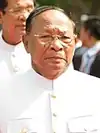 |
Heng Samrin ហេង សំរិន (born 1934) |
5 December 1981 | 17 October 1991 | 9 years, 316 days | ― | |
| – (De facto)[1] |
|
Chea Sim ជា ស៊ីម (1932–2015) and Hun Sen ហ៊ុន សែន (born 1952) |
Sometime during Samrin's leadership | c. 17 October 1991 | c. 9 years, 316 days | ― | |
See also
Notes
References
- 1 2 "Heng Samrin Biography". American Cambodian Intelligence Center (ACIC). 2004.
- ↑ https://books.google.de/books?id=Gq7mAAAAMAAJ&q=Phuthong+%22koh+kong%22&dq=Phuthong+%22koh+kong%22&hl=de&newbks=1&newbks_redir=0&source=gb_mobile_search&sa=X&ved=2ahUKEwio0YG-rfGVAxUrBNsEHVXMNGIQ6AF6BAgOEAM#Phuthong%20%22koh%20kong%22
- ↑ https://countrystudies.us/cambodia/79.htm
- ↑ Norén-Nilsson, Astrid (2022). "Liberalism in Cambodia: Broken Lineages". Asian Studies Review. Taylor & Francis: 9. doi:10.1080/10357823.2022.2041551.
This is rooted in an anti-Communist analysis opposing the incumbent, formerly Communist, Cambodian People's Party (CPP), and perceived foreign Communist influence over it.
- 1 2 Vickery, Michael (1 January 1994). "The Cambodian People's Party: Where Has It Come From, Where Is It Going?". Southeast Asian Affairs. 21: 102. doi:10.1355/SEAA94G (inactive 1 July 2025). ProQuest 1308074383.
{{cite journal}}: CS1 maint: DOI inactive as of July 2025 (link) - ↑ Vickery, Michael (1994). "THE CAMBODIAN PEOPLE'S PARTY: Where Has It Come From, Where Is It Going?". Southeast Asian Affairs: 102–117 – via JSTOR.
- 1 2 3 Frings, K. Viviane (1997). "Rewriting Cambodian History to 'Adapt' It to a New Political Context: The Kampuchean People's Revolutionary Party's Historiography (1979-1991)". Modern Asian Studies. 31 (4): 807–846 – via JSTOR.
- 1 2 3 4 "Cambodia - THE KPRP". countrystudies.us.
- 1 2 3 4 "Cambodia - a country study" (PDF). apps.dtic.mil.
- 1 2 "Countryfacts Cambodia". bp.talktalk.co.uk.
- ↑ "AVI PERSPECTIVE ISSUE: 2019, No. 3 | The Cambodian People's Party: History and Political Transformation".
- ↑ "Buddhism and Revolution in Cambodia | Cultural Survival". www.culturalsurvival.org. March 2, 2010.
- ↑ "Democracy and Human Rights in Cambodia" (PDF). Michael Vickery and Ramses Amer. 2012.
- ↑ "Cambodia - The KPRP Second Congress". countrystudies.us.
- ↑ Kiernan, Ben (January 1, 1980). "Conflict in the Kampuchean Communist movement". Journal of Contemporary Asia. 10: 7–74. doi:10.1080/00472338085390021 – via ResearchGate.
- ↑ Jackson, Karl D. (1979). "Cambodia 1978: War, Pillage, and Purge in Democratic Kampuchea". Asian Survey. 19 (1): 72–84. doi:10.2307/2643657 – via JSTOR.
- ↑ Jackson, Karl D. (April 28, 2014). "Cambodia, 1975-1978: Rendezvous with Death". Princeton University Press – via Google Books.
- ↑ "The political evolutionary process of the Cambodian People's Party from 2008 to 2017: A critical review". Cambodian Journal of Educational and Social Sciences (CJESS). December 2024.
- ↑ "Cambodia veers from socialist path". The Washington Post. 11 June 1989.
- ↑ "Cambodia abolishes communism". The Washington Post.
- ↑ "Documentation Center of Cambodia (DC-Cam)". www.dccam.org.
- ↑ "Bridging policy and practice: RECOFTC and the story of community forestry in Cambodia". RECOFTC.
- ↑ "Kampuchea in 1980: The Politics of Attrition". Michael Leifer. January 1981.
- ↑ Harish Mehta (2001), Warrior Prince: Norodom Ranariddh, Son of King Sihanouk of Cambodia, p. 62.
- ↑ "Politics and society in contemporary Cambodia". Michiel Verver and Jake Wieczorek. 2017.
- ↑ Gottesman, E. 2003. Cambodia after the Khmer Rouge: Inside the Politics of Nation Building. New Haven: Yale University Press.
- ↑ https://www.latimes.com/archives/la-xpm-1990-09-18-wr-840-story.html
- ↑ https://www.nytimes.com/1992/04/26/world/specter-of-khmer-rouge.html
- ↑ van der Kroef, Justus M. (1991). "Cambodia in 1990: The Elusive Peace". Asian Survey. 31 (1): 94–102. doi:10.2307/2645190. JSTOR 2645190 – via JSTOR.
- ↑ Brown, Frederick Z. (1992). "Cambodia in 1991: An Uncertain Peace". Asian Survey. 32 (1): 88–96. doi:10.2307/2645203. JSTOR 2645203.
- ↑ https://www.jstor.org/stable/27908479


- 1979 establishments in Cambodia
- 1991 disestablishments in Cambodia
- Communist parties in Cambodia
- Defunct communist parties
- Defunct political parties in Cambodia
- Formerly ruling communist parties
- Kampuchean United Front for National Salvation
- Nationalist parties in Cambodia
- Political parties disestablished in 1991
- Political parties established in 1979
- Republican parties in Cambodia
- Reformist political parties