Kalipada Pahan
Kalipada Pahan | |
|---|---|
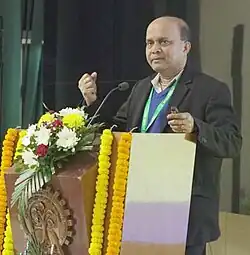 | |
| Born | 19 February 1964 Midnapore, West Bengal, India |
| Occupations | Professor, Neuroscientist |
| Known for | Research on statins (cholesterol-lowering drugs) and cinnamon |
Kalipada Pahan (born 19 February 1964, Midnapore)[Ref] is a professor of Neurological Sciences, Biochemistry, and Pharmacology, holding the Floyd A. Davis, M.D., Endowed Chair in Neurology at Rush University Medical Center. He is also a research career scientist at the Department of Veterans Affairs, Jesse Brown VA Medical Center. An Indian American neuroscientist, Pahan focuses on translational research related to multiple sclerosis, Parkinson's disease, Alzheimer's disease, dementia, and Batten disease .[1]
Life
Early Life in India: Dr. Pahan was born in 1964 at a remote Indian village (Muksudpur) in Midnapore, West Bengal, India. He received his early education in Muksudpur High School and Changrachak High School followed by bachelor’s in Chemistry from Midnapore College, a renowned autonomous college, which was then under the University of Calcutta.
Pursuit of Education and his journey to the USA: After completing his graduation, he moved to Kolkata to pursue a Masters’ degree in Biochemistry and then completed Ph.D. in Biochemistry with Departmental fellowship. In 1992, he came to Medical University of South Carolina (MUSC), Charleston, SC for pursuing his post-doctoral studies, where he rose to the rank of Assistant Professor in 1998. In 1999, he moved to the College of Dentistry in University of Nebraska Medical Center as an Assistant Professor of Biochemistry. He was promoted to Associate Professor of Biochemistry in 2002. In 2006, he moved to Rush University Medical Center as a Professor and Floyd. A. Davis, M.D., Endowed Chair of Neurology.
Research Career
Professor Pahan is highly regarded for his contributions to research on statins, cholesterol-lowering medications. His initial investigations focused on the role of statins in suppressing inflammatory responses within microglia, astroglia, and macrophages[Ref]. This discovery significantly influenced subsequent studies on statin drugs. Over the past 30 years, Professor Pahan has conducted pioneering research into the efficacy of statins for neuronal diseases. His laboratory later demonstrated that statins have potential neuroprotective effects and may enhance locomotor activity in Parkinson's disease by inhibiting activation of p21/Ras[ref]. Statins, classified as HMG CoA reductase inhibitors, are recognized for their cholesterol-lowering properties. Professor Pahan's research further revealed that statins can exert HMG CoA reductase-independent actions[Ref}, supporting cognitive function via the PPAR-alpha-CREB pathway[Ref]. Most recently, his research has characterized a novel interaction between lipid metabolism and memory, indicating that the lipid-regulating transcription factor PPAR-alpha modulates hippocampal memory formation via transcriptional regulation of CREB (Roy et al., 2013, Cell Reports 4: 724–737), providing a potential explanation for the observed association between increased abdominal fat and memory impairment.[5]
His laboratory is also renowned for its research on cinnamon, where findings indicate that this widely used spice may offer benefits for various neurological disorders, including enhancing memory and learning in individuals with learning difficulties[Ref].
In 2021, his discovery on nasal drugs for Parkinson's disease was selected among the top three neuroscience discoveries in the world by Penn Neuro.[7].
Most importantly, his laboratory findings on cinnamon, cinnamon metabolite sodium benzoate, gemfibrozil, low-dose aspirin, and physically-modified saline RNS60 have been confirmed in patients with different diseases by many clinical trials performed by several groups all over the world:
Awards & Honors
He has written many book chapters and published more than 200 articles in many peer-reviewed journals including Journal of Biological Chemistry, Journal of Immunology, Journal of Neuroscience, Cell Death and Differentiation, Proceedings of the National Academy of Sciences of the United States of America, Journal of Clinical Investigation, Science Signaling, Cell Reports, Cell Metabolism, Nature Communications, and Nature Chemical Biology. His research on aspirin was featured in Society for Neuroscience 2019 Hot Topic. He is the recipient of "D. H. Reinhardt Scholar" award from the University of Nebraska Medical Center (UNMC) College of Dentistry, the "Silver U" award from the UNMC Chancellor's council, and the outstanding teaching award from the UNMC College of Dentistry. He also received the Joseph Wybran, M.D., Award from the Society on Neuroimmune Pharmacology and the Zenith Fellows Award from the Alzheimer's Association.[6]
1. Senior editor, Journal of Neuroimmune Pharmacology.
2. Senior editor, Neuroimmune Pharmacology and Therapeutics.
3. Editor-in-Chief, Journal of Multiple Sclerosis.
4. Permanent member, Clinical Neuroimmunology and Brain Tumors NIH study section.
5. Outstanding Teaching Award, University of Nebraska Medical Center College of Dentistry, 2000.
6. Outstanding Performance Award, University of Nebraska Medical Center College of Dentistry, 2000-2004.
7. Chancellor's Council Silver U Award, University of Nebraska Medical Center, 2004.
8. Reinhardt Research Scholar Award, University of Nebraska Medical Center College of Dentistry, 2005.
9. Floyd A. Davis, MD, Endowed Professor of Neurology, Rush University Medical Center, 2006.
10. Zenith Fellows Award, Alzheimer's Association, 2017.
11. Featured in Neuroscience Hot Topic, Society for Neuroscience, 2019.
12. Research Career Scientist Award, Veterans Affairs, 2019.
13. Joseph Wybran, MD, Award, Society for Neuroimmune Pharmacology, 2024.
14. BRAVE Award, Veterans Affairs, 2024.
Clinical evidence of his laboratory findings
- Cinnamon metabolite sodium benzoate reduces amyloid plaques from Alzheimer's disease patients.[2]
- Cinnamon is beneficial for patients with relapsing-remitting multiple sclerosis[3]
- Cinnamon metabolite (Sodium Benzoate) improves memory and learning in patients with amnestic MCI [4]
- Gemfibrozil in patients with Alzheimer's Disease [5]
- Sodium Benzoate in patients with Later-Phase Dementia [6]
- Low-dose Aspirin in Dementia patients [7]
- Cinnamon in Rheumatoid Arthritis patients [8]
- RNS60 (Physically-modified saline) in ALS patients [9] Note: Reference for original characterization:[10]
- Cinnamon for Cognitive Function (Systematic Review) [11]
- RNS60 is beneficial in Stroke patients [12]
References
- ↑ "Home". Pahanlab.com. Retrieved 3 February 2014.
- ↑ Lin, Chieh-Hsin; Lane, Hsien-Yuan (5 August 2025). "Sodium benzoate treatment decreased amyloid beta peptides and improved cognitive function among patients with Alzheimer's disease: secondary analysis of a randomized clinical trial". Translational Psychiatry. 15 (1): 264. doi:10.1038/s41398-025-03492-3. ISSN 2158-3188. PMC 12326001. PMID 40764372.
- ↑ Delaviz, Elham; Salehi, Moosa; Ahmadi, Afsane; Fararooei, Mohammad; Vakili, Mahdis; Ashjazadeh, Nahid (18 July 2017). Effect of Cinnamon on Inflammatory Factors, Pain and Anthropometric Indices in Progressive-relapsing Multiple Sclerosis Patients: A Randomized Controlled Trial (Report). Jundishapur Journal of Natural Pharmaceutical Products. pp. e14505.
- ↑ Lane, H. Y.; Lin, C. H.; Greenberg, W. M.; Chen, V. C.; Loh, E. W.; Huang, C. L.; Chen, C. J.; Chen, P. W.; Luo, S. C.; Chuo, P. N.; Hsu, C. H.; Lane, H. Y. (2021). "A Randomized, Double-Blind, Placebo-Controlled Comparison Study of Sodium Benzoate, a D-Amino Acid Oxidase Inhibitor, in Patients With Mild Cognitive Impairment". The Journal of Clinical Psychiatry. 82 (1) 20m13437. doi:10.1093/ijnp/pyab001. PMC 8130199. PMID 33406269.
- ↑ Meglio, M. (2022). "Gemfibrozil Shows Promise in Patients With Predementia Alzheimer Disease, Metabolic and CVD Outcomes". NeurologyLive. Retrieved 10 February 2026.
- ↑ Lin, C. H.; Chen, P. K.; Chang, Y. C.; Chuo, P. N.; Chen, Y. S.; Tsai, G. E.; Lane, H. Y. (2021). "Sodium Benzoate, a D-Amino Acid Oxidase Inhibitor, for the Treatment of Alzheimer's Disease: A Randomized Double-Blind Placebo-Controlled Trial". Biological Psychiatry. 89 (10): 951–959. doi:10.1016/j.biopsych.2020.12.009. PMC 8060832. PMID 33881530.
- ↑ Tan, M. S.; Tan, L.; Yu, J. T. (2022). "Low-dose aspirin for the prevention of cardiovascular disease and cancer: a meta-analysis of randomized controlled trials". Alzheimer's Research & Therapy. 14 (1): 102. doi:10.1186/s13195-022-01017-4. PMC 9310022. PMID 35879774.
- ↑ Shishehbor, F.; Safari, M.; Amani, R.; Haghighizadeh, M. H. (2018). "Cinnamon consumption improves clinical symptoms and inflammatory markers in women with rheumatoid arthritis". Journal of the American College of Nutrition. 37 (8): 685–690. doi:10.1080/07315724.2018.1460733. PMID 29722610.
- ↑ Paganoni, S.; Berry, J. D.; Cupler, E.; Goutman, S. A.; Goyal, N. A. (2024). "A Randomized, Double-Blind, Placebo-Controlled Phase 2 Clinical Trial of RNS60 in Amyotrophic Lateral Sclerosis (ALS)". Muscle & Nerve. 122: 456–462. doi:10.1002/mus.28214. PMID 39182589.
- ↑ Khasnavis, S.; Pahan, K. (2012). "Sodium benzoate, a metabolite of cinnamon and a food additive, reduces microglial activation and protects nigrostriatal dopaminergic system in mice". Journal of Neuroimmune Pharmacology. 7 (2): 424–435. doi:10.1074/jbc.M111.338012. PMC 3436140. PMID 22753407.
- ↑ Nakhaee, S.; Kooshki, A.; Hormozi, A.; Akbari, A.; Mehrpour, O.; Farrokhfall, K. (2023). "Cinnamon and cognitive function: a systematic review of nano-formulations". Nutritional Neuroscience. 26 (1): 132–146. doi:10.1080/1028415X.2023.2166436. PMID 36652384.
- ↑ Watson, R.; Pahan, K. (2024). "Physically-modified saline (RNS60) exhibits promise in patients with stroke". Frontiers in Neurology. 15 (9) 40671649. doi:10.1161/STROKEAHA.125.051179. PMID 40671649.