Symphony No. 1 (Mozart)
| Symphony No. 1 | |
|---|---|
| by W. A. Mozart | |
 1763 portrait of Mozart at age seven, painted before he composed the symphony | |
| Key | E♭ major |
| Catalogue | K. 16 |
| Composed | August/September 1764, London |
| Published | 1879, Leipzig |
| Publisher | Breitkopf & Härtel |
| Duration | c. 12 minutes |
| Movements | 3 |
| Scoring | Orchestra |
| Premiere | |
| Date | 21 February 1765 |
| Location | Theatre Royal Haymarket, London |
| Conductor | Wolfgang Amadeus Mozart |
The Symphony No. 1 in E♭ major, K. 16, is Wolfgang Amadeus Mozart's first ever symphony, written in August or September 1764 at the age of only eight.[1] By this time, he was already notable in Europe as a child prodigy (Wunderkind)[2] but had composed little music.
The autograph manuscript of the symphony is today preserved in the Jagiellonian Library in Kraków, Poland.[1]
A typical performance lasts about 12 minutes.[3]
Background
The symphony was written on the Mozart family's Grand Tour of Europe in London when they had to move to Chelsea during the summer of 1764, when Leopold caught a cold on the way home one night, with a severe throat infection.[1][4][5] The house at 180 Ebury Street, now in the borough of Westminster, where this symphony was written, is marked with a plaque.

Leopold was gravely ill and for his recovery demanded total silence with absolutely no noise to be made anywhere in the house, not even music. He forbade anyone from touching the keyboard, according to a recall by Nannerl made in her later years, so Mozart occupied himself by composing the symphony silently in his mind.[5]
The symphony was first performed on 21 February 1765 at the Little Theatre, Haymarket, directed by Mozart himself, in a concert given by him and Nannerl.[5] It shows the influence of several composers, including his father and the sons of J. S. Bach, especially Johann Christian, an important early symphonist working in London whom Mozart had met during his time there.[6]
Music
The symphony is scored for two oboes, two horns in E♭, strings.[7]
The work is in three movements:
- Molto allegro,

- Andante, C minor, 2
4 - Presto, 3
8
I. Molto allegro
The first movement opens with an exuberant unison fanfare; it is then answered quietly by a gentler accompanied passage accompanied by the basso continuo. The contrast between loud and soft passages here provides the movement's principal character.

In his book on the piano concertos, Cuthbert Girdlestone pointed out the similarity between the opening of this symphony and that of the Piano Concerto No. 22, K. 482, composed some twenty years later.[8]
II. Andante
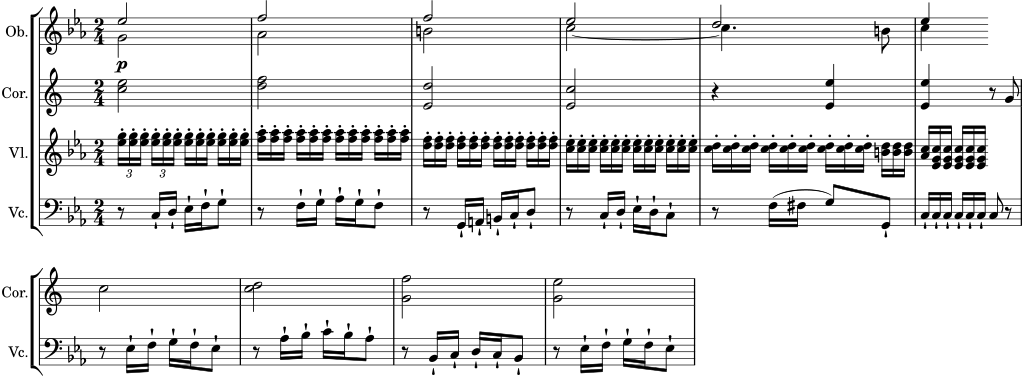
In the second movement, bars 7ff, Mozart uses the four note motif C–D–F–E which appeared in several of his later works, including his symphonies 33 and 41 "Jupiter", specifically the fourth movement of the latter.[9] The horns play this theme above a slow, heavy bass line which likely reflects his concern for his father's severe illness.[7] Marc Rochester suggests that shivering strings remind listeners of the cold English winter weather under which the symphony was composed.[7]
III. Presto
The exuberant brief closing movement of the symphony, dominated by the horns and violins, according to Rochester, reflects the young Mozart's inability to stay serious for long.[7] The strings play a brief unison figure exploring chromaticism, which audiences at the time found questionable.[5]

Discography

| Year | Conductor | Orchestra | Label |
|---|---|---|---|
| 1973 | Neville Marriner | Academy of St. Martin in the Fields | Philips Classics |
| 1991 | Charles Mackerras | Prague Chamber Orchestra | Telarc |
| 1992 | James Levine | Vienna Philharmonic | Deutsche Grammophon |
| 1995 | Nicholas Ward | Northern Chamber Orchestra | Naxos |
| 2005 | Klaus Tennstedt | Bavarian Radio Symphony Orchestra | Profil Medien |
| 2013 | Ádám Fischer | Danish National Chamber Orchestra | Dacapo Records |
| 2018 | Ian Page | The Mozartists | Signum Records |
| 2024 | Luca Bertazzi | Chamber orchestra of the Conservatory of Music "Lucio Campiani", Mantua | Conservatory of Music "Lucio Campiani", Mantua |
References
- 1 2 3 Mozart, Wolfgang Amadeus (2005). Die Sinfonien I. Translated by Robinson, J. Branford. Kassel: Bärenreiter-Verlag. p. IX. ISMN M-006-20466-3
- ↑ "14 of the Most Extraordinary Child Prodigies in History" by Rosie Pentreath, Australian Chamber Orchestra
- ↑ Michael Rodman. Wolfgang Amadeus Mozart: Symphony No. 1 in E-flat major, K. 16 at AllMusic
- ↑ Sadie, Stanley, Mozart: The Early Years 1756–1781, pp. 64–65, Oxford University (2006), ISBN 978-0-19-816529-3
- 1 2 3 4 "Symphony No 1 in E-flat major, K. 16 (Mozart)". Hyperion Records. SIGCD201. Retrieved 15 May 2026.
- ↑ Manning, Stephanie. "A Guide to Mozart's Symphonies". Carnegie Hall. Retrieved 15 May 2026.
- 1 2 3 4 Rochester, Marc (19 April 2019). "JAAP: Mozart" (PDF). www.hkphil.org. Archived from the original on 21 May 2026. Retrieved 21 May 2026.
- ↑ Girdlestone, C. M. (1948) Mozart's Piano Concertos, p. 346, London, Cassell.
- ↑ "Fall Concert 2011". Kamuela Philharmonic Orchestra. 31 August 2011. Retrieved 29 December 2013.
External links
- Sinfonie in Es, KV 16: Score and critical report (in German) in the Neue Mozart-Ausgabe
- Symphony No. 1 (W. A. Mozart): Scores at the International Music Score Library Project
- "Work details, sound file", Köchel-Verzeichnis, International Mozarteum Foundation
- Concert performance on YouTube, Folkwang Kammerorchester Essen, Johannes Klumpp conducting
| Biography | |||
|---|---|---|---|
| Music |
| ||
| Family |
| ||
| Influences | |||
| Related | |||
