John William Wadsworth
John William Wadsworth (1879–1955) was a British ceramicist.[1]
Wadsworth came from Macclesfield where he studied art before winning a scholarship to the Royal College of Art in London. He was recruited in 1900 by Mintons, then one of the leading pottery companies in Stoke-on-Trent. The company needed to expand its sales and to this end Wadsworth collaborated closely with the art director Léon-Victor Solon on Art Nouveau designs. Art Nouveau ceramics were in vogue in the first decade of the 20th century, but these designs have been seen as continental rather than British in style.[1] Mintons marketed them as "secessionist ware" in reference to the Vienna Secession art movement.[2] The ware is typically tubelined.
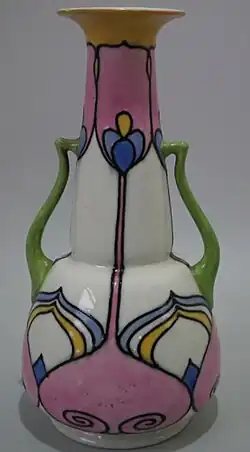
He moved to the Royal Worcester Porcelain Company as Art Director in 1915.
Legacy
John Wadsworth was the father of the potter Philip Wadsworth, born in Stoke-on-Trent in 1910.[3] [4] After Philip Wadsworth's death, there was a sale of work by father and son at the London auctioneers Phillips (8 April 1992).[5]
Art work by Wadsworth is preserved in the Minton Archive,[6] although it is sometimes difficult to distinguish his designs from those of Solon.[2]
References
- 1 2 "John William Wadsworth". British Museum. Retrieved 21 May 2026.
- 1 2 Muter, Grant (1985). "Léon Solon and John Wadsworth: Joint Designers of Minton's Secessionist Ware". The Journal of the Decorative Arts Society (9): 41–49. JSTOR 41809144.
ASPECTS OF BRITISH DESIGN 1870 - 1930
- ↑ "Philip Smeale Wadsworth". Contemporary Art Society. Retrieved 19 May 2026.
- ↑ "Philip Smeale Wadsworth". British Museum. Retrieved 18 May 2026.
- ↑ There is a catalogue "The Ceramic Art and Paintings of John and Philip Wadsworth". Some of the items have appeared in subsequent sales, for example a 2023 Lyon & Turnbull sale (John Wadsworth: British 1879-1955)
- ↑ "Wadsworth's sketch books". Minton Archive. Retrieved 21 May 2026.
Further reading
- J. Jones, Minton. The First Two Hundred Years of Design & Production, Shrewsbury, 1993, pp. 242–53.