John Lewis (antiquarian and diarist)
John Lewis (23 August 1685 – 28 October 1761) was an English clergyman of the Church of England, antiquarian, diarist, and amateur geologist.
Born at Kingswood, which was then in Wiltshire, on 23 August 1685, by his own account,[1] Lewis was a son of Ambrose Lewis, of Kingswood,[2] and his wife Martha, and was baptized there into the Church of England on 7 September 1685.[3] On 10 April 1701, aged 15, he matriculated at St Edmund Hall, Oxford, and graduated BA in 1704.[2] He was schoolmaster of the grammar school at Tetbury, Gloucestershire, from 1705 to 1712,[1] and in 1713 was appointed as rector of Great Chalfield, Wiltshire.[2] Soon after that, he married, and with his wife Esther had a daughter, Esther Lewis, later notable as a poet, who was baptized in 1716. His wife died in 1744.[4]
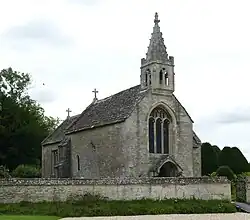
Lewis was also curate and later vicar of Holt, Wiltshire, where he lived for 48 years.[5] During that time, a mineral waters spa was developed there,[6] and in 1728 Lewis submitted a paper to the Royal Society, "An Account of the several Strata of Earths and Fossils found in sinking the mineral wells at Holt", which shows his keen interest in geology. He notes several strata, including one of yellow clay very like ochre and one of large heavy oval rocks coated in flakes of gypsum.[7] The next year, he submitted a further paper about "the Nature and Virtues of the Holt-waters".[8] The Holt spa, promoted by Lewis and a landowner, Lady Lisle, was well frequented by 1720 and eventually had both a Pump Room, imitating one at Bath, and a Great House at which visitors taking the waters could stay. Little now remains, apart from a cast iron pump and a marble tablet (pictured) which commemorates the efforts of Lisle and Lewis "… who patronized this Spring and rendered it Famous in the year 1720".[9][10]

Lewis belonged to what he called the Clergy Club of Melksham, a small group of clergymen from that part of Wiltshire who had dinner together once a month.[5] He corresponded with John Wesley (1703–1791), the founder of Methodism, who visited him at Holt in October 1750.[11]
Between 1717 and 1760, Lewis kept a comprehensive diary, most of which is now at the Bodleian Library.[1] After 1725, the diary became less a detailed account of Lewis's daily life and included more of his reflections.[5] The Wiltshire and Swindon History Centre has a diary volume containing notes on national events and medicinal cures, as well as some other papers.[12] Donald A. Spaeth has studied Lewis's diary from 1718 to 1724, finding that as rector of Great Chalfield and curate of Holt and Atworth, in a single year Lewis "engaged in over 170 social contacts, dining with, visiting and receiving visits from the gentry, tenant farmers, and the clergy".[5] The Bodleian Library also has Lewis's manuscript "A Geographical Description of Wiltshire", which remains unpublished, and a collection of his antiquarian papers.[13]
A notebook of Lewis's is in the Gloucestershire archives.[14] A biography of his daughter notes that Lewis had a particular interest in heraldry.[4]
Lewis died on 28 October 1761, aged 76,[15] and was buried on 3 November by the west door of St Katharine's church, Holt, with a Latin inscription beginning "In spe resurrectionis ad vitem aeternum Reverendus Johannes Lewis hic jacet" (Here lieth the Reverend John Lewis, in hope of resurrection to everlasting life).[16] His will dated 24 September 1760 was proved in the Prerogative Court of Canterbury on 25 November 1761, and there is a copy in the National Archives. In the will he leaves to a grandson, Samuel Lewis, two properties in Kingswood, with orchards and stables; to his daughter Esther, £600; sums of money to three other grand-children, and five guineas to the poor of Holt, Chalfield, and Atworth. He appoints his daughter as sole executrix and requests the burial of his remains as near as convenient to those of his beloved wife.[17]
Selected publications
- "An Account of the several Strata of Earths and Fossils found in sinking the mineral wells at Holt. By the Rev. Mr. Lewis, Vicar of the Place", Philosophical Transactions of the Royal Society, Vol. 35, No. 403 (1728), pp. 489–491
- "A letter to Dr. Rutty… of the Nature and Virtues of the Holt-waters", Philosophical Transactions of the Royal Society, Vol. 36, No. 408 (1729), pp. 43–45
Unpublished
- Diaries, 1717–1760, most at Bodleian Library, Oxford
- "A Geographical Description of Wiltshire", at Bodleian Library
Notes
- 1 2 3 Bodleian Archives & Manuscripts catalogue, Shelfmark MS. Eng misc f. 10; the early diary includes an account of his life up to 1716.
- 1 2 3 "Lewis, John, s. Amb. Kingswood, Wilts" in Joseph Foster, Alumni Oxonienses 1500–1714, Vol. III (Oxford and London: Parker & Co., 1891) p. 908
- ↑ "John the son of Ambross and Martha Lewis", Baptized 7 September 1685, Kingswood, Wiltshire, England, Family History Library Film Number 425449
- 1 2 Richard Greene, revised, "Clark (née Lewis), Esther (bap. 1716, d. 1794)", Oxford Dictionary of Biography (2004) (subscription required)
- 1 2 3 4 Donald A. Spaeth, The Church in an Age of Danger: Parsons and Parishioners, 1660–1740 (Cambridge University Press, 2000), pp. 25–26, 54–55
- ↑ Wiltshire Archaeological and Natural History Magazine, Vol. 55 (1954), pp. 1–29; and J. H. P. Pafford, "The Spas and Mineral Springs of Wiltshire", in W.A.& N.H.M. Vol. 56 (1956), pp. 388–389
- ↑ Philosophical Transactions of the Royal Society, Vol. 35, No. 403 (1728), pp. 489–491
- ↑ Philosophical Transactions of the Royal Society, Vol. 36 No. 408 (1729), pp. 43–45
- ↑ "The Story of Holt: No. 1 Holt Spa", Holt Magazine (1971), pp. 1–5
- ↑ Roland Millward, "Holt Spa", rolandmillward.com, 5 March 2023, accessed 18 August 2026
- ↑ Randy L. Maddox, "A Zealous (but Respected) Adversary: John Lewis's Correspondence with John Wesley" in Wesley and Methodist Studies, Vol. 7 (2015) pp. 121–148
- ↑ Wiltshire and Swindon History Centre catalogue, accession 1981; the diary volume is at 1981/1 and is shown as dated 1720.
- ↑ Bodleian Archives & Manuscripts catalogue, MS. Eng. misc. f. 11
- ↑ Gloucestershire County Record Office, reference D6755/3/1
- ↑ Wiltshire Archaeological and Natural History Magazine, Vol. 55, p. 29, note 11
- ↑ Parish Register of St. Katharine's, Holt, WSHC ref. 1555/3, "Burials A.D. 1761", Ancestry.com, accessed 17 August 2026 (subscription required)
- ↑ PROB 11/870/436; "Will of John Lewis and codicil", Ancestry.com, accessed 17 August 2026 (subscription required)