John Charles Lucchesi
John Charles Lucchesi | |
|---|---|
 | |
| Born | Cairo, Egypt |
| Alma mater | LaGrange College; University of Georgia; University of California, Berkeley |
| Known for | Dosage compensation in Drosophila melanogaster; chromatin regulation |
| Scientific career | |
| Fields | Genetics, molecular biology, epigenetics |
| Workplaces | University of North Carolina at Chapel Hill; Emory University |
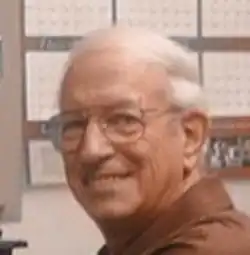
John Charles Lucchesi is an American geneticist known for pioneering research on dosage compensation in Drosophila melanogaster and the epigenetic regulation of gene expression.[1] His laboratory identified chromatin remodeling factors important for gene regulation in normal and cancer cells.[2][3] He is Emeritus Asa Griggs Candler Professor of Biology at Emory University.[4]
Early life and education
Lucchesi was born in Cairo, Egypt. He attended the Lycée Français du Caire before moving to the United States to enroll at LaGrange College in Georgia, where he received an A.B. degree in chemistry in 1955. He earned an M.S. degree from the University of Georgia in 1958 and a Ph.D. in genetics from the University of California, Berkeley in 1963, where he studied under geneticist Curt Stern.[5]
Career
Following postdoctoral training at the University of Oregon with Edward Novitski,[6] Lucchesi joined the faculty of the University of North Carolina at Chapel Hill, where he became Cary C. Boshamer Professor of Biology and Genetics.[7] In 1983, he was named a Fellow of Churchill College, University of Cambridge.[8]
In 1990, he joined the Department of Biology at Emory University as Asa Griggs Candler Professor of Biology and served as department chair.[4]
Lucchesi’s early work focused on chromosome mechanics and recombination.[9][10] He later became a leading figure in developmental genetics, using dosage compensation in Drosophila as a model system. His research demonstrated that enhanced chromatin accessibility and transcriptional elongation underlie X-chromosome upregulation in males.[11][12]
Research impact
Lucchesi’s work has significantly influenced understanding of the relationship between dosage compensation, sex determination, and sex chromosome evolution.[13] His contributions to chromatin biology and epigenetic regulation are widely cited in the field.[14]
Awards and honors
- Fellow, American Association for the Advancement of Science (1998)[15]
- President, National Drosophila Board (1993)[16]
- President (1992) and Vice President (1991), Genetics Society of America[17]
- Chair, NIH Genetics Study Section (1987)[18]
- Fellow, Churchill College, University of Cambridge (1983)[8]
- Cary C. Boshamer Professor, University of North Carolina at Chapel Hill (1982)[7]
Selected works
See also
References
- ↑ Kuroda, M.I. (2016). "Dosage compensation in Drosophila – a model for the coordinate regulation of transcription". Genetics. 204 (2): 435–450. doi:10.1534/genetics.115.185108. PMC 5068838. PMID 27729494.
- ↑ Neal, K.C. (2000). "A new human member of the MYST family of histone acetyl transferases". Biochimica et Biophysica Acta. 1490 (1–2): 170–174. doi:10.1016/S0167-4781(99)00211-0. PMID 10786633.
- ↑ Sharma, G.G. (2010). "MOF and histone H4 acetylation at lysine 16 are critical for DNA damage response". Molecular and Cellular Biology. 30 (14): 3582–3595. doi:10.1128/MCB.01476-09. PMC 2897562. PMID 20479123.
- 1 2 "Emeritus Faculty – Department of Biology". Emory University.
- ↑ Lucchesi, J.C. (1983). "Curt Stern". Genetics. 103 (1): 1–4.
- ↑ Crow, J.F. (2006). "Edward Novitski: Drosophila virtuoso". Genetics. 174 (2): 549–553. doi:10.1534/genetics.104.65953. PMC 1602066. PMID 17068121.
- 1 2 Record of the University of North Carolina at Chapel Hill: The Graduate School. 1984.
- 1 2 "Churchill College Fellows Archive" (PDF). University of Cambridge, P. 4 "About the Author".
- ↑ Hinton, C. (1960). "A cytogenetic study of crossing over in inversion heterozygotes". Genetics. 45 (1): 87–94. doi:10.1093/genetics/45.1.87. PMID 17247910.
- ↑ Lucchesi, J.C.; Suzuki, D.T. (1968). "The interchromosomal control of recombination". Annual Review of Genetics. 2: 53–86. doi:10.1146/annurev.ge.02.120168.000413.
- ↑ Smith, E.R. (2001). "Linking global histone acetylation to transcription enhancement". Journal of Biological Chemistry. 276 (34): 31483–31486. doi:10.1074/jbc.C100351200.
- ↑ Larschan, E. (2011). "X chromosome dosage compensation via enhanced transcriptional elongation". Nature. 471 (7336): 115–118. doi:10.1038/nature09757. PMC 3076316. PMID 21368835.
- ↑ Straub, T. (2007). "Dosage compensation: the beginning and end of generalization". Nature Reviews Genetics. 8 (1): 47–57. doi:10.1038/nrg2013. PMID 17173057.
- ↑ Makki, R. (2021). "When down is up: heterochromatin, nuclear organization and X upregulation". Cells. 10 (12): 3416. doi:10.3390/cells10123416. PMC 8700316. PMID 34943924.
- ↑ "AAAS Fellows". AAAS.
- ↑ "Drosophila Information Service" (PDF). 1993.
- ↑ "Past Officers". Genetics Society of America.
- ↑ Lucchesi, John. "NIH Chair". National Institutes of Health.
- American geneticists
- Living people
- Scientists from Cairo
- University of California, Berkeley alumni
- LaGrange College alumni
- University of Georgia alumni
- Emory University faculty
- University of North Carolina at Chapel Hill faculty
- Fellows of the American Association for the Advancement of Science
- Epigeneticists
- Molecular biologists
- Egyptian emigrants to the United States