List of Japanese Nobel laureates and nominees

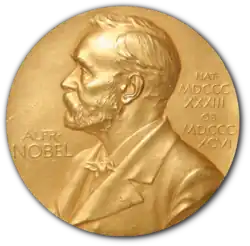
Since 1949, there have been 32 Japanese laureates of the Nobel Prize. The Nobel Prize is a Sweden-based international monetary prize. The award was established by the 1895 will and estate of Swedish chemist and inventor Alfred Nobel. It was first awarded in Physics, Chemistry, Physiology or Medicine, Literature, and Peace in 1901. An associated prize, thus far, the Sveriges Riksbank Prize in Economic Sciences in Memory of Alfred Nobel, also sometimes known as the Nobel Prize in Economics, has yet to be awarded to a Japanese national.
The Nobel Prizes in the above specific sciences disciplines and the Prize in Economics, which is commonly identified with them, are widely regarded as the most prestigious award one can receive in those fields.[1][2] Of Japanese winners, twelve have been physicists, nine chemists, three for literature, six for physiology or medicine, and two for efforts towards peace.[2]
Summary
| Category | Japanese citizens/ organizations | Others born as Japanese citizens | Total | Others born in Japanese colonies | Remarks |
|---|---|---|---|---|---|
| Physics | 9 | 3 | 12 | - | Yoichiro Nambu, Shuji Nakamura, and Syukuro Manabe became American citizens. |
| Chemistry | 9 | - | 9 | 2 | Charles J. Pedersen has half Japanese ancestry (listed under the Diaspora), but Yuan T. Lee is not. |
| Physiology or Medicine | 6 | - | 6 | - | |
| Literature | 2 | 1 | 3 | - | Kazuo Ishiguro became a British citizen in 1983.[3][4] |
| Peace | 2 | - | 2 | - | |
| Total | 28 | 4 | 32 | 2 | Japanese media usually count 31 laureates (excluding Kazuo Ishiguro). |
Laureates
| Year | Portrait | Laureate (birth/death) | Field | Rational | Undergraduate alma mater | ||
|---|---|---|---|---|---|---|---|
| Citizens | |||||||
| 1949 |  |
Hideki Yukawa (1907–1981) |
Physics | "for his prediction of the existence of mesons on the basis of theoretical work on nuclear forces."[5] | KyotoU | ||
| 1965 |  |
Shin'ichirō Tomonaga (1906–1979) |
Physics | "for their fundamental work in quantum electrodynamics, with deep-ploughing consequences for the physics of elementary particles."[6] (jointly with American theoretical physicists Julian Schwinger and Richard Feynman) | KyotoU | ||
| 1968 |  |
Yasunari Kawabata (1899–1972) |
Literature | "for his narrative mastery, which with great sensibility expresses the essence of the Japanese mind."[7] | UTokyo | ||
| 1973 |  |
Leo Esaki (1925–) |
Physics | "for their experimental discoveries regarding tunneling phenomena in semiconductors and superconductors, respectively."[8] (jointly with Norwegian-American physicist Ivar Giaever and shared with Welsh theoretical physicist Brian David Josephson) | UTokyo | ||
| 1974 |  |
Eisaku Satō (1901–1975) |
Peace | "for his contribution to stabilize conditions in the Pacific rim area and for signing the Nuclear Non-Proliferation Treaty."[9] (shared with Irish politician Seán MacBride) | UTokyo | ||
| 1981 |  |
Kenichi Fukui (1918–1998) |
Chemistry | "for their theories, developed independently, concerning the course of chemical reactions."[10] (jointly with Polish-American theoretical chemist Roald Hoffmann) | KyotoU | ||
| 1987 |  |
Susumu Tonegawa (1939–2026) |
Physiology or Medicine | "for his discovery of the genetic principle for generation of antibody diversity."[11] | KyotoU | ||
| 1994 |  |
Kenzaburō Ōe (1935–2023) |
Literature | "who with poetic force creates an imagined world, where life and myth condense to form a disconcerting picture of the human predicament today."[12] | UTokyo | ||
| 2000 |  |
Hideki Shirakawa (1936–) |
Chemistry | "for their discovery and development of conductive polymers."[13] (jointly with American chemist Alan MacDiarmid and physicist Alan J. Heeger) | Tokyo Tech | ||
| 2001 |  |
Ryōji Noyori (1938–) |
Chemistry | "for their work on chirally catalysed hydrogenation reactions."[14] (jointly with American chemist William S. Knowles and shared with American chemist K. Barry Sharpless) | KyotoU | ||
| 2002 |  |
Masatoshi Koshiba (1926–2020) |
Physics | "for pioneering contributions to astrophysics, in particular for the detection of cosmic neutrinos."[15] (jointly with American chemist Raymond Davis Jr. and shared with Italian-American Riccardo Giacconi) | UTokyo | ||
 |
Koichi Tanaka (1959–) |
Chemistry | "for the development of methods for identification and structure analyses of biological macromolecules... [and] for their development of soft desorption ionisation methods for mass spectrometric analyses of biological macromolecules."[16] (jointly with American analytical chemist John B. Fenn and Swiss chemist Kurt Wüthrich) | Tohokudai | |||
| 2008 |  |
Makoto Kobayashi (1944–) |
Physics | "for the discovery of the origin of the broken symmetry which predicts the existence of at least three families of quarks in nature."[17] (shared with Japanese-American physicist Yoichiro Nambu) | NagoyaU | ||
 |
Toshihide Maskawa (1940–2021) |
NagoyaU | |||||
 |
Osamu Shimomura (1928–2018) |
Chemistry | "for the discovery and development of the green fluorescent protein, GFP."[18] (jointly with American neurobiologist Martin Chalfie and biochemist Roger Y. Tsien) | Nagasaki | |||
| 2010 |  |
Ei-ichi Negishi (1935–2021) |
Chemistry | "for palladium-catalyzed cross couplings in organic synthesis."[19] (jointly with American chemist Richard F. Heck) | UTokyo | ||
 |
Akira Suzuki (1930–) |
Hokudai | |||||
| 2012 |  |
Shinya Yamanaka (1962–) |
Physiology or Medicine | "for the discovery that mature cells can be reprogrammed to become pluripotent."[20] (jointly with British developmental biologist John B. Gurdon) | KobeU | ||
| 2014 |  |
Isamu Akasaki (1929–2021) |
Physics | "for the invention of efficient blue light-emitting diodes which has enabled bright and energy-saving white light sources."[21] (jointly with Japanese-born American Shuji Nakamura) | KyotoU | ||
 |
Hiroshi Amano (1960–) |
NagoyaU | |||||
| 2015 |  |
Satoshi Ōmura (1935–) |
Physiology or Medicine | "for their discoveries concerning a novel therapy against infections caused by roundworm parasites."[22] (jointly with Irish-American parasitologist William C. Campbell and shared with Chinese pharmaceutical chemist Tu Youyou) | Nashidai | ||
 |
Takaaki Kajita (1959–) |
Physics | "for the discovery of neutrino oscillations, which shows that neutrinos have mass."[23] (jointly with Canadian astrophysicist Arthur B. McDonald) | SaitamaU | |||
| 2016 |  |
Yoshinori Ohsumi (1945–) |
Physiology or Medicine | "for his discoveries of mechanisms for autophagy."[24] | UTokyo | ||
| 2018 |  |
Tasuku Honjo (1942–) |
Physiology or Medicine | "for their discovery of cancer therapy by inhibition of negative immune regulation."[25] (jointly with American immunologist James P. Allison) | KyotoU | ||
| 2019 |  |
Akira Yoshino (1948–) |
Chemistry | "for the development of lithium ion batteries."[26] (jointly with American materials scientist John B. Goodenough and British-American chemist M. Stanley Whittingham) | KyotoU | ||
| 2024 |  |
Nihon Hidankyo | Peace | "for its efforts to achieve a world free of nuclear weapons and for demonstrating through witness testimony that nuclear weapons must never be used again."[27] | |||
| 2025 |  |
Shimon Sakaguchi (1951–) |
Physiology or Medicine | "for their discoveries concerning peripheral immune tolerance."[28] (jointly with American immunologists Mary E. Brunkow and Fred Ramsdell) | KyotoU | ||
 |
Susumu Kitagawa (1951–) |
Chemistry | "for the development of metal-organic frameworkse."[29] (jointly with American materials scientist Richard Robson and Omar M. Yaghi) | KyotoU | |||
| Diaspora[a] | |||||||
| 1987 | Charles J. Pedersen[b] (1904–1989) |
Chemistry | "for their development and use of molecules with structure-specific interactions of high selectivity."[30] (jointly with American chemist Donald J. Cram and French chemist Jean-Marie Lehn) | UDayton | |||
| 2008 |  |
Yoichiro Nambu (1921–2015) |
Physics | "for the discovery of the mechanism of spontaneous broken symmetry in subatomic physics."[17] (jointly with Japanese physicists Toshihide Maskawa and Makoto Kobayashi) | UTokyo | ||
| 2014 |  |
Shuji Nakamura (1954–) |
Physics | "for the invention of efficient blue light-emitting diodes which has enabled bright and energy-saving white light sources."[21] (jointly with Japanese physicists Isamu Akasaki and Hiroshi Amano) | TokushimaU | ||
| 2017 |  |
Kazuo Ishiguro (1954–) |
Literature | "who, in novels of great emotional force, has uncovered the abyss beneath our illusory sense of connection with the world."[31] | Kent | ||
| 2021 |  |
Syukuro Manabe (1931–) |
Physics | "for the physical modelling of Earth's climate, quantifying variability and reliably predicting global warming."[32] (jointly with German climate modeller Klaus Hasselmann and shared with Italian theoretical physicist Giorgio Parisi) | UTokyo | ||
List by alma mater
As of 2025, the list of Nobel Prize winners of Japanese nationality and Japanese ancestry by undergraduate alma mater.


- Number of People by Degree Granting Institutions
- By degree (bachelor, master, doctorate) awarded, the number of Japanese alumni awarded by each university is as follows (including those with Japanese nationality and those of Japanese origin; as of October 9, 2019):
- Only one Japanese degree holder from the following universities has won the Nobel Prize: Hokkaido University, Kobe University, Nagasaki University, Osaka City University, Saitama University, Tohoku University, Tokushima University, Tokyo Institute of Technology, Tokyo University of Science, University of East Anglia, University of California, San Diego, University of Kent, University of Pennsylvania, University of Rochester, University of Yamanashi
Nominees
| Picture | Name[c] | Born | Died | Years Nominated | Notes |
|---|---|---|---|---|---|
| Physiology or Medicine | |||||
 |
Kitasato Shibasaburō | 29 January 1853 Oguni, Kumamoto, Japan |
13 June 1931 Tokyo, Japan |
1901 | Nominated by Árpád Bókay (1856–1919).[33] |
 |
Oscar Loew* | 2 April 1844 Marktredwitz, Bavaria, Germany |
26 January 1941 Berlin, Germany |
1912 | Nominated by Rudolph Emmerich (1856–1914).[34] |
 |
Sahachirō Hata | 23 March 1873 Masuda, Shimane, Japan |
22 November 1938 Tokyo, Japan |
1912 | Nominated for the Nobel Prize in Chemistry too.[35] |
 |
Hideyo Noguchi | 17 April 1866 Inawashiro, Fukushima, Japan |
2 May 1927 Accra, Ghana |
1913, 1914, 1915, 1920, 1921, 1924, 1925, 1926, 1927, 1928[36] | [37] |
 |
Umetaro Suzuki | 7 April 1874 Makinohara, Shizuoka, Japan |
20 September 1943 Tokyo, Japan |
1914 | Nominated by Wolfgang Heubner (1877–1957) and nominated for the Nobel Prize in Chemistry.[38][39] |
 |
Yutaka Ido | 1881 Okayama, Japan |
1919 Tokyo, Japan |
1919 | Nominated jointly with Jules Bordet (1870–1961) and Ryukichi Inada (1874–1950) by Louis Martin (1864–1946).[40] |
 |
Ryukichi Inada | 18 March 1874 Nagoya, Aichi, Japan |
27 February 1950 Tokyo, Japan |
1919, 1923[41] | [42] |
 |
Yamagiwa Katsusaburō | 23 February 1863 Ueda, Nagano, Japan |
2 March 1930 Tokyo, Japan |
1924,[43] 1925, 1926, 1927,[44] 1928, 1930,[45] 1936 | [46] |
|
Gen'ichi Katō | 11 February 1890 Niimi, Okayama, Japan |
1 May 1979 Niimi, Okayama, Japan |
1928, 1935, 1937, 1944[47] | [48] |
 |
Otto Schöbl* | 27 August 1877 Zditz, Beroun, Czechia |
13 October 1938 Tokyo, Japan |
1929 | [49] |
|
Kure Ken | 27 October 1883 Tokyo, Japan |
27 June 1940 Tokyo, Japan |
1931, 1933, 1935, 1936, 1937, 1939 | [50] |
 |
Takaoki Sasaki | 5 May 1878 Tokyo, Japan |
31 October 1966 Tokyo, Japan |
1935, 1936, 1939, 1941 | [51] |
 |
Koichi Ichikawa | 6 April 1888 Sakuragawa, Ibaraki, Japan |
4 September 1948 Japan |
1936 | Nominated jointly with Takaoki Sasaki (1878–1966) and Yamagiwa Katsusaburō (1863–1930) by Ren Kimura (1896–1982).[52] |
|
Kuno Yasu | 30 March 1882 Nagoya, Aichi, Japan |
30 December 1977 Japan |
1936, 1938, 1953 | [53] |
|
Bun'ichi Hasama | 1898 Ōita, Japan |
1946 Japan |
1938 | Nominated jointly with Alexander Gurwitsch (1874–1954) and Alexander Ludwig von Muralt (1903–1990) by Albrecht Bethe (1872–1954).[54] |
|
Makoto Ishihara | 18 May 1879 Itami, Hyōgo, Japan |
11 December 1938 Japan |
1939 | Nominated posthumously by Daize Ogata (?).[55] |
 |
Ichiji Tasaki | 10 October 1910 Fukushima, Japan |
4 January 2009 Bethesda, Maryland, United States |
1944[56] | Nominated jointly with Gen'ichi Katō (1890–1979) by Alexander Ludwig von Muralt (1903–1990). |
 |
Toshiyuki Kurotsu | 12 November 1898 Kyoto, Japan |
16 November 1992 Japan |
1952 | Nominated by Naosaburo Yoshii (1910–1997).[57] |
 |
Katsunuma Seizō | 28 August 1886 Shizuoka, Japan |
9 November 1963 Nagoya, Aichi, Japan |
1953 | Nominated by Naka Kikkawa (1888–?).[58] |
 |
Furuhata Tanemoto | 15 June 1891 Mie Prefecture, Japan |
6 May 1975 Tokyo, Japan |
1954, 1956 | [59] |
 |
Kōichi Motokawa | 17 January 1903 Ishikawa, Japan |
3 February 1971 Sendai, Miyagi, Japan |
1955 | [60] |
 |
Tomizo Yoshida | 10 February 1903 Asakawa, Fukushima, Japan |
27 April 1973 Tokyo, Japan |
1955,1956 | [61] |
 |
Ogata Tomosaburō | 31 January 1883 Tokyo, Japan |
25 August 1973 Japan |
1956 | Nominated by A. Kimara (?).[62] |
| Physics | |||||
 |
Kristian Birkeland* | 13 December 1867 Oslo, Norway |
15 June 1917 Tokyo, Japan |
1915, 1916, 1917 | Nominated jointly with Carl Størmer (1874–1957) each time and nominated for the Nobel Prize in Chemistry too.[63] |
 |
Kotaro Honda | 23 February 1870 Okazaki, Aichi, Japan |
12 February 1954 Tokyo, Japan |
1932 | [64] |
 |
Hideki Yukawa | 23 January 1907 Tokyo, Japan |
8 September 1981 Kyoto, Japan |
1940, 1941, 1943, 1944, 1945, 1946, 1948, 1949, 1950 | Awarded the 1949 Nobel Prize in Physics and nominated for Nobel Peace Prize too[65] |
|
Shin'ichirō Tomonaga | 31 March 1906 Tokyo, Japan |
8 July 1979 Tokyo, Japan |
1951, 1952, 1955, 1956, 1957, 1960, 1962, 1963, 1964, 1965 | Shared the 1965 Nobel Prize in Physics with Richard Feynman and Julian Schwinger.[66] |
 |
Kazuhiko Nishijima | 4 October 1926 Tsuchiura, Ibaraki, Japan |
15 February 2009 Tokyo, Japan |
1960, 1961, 1964, 1966, 1967, 1968, 1969, 1970 | [67] |
|
Tadao Nakano | 1926 Tokyo, Japan |
15 August 2004 Takatsuki, Osaka, Japan |
1961, 1970 | Nominated jointly with Kazuhiko Nishijima (1926–2009) each time.[68] |
|
Susumu Okubo | 2 March 1930 Tokyo, Japan |
17 July 2015 Rochester, New York, United States |
1965 | Nominated by Robert Marshak (1916–1992).[69] |
|
Yoshio Ōnuki | 7 November 1928 Tochigi, Japan |
(aged 97) | 1965, 1966[d] | Nominated jointly with Murray Gell-Mann (1929–2013) and Yuval Ne'eman (1925–2006) by Gordon Sutherland (1907–1980).[70][e] |
 |
Shuji Fukui | 19 August 1923 Osaka, Japan |
4 May 2018 Japan |
1966 | Nominated jointly with Jack Warren Keuffel (1919–1974), Thomas Edwin Cranshaw (1922–2016) and Johannes Frederik de Beer (1933–2021) by Yozo Nogami (1918–2008).[71][72] |
|
Sigenori Miyamoto | 20 October 1931 Akashi, Hyōgo, Japan |
31 December 2017 Japan |
1966 | |
|
Leo Esaki | 12 March 1925 Higashiōsaka, Osaka, Japan |
(aged 101) | 1968,[f] 1971, 1972, 1973 | Shared the 1973 Nobel Prize in Physics with Ivar Giaever and Brian Josephson.[73][g] |
|
Hiroomi Umezawa | 20 September 1924 Kurihashi, Saitama, Japan |
24 March 1995 Edmonton, Alberta, Canada |
1968 | Nominated by Eduardo Renato Caianiello (1921–1993) and nominated for the Nobel Prize in Chemistry too.[74] |
 |
Jun Kondō | 6 February 1930 Tokyo, Japan |
11 March 2022 Suginami, Japan |
1969, 1972, 1974 | [75][76] |
 |
Shoichi Sakata | 18 January 1911 Tokyo, Japan |
16 October 1970 Nagoya, Japan |
1970 | Nominated jointly with Tadao Nakano (1926–2004) and Kazuhiko Nishijima (1926–2009) by Hideki Yukawa (1907–1981).[77] |
|
Ryogo Kubo | 15 February 1920 Tokyo, Japan |
31 March 1995 Japan |
1970, 1973, 1974, 1975 | Nominated for the Nobel Prize in Chemistry too.[78][79] |
|
Yoichiro Nambu | 18 January 1921 Tokyo, Japan |
5 July 2015 Toyonaka, Osaka, Japan |
1971, 1975 | Shared the 2008 Nobel Prize in Physics with Makoto Kobayashi and Toshihide Maskawa[80][81] |
 |
Chushiro Hayashi | 25 July 1920 Kyoto, Japan |
28 February 2010 Kyoto, Japan |
1972 | Nominated by Hiroshi Maeda (1938–2021).[82] |
| Chemistry | |||||
|
Kristian Birkeland* | 13 December 1867 Oslo, Norway |
15 June 1917 Tokyo, Japan |
1907, 1909, 1912, 1913 | Nominated for the Nobel Prize in Physics too.[63] |
|
Sahachirō Hata | 23 March 1873 Masuda, Shimane, Japan |
22 November 1938 Tokyo, Japan |
1911 | Nominated jointly with Paul Ehrlich (1854–1915) by Emil Theodor Kocher (1841–1917) and nominated for the Nobel Prize in Physiology or Medicine too.[35] |
|
Umetaro Suzuki | 7 April 1874 Makinohara, Shizuoka, Japan |
20 September 1943 Tokyo, Japan |
1927,[h] 1936 | Nominated for the Nobel Prize in Physiology or Medicine too.[38][39] |
|
Yasuhiko Asahina | 16 April 1881 Tokyo, Japan |
30 June 1975 Tokyo, Japan |
1951, 1952 | [83] |
|
Yoshiyuki Toyama | 6 September 1896 Tokyo, Japan |
12 February 1980 Tokyo, Japan |
1958 | [84] |
|
Gerhard Schramm* | 27 June 1910 Yokohama, Kanagawa, Japan |
3 February 1969 Tübingen, Baden-Württemberg, Germany |
1960, 1963, 1964, 1965, 1966, 1967, 1968 | [85] |
|
San'ichirō Mizushima | 21 March 1899 Tokyo, Japan |
3 August 1983 Tokyo, Japan |
1962, 1964, 1967, 1968, 1970, 1971 | [86] |
 |
Eiji Ochiai | 26 June 1898 Urawa, Saitama, Japan |
4 November 1974 Japan |
1968 | Nominated by Shuzo Shibata (1924–).[87] |
|
Yusuke Sumiki | 10 February 1901 Niigata, Japan |
11 September 1974 Tokyo, Japan |
1968 | Nominated jointly with Brian Edward Cross (1923–) by Kozo Hirota (?).[88][89] |
|
Teijirō Yabuta | 16 December 1888 Ōtsu, Shiga, Japan |
20 July 1977 Tokyo, Japan |
1968 | |
|
Tetsuo Nozoe | 16 May 1902 Sendai, Miyagi, Japan |
4 April 1996 Tokyo, Japan |
1970, 1971, 1972, 1973, 1974 | [90] |
|
Setsuro Ebashi | 31 August 1922 Tokyo, Japan |
17 July 2006 Okazaki, Aichi, Japan |
1971 | Nominated by Mohamad Khalil Salah (?).[91] |
 |
Osamu Hayaishi | 8 January 1920 Stockton, California, United States |
17 December 2015 Kyoto, Japan |
1972, 1973, 1974 | [92] |
|
Kenzi Tamaru | 2 November 1923 Kamakura, Kanagawa, Japan |
22 July 2020 United States |
1973 | [93] |
|
Hiroomi Umezawa | 20 September 1924 Kurihashi, Saitama, Japan |
24 March 1995 Edmonton, Alberta, Canada |
1973 | Nominated for the Nobel Prize in Physics too.[74] |
|
Ryogo Kubo | 15 February 1920 Tokyo, Japan |
31 March 1995 Japan |
1974 | Nominated jointly with Nikolay Bogolyubov (1909–1992) and Ilya Prigogine (1917–2003) by Nikolay Emanuel (1915-1984) and nominated for the Nobel Prize in Physics too.[78] |
 |
Koichi Shimoda | 5 October 1920 Urawa, Saitama, Japan |
29 May 2023 Tokyo, Japan |
1975 | [94] |
| Literature | |||||
 |
Toyohiko Kagawa | 10 July 1888 Kobe, Hyōgo, Japan |
23 April 1960 Tokyo, Japan |
1947, 1948 | Nominated for Nobel Peace Prize too.[95] |
 |
Jun'ichirō Tanizaki | 24 July 1886 Nihonbashi, Tokyo, Japan |
30 July 1965 Yugawara, Kanagawa, Japan |
1958, 1960, 1961, 1962, 1963, 1964, 1965 | [96] |
 |
Junzaburō Nishiwaki | 20 January 1894 Ojiya, Niigata, Japan |
5 June 1982 Ojiya, Niigata, Japan |
1958, 1960, 1961, 1962, 1963, 1964, 1965, 1966, 1967, 1968 | [97][98] |
|
Yasunari Kawabata | 14 June 1899 Osaka, Japan |
16 April 1972 Kanagawa, Japan |
1961, 1962, 1963, 1964, 1965, 1966, 1967, 1968 | Awarded the 1968 Nobel Prize in Literature.[99] |
 |
Yukio Mishima | 14 January 1925 Tokyo, Japan |
25 November 1970 Tokyo, Japan |
1963, 1964, 1965, 1967, 1968 | [100] |
 |
Yasushi Inoue | 6 May 1907 Asahikawa, Kamikawa, Japan |
29 January 1991 Tokyo, Japan |
1969 | Nominated by Erich Ruprecht (1906–1997).[101] |
 |
Sei Itō | 16 January 1905 Otaru, Japan |
15 November 1969 Tokyo, Japan |
1970 | Nominated jointly (Itō – posthumously) by Serizawa Kōjirō (1897–1993).[102][103] |
 |
Tatsuzō Ishikawa | 2 July 1905 Yokote, Akita, Japan |
31 January 1985 Tokyo, Japan | ||
 |
Kenzaburō Ōe | 31 January 1935 Uchiko, Ehime, Japan |
3 March 2023 Tokyo, Japan |
1974, 1975 | Awarded the 1994 Nobel Prize in Literature.[104] |
 |
Masuji Ibuse | 15 February 1898 Fukuyama, Hiroshima, Japan |
20 July 1993 Suginami, Tokyo, Japan |
1975 | Nominated by Michel Cadot (1926–2022).[105] |
 |
Kōbō Abe | 7 March 1924 Kita, Tokyo, Japan |
22 January 1993 Tokyo, Japan |
1984, 1987, 1991, 1992, 1993 | [106] |
 |
Shūsaku Endō | 27 March 1923 Toshima, Tokyo, Japan |
29 September 1996 Tokyo, Japan |
1994 | [107] |
| Peace | |||||
 |
Nagao Ariga | 13 November 1860 Osaka, Japan |
17 May 1921 Tokyo, Japan |
1909 | Nominated by Carl Hilty (1833–1909).[108] |
 |
Shibusawa Eiichi | 16 March 1840 Fukaya, Saitama, Japan |
11 November 1931 Tokyo, Japan |
1926, 1927 | [109] |
 |
Richard von Coudenhove-Kalergi | 16 November 1894 Tokyo, Japan |
27 July 1972 Schruns, Vorarlberg, Austria |
1931, 1932, 1933, 1934, 1935, 1937, 1938, 1940,[110] 1941,[111] 1946, 1948, 1949, 1950, 1951, 1952, 1956, 1958, 1961, 1963, 1965, 1967, 1968, 1971, 1972 | [112] |
|
Toyohiko Kagawa | 10 July 1888 Kobe, Hyōgo, Japan |
23 April 1960 Tokyo, Japan |
1947, 1948 | Nominated for Nobel Prize in Literature too.[95] |
 |
Nobusuke Kishi | 13 November 1896 Tabuse, Yamaguchi, Japan |
7 August 1987 Tokyo, Japan |
1960 | Nominated by Spessard Holland (1892–1971).[113] Prime Minister of Japan (1957–1960) |
 |
Daisetsu Teitaro Suzuki | 18 October 1870 Kanazawa, Ishikawa, Japan |
12 July 1966 Kamakura, Kanagawa, Japan |
1963 | Nominated by Hideo Kishimoti (1903–1964).[114] |
 |
Shigeru Yoshida | 22 September 1878 Surugadai, Tokyo, Japan |
20 October 1967 Oiso, Kanagawa, Japan |
1965, 1966, 1967 | Prime Minister of Japan (1948–1954)[115] |
|
Hideki Yukawa | 23 January 1907 Tokyo, Japan |
8 September 1981 Kyoto, Japan |
1966 | Awarded the 1949 Nobel Prize in Physics.[65] |
 |
Yoshio Koya | 1890 Japan |
1974 Japan |
1968 | Nominated by Martin Allwood (1916–1999).[116] |
 |
Kaoru Hatoyama | 21 November 1888 Yokohama, Kanagawa, Japan |
15 August 1982 Tokyo, Japan |
1969 | [117] |
|
Eisaku Satō | 27 March 1901 Tabuse, Yamaguchi, Japan |
3 June 1975 Minato, Tokyo, Japan |
1974 | Shared the 1974 Nobel Peace Prize with Seán MacBride.[118] Prime Minister of Japan (1964–1972) |
 |
Tsūsai Sugawara | 16 February 1894 Kashiwa, Chiba, Japan |
13 June 1981 Japan |
1976 | Nominated by Masayuki Fujio (1917–2006).[119] |
|
Nihon Hidankyō | August 1956 Shibadaimon, Minato, Tokyo, Japan |
1985, 1994, 2005, 2017, 2018, 2024 | Awarded the 2024 Nobel Peace Prize.[120][121][122][123][124] | |
| Hibakusha of Japan | 1945 Hiroshima and Nagasaki, Japan |
2015, 2022 | |||
 |
Moon Ik-hwan* | 2 June 1918 Longjing, Jilin, China |
18 January 1994 Fukuoka, Japan |
1992 | Nominated by the American Friends Service Committee.[120] |
|
Shinichi Suzuki | 17 October 1898 Nagoya, Aichi, Japan |
26 January 1998 Matsumoto, Nagano, Japan |
1993 | [125] |
 |
Iri Maruki | 20 June 1901 Asakita-ku, Hiroshima, Japan |
19 October 1995 Higashimatsuyama, Saitama, Japan |
1995 | Nominated jointly by Lawrence Wittner (1941–).[126] |
 |
Toshi Akamatsu-Maruki | 11 February 1912 Chippubetsu, Hokkaido, Japan |
13 January 2000 Moroyama, Saitama, Japan |
1995 | |
|
Shozo Shimamoto | 22 January 1928 Osaka, Japan |
25 January 2013 Osaka, Japan |
1996 | Nominated by Bern Porter (1911–2004).[127] |
 |
Saburō Ienaga | 3 September 1913 Nagoya, Aichi, Japan |
29 November 2002 Tokyo, Japan |
1999, 2001 | [128] |
 |
Katsuko Nomura | 26 November 1910 Kyoto, Japan |
21 August 2010 Japan |
2005 | Nominated jointly by Ruth-Gaby Vermot-Mangold (1941–) as part of the 1000 PeaceWomen Across the Globe.[129] |
|
Kumiko Yokoi | 1944 Nagoya, Aichi, Japan |
14 January 2021 Kunitachi, Tokyo, Japan |
2005 | |
|
Song Sin-do* | 24 November 1922 Chūseinan, South Korea |
16 December 2017 Tokyo, Japan |
2005 | |
|
Suzuyo Takazato | 1940 Taiwan |
(aged 86) | 2005 | |
|
Yuki Ando | Japan | N/a | 2005 | |
 |
Yukika Sohma | 26 January 1912 Tokyo, Japan |
8 November 2008 Karuizawa, Nagano, Japan |
2005 | |
|
Yuri Kochiyama | 19 May 1921 San Pedro, Los Angeles, California, United States |
1 June 2014 Berkeley, California, United States |
2005 | |
 |
Yoshioka Tatsuya | 1960 Osaka, Japan |
(aged 66) | 2008 | [130] |
 |
Peace Boat | September 1983 Tokyo, Japan |
2008 | [131] | |
 |
Mayors for Peace | June 1982 Hiroshima, Japan |
2008, 2011 | [132][133] | |
|
Article 9 Association | 2004 Tokyo, Japan |
2014, 2015, 2021 | [134][135][136][137] | |
 |
Setsuko Thurlow | 3 January 1932 Hiroshima, Japan |
(aged 94) | 2015 | [138] |
 |
Masahide Ōta | 12 June 1925 Kumejima, Okinawa, Japan |
12 June 2017 Naha, Okinawa, Japan |
2017 | [139] |
|
Onodera Toshitaka | 1941 Japan |
(aged 85) | 2017 | [140] |
|
Hiroshima and Nagasaki Peace Messengers | 1998 Nyon, Vaud, Switzerland |
2019 | [141] | |
Notes
- Physics
- Shoichi Sakata reported the "Sakata model" - a model of hadrons in 1956, that inspired Murray Gell-Mann and George Zweig's quark model. Moreover, Kazuhiko Nishijima and Tadao Nakano originally given the Gell-Mann–Nishijima formula in 1953.[142] However, 1969 physics prize was only awarded to Murray Gell-Mann. Afterward, Ivar Waller, the member of Nobel Committee for Physics was sorry that Sakata had not received a physics prize.[143]
- Yoji Totsuka was leading the experiment that the first definitive evidence for neutrino oscillations was measured, via a high-statistics, high-precision measurement of the atmospheric neutrino flux. His Super-K group also confirmed, along with the Sudbury Neutrino Observatory (SNO), the solution to the solar neutrino problem. The Nobel Prize winning physicist Masatoshi Koshiba was told that if Totsuka could extend his lifespan by eighteen months, he would receive the physics prize.[144]
- Chemistry
- Eiji Osawa prediction of the C60 molecule at Hokkaido University in 1970.[145][146] He noticed that the structure of a corannulene molecule was a subset of an Association football shape, and he hypothesised that a full ball shape could also exist. Japanese scientific journals reported his idea, but it did not reach Europe or the Americas.[147][148] Because of this, he was not awarded the 1996 chemistry prize.
- Seiji Shinkai invented the first molecular machine in 1979,[149] but he was not awarded the 2016 chemistry prize. On the contrary, Ben Feringa, one of the 2016 Nobel laureates, made a special trip to Japan in the 1980s to ask Shinkai for advice in the research.[150]
- Physiology or Medicine
- Kitasato Shibasaburō and Emil von Behring working together in Berlin in 1890 announced the discovery of diphtheria antitoxin serum; Von Behring was awarded the 1901 prize because of this work, but Kitasato was not. Meanwhile, Hideyo Noguchi[151] and Sahachiro Hata,[152] those who missed out on the early Nobel Prize for many times.
- Katsusaburō Yamagiwa and his student Kōichi Ichikawa successfully induced squamous cell carcinoma by painting crude coal tar on the inner surface of rabbits' ears. Yamagiwa's work has become the primary basis for research of cause of cancer.[153] However, Johannes Fibiger was awarded the 1926 medicine prize because of his incorrect Spiroptera carcinoma theory, while the Yamagiwa group was snubbed by Nobel Committee. In 1966, the former committee member Folke Henschen claimed "I was strongly advocate Dr. Yamagiwa deserve the Nobel Prize, but unfortunate it did not realize".[154] In 2010, the Encyclopædia Britannica 's guide to Nobel Prizes in cancer research mentions Yamagiwa's work as a milestone without mentioning Fibiger.[155]
- Umetaro Suzuki completed the first vitamin complex was isolated in 1910.[156] When the article was translated into German, the translation failed to state that it was a newly discovered nutrient, a claim made in the original Japanese article, and hence his discovery failed to gain publicity. Because of this, he was not awarded the 1929 medicine prize.
- Satoshi Mizutani[157] and Howard Martin Temin jointly discovered that the Rous sarcoma virus particle contained the enzyme reverse transcriptase, and Mizutani was solely responsible for the original conception and design of the novel experiment that confirmed Temin's provirus hypothesis.[158] However, Mizutani was not awarded the 1975 medicine prize along with Temin.
- As of 2015, there have been seven Japanese who have received the Lasker Award and twelve Japanese who have received the Canada Gairdner International Award, but only three Japanese who have received the Nobel Prize in Physiology or Medicine.
- Others
- A number of important Japanese native scientists were not nominated for early Nobel Prizes, such as Yasuhiko Kojima and Yasuichi Nagano (jointly discovered Interferon), Jōkichi Takamine (first isolated epinephrine),[159] Kiyoshi Shiga (discovered Shigella dysenteriae), Tomisaku Kawasaki (Kawasaki disease is named after him), and Hakaru Hashimoto. After World War II, Reiji Okazaki and his wife Tsuneko were known for describing the role of Okazaki fragments, but he died of leukemia (sequelae of the atomic bombing of Hiroshima) in 1975 at the age of 44.
- Masahiko Aoki, seen as the most likely candidate to become the first Japanese to win the Nobel Prize for economics, for developing the Institutional Comparative Analysis, he taught at Kyoto University and Stanford University. He died in Palo Alto, California, in July, 2015. He was 77.
See also
Notes
- ↑ Nobel laureates of Japanese birth and origin but subsequently acquired foreign citizenship. Excluding Yuan T. Lee, who was born in Japanese Taiwan, has no Japanese ancestry, and did not have Japanese nationality when he won the Nobel Prize in 1986.
- ↑ The 1987 Nobel Prize in Chemistry winner Charles J. Pedersen has a Japanese mother and his Japanese first name was Yoshio (良男). Born in Busan, Korea, Japanese protectorate, he moved to Japan with his family at the age of 8 years to attend a convent school in Nagasaki. When he was 10 years old, he moved to Yokohama and entered an international school, called Saint Joseph College in Yamate, Naka-ku.
- ↑ The (*) asterisks on the name denote the nominees were expatriates who resided or died in Japan.
- ↑ "Nominations 18847&19324 to Yoshio Ohnuki have been hidden at the Nomination Archive site according to § 8 of the statutes governing the Nobel archives of the Royal Swedish Academy of Sciences"
- ↑ "Data of Y Ohnuki (id 13855) have been hidden at the Nomination Archive site according to § 8 of the statutes governing the Nobel archives of the Royal Swedish Academy of Sciences"
- ↑ "Nomination 20252 and following ones have been hidden at the Nomination Archive site according to § 8 of the statutes governing the Nobel archives of the Royal Swedish Academy of Sciences"
- ↑ "Data of Leo Esaki (id 14575) have been hidden at the Nomination Archive site according to § 8 of the statutes governing the Nobel archives of the Royal Swedish Academy of Sciences"
- ↑ Nominations were declared invalid by the Nobel Committee - The Nobel Population 1901-1937: A Census of the Nominators and Nominees for the Prizes in Physics and Chemistry Elisabeth T. Crawford, J. L. Heilbron, Rebecca Ullrich (Office for History of Science and Technology, University of California, 1987)
References
- ↑ "Nobel Prize". Encyclopædia Britannica. Archived from the original on 29 April 2015. Retrieved 19 December 2009.
- 1 2 "All Nobel Laureates". Nobel Foundation. Archived from the original on 5 June 2016. Retrieved 19 December 2009.
- ↑ Wroe, Nicholas (19 February 2005). "Living memories". The Guardian. Archived from the original on 25 May 2010. Retrieved 7 October 2017.
When Ishiguro was included as the youngest member of the 1983 best of young British writers, he wasn't a British citizen. He took citizenship later that year as a very practical decision.
- ↑ "Kazuo Ishiguro wins 2017 Nobel Prize for literature". The Financial Times. 5 October 2017. Archived from the original on 2 October 2020. Retrieved 7 October 2017.
He became a British citizen in 1983.
- ↑ The Nobel Prize in Physics 1949 Archived 22 May 2020 at the Wayback Machine nobelprize.org
- ↑ The Nobel Prize in Physics 1965 Archived 22 May 2020 at the Wayback Machine nobelprize.org
- ↑ The Nobel Prize in Literature 1968 Archived 1 August 2018 at the Wayback Machine nobelprize.org
- ↑ The Nobel Prize in Physics 1973 Archived 25 March 2021 at the Wayback Machine nobelprize.org
- ↑ The Nobel Peace Prize 1974 Archived 22 May 2020 at the Wayback Machine nobelprize.org
- ↑ The Nobel Prize in Chemistry 1981 Archived 22 May 2020 at the Wayback Machine nobelprize.org
- ↑ The Nobel Prize in Physiology or Medicine 1987 Archived 23 May 2020 at the Wayback Machine nobelprize.org
- ↑ The Nobel Prize in Literature 1994 Archived 25 November 2021 at the Wayback Machine nobelprize.org
- ↑ The Nobel Prize in Chemistry 2000 Archived 21 May 2020 at the Wayback Machine nobelprize.org
- ↑ The Nobel Prize in Chemistry 2001 Archived 22 May 2020 at the Wayback Machine nobelprize.org
- ↑ The Nobel Prize in Physics 2002 Archived 22 May 2020 at the Wayback Machine nobelprize.org
- ↑ The Nobel Prize in Chemistry 2002 Archived 21 May 2020 at the Wayback Machine nobelprize.org
- 1 2 The Nobel Prize in Physics 2008 Archived 25 July 2018 at the Wayback Machine nobelprize.org
- ↑ The Nobel Prize in Chemistry 2008 Archived 22 May 2020 at the Wayback Machine nobelprize.org
- ↑ The Nobel Prize in Chemistry 2010 Archived 21 May 2020 at the Wayback Machine nobelprize.org
- ↑ The Nobel Prize in Physiology or Medicine 2012 Archived 23 May 2020 at the Wayback Machine nobelprize.org
- 1 2 The Nobel Prize in Physics 2014 Archived 23 April 2020 at the Wayback Machine nobelprize.org
- ↑ The Nobel Prize in Physiology or Medicine 2015 Archived 23 May 2020 at the Wayback Machine nobelprize.org
- ↑ The Nobel Prize in Physics 2015 Archived 14 April 2020 at the Wayback Machine nobelprize.org
- ↑ The Nobel Prize in Physiology or Medicine 2016 Archived 23 May 2020 at the Wayback Machine nobelprize.org
- ↑ The Nobel Prize in Physiology or Medicine 2018 Archived 1 October 2018 at the Wayback Machine nobelprize.org
- ↑ The Nobel Prize in Chemistry 2019 Archived 29 June 2023 at the Wayback Machine nobelprize.org
- ↑ Press release - Nobel Peace Prize 2024 - NobelPrize.org
- ↑ "Nobel Prize in Physiology or Medicine 2025". NobelPrize.org. Nobel Foundation. 14 May 2026. Archived from the original on 13 March 2026. Retrieved 14 May 2026.
- ↑ "Nobel Prize in Chemistry 2025". NobelPrize.org. Nobel Foundation. 8 October 2025. Archived from the original on 8 October 2025. Retrieved 14 May 2026.
- ↑ The Nobel Prize in Chemistry 1987 Archived 21 May 2020 at the Wayback Machine nobelprize.org
- ↑ The Nobel Prize in Literature 2017 Archived 19 May 2023 at the Wayback Machine nobelprize.org
- ↑ The Nobel Prize in Physics 2021 Archived 20 July 2022 at the Wayback Machine nobelprize.org
- ↑ "Nomination Archive – Shibasaburo Kitasako". nobelprize.org. Retrieved 15 May 2026.
- ↑ "Nomination Archive – Oskar Loew". nobelprize.org. Retrieved 15 May 2026.
- 1 2 "Nomination Archive – Sachachiro Hata". nobelprize.org. Retrieved 15 May 2026.
- ↑ "Nomination was declared invalid by the Nobel Committee". nobelprize.org. Retrieved 15 May 2026.
- ↑ "Nomination Archive – Hideyo Noguchi". nobelprize.org. Retrieved 15 May 2026.
- 1 2 "Nomination Archive – U Suzuki". nobelprize.org. Retrieved 15 May 2026.
- 1 2 "Nomination Archive – Umetaro Suzuki". nobelprize.org. Retrieved 15 May 2026.
- ↑ "Nomination Archive – Ido". nobelprize.org. Retrieved 15 May 2026.
- ↑ "Nomination was declared invalid by the Nobel Committee". nobelprize.org. Retrieved 15 May 2026.
- ↑ "Nomination Archive – Inada". nobelprize.org. Retrieved 15 May 2026.
- ↑ "Nomination was declared invalid by the Nobel Committee". nobelprize.org. Retrieved 15 May 2026.
- ↑ "Nomination was declared invalid by the Nobel Committee". nobelprize.org. Retrieved 15 May 2026.
- ↑ "Nomination was declared invalid by the Nobel Committee". nobelprize.org. Retrieved 15 May 2026.
- ↑ "Nomination Archive – Katsusaburo Yamagiwa". nobelprize.org. Retrieved 15 May 2026.
- ↑ "Nomination was declared invalid by the Nobel Committee". nobelprize.org. Retrieved 15 May 2026.
- ↑ "Nomination Archive – Genichi M Kato". nobelprize.org. Retrieved 15 May 2026.
- ↑ "Nomination Archive – Otto Schöbl". nobelprize.org. Retrieved 15 May 2026.
- ↑ "Nomination Archive – Ken Kuré". nobelprize.org. Retrieved 15 May 2026.
- ↑ "Nomination Archive – Takaoki Sasaki". nobelprize.org. Retrieved 15 May 2026.
- ↑ "Nomination Archive – Koichi Ichikawa". nobelprize.org. Retrieved 15 May 2026.
- ↑ "Nomination Archive – Yas Kuno". nobelprize.org. Retrieved 15 May 2026.
- ↑ "Nomination Archive – Bun-ichi Hasama". nobelprize.org. Retrieved 15 May 2026.
- ↑ "Nomination Archive – Makoto Ishihara". nobelprize.org. Retrieved 15 May 2026.
- ↑ "Nomination was declared invalid by the Nobel Committee". nobelprize.org. Retrieved 15 May 2026.
- ↑ "Nomination Archive – Toshiyuki Kurotsu". nobelprize.org. Retrieved 15 May 2026.
- ↑ "Nomination Archive – Seizo Katsunuma". nobelprize.org. Retrieved 15 May 2026.
- ↑ "Nomination Archive – Tanemoto Furuhata". nobelprize.org. Retrieved 15 May 2026.
- ↑ "Nomination Archive – Koiti Motokawa". nobelprize.org. Retrieved 15 May 2026.
- ↑ "Nomination Archive – Tomizo Yoshida". nobelprize.org. Retrieved 15 May 2026.
- ↑ "Nomination Archive – Tomosaburo Ogata". nobelprize.org. Retrieved 15 May 2026.
- 1 2 "Nomination Archive – Kristian Birkeland". nobelprize.org. Retrieved 15 May 2026.
- ↑ "Nomination Archive – Kotaro Honda". nobelprize.org. Retrieved 15 May 2026.
- 1 2 "Nomination Archive – Hideki Yukawa". nobelprize.org. Retrieved 15 May 2026.
- ↑ "Nomination Archive – Sin-Itiro Tomonaga". nobelprize.org. Retrieved 15 May 2026.
- ↑ "Nomination Archive – Kazuhiko Nishijima". nobelprize.org. Retrieved 15 May 2026.
- ↑ "Nomination Archive – Tadao Nakano". nobelprize.org. Retrieved 15 May 2026.
- ↑ "Nomination Archive – Susumu Okubo". nobelprize.org. Retrieved 15 May 2026.
- ↑ "Nomination Archive – Y Ohnuki". nobelprize.org. Retrieved 15 May 2026.
- ↑ "Nomination Archive – S Fukui". nobelprize.org. Retrieved 15 May 2026.
- ↑ "Nomination Archive – S Miyamoto". nobelprize.org. Retrieved 15 May 2026.
- ↑ "Nomination Archive – Leo Esaki". nobelprize.org. Retrieved 15 May 2026.
- 1 2 "Nomination Archive – Hiroomi Umezawa". nobelprize.org. Retrieved 15 May 2026.
- ↑ "Nomination Archive – K Kondo". nobelprize.org. Retrieved 15 May 2026.
- ↑ "Nomination Archive – Jun Kondo". nobelprize.org. Retrieved 15 May 2026.
- ↑ "Nomination Archive – Shoichi Sakata". nobelprize.org. Retrieved 15 May 2026.
- 1 2 "Nomination Archive – Ryogo Kubo". nobelprize.org. Retrieved 15 May 2026.
- ↑ "Nomination Archive – R. Kubo". nobelprize.org. Retrieved 15 May 2026.
- ↑ "Nomination Archive – Yoichiro Nambu". nobelprize.org. Retrieved 15 May 2026.
- ↑ "Nomination Archive – Y. Nambu". nobelprize.org. Retrieved 15 May 2026.
- ↑ "Nomination Archive – Chushiro Hayashi". nobelprize.org. Retrieved 15 May 2026.
- ↑ "Nomination Archive – Yasuhiko Asahina". nobelprize.org. Retrieved 15 May 2026.
- ↑ "Nomination Archive – Yoshiyuki Toyama". nobelprize.org. Retrieved 15 May 2026.
- ↑ "Nomination Archive – Gerhard Schramm". nobelprize.org. Retrieved 15 May 2026.
- ↑ "Nomination Archive – Sanichiro Mizushima". nobelprize.org. Retrieved 15 May 2026.
- ↑ "Nomination Archive – E Ochiai". nobelprize.org. Retrieved 15 May 2026.
- ↑ "Nomination Archive – Y Sumiki". nobelprize.org. Retrieved 15 May 2026.
- ↑ "Nomination Archive – T Yabuta". nobelprize.org. Retrieved 15 May 2026.
- ↑ "Nomination Archive - Tetsuo Nozoe". nobelprize.org. Retrieved 15 May 2026.
- ↑ "Nomination Archive - Setsuro Ebashi". nobelprize.org. Retrieved 15 May 2026.
- ↑ "Nomination Archive – Osamu Hayaishi". nobelprize.org. Retrieved 15 May 2026.
- ↑ "Nomination Archive – Kenzi Tamaru". nobelprize.org. Retrieved 15 May 2026.
- ↑ "Nomination Archive – K Shimoda". nobelprize.org. Retrieved 15 May 2026.
- 1 2 "Nomination Archive - Toyohiko Kagawa". nobelprize.org. Retrieved 15 May 2026.
- ↑ "Nomination Archive - Junichiro Tanizaki". nobelprize.org. Retrieved 15 May 2026.
- ↑ "Nomination Archive - Janzaburo Nihiwaki". nobelprize.org. Retrieved 15 May 2026.
- ↑ "Nomination Archive - Junzaburo Nishiwaki". nobelprize.org. Retrieved 15 May 2026.
- ↑ "Nomination Archive - Yasunari Kawabata". nobelprize.org. Retrieved 15 May 2026.
- ↑ "Nomination Archive - Yukio Mishima". nobelprize.org. Retrieved 15 May 2026.
- ↑ "Nomination Archive - Yasushi Inoue". nobelprize.org. Retrieved 15 May 2026.
- ↑ "Nomination Archive - Sei Itō". nobelprize.org. Retrieved 15 May 2026.
- ↑ "Nomination Archive - Tatsuzō Ishikawa". nobelprize.org. Retrieved 15 May 2026.
- ↑ "Nomination Archive - Kenzaburo Oë". nobelprize.org. Retrieved 15 May 2026.
- ↑ "Nomination Archive - Masuji Ibuse". nobelprize.org. Retrieved 15 May 2026.
- ↑ "Nomination Archive - Kōbō Abe". nobelprize.org. Retrieved 15 May 2026.
- ↑ "Nomination Archive - Shūsaku Endō". nobelprize.org. Retrieved 15 May 2026.
- ↑ "Nomination Archive – Nagao Ariga". nobelprize.org. Retrieved 15 May 2026.
- ↑ "Nomination Archive – Viscount Shishaku Shibusawa Eiichi". nobelprize.org. Retrieved 15 May 2026.
- ↑ "Nomination of Count Richard Nicolas Coudenhove-Kalergi (Austria) for the Nobel Peace Prize for 1940". media.digitalarkivet.no. Retrieved 15 May 2026.
- ↑ "Nomination of Count Richard Nicolas Coudenhove-Kalergi (Austria) for the Nobel Peace Prize for 1941". media.digitalarkivet.no. Retrieved 15 May 2025.
- ↑ "Nomination Archive – Count Richard Nicolas Coudenhove-Kalergi". nobelprize.org. Retrieved 15 May 2026.
- ↑ "Nomination Archive – Nobusuke Kishi". nobelprize.org. Retrieved 15 May 2026.
- ↑ "Nomination Archive – Daisetz T Suzuki". nobelprize.org. Retrieved 15 May 2026.
- ↑ "Nomination Archive – Shigeru Yoshida". nobelprize.org. Retrieved 15 May 2026.
- ↑ "Nomination Archive – Yoshio Koya". nobelprize.org. Retrieved 15 May 2026.
- ↑ "Nomination Archive – Kaoru Hatoyama". nobelprize.org. Retrieved 15 May 2026.
- ↑ "Nomination Archive – Eisako Sato". nobelprize.org. Retrieved 15 May 2026.
- ↑ "Nomination of Tsusai Sugahara (Japan) for the Nobel Peace Prize for 1976". media.digitalarkivet.no. Retrieved 15 May 2026.
- 1 2 "AFSC and the Nobel Peace Prize". American Friends Service Committee. Retrieved 15 May 2026.
- ↑ "Nomination for Nobel Peace Prize". ne.jp. 4 February 1994. Retrieved 15 May 2026.
- ↑ "AFSC Letter to Nobel Committee" (PDF). afsc.org. Retrieved 15 May 2026.
- ↑ "IPB Nominates Hibakusha for 2015 Nobel Peace Prize". UN Office of Disarmament Affairs. 3 February 2015. Retrieved 15 May 2026.
- ↑ "Celebrating IPB's 2022 Nobel Peace Nominees: Hope Cristobal & Hibakusha". International Peace Bureau. 26 March 2022. Retrieved 15 May 2026.
- ↑ Wood, Enid. "Shinichi Suzuki (1898–1998): A Short Biography". Retrieved 15 May 2026.
- ↑ "A Call for Peace: Iri and Toshi Maruki's Hiroshima Panels & Artifacts from the Bombings of Hiroshima and Nagasaki". Boston University. 11 September 2015. Retrieved 15 May 2026.
- ↑ "Biography – Shōzō Shimamoto". Associazione Shozo Shimamoto. Retrieved 15 May 2026.
- ↑ Watts, Jonathan (3 December 2002). "Obituary: Saburo Ienaga: One man's campaign against Japanese censorship". The Guardian. London (UK). p. 22. Retrieved 15 May 2026.
- ↑ "PeaceWomen Across the Globe". 1000peacewomen.org. Retrieved 15 May 2026.
- ↑ Alexandra Homma (8 May 2011). "Peace Boat founder Yoshioka still has a lot to achieve". Japan Today. Retrieved 15 May 2026.
- ↑ Metropolis, "Q&A: Tatsuya Yoshioka, Founding Director of Peace Boat", #893, 6–19 May 2011, p. 5. Retrieved 15 May 2026.
- ↑ "Mayors for Peace nominated for the Nobel Peace Prize". The Chugoku Shimbun. 14 February 2008. Retrieved 15 May 2026.
- ↑ "Nobel Peace Laureate Mairead Maguire has nominated jointly Nihon Hidankyo (Japan Confederation of A and H Bomb Sufferers Organization) and Mayors for Peace, for the 2011 Nobel Peace Prize". nobelforpeace-summits.org. 11th World Summit of Nobel Peace Laureates. 28 January 2011. Retrieved 15 May 2026.
- ↑ Adam Connors (10 October 2014). "Nobel Peace Prize: Meet some of the 2014 nominees and the multiple winner tipped to put in a good run". Australian Broadcasting Corporation. Retrieved 15 May 2026.
- ↑ Cite error: The named reference
prio15was invoked but never defined (see the help page). - ↑ Lawmakers also backed the idea of having Japan's Article 9 Committee named as the Nobel Peace Prize nominee. The Korea Times 22 January 2015 Retrieved 15 May 2026
- ↑ Fredrik S. Heffermehl (20 February 2021). "Who should receive the 2021 Nobel Peace Prize?". The Nation. Retrieved 15 May 2026.
- ↑ "Nobels fredspris 2015: Verdige kandidater". Norges Fredsråd (in Norwegian). 21 October 2015. Retrieved 15 May 2026.
- ↑ "Ex-governor Ota nominated for Nobel Peace Prize". Ryukyu Shimpo. 4 April 2017. Retrieved 15 May 2026.
- ↑ "Chinese and Japanese wartime justice seekers co-nominated for 2017 Nobel Peace Prize". China Daily. 23 March 2017. Retrieved 15 May 2026.
- ↑ "Japanese students bring message of peace, nuclear disarmament, and hope to uni". UNI Global Union. 19 August 2019. Retrieved 15 May 2026.
- ↑ Nakano, T; Nishijima, N (1953). "Charge Independence for V-particles". Progress of Theoretical Physics. 10 (5): 581. Bibcode:1953PThPh..10..581N. doi:10.1143/PTP.10.581.
- ↑ Robert Marc Friedman, The Politics of Excellence: Behind the Nobel Prize in Science. New York: Henry Holt & Company (October 2001)
- ↑ 文藝春秋2008年9月号.
- ↑ Osawa, E. (1970). "Superaromaticity". Kagaku. 25: 854–863.
- ↑ Halford, B. (9 October 2006). "The World According to Rick". Chemical & Engineering News. 84 (41): 13–19. doi:10.1021/cen-v084n041.p013. Archived from the original on 16 May 2008. Retrieved 25 September 2015.
- ↑ Kagaku 25: 854–863. 1970.
- ↑ Yoshida, Z.; Osawa, E. (1971). Aromaticity. Chemical Monograph Series 22. Kyoto: Kagaku-dojin. pp. 174–8.
- ↑ Shinkai S, Ogawa T, Nakajima T, Kusano Y, Manabe 0 (1979) Tetrahedron Lett 20: 4569
- ↑ "九州に分子機械の先駆者 新海征治・九大特別主幹教授 今年のノーベル化学賞テーマ:ニュース:九州経済:qBiz 西日本新聞経済電子版 | 九州の経済情報サイト". Archived from the original on 28 March 2019. Retrieved 15 February 2019.
- ↑ Japanese Government Internet TV "Hideyo Noguchi Africa Prize," streaming video 2007/04/26
- ↑ "Sachachiro Hata - Nomination Database". Archived from the original on 26 July 2020. Retrieved 14 June 2017.
- ↑ "Katsusaburo Yamagiwa (1863–1930)". CA: A Cancer Journal for Clinicians. 27 (3): 172–173. 1977. doi:10.3322/canjclin.27.3.172. PMID 406017. S2CID 36283426.
Yamagiwa, then Director of the Department of Pathology at Tokyo Imperial University Medical School, had theorized that repetition or continuation of chronic irritation caused precancerous alterations in previously normal epithelium. If the irritant continued its action, carcinoma could result. These data, publicly presented at a special meeting of the Tokyo Medical Society and reprinted below, focused attention on chemical carcinogenesis. Further more, his experimental method provided researchers with a means of producing cancer in the laboratory and anticipated investigation of specific carcinogenic agents and the precise way in which they acted. Within a decade, Keller and associates extracted a highly potent carcinogenic hydrocarbon from coal tar. Dr. Yamagiwa had begun a new era in cancer research.
- ↑ 「『ガンの山極博士』たたえる」読売新聞1966年10月25日15頁。
- ↑ Guide to Nobel Prize. Britannica.com. Retrieved 25 September 2010.
- ↑ Suzuki, U., Shimamura, T. (1911). "Active constituent of rice grits preventing bird polyneuritis". Tokyo Kagaku Kaishi 32: 4–7; 144–146; 335–358.
- ↑ H. M. Temin and S. Mizutani (1970). "Viral RNA-dependent DNA polymerase in virions of Rous sarcoma virus" (PDF). Nature. 226 (5252): 1211–3. Bibcode:1970Natur.226.1211T. doi:10.1038/2261211a0. PMID 4316301. S2CID 4187764. Archived (PDF) from the original on 7 October 2017. Retrieved 24 August 2015.
- ↑ Horace Freeland Judson, The Great Betrayal: Fraud in Science, 1st. Ed., 2004.
- ↑ Camille Georges Wermuth (2008). The practice of medicinal chemistry (3 ed.). Amsterdam: Elsevier/Academic Press. p. 13. ISBN 9780080568775. Archived from the original on 10 January 2023. Retrieved 19 September 2020.
External links
- All Nobel Laureates from the Nobel Foundation
- Japanese Nobel Laureates — Kyoto University Archived 9 March 2010 at the Wayback Machine(in English)
- 日本人のノーベル賞受賞者一覧 — 京都大学 Archived 2 December 2013 at the Wayback Machine(in Japanese)
- Nominees from JAPAN - Nomination Database(in English)
| Chemistry |
|  |
|---|---|---|
| Literature |
| |
| Peace |
| |
| Physics |
| |
| Physiology or Medicine |
| |
| Prizes | | ||||||||||||
|---|---|---|---|---|---|---|---|---|---|---|---|---|---|
| Laureates |
| ||||||||||||
| Nominees |
| ||||||||||||
| Organisations | |||||||||||||
| Related | |||||||||||||
1 Nobel Memorial Prize (not one of the original Nobel Prizes). | |||||||||||||