James Parker (British politician)
James Parker | |
|---|---|
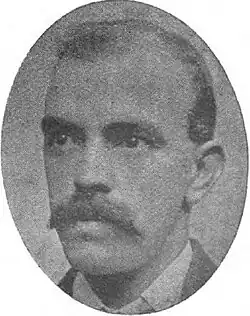 Parker in the mid 1900s | |
| Deputy Leader of the Labour Party | |
| In office 13 February 1912 – 9 February 1914 | |
| Leader | Ramsay MacDonald |
| Preceded by | William Brace |
| Succeeded by | Alfred Henry Gill |
| Member of Parliament for Cannock | |
| In office 14 December 1918 – 15 November 1922 | |
| Preceded by | Constituency Established |
| Succeeded by | William Adamson |
| Member of Parliament for Halifax | |
| In office 8 February 1906 – 14 December 1918 | |
| Preceded by | Savile Crossley |
| Succeeded by | Second seat abolished |
| Personal details | |
| Born | 1863 |
| Died | 11 February 1948 (aged 84–85) |
| Party | Labour (–1922) Independent (1922) |
Other political affiliations | Coalition Labour |
James Parker, CH (1863 – 11 February 1948)[1] was a British Labour Party politician.
Political career
He was elected as Member of Parliament (MP) for Halifax at the 1906 general election, and held the seat until the town's representation was reduced to one seat at the 1918 general election.[2] He did not stand again in Halifax, but instead stood in the Cannock division of Staffordshire, as a Coalition Labour candidate (i.e. a holder of the coalition coupon, supporting the Lloyd George's coalition government). He won the seat, but lost it, standing as an independent but supporting the National Liberal at the 1922 general election.[3]
Parker was made a Member of the Order of the Companions of Honour by King George V in 1918.
References
- ↑ Leigh Rayment's Historical List of MPs – Constituencies beginning with "H" (part 1)
- ↑ Craig, F. W. S. (1989) [1974]. British parliamentary election results 1885–1918 (2nd ed.). Chichester: Parliamentary Research Services. pp. 116–117. ISBN 0-900178-27-2.
- ↑ Craig, F. W. S. (1983) [1969]. British parliamentary election results 1918–1949 (3rd ed.). Chichester: Parliamentary Research Services. p. 461. ISBN 0-900178-06-X.