Italian occupation zone in the Balkans (1941–1943)
The Italian occupation zone in the Balkans during the Second World War was established during negotiations between Fascist Italy and the Nazi Germany in Vienna in April 1941.[1]
Italian occupation zone
Obligations
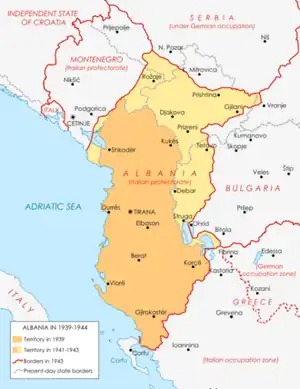
On 7 April 1939, Italian troops invaded Albania and quickly occupied it. The campaign was part of the ambitions of the Fascist leader Benito Mussolini to build an Italian empire.[2] After occupying Albania in 1939, Mussolini used the territory as a launchpad to invade Greece on October 28, 1940, aiming to annex Epirus.[3]
On 28 October 1940, the Greco-Italian War broke out. Initially, the Italian army made gains, advancing into Greek territory, but the Italians were subsequently defeated and driven back, with hostilities shifting to Albanian territory. This forced Hitler to intervene on the side of his ally Mussolini. The Axis forces’ military operation against Greece took place simultaneously with that against Yugoslavia and began on 6 April 1941. In a blitzkrieg, they routed the far weaker armies of Yugoslavia and Greece; Yugoslavia capitulated on 17 April, whilst Greece put up effective resistance until 27 April with the help of British troops who landed on Greek territory.[3]
Vienna Line

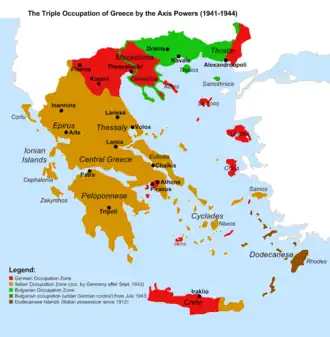
Following the successful conduct of the joint military operations (known respectively as Aufmarsch 25 and Marita) on 21–24 April 1941, a meeting took place in Vienna between Ribbentrop and Galeazzo Ciano.[4] At this meeting, the so-called ‘Vienna Protocol’ was signed, establishing a demarcation line that became known as the ‘Vienna Line’ and delineating the Italian zone in the Balkans. The occupation zone in Yugoslavia included, in the north, large parts of the territory of Slovenia and Croatia. Italy was also granted occupation of Montenegro, Albania and almost the whole of Kosovo. It was also granted part of Western Macedonia, including the towns of Tetovo, Struga, Debar, Kičevo and Gostivar, together with several villages south of Ohrid, with the aim of creating ‘Greater Albania’ . According to the ‘Vienna Protocol’, Italy was also granted the right to occupy vast areas of Greece – South-Western Macedonia (the districts of Paionia and Edessa, parts of Florina and Veria, Kastoria and part of Kozani), as well as Epirus, Thessaly, the Peloponnese, Euboea and the islands of the Cyclades archipelago.[5]
Аdministration and issues in the area


Following the negotiations, Italy had an army of half a million men in the Balkans. The country began to feel cheated because it had not achieved the full extent of its objectives. Subsequently, Germany annexed large territories in Slovenia, whilst Croatia, as an independent state, was to be placed under Italian protectorate, but German influence gradually prevailed there too.[8] The Duke of Spoleto, appointed by Italy as King of Croatia, never actually ascended the throne. Territorial disputes arose between Zagreb and Rome, and between Budapest and Rome.[9] Italy committed itself to proclaiming the independence of Montenegro, but not a single member of the Italian Queen’s family agreed to take the throne.[10] During World War II, Axis occupation forces partitioned Greece. Italy held nominal sway over much of the country, while Germany held key strategic points like Western Aegean Macedonia, parts of Crete, and the Maritsa River. Italy used Albania to push for a "Greater Albania," sparking territorial friction with Bulgaria.[11] The idea of a Greater Albania could be realised through expansion into Epirus (at Greece’s expense), Kosovo and Western Vardar Macedonia, where it clashed with Bulgarian claims. In Epirus, Macedonia and Thessaly, the pro-Italian Vlach separatist organisation, the Roman Legion, was active.[12]
The situation of the Jews and the organisation of resistance
During the war, the Italian authorities and individual officials took a number of measures to prevent the deportation of Jews from the territories occupied by Italy. Many Italian military officers, led by General Mario Roatta, commander of the Second Army stationed in the Balkans, realising that handing over the Jews would result in their mass extermination, decided to sabotage the orders for their deportation. The situation of the Jews in the Italian zone was considerably better than in the Bulgarian zone and, in particular, in the German zone. No Jews were deported from the Italian occupation zone.[13] Moreover, the Italians evacuated Jews from the German zone, saving them from death in the Nazi concentration camps. On the other hand, the Italians fiercely persecuted Resistance fighters and organised several mass massacres of partisans. The Italians also began ethnic cleansing in Slovenia with a view to exterminating and deporting the local Slavic population and replacing it with Italians.[14]
Italy’s armistice with the anti-Hitler coalition and its consequences


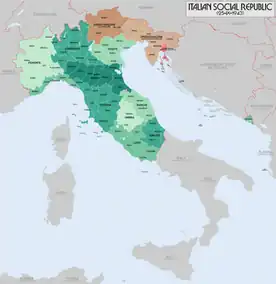
On July 25, 1943, Mussolini was overthrown in Italy. A new Italian government was appointed, headed by Marshal Pietro Badoglio, which in September included representatives of all Italian anti-fascist parties. Italy began to shift away from the Axis.[15] On September 3, an armistice was secretly signed in Sicily between the new Italian government and the Anti-Hitler Coalition, and it was announced on September 8, 1943. On October 13, 1943, Italy declared war on Nazi Germany.[16] Chaos ensued in the occupied zone of the Balkans. Some of the Italian troops stationed on the Balkan Peninsula were captured by the Germans after putting up some resistance. Such was the case with the 33rd “Acqui” Infantry Division on the island of Cephalonia, 5,155 of whose men were executed and 3000 more were taken as prisoners of war.[17] The Second Italian Army in Yugoslavia also put up sustained armed resistance; for the most part, it defected to the Yugoslav partisans, forming the “Garibaldi” Division.[18] Part of the Ninth Italian Army, specifically the “Arezzo” and “Florence” divisions, formed the “Antonio Gramsci” Division, which fought alongside Enver Hoxha’s Albanian partisans.[19] Most of the 24th “Pinerolo” Infantry Division joined the Greek partisans of the EAM and ELAS.[20] Some Italian units declared their allegiance to the new Italian Social Republic, a puppet state of Nazi Germany; this was the case in Slovenia with former units of the Fascist Volunteer Militia for the Protection of National Security, which fought alongside German troops. Overall, the Italian occupation zone in the Balkans was taken over by the Germans supported by Albanians, Croats, and Bulgarians and by the end of November. In November 1943, the Second Occupation Corps was established, a unit of the Bulgarian Army with headquarters in Drama, which was stationed in the area between the Vardar and Struma rivers, which until then had been a German occupation zone, with the aim of replacing the German army, which had been sent to occupy territories previously held by the Italian army.[21]
The Italian occupation zone and Bulgaria


See also
Notes
- ↑ Tomasevich, Jozo (2001). War and Revolution in Yugoslavia, 1941–1945: Occupation and Collaboration. Stanford, California: Stanford University Press. p. 49. ISBN 978-0-8047-0857-9.
- ↑ "Italy Invades and Annexes Albania | History | Research Starters | EBSCO Research". EBSCO. Retrieved 2026-08-10.
- 1 2 Herlihy, Darragh O. (2019-03-13). "A Slippery Road: Mussolini's Disastrous Invasion of Greece | War History Online". warhistoryonline. Retrieved 2026-08-10.
- ↑ "Meeting at Brenner Pass". WW2DB. Archived from the original on 2025-02-12. Retrieved 2026-08-10.
- ↑ Rodogno, Davide (2004). "Italian soldiers in the Balkans. The experience of the occupation (1941–1943)". Journal of Southern Europe and the Balkans. 6 (2): 125–144. doi:10.1080/1461319042000242029.
- ↑ "Italian Invasion of Albania 1939". onwar.com. Retrieved 2026-08-22.
- ↑ Balkan Studies: Biannual Publication of the Institute for Balkan Studies. The Institute. 1992.
- ↑ "How did the borders of Italian Protectorate of Albania change? (1939 AD–1943 AD)". phersu-atlas.com. Retrieved 2026-08-10.
- ↑ "Ante Pavelić | Ustaše leader, WWII leader, Poglavnik | Britannica". www.britannica.com. 2026-07-10. Retrieved 2026-08-10.
- ↑ "Monument to a World War II War Criminal as Part of a Russian-Serbian Influence Operation (Ljubomir Filipović)". Center for Western Balkans Studies. 2025-08-13. Retrieved 2026-08-10.
- ↑ History Hustle (2022-07-09). The Greek Collaborationist WW2 Government: the Hellenic State (1941–1944). Retrieved 2026-08-07 – via YouTube.
- ↑ Visualizing Virtual Borders: Identity Territorialization Shifts and “Imagined Geographies.
- ↑ "Escape from German-Occupied Europe". Holocaust Encyclopedia. Retrieved 2026-08-22.
- ↑ "Italy". Holocaust Encyclopedia. Retrieved 2026-08-07.
- ↑ "Notes on International Affairs". U.S. Naval Institute. 1943-09-01. Retrieved 2026-08-22.
- ↑ "Analysis: Armistice with Italy | History | Research Starters | EBSCO Research". EBSCO. Retrieved 2026-08-07.
- ↑ Ministero degli Affari Esteri e della Cooperazione Internazionale. "The Cephalonia Massacre – eighty years on". Archived from the original on 2026-06-11. Retrieved 2026-08-22.
- ↑ Fournel, Jean-Louis (2006). "Racconti della Resistenza". Laboratoire italien. 6: 247–249. doi:10.4000/laboratoireitalien.247. ISSN 1627-9204.
- ↑ Tsamis, Antonis (2022-01-31). "Monument to the Fallen of the Acqui Division - Kefalonia". Retrieved 2026-08-07.
- ↑ International, Réseau (2023-10-11). "Pinerolo, la division armée… divisée ! - Réseau International" (in French). Retrieved 2026-08-22.
- ↑ "The Bulgarian Army in the Years of the World War II". Meer. 2018-09-24. Retrieved 2026-08-07.
- ↑ "Bulgaria in World War II | Armchair General Magazine - We Put YOU in Command!". Retrieved 2026-08-22.
- ↑ "King Boris III of Bulgaria". Warfare History Network. Archived from the original on 2026-05-11. Retrieved 2026-08-07.
- ↑ Ademi, Haxhi (2017-10-06). "The Bulgarian Occupation Zone During World War II". European Journal of Interdisciplinary Studies. 9: 125. doi:10.26417/ejis.v9i1.p125-131.
- ↑ "North Macedonia". www.worldstatesmen.org. Retrieved 2026-08-22.
- 1 2 3 4 Tomanić, Boris (2021), "THE BULGARIAN OCCUPATION OF YUGOSLAVIA IN 1941", REPEATING HISTORY 1941-1991? TWO BREAK-UPS OF YUGOSLAVIA AS REPEATED HISTORY? SERBIAN PERSPECTIVES, Institut za savremenu istoriju, pp. 33–56, ISBN 978-86-7403-258-9, retrieved 2026-08-20
{{citation}}: CS1 maint: work parameter with ISBN (link) - ↑ Halsey, Eric D. (2026-08-16). "261 Harsh Realities". BGHP. Retrieved 2026-08-22.
- ↑ Jelavich, Barbara (1983-07-29). History of the Balkans. Cambridge University Press. ISBN 978-0-521-25448-9.
- ↑ "Иван Янев — Македония и българо-италианските отношения 1941–1943 г." Моята библиотека (in Bulgarian). 2009-12-10. Retrieved 2026-08-22.
- ↑ Иван Шандански, Въоръжената самозащита на българите в Егейска Македония (март - септември 1943 г.) / 14 бр. док. от Централния държавен архив - София. В: Известия на държавните архиви. - ISSN 0323-9780. - Т. 94 (2007), стр. 34-94.
- ↑ Fonzi, Paolo. 2021. “Political Violence in a Borderland. The Region of Kastoria under Italian Occupation (1941-1943)”. Journal of Balkan and Black Sea Studies, nos. 6: 75-99. https://izlik.org/JA84KZ76AL.
- ↑ Алека Стрезова, Хърватският пълномощен министър д-р Владимир Жидовец и неговият „Преглед на видни личности“ на България: наблюденията на дипломата за цар Борис ІІІ и неговите приближени. Известия на Института за исторически изследвания, том 41, 2025, стр. 401-412. ISSN: 2367-5187 (print), 2815-2913 (online) DOI: https://doi.org/10.71069/III41.25.SA23
- ↑ Kolanović, Nada Kisić (2023-10-03). "Nada KISIĆ KOLANOVIĆ, Zagreb – Sofija, prijateljstvo po mjeri ratnog vremena 1941-1945., Hrvatski državni arhiv, Dom i svijet, Zagreb 2003., 331 str.; Poslanstvo NDH u Sofiji – diplomatski izvještaji 1941-1945. (priredila Nada Kisić Kolanović), Hrvatski državni arhiv, Zagreb 2003., Svezak 1 (782 str.), Svezak 2 (742 str.)". p. 4.
- ↑ DDay.Center (2025-08-07). "The Role of the Balkan Campaign in WWII: Key Events, Impact, and Legacy". D-Day Center. Retrieved 2026-08-10.
Sources
- Yanko Gochev. "24 МАЙ 1941 г. ОХРИД ВЛИЗА ОКОНЧАТЕЛНО В БЪЛГАРИЯ" [May 24, 1941: Ohrid was finally incorporated into Bulgaria]. All Bulgarians United (in Bulgarian). Retrieved 11 August 2026.
- Nikolay Kochankov (2007). "От надежда към покруса: Западна Македония в българската външна политика (1941-1944)" [From Hope to Despair: Western Macedonia in Bulgarian Foreign Policy (1941–1944)] (in Bulgarian). Sofia: Heron Press.