Italian invasion of Tripolitania
| Italian invasion of Tripolitania | |||||||||
|---|---|---|---|---|---|---|---|---|---|
| Part of Italo-Turkish War | |||||||||
 Italian artillery at the Battle of Misrata (1912) during the invasion of Tripolitania, c. 1912 | |||||||||
| |||||||||
| Belligerents | |||||||||
 Ottoman Empire |
 Kingdom of Italy | ||||||||
| Commanders and leaders | |||||||||
| Strength | |||||||||
| 12,000[5]–14,000[6][7] | 10,000[8]–12,000[9] | ||||||||
| Casualties and losses | |||||||||
| Heavy | Minimal | ||||||||
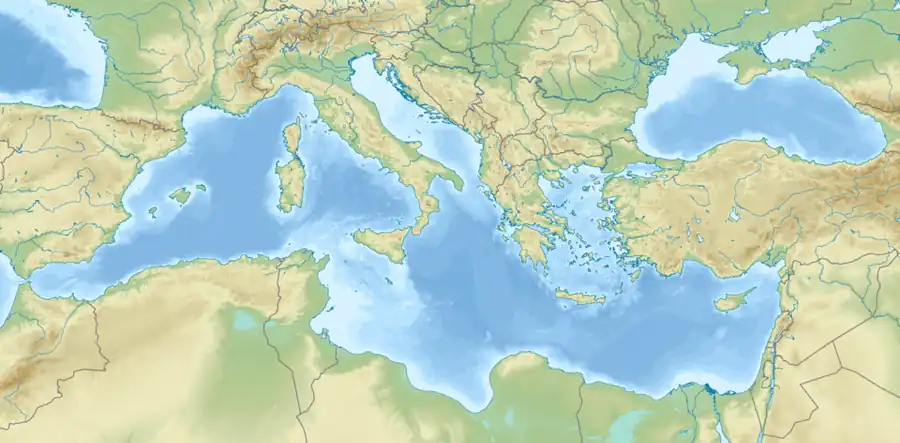  Location within Mediterranean 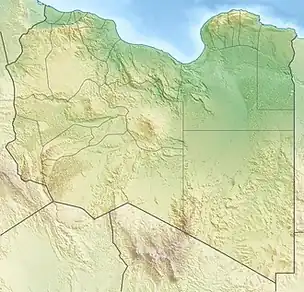 Italian invasion of Tripolitania (Libya) | |||||||||
Italian invasion of Tripolitania[10] also known as Italian conquest of Ottoman Tripolitania[11] or Italian Occupation of Tripolitania[12] was a military engagement between the Kingdom of Italy and Ottoman Empire. After occupation of the coastal areas of Tripolitania and capture of its capital Tripoli in 1911, the Italians launched a full-scale invasion in 1912. The Italians successfully captured Al-Khums, Janzur, Misrata and surrounding areas and annexed them into Italian Tripolitania.
Background
General Caneva, aware of the inadequacy of the Italian national troops in the Libyan theatre, requested the transfer to Libya of askari units from Italian Eritrea[13] and the constitution of mobile camel artillery units; a solution already tested by General Briccola in Benghazi by establishing a squadron of Arab cavalry. On 27 February 1912 the first corps of Libyan volunteers was constituted under the command of Lieutenant Federico Sirolli and at the same time, taking advantage of the destruction of the Turkish gunboats in Kunfida, troops were transported from Italian Eritrea. The first Eritrean battalion landed in Tripoli on 9 February.[14] The units arriving from Italian Eritrea were composed of the best elements of the four historic indigenous battalions (the "Toselli", the "Galliano", the II Eritrean Battalion "Hidalgo" and the "Turitto"). Among the men was Marshal Hamed Mohamed, the most decorated askari of the Italian Royal Army.[15] On February 11, the Eritrean Askaris and the Libyan Meharists of Captain Pollera paraded through the main streets of Tripoli chanting the cry, "Allah! Italy!"[13] attracting an enormous crowd of onlookers who spread out on the sides of the road and which the Carabinieri had difficulty holding back.[16]
The askaris were based in the entrenched camp of Ain Zara and from there they were immediately employed in reconnaissance in Tajura and Gargaresh.[17] Soon other askaris were recruited from among the Libyans themselves even if in this case, at least initially, the families were held "as a guarantee" in Tripoli.[18] One of the actions in which the Eritrean askaris most specialized was to reach the Turkish positions and, having identified a victim, take him prisoner and transport him within the Italian lines.[19]
Battle
In January 1912 it was decided to build some redoubts in Gargaresh, intended to accommodate some companies to defend the stone quarries from which materials were drawn for the construction of the port of Tripoli ; a contingent of troops and cavalry was sent to the area. During the march the Italian column clashed with the Turkish-Arabs; the fighting prevented the completion of the fortification system and the area was temporarily abandoned until the reoccupation on 20 January 1912.[20] Having lost Gargaresh, the Turkish-Arabs entrenched themselves in the sector between the height of Sidi Abd-el Gelil and the oasis of Zanzur, organising guerrilla actions against the Italian lines west of Tripoli, the Italian command then planned to attack the oasis to secure the entire coast up to the Tunisian border and then, to occupy it at a later stage against Zuara. On 8 June 1912 the 1st Division supported by some ships attacked the Ottoman defences.[21]
In addition to the vast area of Tripoli the Italian troops were kept in a constant state of alert also in the surroundings of Al-Khums where large Arab-Turkish formations carried out guerrilla actions in the area of Lebda and Mergèb. The 8th Bersaglieri Regiment, garrisoning Al-Khums, was reinforced with other infantry contingents; also thanks to the support of naval artillery the offensive pressure was alleviated and the Turkish-Arabs withdrew. Caneva decided to expand the defensive belt of Homs to bring the caravan routes of Tripoli, Misurata and Tharuna under stable control, in February 1912 he ordered the occupation of El-Mergèb.[22]
In the following months, still in the Homs sector, General Ezio Reisoli[b] was forced to maintain a considerable force in the Mergèb area, partly destined to garrison and complete the defence works. As soon as the works were completed, an Arab-Turkish attack took place against the Mergèb which was repelled in the first days of March by units of the 89th infantry regiment, the Mondovì Alpine battalion and the 8th Bersaglieri regiment; this offensive action induced General Reisoli to occupy Lebda, which was conquered together with some nearby reliefs, "i Monticelli".[24] The harassing actions in the Homs sector and in particular in the Mergeb and Lebda areas continued for many months, giving rise to clashes of varying importance. In June 1912 the Turkish-Arabs attacked the Monticelli fortified works complex, destroying a redoubt and decimating the soldiers of the garrison; the Italian counterattack repelled them with heavy losses.[25]
Almost simultaneously, in order to limit the smuggling of arms by sea, the occupation of the last Ottoman port in Tripolitania, Misurata at the mouth of the Gulf of Sirte, was carried out. Already planned in December 1911, the attack was postponed until June 1912 due to adverse weather conditions; seven infantry battalions, two Alpine battalions, a cavalry squadron, a company of the Eritrean V and five batteries with their services were assigned to the operation all units of the 1st Special Division drawn from the garrisons of Tripoli, Al-Khums, Benghazi, Derna and Rhodes.[26] The troops were transported by sea and arrived under the protection of the fleet near the coast on 16 June. The landing took place without unforeseen events and the localities of Bu Sceifa and Gasr-Ahmed were immediately occupied; On July 8, the infantry, protected by mounted troops, began to advance and after some clashes conquered Ras Zarrugh and soon after Misurata.[27] On July 20, near Misurata, a battle took place in which some detachments of the 50th and 63rd infantry were involved and occupied, after strong resistance, the village of El Ghiran.[28]
Other operations then concerned the border area towards Tunisia. To interdict war smuggling coming from the border areas, some landing projects at Zuara were studied but were postponed due to the negative weather conditions.[29] In April 1912 the project was taken into consideration again but, for nautical reasons, the occupation of the Ras el Machbez peninsula was decided. Once the landing had been carried out and the fort of Bu Kamech occupied, the Turkish-Arabs deployed in defence between Sidi Said and the Tunisian border. On 27 June the Italian troops, divided into two columns, attacked them, preceding the occupation of Sidi Said. Having lost the heights of Sidi Said, the Turkish-Arabs retreated towards Sidi Alì.[30] In order to dominate the caravan routes bordering Tunisia and control their traffic, the operation was continued with the final objective of Zuara. After carrying out some reconnaissance, all the troops of the 5th division, commanded by General Vincenzo Garioni, advanced along the coast line to proceed with the conquest of Sidi Alì which was taken on 14 July. On 6 August General Garioni's troops joined up with General Giulio Cesare Tassoni's brigade, which had landed near Zuara and was composed of the 34th, the 57th infantry, an Alpine battalion and some artillery units. The troops then entered Zuara without encountering resistance.[31]
Aftermath
The captured territories remained in Italian hands until August 1915, when all Italian troops were withdrawn from the Libya due to Italy's participation in World War I and widespread rebellion in Libya. All the territories would be eventually recaptured by Italian forces in 1922, during the Pacification of Libya.[32] After conquest of the Ottoman Tripolitania, the Italians moved into Cyrenaica to help the forces of Luigi Capello in conquest of Ottoman Cyrenaica.[33]
See also
Footnotes
- ↑ remaining of Ottoman Tripolitania was ceded to Italy along with Ottoman Cyrenaica viva Treaty of Lausanne (1912) on 18 October 1912[1]
- ↑ A second lieutenant in 1876, he commanded the Parma Brigade and rose to the rank of major general in 1908. He participated in the Libyan War, where for the conquest of Mergeb and Lebda, and the defense of Derna, he received the OMS commendation and was promoted to lieutenant general for war merit. In 1915, he commanded the II Army Corps and in 1916, the Genoa Army Corps.[23]
References
- ↑ Johnston, Robert Matteson (1904). "Lord William Bentinck and Murat". The English Historical Review. 19 (74). Oxford University Press: 263–280. JSTOR 2212446. Retrieved 30 July 2025.
- ↑ Schmitt, Bernadotte E., ed. (1966). The Origins of the War of 1914: European Documents. Vol. 2. New York: Fertig. p. 340.
- ↑ Cole, Juan R. I. (1981). The Egyptian Mediterranean: Articles and Documents on Anglo-French Rivalry in the Levant and the Mediterranean, 1770–1830. Princeton, New Jersey: Markus Wiener Publishers. p. 85. ISBN 9780910129947.
- ↑ Albertini, Luigi (1952). The Origins of the War of 1914. Vol. 2. Translated by Massey, Isabella M. London: Oxford University Press. p. 348.
The idea of seizing Tripolitania only occurred to them when the Germans under the sway of the Kaiser's "policy of might" ambitions showed an increasingly suspicious interest in this region which was held but loosely by the feeble Turkish sultanate. Italy decided upon the conquest of Tripolitania in order, as it were, to prevent a German conquest in the Mediterranean. Although she tore Tri-politania and the neighbouring Cyrenaica from Turkey in 1912, she was scarcely in a position to engage in true colonial development in the conquered territory.
- ↑ Stephenson 2014, p. 143.
- ↑ "30 Sep 1912 - TURCO-ITALIAN WAR. THE BATTLE OF ZANZUR. OVER 1". Trove.nla.gov.au. 1912-09-30. Retrieved 2015-05-21.
- ↑ Charles Stephenson, "A Box of Sand: The Italo-Ottoman War 1911-1912" (Tattered Flag Press, 2014), p. 143
- ↑ Stephenson (2014), p. 189.
- ↑ Beehler, William Henry (1913). The History of the Italian-Turkish War, September 29, 1911, to October 18, 1912. Annapolis, Maryland: Advertiser-Republican. p. 90.
- ↑ Fuller 2007, p. 471.
- ↑ Albertini, Luigi (1952). The Origins of the War of 1914. Vol. 2. Translated by Massey, Isabella M. London: Oxford University Press. p. 348.
- ↑ Askew, William C. (1942). Europe and Italy's Acquisition of Libya, 1911–1912. Durham, North Carolina: Duke University Press. p. 310.
- 1 2 Vandervort 2012, p. 310.
- ↑ Gabriele 1998, p. 120.
- ↑ Quirico 2003, p. 286.
- ↑ Quirico 2003, pp. 286–287.
- ↑ Quirico 2003, p. 287.
- ↑ Quirico 2003, p. 288.
- ↑ Quirico 2003, p. 289.
- ↑ Italy in Tripoli: A History of the Events of the Italo-Turkish War. Milan: Milanese Publishing Company. 1912. pp. 226–238.
- ↑ Italy in Tripoli: A History of the Events of the Italo-Turkish War. Milan: Milanese Publishing Company. 1912. pp. 226–238.
- ↑ Italy. Ministero della Guerra. Comando del Corpo di Stato Maggiore. Ufficio Storico 1924, pp. 23–26.
- ↑ Giglio, Carlo (1972). Inventario delle fonti manoscritte relative alla storia dell'Africa del Nord esistenti in Italia. Vol. 2: Gli archivi storici del Ministero della Difesa (Esercito, Marina, Aeronautica) dalle origini al 1922. Istituto di Storia ed Istituzioni dei Paesi Afro-Asiatici della Università di Pavia (in Italian). Leiden: E. J. Brill.
- ↑ Italy. Ministero della Guerra. Comando del Corpo di Stato Maggiore. Ufficio Storico 1924, pp. 32–34.
- ↑ Italy. Ministero della Guerra. Comando del Corpo di Stato Maggiore. Ufficio Storico 1924, pp. 33–34.
- ↑ Gabriele 1998, p. 175.
- ↑ Alberto Malatesta, ed. (1933). Enciclopedia militare: Arte, biografia, geografia, storia, tecnica militare (in Italian). Vol. 5. Milan: Il Popolo d'Italia.
- ↑ Scala 1952, pp. 278–284.
- ↑ Bertarelli, Luigi Vittorio (1929). Possedimenti e colonie: Isole Egee, Tripolitania, Cirenaica, Eritrea, Somalia. Guida d'Italia (in Italian). Vol. 16. Milan: Touring Club Italiano.
- ↑ Italy in Tripoli: A History of the Events of the Italo-Turkish War. Milan: Milanese Publishing Company. c. 1913. pp. 577–580.
- ↑ La formazione dell'impero coloniale italiano. Vol. 1: Le prime imprese coloniali e la rinascita coloniale (in Italian). Milan: Fratelli Treves. 1938. p. 350.
- ↑ Tuccari (1994).
- ↑ Tucker, Spencer C., ed. (2021). World War II: The Definitive Encyclopedia and Document Collection. Vol. 4 (2nd ed.). Santa Barbara, California: ABC-CLIO. p. 1920. ISBN 9781440860768.
Sources
- Vandervort, Bruce (2012). To the Fourth Shore: Italy's War for Libya, 1911–1912 = Verso la quarta sponda: La guerra italiana per la Libia (1911–1912) (in English and Italian). Rome: Stato Maggiore dell'Esercito, Ufficio Storico. ISBN 9788896260296.
- Gabriele, Mariano (1998). La marina nella guerra italo-turca: Il potere marittimo strumento militare e politico (1911–1912) (in Italian). Rome: Ufficio Storico della Marina Militare. ISBN 9788898485314.
- Quirico, Domenico (2003). Squadrone bianco: Storia delle truppe coloniali italiane. Oscar Storia (in Italian). Milan: Mondadori. ISBN 9788804521327.
- Stephenson, Charles (2014). A Box of Sand: The Italo-Ottoman War 1911-1912. Ticehurst: Tattered Flag Press. ISBN 978-0-9576892-2-0.
- Italy. Ministero della Guerra. Comando del Corpo di Stato Maggiore. Ufficio Storico (1924). Campagna di Libia (in Italian). Vol. 3. Rome: Stabilimento Poligrafico per l'Amministrazione della Guerra.
- Scala, Edoardo (1952). Storia delle fanterie italiane. Vol. IV: Le fanterie italiane nelle conquiste coloniali (in Italian). Rome: Stato Maggiore dell'Esercito, Ispettorato dell'Arma di Fanteria.
- Tuccari, L. (1994). I Governi Militari della Libia [The Military Governments of Libya] (in Italian). Rome: General Staff of the Army Historical Office.
- Fuller, Mia (2007). The Construction of Fascist Libya: An Annals of Italian Colonialism. Amsterdam: Gordon and Breach Publishers. ISBN 9789056992248.