Iridium(III) bromide
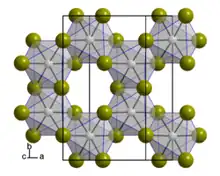 Crystal structure | |
| Identifiers | |
|---|---|
| |
3D model (JSmol) |
|
| ChemSpider | |
| ECHA InfoCard | 100.030.146 |
| EC Number |
|
PubChem CID |
|
CompTox Dashboard (EPA) |
|
| |
| |
| Properties | |
| Br3Ir | |
| Molar mass | 431.929 g·mol−1 |
| Appearance | dark reddish-brown solid[1] |
| Density | 6.82 g·cm−3[2] |
| insoluble[1] | |
| Solubility | insoluble in acids and bases[1] |
| Hazards | |
| GHS labelling:[3] | |
 | |
| Warning | |
| H315, H319, H335 | |
| P261, P264, P264+P265, P271, P280, P302+P352, P304+P340, P305+P351+P338, P319, P321, P332+P317, P337+P317, P362+P364, P403+P233, P405, P501 | |
| Related compounds | |
Other anions |
Iridium(III) hydroxide Iridium(III) chloride Iridium(III) iodide |
Other cations |
Ruthenium(III) bromide Rhodium(III) bromide Osmium(III) bromide Platinum(III) bromide |
Related compounds |
Iridium(II) bromide |
Except where otherwise noted, data are given for materials in their standard state (at 25 °C [77 °F], 100 kPa).
Infobox references | |

Iridium(III) bromide is an inorganic compound, a bromide of iridium(III), with the chemical formula of IrBr3.
Properties
Iridium(III) bromide is a dark reddish-brown solid that is insoluble soluble in water, acids, and alkalis and decomposes to iridium(II) bromide on heating.[1] The light olive green tetrahydrate is slightly soluble in water but insoluble in ethanol and ether. When heated to 100 °C, it turns dark brown with release of water and decomposes to iridium and bromine at higher temperatures.[1]
Structure
Iridium(III) bromide crystallizes in a highly disordered layered structure of aluminum(III) chloride or chromium(III) chloride type, where the monoclinic unit cell contains four formula units. As with rhenium(III) chloride, rhenium(III) bromide, α-iridium(III) chloride and α-ruthenium(III) chloride, the disorder is due to the different stacking of the metal layers.[4]
Preparation
Iridium(III) bromide can be formed by reacting iridium(II) bromide and bromine. Its tetrahydrate can be formed by reacting iridium dioxide dihydrate with hydrobromic acid.[1] It can also be formed by the direct reaction of iridium and bromine at 8 atm and 570 °C.[5]
Reactions
Iridium(III) bromide reacts with germanium dibromide in hydrobromic acid solution to form a compound containing Ir-Ge bond, and adding Cs+ to it can separate Cs3[Ir(GeBr3)nBr6−n] (n=1, 2, 3).[6]
References
- 1 2 3 4 5 6 Kandiner, H. J. (2013-09-03). Iridium (in German). Springer-Verlag. ISBN 978-3-662-12128-3.
- ↑ Perry, Dale L. (2016-04-19). Handbook of Inorganic Compounds. CRC Press. ISBN 978-1-4398-1462-8.
- ↑ PubChem. "Iridium bromide (IrBr3)". pubchem.ncbi.nlm.nih.gov. Retrieved 2026-04-06.
- ↑ Brodersen, K.; Thiele, G.; Ohnsorge, H.; Recke, I.; Moers, F. (1968-07-01). "Die struktur des IrBr3 und über die ursachen der fehlordnungserscheinungen bei den in schichtenstrukturen kristallisierenden edelmetalltrihalogeniden". Journal of the Less Common Metals (in German). 15 (3): 347–354. doi:10.1016/0022-5088(68)90194-X. ISSN 0022-5088.
- ↑ Livingstone, Stanley E. (2017-01-31). The Chemistry of Ruthenium, Rhodium, Palladium, Osmium, Iridium and Platinum: Pergamon Texts in Inorganic Chemistry, Volume 25. Elsevier. ISBN 978-1-4831-5840-2.
- ↑ Antonov, P. G.; Agapov, I. A.; Manasevich, D. S. Iridium(III) complexation with germanium(II) compounds in aqueous hydrobromic acid solutions (in Russian). Zhurnal Prikladnoi Khimii (Sankt-Peterburg), 1999. 72 (4): 556-559. ISSN: 0044-4618.