Interval signal
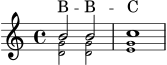
An interval signal, or tuning signal, is a characteristic sound or musical phrase used in international broadcasting, numbers stations, and by some domestic broadcasters, played before commencement or during breaks in transmission, but most commonly between programs in different languages.
It serves several purposes:
- It helps a listener using a radio with an analog tuner to find the correct frequency.
- It informs other stations that the frequency is in use.
- It serves as a station identifier even if the language used in the subsequent broadcast is not one the listener understands.
The practice began in Europe in the 1920s and 1930s and was carried over into shortwave broadcasts. The use of interval signals has declined with the advent of digital tuning systems, but has not vanished. Interval signals were not required on commercial channels in the United States, where jingles were used as identification.
List of interval signals by station
Recent













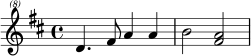
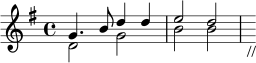






















































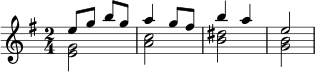






























Formerly used
| Radio station | Playable sound |
|---|---|
 Radio Tirana Këputa një gjethe dafine (transmission intro); the trumpet version of With Pickaxe and Rifle. |
  |
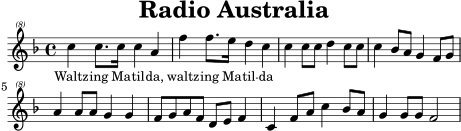
 Radio Australia Chorus segment of Waltzing Matilda; Kookaburra call; News signature tune: Majestic Fanfare. |
 |
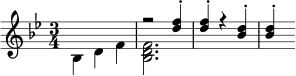
 Radio Österreich International An der schönen blauen Donau ("Blue Danube Waltz") by Johann Strauss.[7] |
 |
| Ö1
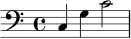
Three notes signifying O–R–F by Werner Pirchner, played on viola.[8] |
 |
| ORF |
1st Program: Schubert, Rosamunde, Ballet Music 2
 3rd Program: Haydn, Surprise Symphony 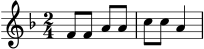 |
 RTBF International: |
Où peut-on être mieux qu’au sein de sa famille ?
 Benoit, Beiaardlied  |
 Rádio Nacional |
 |
 Radio Canada International |
 |
 Cyprus Broadcasting Corporation |
 |
 Radio Prague |
Smetana, Má vlast, 1. Vyšehrad
 Last segment of Kupředu levá ("Forward, Left") by cs:Jan Seidl  Adagio – Allegro molto from Symphony No. 9 by Dvořák.  |
 Radio Denmark: Nielsen, Moderen, Scene7 No.22 Som en rejselysten flåde |
 |
 HCJB: using a motif from Great Is Thy Faithfulness |
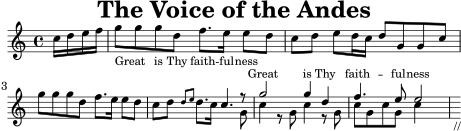 HCJB Japanese program: "Sakura Sakura" (さくらさくら, cherry blossoms)  |
 Yle Radio 1: Pim-pam-pulla, a tune from the 1700s proposed by A. O. Väisänen for 5-string kantele.[11][12] |
 |
 Radio France Internationale: a popular song, Nous n'irons plus au bois.[7] |
 |
 Nordwestdeutscher Rundfunk: The 4th symphony by Brahms. |
 |
 Reichssender Berlin: Ending bars of Volk ans Gewehr, played on celesta. |
 |

Berliner Rundfunk: Motif from the opera Regina, Act3 Finale by Albert Lortzing, played by horns. |
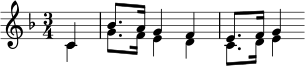 Radio Berlin International: Beginning of Auferstanden aus Ruinen ("Risen from Ruins"), played on chimes[13].  Radio DDR: Refrain of de:Wann wir schreiten Seit’ an Seit’  Radio NTS: Tchaikovsky, Symphony #5, Mvt.4 DFS 904: "Ode to Joy" |
 Germany Deutschlandfunk: Ending bars of "Ich hab' mich ergeben" by August Daniel von Binzer.[14] 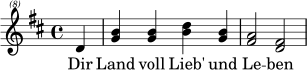 RIAS Berlin: Franz Wallner-Basté 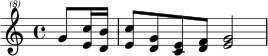 Deutschlandsender: Mozart, The Magic Flute (Ein Mädchen oder Weibchen) / Schubart, Üb’ immer Treu und Redlichkeit 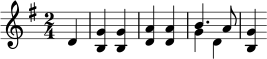 Funk-Stunde Berlin: |
 |
| ORAG Königsberg | |
| Friedrich Dewischeit, de:Masurenlied (Wild flutet der See) |  Wo des Haffes Wellen trecken an den Strand 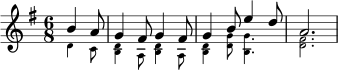 NORAG Hamburg: Wagner, Der fliegende Holländer, Act 3, Steuermann, lass die Wacht (Sailors' Chorus) 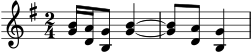  (Dominant major ninth chord)  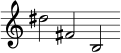 WDR Köln: Beethoven, Bundeslied (In allen guten Stunden)  Deutsche Stunde in Bayern München: Wagner, Parsifal, Parsifal bell 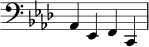 BR München: Wiesberg, de:Solang der alte Peter  Schlesische Funkstunde Breslau: Hohenfriedberger Marsch  Sender Freies Berlin: Es-F-B 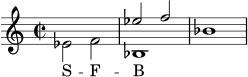 Radio Saarbrücken: Kein schöner Land in dieser Zeit  SR Saarbrücken: de:Steigerlied (2nd line: Und er hat sein helles Licht bei der Nacht) 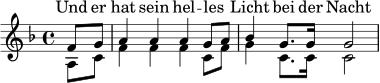 SWF Baden-Baden: Mozart, The Magic Flute (Act 2: No.21, Finale: Bald prangt, den Morgen zu verkünden) 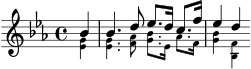 SDR Stuttgart: Silcher, Jetzt gang i ans Brünnele 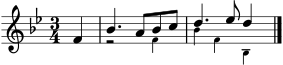 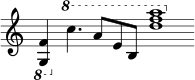 Radio Bremen: Bach, Mass in B minor, Et in terra pax  |
 Budapest I: Excerpts from the suite 1848 by T.K. Polgar played on three trumpets and two cornets. |
  |
 Kol Yisrael: latter half of Hatikvah played on trumpets and timpani. |
 |
 Rai Italia Radio: Mechanically generated canary chirping. |
 |
 Radio Riga: |
 |
 LJBC: |
https://www.intervalsignals.net/sounds/lby-z-ljbc_gj_radio_270411.mp3 https://www.intervalsignals.net/sounds/lby-z-ljbc_koran_040603.mp3 https://www.intervalsignals.net/sounds/lby-z-ljbc_iraq_020603.mp3 https://www.intervalsignals.net/sounds/lby-z-ljbc_vo_africa_051100.mp3 https://www.intervalsignals.net/sounds/lby-z-splajbc_gj_radio_121100.mp3 https://www.intervalsignals.net/sounds/lby-z-splajbc_c1982.mp3 https://www.intervalsignals.net/sounds/lby-z-vogah.mp3 https://www.intervalsignals.net/sounds/lby-z-prb_c1975.mp3 |
 Radio Vilnius: |
 latter half of Anthem of the Lithuanian Soviet Socialist Republic  |
 Voice of Malaysia: Dondang Sayang |
 |
 NPO First eight notes of Wilhelmus, played on:[15]
|
 Radio Netherlands: Carillon version of the Eighty Years' War song Merck toch hoe sterck.  |

|
 Kjenningssignalet: beginning bars of Symphony No.1 "Innover viddene" by Eivind Groven  |

Radio Katowice: Sound of a hammer striking an anvil.[17] Radio Olsztyn: Excerpt from pl:O Warmio moja miła by Feliks Nowowiejski, played on barrel organ. |
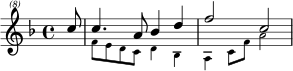 Polish Radio External Service: Excerpt from Prząśniczka by Stanisław Moniuszko[18]  Etude No. 12 ("Revolutionary Etude") by Chopin  Military Polonaise by Chopin 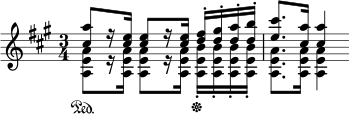 |
 Radio Bucharest 1 and Radio Bucharest External Service (pre 1989): Fragment from Cantata anilor luminǎ by Anatol Vieru |
 |
 Voice of Russia: "Great Gate of Kiev" portion of Pictures at an Exhibition by Mussorgsky. |
 |
 Radio Serbia: Bože pravde, in various renditions. |
 |
 Radio Slovakia International: sk:Kto za pravdu horí |
 |
 Radio RSA (former international service of Apartheid-era South African Broadcasting Corporation): Bokmakierie chirping and first bars of Ver in die Wereld, Kittie, played on guitar.[7][19] |
 |
 Radio Exterior de España: "Generala" (1761,1769) by es:Manuel de Espinosa de los Monteros |
 |
 Radio Sweden: Ut i vida världen ("Out in the Wide World"), composed by Ralph Lundsten[20] |
 The opening notes of Carl Michael Bellman's Storm och böljor tystna r'en.[7]  |

Radio Beromünster: D' Zit isch do, played on music box. |
 Swiss Radio International: de:Lueget, vo Bärgen und Tal.  Red Cross Broadcasting Service: Purcell, The Indian Queen, Trumpet Tune  |
 Voice of Turkey: Turkish makam, played on piano. |
|
 Radio Moscow (former international service of the Soviet Union) |
Подмосковные вечера ("Moscow Nights") performed by "Georgy Garanian and Melodia"  Песня о Родине ("Wide Is My Motherland")  |
 BBC World Service: Trumpet version of Oranges and Lemons; first four notes of Symphony No. 5 by Beethoven, played on timpani; Lillibullero (signature tune).[21] |
  |
 World Christian Broadcasting (Alaska KNLS, Madagascar Madagascar World Voice (MWV)) |
 An unnamed tune by Jeff Brock[22]  |
| WYFR: First bars of To God Be the Glory by William Howard Doane |
 |
 Radio Yugoslavia (1980–1989) Druže Tito, ljubićice bjela anonymous Partisan song, in various orchestral renditions.[23]  |
 |
 Radio Yugoslavia, later International Radio of Serbia and Montenegro: 2nd verse of Svečana Pesma (sr:Свечана песма) by sh:Nikola Hercigonja |
 |
| Classical radio station WQXR-FM in New York City, during its ownership by The New York Times Company, played different variations of a classical infused gong with the ID read at the same time as "The Classical Station of the New York Times, WQXR, New York (And WQXR.com 2000–2009) |
Numbers station interval signals
Numbers stations are often named after their interval signals, such as The Lincolnshire Poacher or Magnetic Fields after "Magnetic Fields Part 1" by Jean-Michel Jarre.
References
- ↑ Archived at Ghostarchive and the Wayback Machine: stephensen (2009-10-19). "Pausesignal". Retrieved 2020-04-02 – via YouTube.
- ↑ Archived at Ghostarchive and the Wayback Machine: Ο τσομπανάκος σήμα ΕΡΤ). YouTube.
- ↑ Tuning into broadcast history. The Hindu BusinessLine, 15 October 2015.
- ↑ "'O'Donnell Abú'". RTÉ.ie.
- ↑ "Pausenzeichen und ihre musikalischen Quellen". 8 October 2007.
- ↑ "Радио холбооны анхны өдрүүд..." 4 May 2022.
- 1 2 3 4 Frost, Jens Mathiesen (1983). World Radio TV Handbook. New York: Billboard Publications.
- ↑ Treiber, Alfred (2007). Ö1 gehört gehört : die kommentierte Erfolgsgeschichte eines Radiosenders (in German). Vienna: Böhlau. p. 218. ISBN 978-3-205-77495-2. OCLC 127107294.
- ↑ "Internet tunes". Archived from the original (M3U) on 2024-04-18.
- ↑ "A NOTE ON THE CYPRIOT SONG "TA RIALIA" ("THE MONEY")". 2024-05-29. Retrieved 2025-10-05.
- ↑ "Radion väliaikamerkki". yle.fi (in Finnish). 4 July 2008. Archived from the original on 2019-06-21.; Audio file (mp3). Archived from the original on 2025-10-01. Retrieved 2025-10-02.
- ↑ "Pim-Pam-Pulla – YLEn välimerkki, joka jäi mieliin! – Tekniikan museo" (in Finnish). 2021-11-15.
- ↑ https://static1.squarespace.com/static/51a013dee4b0a2a2d2ef73e9/t/6a3e078bfe7a2a411be08764/1782450061172/RBI+Berlin+GDR+1970.mp3
- ↑ "Deutschlandfunk - Kalter Krieg im Radio" (in German). p. 3. Archived from the original on 2015-01-23.
- ↑ "Interval Signals Online - Netherlands". www.intervalsignals.net. NOS Hilversum 1-5. Retrieved 2025-10-05.
- ↑ Andy Emmerson. "The interval signal – Vanishing and endangered species" (PDF). Archived from the original (PDF) on 2015-12-08.
- ↑ "Interval Signals Online - Poland". Katowice (vintage - 1975). Retrieved 2025-10-02., Audio file (mp3). Retrieved 2025-10-02.
- ↑ "Interval Signals Online - Poland". Radio Polonia (vintage - 2006). Retrieved 2025-10-02.; Audio file (mp3). Retrieved 2025-10-02.
- ↑ "DX Listening Digest 7-043".
- ↑ "Signaturer & musikvinjetter | Andromeda" (in Swedish). 1984-05-06. Retrieved 2025-10-02.; Audio file (ogg). Retrieved 2025-10-02.
- ↑ "BBC World Service - Pausenzeichen-Datenbank". www.intervalsignals.org (in German). Retrieved 2025-10-05.
- ↑ Image file (jpg). Retrieved 2025-10-04.
- ↑ "Radio Jugoslawien - Pausenzeichen-Datenbank". www.intervalsignals.org (in German). Retrieved 2025-10-05.

Further reading
External links

- Interval Signals Online
- Nobuyuki Kawamura's Interval Signal Library
- IntervalSignal DataBase (German)
- Uwe Volk's Sound Library (available both in English and in German)
- Kurzwelle-Historisch
- Interval Signal Library on www.irkutsk.com