Insular Italy
Insular Italy
| |
|---|---|
 | |
| Country |  Italy |
| Regions |  Sardinia  Sicily |
| Area | |
• Total | 49,932.41 km2 (19,279.01 sq mi) |
| Population (2026)[2] | |
• Total | 6,329,684 |
| • Density | 126.7650/km2 (328.3199/sq mi) |
Insular Italy (Italian: Italia insulare or just isole, lit. 'Islands') is one of the five official statistical regions of Italy used by the National Institute of Statistics (ISTAT), a first level NUTS region and a European Parliament constituency. Insular Italy encompasses two of the country's 20 regions:
Geography
Insular Italy occupies one sixth of the national territory in surface area. Territorially, both Sicily and Sardinia include several minor islands and archipelagoes that are administratively dependent on the mother islands.
Sicily is the largest island in the Mediterranean (25,708 km2) and one of the largest of Europe, while Sardinia is only slightly less extensive (24,090 km2). The lowlands are generally limited in the geographic region and generally appear as narrow coastal belts. The only exceptions are the Campidano and Nurra, in Sardinia, and the Plain of Catania, in Sicily, which extend 1,200 km2 (460 sq mi) and 430 km2 (170 sq mi), respectively. The rest of the area is prevalently hilly, with hills occupying 70% of the territory.
Sicily is home to Mount Etna, Italy's highest non-Alpine peak and Europe's largest active volcano. Sardinia is home to the Gennargentu mountain range.
Regions
| Region | Capital | Population
(2026)[2] |
Area
(km²)[1] |
Density
(inh./km²) |
|---|---|---|---|---|
| Sardinia |
Cagliari | 1,554,490 | 24,100.02 | 64.5 |
| Sicily |
Palermo | 4,775,194 | 25,832.39 | 184.9 |
Demographics
As of 2026, the population is 6,329,684, of which 49.0% are male, and 51.0% are female. Minors make up 14.8% of the population, and seniors make up 25.2%.[2]
| Year | Pop. | ±% |
|---|---|---|
| 1861 | 3,017,528 | — |
| 1871 | 3,226,578 | +6.9% |
| 1881 | 3,613,604 | +12.0% |
| 1901 | 4,363,917 | +20.8% |
| 1911 | 4,679,936 | +7.2% |
| 1921 | 5,108,647 | +9.2% |
| 1931 | 4,889,727 | −4.3% |
| 1936 | 5,034,284 | +3.0% |
| 1951 | 5,762,772 | +14.5% |
| 1961 | 6,140,363 | +6.6% |
| 1971 | 6,154,515 | +0.2% |
| 1981 | 6,501,053 | +5.6% |
| 1991 | 6,614,634 | +1.7% |
| 2001 | 6,600,871 | −0.2% |
| 2011 | 6,642,266 | +0.6% |
| 2021 | 6,420,742 | −3.3% |
| Source: ISTAT[3][4] | ||
The population is just over one-tenth of the Italian population and by far the lowest of all of the country's macro-regions. While it is the smallest macro-region in area, the region also has the lowest population density. This is because of the scarce population of Sardinia, one of the least densely populated parts of Italy at only around one-third of Italy's average population density. The islands are of roughly the same size but three quarters of the region's population lives in Sicily.
Largest cities
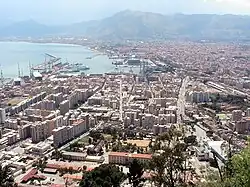


The most populous cities with more than 50,000 inhabitants are:
| City | Region | Population
(2026)[2] |
|---|---|---|
| Palermo | Sicily |
626,273 |
| Catania | Sicily |
296,984 |
| Messina | Sicily |
216,458 |
| Cagliari | Sardinia |
145,981 |
| Sassari | Sardinia |
120,231 |
| Syracuse | Sicily |
115,515 |
| Marsala | Sicily |
79,521 |
| Ragusa | Sicily |
74,122 |
| Gela | Sicily |
70,109 |
| Quartu Sant'Elena | Sardinia |
67,869 |
| Vittoria | Sicily |
66,329 |
| Olbia | Sardinia |
61,739 |
| Caltanissetta | Sicily |
57,922 |
| Agrigento | Sicily |
55,118 |
| Trapani | Sicily |
54,636 |
| Modica | Sicily |
53,622 |
| Bagheria | Sicily |
53,152 |
| Acireale | Sicily |
50,528 |
| Mazara del Vallo | Sicily |
50,070 |
Immigration
As of 2025, immigrants make up 6.1% of the population. The 5 largest foreign countries of birth are Romania, Germany, Tunisia, Morocco, and Switzerland.[5]
Economy
The gross domestic product (GDP) of the region was 123.9 billion euro in 2018, accounting for 7% of Italy's economic output. The GDP per capita adjusted for purchasing power was 18,500 euro or 62% of the EU27 average in the same year.[6]
The unemployment rate of Sicily is the highest in the country at 11.9%, while in Sardinia between 2006-07 it dropped for the first time below 10%, reaching 8.6%, the lowest of all the Mezzogiorno regions, excluding Molise and Abruzzo.
The low level of entrepreneurship in Sicily is tied to the local organized criminal activity, and in Sardinia, it results from the rather expensive operating expenses (electricity, transportation etc.), which are 20-50% higher than other regions because of its peripheral location from the Italian mainland and the lack of a proper territorial continuity (continuità territoriale). That condition has been reduced in Sardinia with the development of information technologies like Tiscali, low-cost carriers like Ryanair and laws regarding fares and routes between the islands and mainland Italy.
See also
References
- 1 2 "Superficie di Comuni Province e Regioni italiane al 9 ottobre 2011" (in Italian). ISTAT.
- 1 2 3 4 "Resident population". ISTAT.
- ↑ "Popolazione residente dei comuni. Censimenti dal 1861 al 1991" [Resident population of the municipalities. Censuses from 1861 to 1991] (PDF) (in Italian). ISTAT. Archived from the original (PDF) on 12 November 2025.
- ↑ "Resident population - Time series". ISTAT.
- ↑ "Resident population by sex, municipality and citizenship". ISTAT.
- ↑ "Regional GDP per capita ranged from 30% to 263% of the EU average in 2018". Eurostat.
