Indigenous conflicts on the Mexico–United States barrier
Several Indigenous peoples who live on the United States–Mexico border have objected to the construction of a border wall on their territories and what they perceive as the militarization of the border by the United States government. The US–Mexico border crosses several Indigenous territories and divides these communities. The barrier erected between the United States and Mexico cuts through and/or affects at least 29 Indigenous tribes, which include Kumeyaay Nation and Tohono O'odham.[1]
Increased efforts by the US government at border control, beginning in the 1980s, and the construction of a physical border wall, beginning in the 1990s, along the US-Mexico boundary, have significantly impacted tribal nations. Whether it be disrupting the movement of tribal members across the US-Mexico border by requiring the use of a specific port of entry or specific documentation or the destruction of Native territory, the border had significant implications. In response, the Tohono O'odham and the Kumeyaay nations, among others, have engaged in protests against the barrier.[2]
History
Creation of the US-Mexico border
The border between the United States and Mexico was formed through treaties and negotiations that often failed to include Indigenous peoples in the negotiations and conversations.[3]
In 1848, the Treaty of Guadalupe Hidalgo was signed after the Mexican-American War, and it drew a demarcation between the United States and Mexico.[2][3] Additionally, Article XI of this treaty puts Indigenous tribes under the control of the United States and also allows restrictions of Indigenous movements across the border, while also honoring land claims of Mexican citizens.[2] Some tribal nations were able to obtain said land grants, but those tribes who did not live in established villages were unable to receive land grants. Thus, their territory rights were not honored in this treaty nor by the United States. Native Americans, including those who were impacted by this treaty, were excluded from conversations and negotiations between the United States and Mexico. Furthermore, governments of the United States and Mexico both failed to consider Indigenous homelands and sites of spiritual significance when creating the border. It is additionally argued creation of the border also included creation of citizenship which led to the restriction of free travel and a plethora of other issues.[2][3]
Around five years after the Treaty of Guadalupe Hidalgo was signed, the Gadsden Purchase modified the earlier boundary For $10 million, United States bought 30,000 square miles which makes up present-day the southernmost regions of southern Arizona and southern New Mexico. A primary reason for this purchase was the desire to build a transcontinental railroad. The same protections provided in the Treaty of Guadalupe Hidalgo still applied to the residents in this newly added tract of land.[4]
Border wall construction and militarization
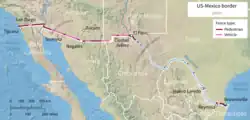
In the 1990s during the administration of American President George W. Bush, 14 miles of border wall were constructed near San Diego, California. The Illegal Immigration Reform and Immigration Responsibility Act of 1996 additionally fortified that 14 mile stretch of wall as part of efforts to reduce illegal immigration. Other legislation, such as the Secure Fence Act, have expanded upon those initial 14 miles of wall.[5] Further expansion of wall construction occurred with President Donald Trump's Executive Order: Border Security and Immigration Enforcement Improvements.[6] In order to reduce the amount of drugs and human-trafficking instances and to crack down on immigration, the United States began militarizing the border.[2] The war on drugs in the 1980s led to Border Patrol agents expanding their duties from immigration duties to drug enforcement, which included, at times, collaboration with the military.[7]
Tribal nations' borders

Various Indigenous groups inhabited the modern region of the American-Mexican border for thousands of years before Europeans, and often had their own conflicts over territory and resources.[8][9] The Apache and Navajo, in particular, were aggressively expansionist and displaced a number of other Indigenous groups.[10] The Kickapoo were lived in what is now Ohio at the time of contact with Europeans, and migrated south and west eventually settling in and around the US-Mexico border. the border region of what is now the Several nations, regardless of when they established themselves in the region, had sacred lands, resources, and members that extended beyond the border created after the Mexican-American War and the Gadsden Purchase, and with the creation of such a border also came the creation of citizenship which led to the restriction of free travel, jurisdictional issues, and a plethora of other issues.[2][3] For instance, a tribal nation that spans the border might offer citizenship to all people regardless of location, but the states in which they exist may not recognize them as citizens of their locale. This citizenship issue particularly along the United States and Mexico border has many implications including limiting travel amongst members of a tribal nations and providing resources and services to a fragment of the tribal population.[11]
Tribal nations that span the border include:[12]
- Apaches
- Cocopah / Cucapá
- Kickapoo / Kikapú
- Kumeyaay / Kumiai
- O'odham
- Pai
- Yaqui / Yoeme
Many of these tribes are units comprising multiple nations. For instance, the Kumeyaay nation is made up of thirteen reservations in the United States and four communities in Mexico.[12]
Kumeyaay
The Kumeyaay initially were located along the Pacific coastline, but they were later forced inland towards present-day San Diego and occupied territory that would later span the United States and Mexico border.[3] Kumeyaay initially responded to encounters with the Spaniards with violence, but after two of the Kumeyaay's raid attempts failed, they resorted to tolerance. However this short respite did not last long as Spanish missions began to interfere with the Kumeyaay peoples. Over the almost forty years (1768-1822) that missions were present in the Kumeyaay region, the relationship was characterized by intermittent violence and reshaping boundaries.[13] In 1821, Mexican Independence did not bring peace between the new nation and the Kumeyaay people. It did however mark a change in relationship as the Kumeyaay successfully raided surrounding ranchos and left the San Diego mission town weakened by 1846.[14] The Kumeyaay advances to the coast combined with Quechan resistance to the Colorado River, cut off land routes from Alta California to the rest of Mexico, further splitting Alta California from Mexico economically and unintentionally forming the formation of the state's southern border. In 1848, the Americans arrive to fight the Mexican American War; the Kumeyaay offered their assistance, but their services were declined. Although they were not allied with the Americans, the Kumeyaay people still took revenge against the Mexicans for wrongdoings towards the end of the war. The war between Mexico and the United States ended with the Treaty of Guadalupe Hidalgo, but it failed to include the Kumeyaay and other tribes in negotiations.[15] Land disputes, violence, and territory loss lasted for many years after the Treaty of Guadalupe Hidalgo because of the massive influx of people participating in the California Gold Rush. The Kumeyaay, and more broadly American Indians, were subjected to legalized forced servitude for four months if an American Indian was unemployed. In 1851, the San Diego government required the Native Americans to pay taxes, and if not, their land may be confiscated. There were many legislative and political decisions made in an effort to obtain the territory of the Kumeyaay and other tribes.[16]
Tohono O'odham
The Tohono O'odham people were historically established in the Papagueria region, which crosses present-day state lines and national borders.[17] Similarly to the Kumeyaay peoples, the Tohono O'odham peoples were subjected to dealing with Spanish colonization, Mexican Independence, the Mexican-American War, and the Gadsden purchase.[17] Spanish missionaries were present in the region, and helped protect the Tohono O'odham people from being subjected to forced servitudes. However, when Mexican Independence was achieved, this protection diminished and Mexicans encroached upon their territory and violence ensued, yet the violence lessened between the 1830s and 1850s. Mexicans also began to further encroach upon the Tohono O'odham territory, which increased tensions and hostilities, but these concerns were reduced with the Gadsden Purchase. For the next few decades, the tensions and violence shifted from colonists to the Apache, but when the United States did not honor the land rights, the United States government established reservations to end land disputes, which did not encompass their entire traditional territory. On the other hand, the Mexican government did not initially create a reservation, so the Mexican people continued to encroach upon Tohono O'odham lands, which in turn led to violence. Many of the Tohono O'odham fled to the United States, but a few remained in Mexico.[18]
Issues
Militarization of border
Border control has made it increasingly difficult for tribal nations whose territories extend across the border to travel freely. Racial profiling, requiring documentation, and fear have restricted free movement of Indigenous peoples to their counterparts across the border while also interrupting their daily practices and lives. A Supreme Court ruling upheld the precedent that "apparent Mexican ancestry" is reasonable suspicion to stop people near the United States and Mexico border. This contributed to an increase of racial profiling and stops of Native Americans.[2] When an Indigenous individual is stopped and declares they are a member of a tribe, they often face further interrogation. In addition to racial profiling, documentation required to cross the border has led to numerous challenges. For instance, the Tohono O'odham people in Mexico and the United States are members of a binational tribe, and able to access tribal nation services like healthcare. However, the militarization of the United States border makes it very difficult for them to cross and visit family, participate in ceremonies, and access available resources and services. Whether they have to obtain specific documentation or drive hundreds of miles to an official point of entry, the Tohono O'odham are restricted from free travel within their territories. The Tohono O'odham nation are willing to cooperate and discuss methods that would help protect the United States border while also protecting their members in northern Mexico.[11] U.S. Border Control has at times refused to accept traditional tribal identification and not only restricted access to their counterparts across the border but also undermined tribal sovereignty. This necessity for proper documentation and specific ports of entry stemmed from hyper-fear of illegal immigrants as well as the "Drug War"; tribal nations are working with the United States government to create systems for crossing the border that work for both the tribal nation and the United States, such as enhanced technological security measure with tribal IDs that would be approved at ports of entry, but most legislative attempts by the United States Congress have not been enacted into law. In 1998, the Tohono O'odham Nation pursued legal means to ensure free passage through gates on traditional lands, which failed to pass in the United States Congress. In the mid 2010s, the Tohono O'odham Nation and the Pascua Yaqui tribe formed agreements with Homeland Security regarding the enhanced tribal ID cards.[3] However, the consequences of militarizing the United States and Mexico border still have effects that are felt in Indigenous communities.
Border wall
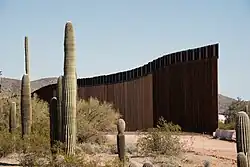
The physical border wall is alleged to have violated acts as it has interrupted the lives of Indigenous peoples that exist along the United States and Mexico border. A frequent issue that arises with the building of a wall or fence is the destruction of Indigenous lands.[11] The border wall is argued to violate, in certain instances, the American Indian Religious Freedom Act as it restricts access to elders and sacred sites to practice their religion.[3] For example, the physical border wall that was built between the Tohono O'odham territories was constructed through two burial sites in the Organ Pipe Cactus National Monument and is also interrupted efforts at preserving cultural traditions.[19][2]
Environment
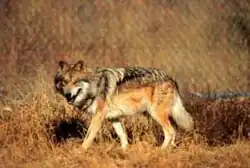
There are several environmental concerns that come with the construction of the border wall along the United States and Mexico border. One such impact is the threat to the wildlife, particularly endangered species. More specifically, it disrupts their migration patterns, roaming territory, water access, and more.[20] For endangered species, like the Mexican gray wolf and the Sonoran pronghorn, it is proposed the border wall may fragment their habitat and make reestablishing their populations near impossible.[21] Also by disrupting migration patterns, a border wall is argued to impact the distribution and fertilization of seeds,[22] and to possibly violate 30 federal environmental laws.[20]
Notable protests
Tohono O'odham
The Tohono O'odham people have been protesting the building of the border wall as it affects their sacred lands. The Tohono O'odham have historically been in opposition to the construction of a physical wall. The Tohono O'odham Nation Legislative Council has passed several resolutions reiterating the Nation's opposition. They have helped in efforts in securing the border such as extensive vehicle barriers, in 2007–2008, and CBP highway checkpoints.[23] In early 2020, the Tohono O'odham tribal leaders approved the construction of integrated fixed tower that would have advanced technology in an effort to secure the border virtually. Some members of the tribal legislative council hoped that such towers would reduce the foot traffic of Border Control agents. However, these towers have sparked conflict within the tribal nation, as some are concerned that allowing the integrated fixed towers is only the beginning.[24]
The protests in September and October 2020 became violent. While protesting the destruction of a part of Organ Pipe Cactus National Monument, a group of protesters set up a camp. They were asked to leave by National Park Service officers, and after ignoring warnings to leave the site, force was used. Border Patrol agents and park rangers pushed and shoved protesters; other officers threatened the use of paintball guns to disperse the crowd. The protesters were ultimately removed from the construction site, and no one was arrested.[25] The same cannot be said for a similar protest. Protesting in the same Organ Pipe Cactus National Monument region, two women were arrested, but they were able to temporarily halt construction of the wall. One woman sat inside a construction vehicle while the other blocked traffic. Both women face misdemeanor charges.[26] Similarly, on Indigenous Peoples' Day 2020, 12 people were arrested after protesters blocked the highway and refused to leave. Taking place near an immigration checkpoint on State Route 85, troopers fired tear gas, smoke canisters, and rubber bullets and used physical force, such as kneeling. This protest was also in response to the destruction of sacred lands brought forth by the wall, and the chairman of Tohono O'odham Nation, Ned Norris Junior, released a statement expressing his grievances and asking for a cease in construction of the wall.[27]
Kumeyaay
The proposed border wall cuts through a sacred and ancient burial site of the Kumeyaay nation. The tribe, in August, filed a lawsuit against the Trump Administration citing the importance of the site and the discovery of human remains. According to the U.S. Customs and Border Protection stated that the "remains" were construction materials while the San Diego medical examiner confirmed the sample was human. The construction moved forward citing the remains were outside of the construction zone. Before and after August, the Kumeyaay have had success temporarily halting construction.[28] On September 21, 2020, two individuals were arrested after refusing to leave the campsite, which had been an active protest camp for months, when the Bureau of Land Management issued a closure. Neither of the arrested individuals were charged with a crime.[29] Similarly, an arrest was not made against a woman who yelled obscenities at and physically assaulted some of the peaceful protesters at the camp the protesters had established because no one had reported it or filed a complaint.[30] As of October 18, 2020, the legal challenge to the construction of the Border Wall, filed by La Posta Band of Mission Indians, is in the Court of Appeals.[29]
Sources
- ↑ "Border Tribes". Native American Environmental Protection Coalition. Retrieved October 9, 2020.
- 1 2 3 4 5 6 7 8 Kowalski, Joseph (July 1, 2017). "Imaginary Lines, Real Consequences: The Effect of the Militarization of the United States-Mexico Border on Indigenous Peoples". American Indian Law Journal. 5 (2): 645–667.
- 1 2 3 4 5 6 7 Luna-Firebaugh, Eileen (2002). "The Border Crossed Us: Border Crossing Issues of the Indigenous Peoples of the Americas". Wíčazo Ša Review. 17 (1): 159–181. doi:10.1353/wic.2002.0006. JSTOR 1409565. S2CID 159542623.
- ↑ Britannica Editors (December 23, 2019). "Gadsden Purchase". Britannica. Retrieved October 17, 2020.
- ↑ "This is how much of the border wall has been built so far". Fox 47. CNN. January 19, 2019. Retrieved October 31, 2020.
- ↑ "Executive Order: Border Security and Immigration Enforcement Improvements". whitehouse.gov. Retrieved November 7, 2020 – via National Archives.
- ↑ Dunn, Timothy J. (2001). "Border Militarization Via Drug And Immigration Enforcement: Human Rights Implications". Social Justice. 28 (2 (84)): 7–30. ISSN 1043-1578. JSTOR 29768073.
- ↑ Spicer, Edward H. Cycles of Conquest: The Impact of Spain, Mexico, and the United States on the Indians of the Southwest, 1533–1960. Illustrated by Hazel Fontana, University of Arizona Press, 1962. JSTOR, http://www.jstor.org/stable/j.ctv1220r6w. Accessed 27 Aug. 2026.
- ↑ “Jumano Indians.” Handbook of Texas Online, Texas State Historical Association, https://www.tshaonline.org/handbook/entries/jumano-indians. Accessed 26 Aug. 2026.
- ↑ Webb, Daniel. Mapping the Apachería: American Indian Sovereignty and State Power in the U.S.-Mexico Borderlands, 18th–19th c. University of Chicago, 2017. UChicago Knowledge, https://knowledge.uchicago.edu/records/y4x9s-t6b46.
- 1 2 3 Starks, Rachel; McCormack, Jen; Cornell, Jen (2011). Native Nations and U.S. Borders. Tucson: Udall Center for Studies in Public Policy, The University of Arizona.
- 1 2 Leza, Christina; Indigenous Alliance Without Borders. "Handbook on Indigenous Peoples' Border Crossing Rights Between the United States and Mexico" (PDF). Retrieved November 10, 2020.
- ↑ Connolly, Mike. "Kumeyaay - Spanish Contact". Kumeyaay. Retrieved October 17, 2020.
- ↑ Connolly, Mike. "Kumeyaay- The Mexican Period". Kumeyaay. Retrieved October 17, 2020.
- ↑ Connolly, Mike. "Kumeyaay- The American Entry". Kumeyaay.
- ↑ Connolly, Mike. "Kumeyaay- The American Period". Kumeyaay - The American Period.
- 1 2 "History & Culture". Tohono O'odham Nation. Retrieved October 9, 2020.
- ↑ "Tohono O'odham | Encyclopedia.com". www.encyclopedia.com. Retrieved October 18, 2020.
- ↑ "Native burial sites blown up for US border wall". BBC News. February 10, 2020. Retrieved November 20, 2020.
- 1 2 Parker, Laura (January 10, 2019). "6 ways the border wall could disrupt the environment". National Geographic. Archived from the original on January 11, 2019. Retrieved October 31, 2020.
- ↑ Peters, Robert; Ripple, William J.; Wolf, Christopher; Moskwik, Matthew; Carreón-Arroyo, Gerardo; Ceballos, Gerardo; Córdova, Ana; Dirzo, Rodolfo; Ehrlich, Paul R.; Flesch, Aaron D.; List, Rurik (October 1, 2018). "Nature Divided, Scientists United: US–Mexico Border Wall Threatens Biodiversity and Binational Conservation". BioScience. 68 (10): 740–743. doi:10.1093/biosci/biy063. ISSN 0006-3568.
- ↑ Peters, Robert; Clark, Matt (2018). "In the Shadow of the Wall Part I: Borderlands Conservation Hotspots on the Line" (PDF). Retrieved November 17, 2020.
- ↑ Tohono O'odham Nation. "The Tohono O'odham Nation Opposes a "Border Wall"" (PDF).
- ↑ Hennessy-Fiske, Molly (May 9, 2019). "Arizona tribe refuses Trump's wall, but agrees to let Border Patrol build virtual barrier". Los Angeles Times. Retrieved November 20, 2020.
- ↑ Ruiz, Raphael Romero. "Protest at border wall site on Hia-Ced O'odham territory ends in standoff, scuffle". The Arizona Republic. Retrieved October 19, 2020.
- ↑ Prendergast, Curt. "2 O'odham women arrested after they stop border wall construction southwest of Tucson". Arizona Daily Star. Retrieved October 19, 2020.
- ↑ Lopez, Pablo (October 14, 2020). "Tohono O'odham Nation condemns use of chemical agents on protesters, destruction of sacred sites". KVOA. Retrieved October 19, 2020.
- ↑ Fry, Wendy (August 12, 2020). "Kumeyaay band seeks federal injunction to halt construction of border wall". Los Angeles Times. Retrieved October 18, 2020.
- 1 2 Rivlin-Nadler, Max (September 22, 2020). "Two Arrested As Kumeyaay Protests Against Border Wall Construction Ordered To Stop". KPBS Public Media. Retrieved October 19, 2020.
- ↑ Rivera, Salvador (September 23, 2020). "No complaints yet filed against woman attacking border-wall protesters on video". Border Report. Retrieved October 18, 2020.