Mathematics
Given a utility function  and a claim
 with known payoffs at some terminal time
 let the function
 be defined by
 ,
where  is the initial endowment,
 is the set of all self-financing portfolios at time
 starting with endowment , and
 is the number of the claim to be purchased (or sold). Then the indifference bid price
 for units of is the solution of
 and the indifference ask price
 is the solution of
 . The indifference price bound is the range
 .[2]
Example
Consider a market with a risk free asset  with
 and
 , and a risky asset
 with
 and
 each with probability
 . Let your utility function be given by
 . To find either the bid or ask indifference price for a single European call option with strike 110, first calculate
 .

 .
Which is maximized when  , therefore
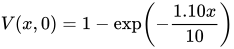 .
Now to find the indifference bid price solve for 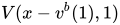


Which is maximized when  , therefore
 .
Therefore  when
 .
Similarly solve for  to find the indifference ask price.
References
- ↑ John R. Birge (2008). Financial Engineering. Elsevier. pp. 521–524. ISBN 978-0-444-51781-4.
- 1 2 Carmona, Rene (2009). Indifference Pricing: Theory and Applications. Princeton University Press. ISBN 978-0-691-13883-1.


