Ilseongsan Formation
| Ilseongsan Formation | |
|---|---|
| Stratigraphic range: mid-Cretaceous (Albian–Cenomanian), ~ | |
| Type | Geological formation |
| Underlies | Dalido Formation |
| Overlies | Injiri Formation |
| Lithology | |
| Primary | Sandstone, mudstone, conglomerate |
| Location | |
| Coordinates | 34°48′N 126°24′E / 34.8°N 126.4°E |
| Approximate paleocoordinates | 34°12′N 122°48′E / 34.2°N 122.8°E |
| Region | South Jeolla Province |
| Country |  South Korea |
| Type section | |
| Named for | Ilseongsan, Haenam |
| Named by | Lee and Lee, 1976[1] |
  Ilseongsan Formation (South Korea) | |
The Ilseongsan Formation (Korean: 일성산층; Hanja: 日星山層) is a mid-Cretaceous (Albian to lower Cenomanian) geologic formation in South Korea. Fossil records, including the ornithischian dinosaur Doolysaurus and diverse types of theropod eggs, have been reported.
Geology
The Ilseongsan Formation is distributed from Haenam to Mokpo, and conformably overlies the Injiri Formation and is conformably overlain by the Dalido Formation. The lithology of the Ilseongsan Formation is mainly distinguished by the alternation of purple-grey sandstone and light-grey sandstone, intercalated with tuff or tuffaceous sandstones.
The depositional age of the Ilseongsan Formation was initially proposed as lower Campanian (83 to 77 Ma) of the Upper Cretaceous based on K-Ar dating of volcanic pebbles from conglomerate units of this formation and samples from an overlying tuff,[2] but Kim et al. (2014) re-dated the tuff, now named the Maewoli Tuff which unconformably overlies the Dalido Formation, to 97.55 ± 0.62 Ma{ by using U-PB SHRIMP zircon analysis.[3] It indicates that the underlying Dalido Formation, as well as the Injiri and Ilseongsan Formations, are older. Based on ostracods from the Dalido Formation, Choi et al. (2023) estimated the Dalido and Ilseongsan Formations from the Albian to the Cenomanian (~113 to 94 Ma).[4] But, with the older age estimated of the Maewolli Tuff, the range of the Ilseongsan Formation is considered as Albian to early Cenomanian (~113 to 97 Ma) in age.[5]
Fossil content
Color key
|
Notes Uncertain or tentative taxa are in small text; |
Dinosaurs
Ornithischians
| Ornithischians of the Ilseongsan Formation | ||||||
|---|---|---|---|---|---|---|
| Genus | Species | Location | Stratigraphic position | Material | Notes | Images |
| Doolysaurus[5] | D. huhmini | Aphaedo | Albian to Cenomanian | Associated partial skeleton including cranial and postcranial material, in addition to gastroliths | A thescelosaurid ornithischian | 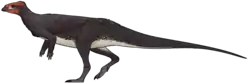 |
Oofossils
| Oofossils of the Ilseongsan Formation[6] | ||||||
|---|---|---|---|---|---|---|
| Genus | Species | Location | Stratigraphic position | Material | Notes | Images |
| Macroelongatoolithus[7] | M. carlylei | Aphaedo | Albian to Cenomanian | Complete egg clutch | Likely laid by a giant oviraptorosaur | |
| Onggwanoolithus | O. aphaedoensis | Aphaedo | Albian to Cenomanian | Several eggs | Likely laid by ornithurine bird | |
| Dendroolithidae | indeterminate | Aphaedo | Albian to Cenomanian | Eggshells | Likely laid by therizinosaur | |
| Prismatoolithidae | Indeterminate | Aphaedo | Albian to Cenomanian | Eggshells | Likely laid by troodontid | |
| Elongatoolithidae | Indeterminate | Aphaedo | Albian to Cenomanian | Eggshells | Eggshell much thinner than Macroelongatoolithus from the same formation. Likely laid by oviraptorosaur. | |
See also
References
- ↑ Lee, Dai Sung; Lee, Ha-Young (1976). "Geologic and Geochemical study on the rock sequences containing oily materials in Southwestern Coast Area of Korea". Economic and Environmental Geology. 9 (1): 45–73.
- ↑ Rhee, Chan-Young; Kim, Bo-Seong; Kim, Myung-Gee; Kim, Cheong-Bin (31 August 2012). "K-Ar Ages of Dinosaur Egg Nest found in Cretaceous Formation of Aphaedo, Jeollanam-do, Korea". Journal of the Korean earth science society. 33 (4): 329–336. doi:10.5467/JKESS.2012.33.4.329.
- ↑ Kihm, You Hong; Choi, Pom-yong; Hwang, Jae Ha; Kim, Hyeoncheol; Ko, Kyoungtae; Chun, Hee Young (2014). Geological Report of the Mokpo Sheet (1:50,000). Korea Institute of Geoscience and Mineral Resources.
- ↑ Choi, Byung-Do; Jung, Jongyun; Huh, Min (30 September 2023). "Biostratigraphy and paleoecology of non-marine ostracods from the Cretaceous deposits in southwestern Korean Peninsula: a preliminary report". Journal of the Geological Society of Korea. 59 (3): 495–511. doi:10.14770/jgsk.2023.030.
- 1 2 Jung, Jongyun; Kim, Minguk; Jo, Hyemin; Clarke, Julia A. (19 March 2026). "A new dinosaur species from Korea and its implications for early-diverging neornithischian diversity". Fossil Record. 29 (1): 87–113. doi:10.3897/fr.29.178152.
- ↑ Jo, Hyemin; Jung, Jongyun; Kim, Minguk; Huh, Min; Clarke, Julia A. (1 May 2026). "Description of the first Mesozoic bird eggs from Korea and a new mid-Cretaceous theropod-dominated egg locality". Palaeogeography, Palaeoclimatology, Palaeoecology. 689 113653. doi:10.1016/j.palaeo.2026.113653.
- ↑ Huh, Min; Kim, Bo Seong; Woo, Yeon; Simon, D. Jade; Paik, In Sung; Kim, Hyun Joo (4 March 2014). "First record of a complete giant theropod egg clutch from Upper Cretaceous deposits, South Korea". Historical Biology. 26 (2): 218–228. doi:10.1080/08912963.2014.894998.