Idrisid–Mutawakkilite war
| Idrisid–Mutawakillite War | |||||||
|---|---|---|---|---|---|---|---|
| |||||||
| Belligerents | |||||||
 Kingdom of Yemen Supported by:  Italy[1][2] |
 Emirate of Asir | ||||||
| Commanders and leaders | |||||||
|
Ali bin Muhammad al-Idrisi (until early 1925) Al-Hasan bin Ali al-Idrisi | |||||||
| Strength | |||||||
|
50,000 fighters[3] 4 Italian Ships[4] | Unknown number of tribal militias and loyalist regulars | ||||||
| Casualties and losses | |||||||
|
~500–1,000 killed Dozens Italian spies captured[5] | ~200–300 killed | ||||||
The Idrisid–Mutawakillite War (Arabic: الحرب الإدريسية-المتوكلية) was a conflict fought between the Idrisid Emirate of Asir and the Mutawakkilite Kingdom of Yemen. The war culminated in 1925 with the Yemeni capture of the port of Al Hudaydah, effectively ending Idrisid sovereignty over the southern Tihamah coastal plain and the eventual transformation of the remaining Idrisid territories into a Saudi protectorate.[6][7]
Background
The Idrisid Emirate of Asir was established in 1909 by Muhammad ibn Ali al-Idrisi after the weakening of Ottoman control in the southern Arabian Peninsula.[8] The Emirate maintained its autonomy along the Red Sea coast while navigating complex relations with the Mutawakkilite Kingdom of Yemen, the Ottoman Empire, and neighboring tribal confederations.
After the fall of the Ottoman Empire, the Mutawakkilite Kingdom of Yemen sought to consolidate power over the western highlands and the Tihama coastal region, areas historically contested with Asir. Saudi Arabia, then the Sultanate of Nejd, maintained influence in Asir and supported local rulers opposed to Imam Yahya's expansion. Meanwhile, British forces in Aden observed closely due to their interests in the Red Sea and South Arabian trade routes.[9]
The Idrisid Emirate reached its territorial peak following the First World War, controlling the Red Sea coast from Al Qunfudhah to Al Hudaydah.[10] However, the state’s stability relied heavily on the personal prestige and religious charisma of its founder. Following the death of Muhammad al-Idrisi in March 1923, the emirate entered a period of rapid decline characterized by internal dynastic rivalry.[11]
The succession of his young son, Ali bin Muhammad al-Idrisi, was contested by his uncles, most notably Al-Hasan bin Ali al-Idrisi.[12] This "state of two capitals"—with Ali ruling from Al-Hudaydah and Al-Hasan from Sabya—fractured the emirate's defense and tribal allegiances.[13] Imam Yahya of Yemen, who maintained a historical claim to the Tihama, exploited this weakness by launching a systematic offensive into Idrisid territories.[14]
Conflict
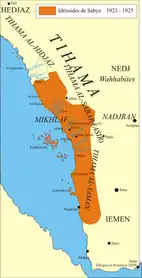
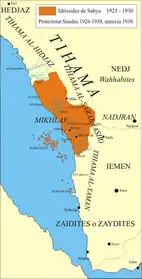
In 1924 Imam Yahya exploited the weakness of the Idrisids and the internal conflicts within their emirate. He began amassing his armies, mostly composed of tribesmen, estimated at fifty thousand fighters under the command of Abdullah al-Wazir.[15] With Italian support, he began occupying the cities of Tihama one after another. It is even believed that Italy instigated Imam Yahya's military campaigns against the Idrisids to facilitate communication between the Mutawakkilite Kingdom and the Italian government in Massawa after the signing of the Treaty of Friendship between Italy and Yemen. It is also believed that Imam Yahya would grant Italy half of the Idrisid lands' privileges and the right to explore for oil in the Farasan Islands if he managed to control the entire Idrisid emirate.[16] Italy supported him with weapons, money, and experts, giving him an advantage over his Idrisid rivals. This facilitated his annexation of the cities previously under Idrisid control.[17][18] ultimately weakening the emir's position Ali was Britain's refusal to support him against Imam Yahya and its abandonment of him, considering it an internal problem in which it had no relation. Then, in May 1925, Britain followed a policy of banning the supply of weapons to both Imam Yahya and Prince Ali, as it had done with Sharif Hussein and Ibn Saud during the Najd-Hijaz War. At that time, European governments such as (Italy - France - Belgium) agreed to this decision. However, it weakened the Idrisid position more than it increased the protest against the British government, that Imam Yahya was getting what he wanted of weapons from Italy, while Britain was applying the embargo policy to the Idrisid alone. This made Imam Idrisid take a counter-position on his part to cancel the trade and economic negotiations between him and the British companies.[19]
Fall of Al-Hudaydah
On March 27, 1925 the Mutawakkilite forces launched an attack on the city of Hodeidah with 800 fighters led by Abdullah al-Wazir. They occupied it without significant resistance, and its governor , Abdul Muttalib Haroun, the maternal uncle of Prince Ali al-Idrisi fled. They were able to seize cities such as Salif and Luhayyah, as far as Midi on the Red Sea coast, without any fighting. They were able to obtain the ports of Hodeidah and Luhayyah, which connect Sana'a to the sea.[20][21][22]
Invasion of Midi & Harad
The Mutawakkilite forces advanced to Midi, where they began to threaten the independence of the Idrisids in their country. A battle took place in Midi, where the Idrisid forces initially achieved a clear victory and the Mutawakkilite forces suffered heavy losses.[23] However, in the end, the city fell to the Mutawakkilite forces after the people of Midi allowed them to enter it.[24] The Mutawakkilite forces were able to take control of Haradh without a fight in January 1926 and release the hostages Yemeni imprisoned by Muhammad bin Ali al-Idrisi, which forced Prince Ali to flee to the Farasan Islands.[25][26]
Mutawakkilite advance attempt northward
After Imam Yahya managed to control the southern part of the Idrisid Emirate, he insisted on continuing to advance north, thinking that he would be able to control the Idrisid capital, Sabya. His forces advanced until they reached Samtah in January 1926,[27] where a fierce battle took place, resulting in the defeat of the Mutawakkilite forces and the return of those who remained to Haradh and Midi after suffering heavy losses in lives.[28] Otherwise, they would have continued to advance to Sabya and Jazan. At that time,[29] after his failed military attempt, Imam Yahya followed a policy of negotiations and diplomacy with Al-Hassan al-Idrisi.[30]
Eastern Front
In January 1926, the Mutawakkilite forces attacked the Jabal Shada center on the eastern border of the Idrisid Emirate. The Mutawakkilites seized the mountain, but the tribes loyal to the Idrisids attacked them. The fighting lasted for three days, which led to the defeat of the Mutawakkilite forces and their withdrawal from their positions on the mountain after they lost 135 killed as a result of the strong resistance from the followers of the Idrisids. Seven men from the Masarhah and Bani Harith tribes, who were loyal to the Idrisids, were killed.[31]
Italian government intervened and asked Imam Yahya to stop at Harad and not advance north because he had suffered heavy defeats as a result of the strong resistance from the Idrisids. As for Ibn Saud position on that war, he was preoccupied with the conflict between him and Sharif Hussein over annexing the Hijaz to his kingdom, but he was interested in the events of the conflict when the Yemeni forces advanced in southern Tihama as a result of the weakness of the Idrisid rule. At that time, he sent a delegation on his behalf headed by Muhammad bin Dulaim to reconcile Prince Ali and his uncle Hassan al-Idrisi.[32]
Tihami tribes rebellion
When the Mutawakkilite forces occupied the Tihami lands that were in the hands of the Idrisids, the Zaraniq, Abs and Al-Jaraih tribes rebelled against Imam Yahya. The Abs and Al-Jaraih tribes launched an attack on Bajil in July 1925, which resulted in the killing of more than 300 men from the Mutawakkilite army, forcing Imam Yahya to send reinforcements from Sana’a and Al-Haymah.[33]
In November 1925, the Mutawakkilite forces prepared to attack the rebels in southern Tihama. They headed to Al-Absiyah and attacked the rebellious tribes. That battle resulted in the killing of 100 men from the Zaraniq tribe, their escape, and the Mutawakkilite forces taking control of the village of Al-Absiyah.[34]
Impact of the conflict on British-Italian rivalry in the Red Sea
Britain later abandoned its policy of prohibiting arms supplies to Al-Idrisi for fear that Italy would encourage the Yemenis to invade the Farasan Islands and the Kamaran Islands, which would threaten British interests in the southern Red Sea. The British government intervened in the existing conflict and tried to support Al-Idrisi through its companies in the Farasan Islands and allow him to obtain weapons and ammunition. It feared that the existing conflict between Al-Idrisi and Imam Yahya would lead to a clash of interests between it and Italy, and it saw that economic competition between the two countries was natural and beneficial to both parties, and it would not have objected to equal commercial opportunities - in the words of Austen Chamberlain - in all areas of the Red Sea as long as it was far from political ambitions.[35]
Italian intervention in Asir affairs
After the First World War, Benito Mussolini made a strong effort to extend Italian colonial influence over the eastern Red Sea with the aim of strengthening the security of the Italian colonies in East Africa. Italian intervention in the Idrisid Emirate had already begun as early as 1921 when the Italian governor of Eritrea tried to convert the support of Sayyid al-Idrisi from the British by gifting him a car and logistical supplies in order to obtain oil, mineral and salt concessions in the Idrisid country. When Sayyid al-Idrisi died in 1923, the Italians took advantage of the weakness of the young Prince Ali al-Idrisi a month after he took power. They were pressing for permission to establish an Italian consulate in Hodeidah. Prince Ali refused the work of the European Italians in Hodeidah.[36]
With the loss of the Idrisid prince’s lands during their war with Imam Yahya, Italian tactics changed. They began sending Arab spies from Eritrea to the Idrisid lands to bribe tribal sheikhs, hoping they would pressure the Idrisid to adopt a pro-Italian policy and promote a peaceful resolution to the Idrisid-Mutawakkilite conflict, which, if successful, would benefit Italy. However, Ibn Saud intervention in favor of the Idrisids thwarted the Italian plans.[37]
Battle of Farasan
In December 1926, when the Idrisids granted the oil exploration concession to a British company, the Italians responded by sending Abdullah Suhail, one of the notables of the Farasan Islands. He invited the sheikhs and notables of the islands to board the ship he came on. The sheikhs refused his hospitality, and Suhail suggested that they take hostile actions against the property of the British oil company. At that time, Sayyid Mustafa al-Idrisi sent his son al-Muhtadi with 200 soldiers and two cannons to Farasan to prevent the Italians from landing on the islands and arresting Suhail, Al-Muhtadi managed to expel the Italians, forcing them to leave and go to the Al-Mayasam.[38]
In the south of the Emirate of Asir, they succumbed to Italian bribes and declared their independence from the Idrisid in order to work for the benefit of Italian interests, to help the forces of Imam Yahya Hamid al-Din when they moved against the Idrisid. This was reported at the same time that the Mutawakkilite forces began to be stationed in Midi, Harad, Hajur and Saada. It was reported that the Italians paid large sums to the Sheikh of Al-Mayasam in exchange for the rights to extract salt and monopolize the sale of kerosene. At that time, 500 gallons of kerosene were unloaded in Al-Wahla in a short time. At that time, the Idrisid arrested dozens of Italian spies.[5]
The total amount of Italian bribes paid by Abdullah Suhail and Jacopo Gasparini to the people of the Farasan Islands exceeded $800,000, but to no avail. Abdullah Suhail remained in Jizan under strict surveillance by the Idrisids, and was not allowed to leave the city.[39]
Aftermath
The loss of the southern Tihamah essentially ended Idrisid independence. Facing total annihilation by the Yemeni army, the new Idrisid leader, Al-Hasan bin Ali al-Idrisi, who had successfully ousted his nephew Ali, sought the protection of Ibn Saud of Nejd.[20] This set the stage for greater Saudi involvement in Asir's affairs.[40] Continued pressure from both Yemen and Nejd led to Asir's gradual absorption into the expanding Saudi state by 1930.[41]
This led to the Mecca Agreement in 1926, which formally placed the remainder of Asir under a Saudi protectorate. While the Idrisids remained as nominal rulers, Saudi officials assumed control of the administration and defense.[42] This arrangement was a primary cause of the later Saudi–Yemeni War (1934), as Imam Yahya refused to recognize the Saudi-Idrisid borders established by the treaty.[43]
Eventually, the territorial disputes between Yemen and Saudi Arabia culminated in the Treaty of Taif (1934), which confirmed Saudi control of Asir, Jizan, and Najran, while Yemen retained sovereignty over its northern highlands.[44] Despite Yemen's military initiative in 1925, the shifting alliances and the rise of Ibn Saud's power fundamentally changed the balance in Arabia.
Legacy
The conflict marked one of the last attempts by the Mutawakkilite Kingdom to expand its influence before Saudi unification. It also reflected the transitional nature of Arabian politics in the 1920s, where tribal allegiances, colonial influence, and emerging state powers converged.[45]
See also
References
Citations
- ↑ مجموعة من المؤلفين السوفيت. تاريخ اليمن المعاصر 1917 - 1982 (in Arabic). p. 38.
- ↑ Baldry 1976, pp. 172.
- ↑ إسماعيل بن محمد الوشلي. نشر الثناء الحسن المنبئ ببعض حوادث الزمن ، من الغرائب الواقعة في اليمن (تهامة - والمخلاف السليماني). p. 232.
- ↑ Baldry 1976, pp. 177.
- 1 2 Baldry 1976, pp. 169.
- ↑ "الحرب الإدريسية الإمامية (1912 - 1926م) - حكمة يمانية". حكمة يمانية (in Arabic). 2022-05-31. Archived from the original on 2026-02-14. Retrieved 2026-05-27.
- ↑ Alamer, Sultan (2024-10-17). "From Paris to Ṭā'if: Sovereignty, Borders, and the Question of Minorities in the Arabian Peninsula". Nationalities Papers: 1–21. doi:10.1017/nps.2024.57. ISSN 0090-5992.
- ↑ Daum, Werner (1988). Yemen: 3000 Years of Art and Civilisation in Arabia Felix. Institute for the History of Arabic-Islamic Science. p. 210.
- ↑ Al-Fageeh, Ali (1996). The Saudi-Yemeni Border Dispute. Middle East Studies Journal.
- ↑ Bang 1996, p. 107.
- ↑ Bang 1996, p. 115.
- ↑ Bang 1996, p. 117.
- ↑ Bang 1996, pp. 117–118.
- ↑ Bang 1996, p. 119.
- ↑ Al-Washli, Ismail bin Muhammad (2008) [2008]. نشر الثناء الحسن المنبئ ببعض حوادث الزمن ، من الغرائب الواقعة في اليمن (تهامة - والمخلاف السليماني [Spreading praise for some of the virtuous and accomplished people of Yemen and mentioning the events that occurred in this era]. p. 232.
- ↑ مجموعة من المؤلفين السوفيت. تاريخ اليمن المعاصر 1917 - 1982 (in Arabic). p. 38.
- ↑ البيان في تاريخ جازان وعسير ونجران (in Arabic) (2nd ed.). p. 222.
- ↑ محمد بن أحمد العقيلي (10 June 2025). أضواء على تاريخ الجزيرة العربية الحديث. p. 98.
- ↑ فتوح عبد المحسن الخترش. تاريخ العلاقات اليمنية السعودية. p. 199.
- 1 2 Bang 1996, p. 121.
- ↑ محمد بن محمد بن يحيى زبارة. أئمة اليمن بالقرن الرابع عشر للهجرة. Vol. 2. p. 120.
- ↑ فتوح عبد المحسن الخترش. تاريخ العلاقات اليمنية السعودية. pp. 29–30.
- ↑ محمد بن محمد بن يحيى زبارة. أئمة اليمن بالقرن الرابع عشر للهجرة. Vol. 2. p. 128.
- ↑ محمد بن أحمد العقيلي. تاريخ المخلاف السليماني. p. 892.
- ↑ عبد الواحد محمد راغب دلال. البيان في تاريخ جازان وعسير ونجران (in Arabic). Vol. 2. p. 219.
- ↑ إسماعيل بن محمد الوشلي. نشر الثناء الحسن المنبئ ببعض حوادث الزمن ، من الغرائب الواقعة في اليمن (تهامة - والمخلاف السليماني) (in Arabic). p. 238.
- ↑ فؤاد حمزة. في بلاد عسير (in Arabic). p. 10.
- ↑ إسماعيل بن محمد الوشلي. نشر الثناء الحسن المنبئ ببعض حوادث الزمن ، من الغرائب الواقعة في اليمن (تهامة - والمخلاف السليماني) (in Arabic). p. 238.
- ↑ محمد عمر رفيع. في ربوع عسير. p. 146.
- ↑ محمد بن أحمد العقيلي (10 June 2025). أضواء على تاريخ الجزيرة العربية الحديث. p. 98.
- ↑ الأدارسة في تهامة -(1341-1347 هـ) - القاضي عبد الله علي العمودي. pp. 136–137.
- ↑ عبد الواحد محمد راغب دلال. البيان في تاريخ جازان وعسير ونجران (in Arabic). Vol. 2. pp. 222–223.
- ↑ محمد بن محمد بن يحيى زبارة. أئمة اليمن بالقرن الرابع عشر للهجرة. Vol. 2. p. 126.
- ↑ محمد بن محمد بن يحيى زبارة. أئمة اليمن بالقرن الرابع عشر للهجرة. Vol. 2. p. 128.
- ↑ فتوح عبد المحسن الخترش. تاريخ العلاقات اليمنية السعودية. pp. 200–201.
- ↑ Baldry 1976 p 166.
- ↑ Baldry 1976, pp. 167–168.
- ↑ Baldry 1976, pp. 168.
- ↑ أميرة علي المداح. المخلاف السليماني تحت حكم الأدارسة (in Arabic). p. 336.
- ↑ Philby, H. St. J. (1928). Arabia of the Wahhabis. Constable. p. 231.
- ↑ Commins, David (2006). The Wahhabi Mission and Saudi Arabia. I.B. Tauris. p. 72.
- ↑ Bang 1996, pp. 121–122.
- ↑ Bang 1996, pp. 122.
- ↑ Burrowes, Robert D. (2010). Historical Dictionary of Yemen. Scarecrow Press. p. 368.
- ↑ Day, Stephen W. (2012). Regionalism and Rebellion in Yemen. Cambridge University Press. p. 33.
Bibliography
- Bang, Anne (1996). The Idrisi State in Asir 1906–1934. Hurst Publishers. ISBN 9781850653066. Archived from the original on 9 December 2019.
- Baldry, John (1976). Anglo-Italian-Rivalry-in-Yemen-and-Asīr-1900-1934. Vol. 17. Brill. pp. 155–193. doi:10.2307/1570344. JSTOR 1570344.