I'm Your Man (1992 film)
| I'm Your Man | |
|---|---|
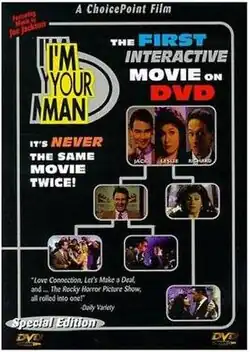 1998 DVD cover | |
| Directed by | Bob Bejan |
| Written by | Bob Bejan Michael Ian Black Robert Ben Garant Jeff Durian Alisa Tager[1] |
| Starring | Kevin Seal A. Whitney Brown Mark Metcalf Colleen Quinn |
| Edited by | Rutt Video |
| Music by | Joe Jackson |
Production company | Controlled Entropy Entertainment |
| Distributed by | Interfilm Technologies Sony Pictures Entertainment Loews Theatres |
Release date |
|
Running time | 20 minutes |
| Country | United States |
| Language | English |
| Budget | $370,000.00 |
I'm Your Man is a 1992 short film which was created to showcase Loews Theatres' interactive cinema technology. Audiences used seat-mounted joysticks to vote between three options in action at six different points throughout the movie.
Plot
The film begins with a brief introductory sequence where a scientist named Professor Bob explains the film's voting system and introduces the three main characters. After this introduction ends, the audience is shown an opening scene where they can freely "channel-surf" between either character’s perspective at any time by casting a vote, with the film switching to the chosen character as soon as a majority is reached. [a]
Leslie Campbell, the head of an architectural company in New York City, has been framed for siphoning money by her corrupt business partner Richard Hewitt. To clear her name, she arranges to exchange incriminating evidence with an FBI agent at a party in an office building.
As she is preparing to leave, the agent, Laurence, calls to rearrange the meeting time and to tell her that she will recognise him via the password "I'm Your Man". Unbeknownst to her, Laurence is actually a double agent working for Richard, who is silently listening to the call on speakerphone in the back of his chauffeur-driven car. As Leslie walks the streets of New York to reach the party venue, Richard murders Laurence and uses the information gained from the call to ambush her at the party.
As Leslie reaches the front door of the venue, she walks past Jack Beaner, a socially-awkward businessman who is attending the party simply as a way of picking up women. The two get into an elevator and make their way up to the party, with Richard following closely behind. At this point, the audience chooses which character the film follows from then on, with votes now occurring at set intervals.
Upon walking into the party, Jack realises that he, thanks to misleading advice from an unseen friend, has completely misunderstood the kind of party he is attending. Deciding to see if he can pick up some partygoers before he leaves in embarrassment, Jack lets the audience choose whether he approaches Leslie directly, or attempts to approach other women beforehand. In either case, he eventually approaches Leslie and accidentally says the password while attempting to flirt with her, causing Leslie to believe that he is Laurence.
If the audience chooses to follow Leslie, the same scene plays out from her perspective, except that she lets the audience decide whether she approaches Jack, or a man dressed as a stereotypical secret agent. No matter what the audience chooses, Leslie inevitably ends up crossing paths with Jack.
After meeting up with Jack, and depending on the context of the encounter, Leslie takes him into a nearby hallway or a bedroom and attempts to give him the evidence, much to his confusion.
Just as Leslie realises her mistake, Richard ambushes the two and, after unsuccessfully offering Leslie a fortune in hush money, begins shooting at them. Jack, panicking, climbs out of a window onto a fire escape while Leslie sprays Richard with mace and escapes. Having not seen where either of them got away to, Richard turns to the audience and, with the help of some over-engineered gadgets, threatens to either electrocute them or lock them in the theatre if they don't tell him which way either of them went.
On the roof of the building, Jack realises that Leslie is in serious trouble and has the audience decide whether he should run for his life or live up to his mistaken identity and save her. If the audience chooses the former, Jack attempts to escape before being confronted by a group of FBI agents who force him to rescue Leslie. If the latter is chosen, Jack suddenly gains nerves of steel and singlehandedly defeats a gang of attacking ninjas before heroically rushing off to save Leslie, to the agents’ amazement.
Back at the party, Leslie once again attempts to find Laurence by approaching various partygoers, before sitting down in despair. She begins to question whether she should take Richard’s hush money or continue trying to expose him, with the audience making the decision for her.
If the former is chosen, she approaches Richard, dances with him, and appears to consider his offer when Jack, followed by the agents, rushes into the room. Realising that Richard is distracted by the commotion, Leslie kicks him in the groin and leaves him to be arrested by the agents.
If the audience chooses the latter, Leslie borrows a microphone off of the party's DJ, and directly asks for any agents to reveal themselves. Richard, who has just caught up with her, then holds the entire party at gunpoint from the other side of the room. Just as Richard is about to shoot Leslie, Jack, followed closely by the agents, runs into the room to save her. As he enters, he accidentally slams a door into the back of Richard's head, knocking him over. Just before Richard can grab Jack to take him hostage, the agents arrest him.
After Richard is arrested, Jack and Leslie reunite before realising that they have reached the end of the film. They ask the audience to decide which of the three ultimately receives a happy ending:
In Jack’s ending, Richard's arrest leads him to become swarmed by news reporters and partygoers while Leslie confesses her love for him.
In Leslie's ending, she is given an extremely valuable design contract before she and Jack run off to catch the Concorde to Paris.
In Richard’s ending, Leslie abandons Jack as Richard is removed from the building by the agents. Once they reach the street, the agents are revealed to also be working for Richard, with his ‘arrest’ merely being a way for him to escape with the evidence.
Production
The movie was designed as the first test of Interfilm, Bob Bejan's interactive cinema company. The film was shot on 16mm Kodak film, transferred to LaserDisc, and digitally projected to allow for nearly seamless transitions when audiences made their choices.[2] Acting and direction were less than impressive; the movie was shot over only 6 days, and Bejan did not require a second take of any shot.[3]
In very early roles for both of them, comedy actors Michael Ian Black and Ben Garant appear as background in a party scene.[4]
Distribution
The film premiered in a special theater at the Loews on 19th Street and Broadway in New York City in December 1992.[5][6] Tickets to the 20-minute show were $3, and ticket holders were allowed to stay for as many viewings as they wanted.[3] Retrofitting an existing theater with the necessary voting equipment cost approximately $70,000, and 42 other theaters made the investment in 1993 and 1994.[7] The film—and the interactivity itself—were well received by teens but dismissed by critics and adult moviegoers as being "as gimmicky as three-dimensional glasses or scratch 'n' sniff"[6] and "not like watching a real movie... more like rooting for a basketball team."[8] A common criticism was that moviegoers would use the controls at vacant seats to vote more than once.[6][9] Another concern was that the act of voting took moviegoers out of the story; it was thought that real-time interaction hampered the viewing experience, and engineers began working on an alternative technology that would let users customize movies before viewing began.[10]
Although the format ultimately failed due to lack of marketing and mixed audience reception, Interfilm would go on to produce Mr. Payback: An Interactive Movie and Ride For Your Life for the same voting system in 1995. Despite both of these successor films having higher budgets and featuring multiple celebrity actors, they would ultimately see the same reception as I'm Your Man.
I'm Your Man was released on DVD on August 18, 1998 as part of a second attempt at interactive video.[11][12] As a result of this release, I'm Your Man is the only film produced for the Interfilm system that is known to exist in its entirety, with Mr. Payback and Ride For Your Life being considered lost outside of a few surviving clips.
See also
References
- ↑ "I'm Your Man (Video Game 1992)". IMDb.
- ↑ "AMC Loews 19th Street East 6".
- 1 2 Grimes, William (January 13, 1993). "When the film audience controls the plot". New York Times.
- ↑ "I'm Your Man - Full cast and crew". IMDB.
- ↑ "You make the movie/Interactive film allows audience to decide plot turns". Houston Chronicle. December 18, 1992.
- 1 2 3 Zonana, Victor F. (December 23, 1992). "This movie requires a pistol grip". Los Angeles Times.
- ↑ "Rutt Video & Interactive". Archived from the original on 2016-03-04.
- ↑ James, C. (February 7, 1993). "Look, Ma, I'm an Auteur!". The New York Times.
- ↑ "When the film audience controls the plot (pdf version of NYT article)" (PDF).
- ↑ Davenport, G.; Evans, R.; Halliday, M. "Orchestrating Digital Micromovies" (PDF). Massachusetts Institute of Technology.
- ↑ Bates, Jason (August 12, 1998). "First FMV Games Hit DVD Drives". IGN. Archived from the original on November 17, 1999. Retrieved December 6, 2019.
- ↑ Napoli, L. (August 17, 1998). "Interactive Filmmakers Hope to Make a Comeback". The New York Times.
Notes
- ↑ In the 1998 DVD release, the viewer is only able to switch perspectives at set intervals, due to format limitations. The introductory sequence is also replaced with credits, but remains viewable as a special feature.