Hydrazinium chloride
 | |
| Names | |
|---|---|
| IUPAC name
Diazanium chloride | |
| Other names | |
| Identifiers | |
3D model (JSmol) |
|
| ECHA InfoCard | 100.018.323 |
| EC Number |
|
PubChem CID |
|
| UNII | |
CompTox Dashboard (EPA) |
|
| |
| |
| Properties | |
| [NH2NH3]Cl | |
| Molar mass | 68.50 g·mol−1 |
| Appearance | Colorless hygroscopic crystalline solid[2][3] |
| Density | 1.5 g/cm3[4] |
| Melting point | 89 °C (192 °F; 362 K)[2][5] |
| Soluble[3]; 370 g/l at 20 °C (68 °F)[2] | |
| Structure | |
| Orthorhombic | |
| Hazards | |
| Occupational safety and health (OHS/OSH): | |
Main hazards |
May cause cancer[1], damage to the liver and kidneys[2] |
| GHS labelling: | |
     | |
| Danger | |
| H301, H310, H310+H330, H311, H314, H317, H330, H331, H341, H350, H410 | |
| P203, P260, P262, P264, P270, P271, P272, P273, P280, P284, P301+P316, P301+P330+P331, P302+P352, P302+P361+P354, P304+P340, P305+P354+P338, P316, P318, P320, P321, P330, P333+P317, P361+P364, P362+P364, P363, P391, P403+P233, P405, P501 | |
| Lethal dose or concentration (LD, LC): | |
LD50 (median dose) |
|
| Related compounds | |
Other anions |
|
Other cations |
|
Related compounds |
|
Except where otherwise noted, data are given for materials in their standard state (at 25 °C [77 °F], 100 kPa).
Infobox references | |
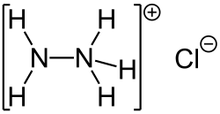
Hydrazinium chloride is an inorganic compound with the chemical formula [NH2NH3]Cl or [N2H5]Cl. It is a colorless hygroscopic crystalline solid. It is the hydrazine salt of hydrogen chloride. It consists of hydrazinium cations [H2N−NH3]+ and chloride anions Cl−. It decomposes at 240 °C (464 °F), producing hydrogen chloride and nitrogen oxides.[2]
Synthesis
Hydrazinium chloride can be synthesized by the reaction of hydrazine and hydrogen chloride.[6]
- H2N−NH2 + HCl → [H2N−NH3]+Cl−
Structure
Hydrazinium chloride has an orthorhombic crystal structure (a = 1249 pm, b = 2185 pm, c = 441 pm) with the space group Fdd2. The crystal of hydrazinium chloride obtained from an alcoholic solution are very fine needles parallel to the c axis.[4][7]
Hydrazinium chloride passes through several phase transitions at elevated pressures. The structure of phase I at room temperature and 1.8 GPa is confirmed to be space group C2/c. A structural transition from phase I to phase II is observed at 7.3 GPa. Pressure-induced position variation of hydrogen atoms in −NH+3 units during the phase transition is attributed to the formation of N―H···Cl hydrogen bonds. Finally, a further transition from phase II to phase III accompanied with a slight distortion in the hydrazinium ions occurs above 19.8 GPa. Phase III exists up to at least 39.5 GPa.[8]
Uses
Hydrazinium chloride is commonly used as a reagent in the synthesis of pyrazoles. It is used as a catalyst in the synthesis of titanium oxide polymers via catalytic sol-gel process, and in preparation of amorphous titanium dioxide thin films with high refractive indices and high transparency.[9]
Hydrazinium chloride is often used as a reducing agent in various chemical reactions and has uses in the preparation of other hydrazine derivatives. It is also used in the preparation of certain pharmaceuticals and as a reagent in analytical chemistry.[10]
Hydrazinium chloride can be used to synthesize energetic materials containing hydrazinium cation.[11][12]
References
- 1 2 3 4 5 6 7 8 PubChem. "Hydrazinium chloride". pubchem.ncbi.nlm.nih.gov. Retrieved 23 April 2026.
- 1 2 3 4 5 GESTIS-Stoffdatenbank. "Hydrazine hydrochloride". gestis.dguv.de. Retrieved 23 April 2026.
- 1 2 TCI. "Hydrazine Monohydrochloride". www.tcichemicals.com. Retrieved 23 April 2026.
- 1 2 Perry, Dale L. (19 April 2016). Handbook of Inorganic Compounds. CRC Press. ISBN 978-1-4398-1462-8.
- ↑ Sigma-Aldrich. "Hydrazine monohydrochloride". www.sigmaaldrich.com. Retrieved 23 April 2026.
- ↑ Bjerrum, Niels; Ebert, Ludwig (12 March 2013). Kurzes Lehrbuch der Anorganischen Chemie. Springer. ISBN 978-3-642-91147-7.
- ↑ Sakurai, K.; Tomiie, Y. (1952). "The crystal structure of hydrazinium chloride, N2H5Cl". Acta Crystallographica. 5 (2): 293–294. Bibcode:1952AcCry...5..293S. doi:10.1107/S0365110X5200085X.
- ↑ Jiang, Shuqing; Duan, Defang; Li, Fangfei; Huang, Xiaoli; Yang, Xue; Li, Wenbo; Huang, Yanping; Bao, Kuo; Zhou, Qiang; Liu, Bingbing; Cui, Tian (2015). "The hydrogen-bond effect on the high pressure behavior of hydrazinium monochloride". Journal of Raman Spectroscopy. 46 (2): 266–272. Bibcode:2015JRSp...46..266J. doi:10.1002/jrs.4623.
- ↑ Sigma-Aldrich. "Hydrazine monohydrochloride". www.sigmaaldrich.com. Retrieved 23 April 2026.
- ↑ Cymit Quimica. "CAS 2644-70-4: Hydrazinium chloride". cymitquimica.com. Retrieved 23 April 2026.
- ↑ Zhang, Yanqiang; Parrish, Damon A.; Shreeve, Jean'ne M. (2012). "4-Nitramino-3,5-dinitropyrazole-Based Energetic Salts". Chemistry – A European Journal. 18 (3): 987–994. doi:10.1002/chem.201102773. PMID 22170699.
- ↑ Li, Hui; Zhao, Feng-Qi; Gao, Hong-Xu; Tong, Jun-Feng; Wang, Bo-Zhou; Zhai, Lian-Jie; Huo, Huan (2014). "Three energetic salts based on oxy-bridged bis(gem-dinitro) furazan: Syntheses, structures and thermal behaviors". Inorganica Chimica Acta. 423: 256–262. doi:10.1016/j.ica.2014.08.019.