Hyaenodonta
| Hyaenodonta Temporal range: Early Paleocene to Late Miocene (Suspected Late Cretaceous origin, but unconfirmed by fossils yet)[1][2][3] | |
|---|---|
 | |
| Species from the order Hyaenodonta | |
Scientific classification  | |
| Kingdom: | Animalia |
| Phylum: | Chordata |
| Class: | Mammalia |
| Infraclass: | Placentalia |
| Mirorder: | Ferae |
| Clade: | Pan-Carnivora |
| Order: | †Hyaenodonta Van Valen, 1967[4] |
| Subgroups | |
|
[see classification] | |
| Synonyms | |
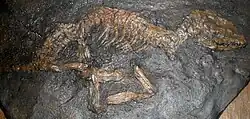
Hyaenodonta ("hyena teeth") is an extinct order of mostly carnivorous placental mammals of clade Pan-Carnivora from mirorder Ferae.[7][8] Hyaenodonts were important mammalian predators that are believed to have arose either in the Late Cretaceous[2][1][3] or Early Paleocene[9] within Europe[2][1][9] or North America,[3] and persisted well into the Late Miocene.[10][11][12] Hyaenodonts were found across Africa, Eurasia, and North America throughout the Cenozoic and occupied a variety of ecosystems, from forests to coastlines. They displayed a variety of body shapes, diet, and sizes. Ranging from ambush predators like Hyainailouros to Hyaenodon, in which some species were pounce-pursuit predators.[9][13]
The order currently consists of three superfamilies, Hyaenodontoidae, Hyainailouroidea, and Limnocyonoidea, in addition to smaller groups such as the Galecyon clade. The hyaenodontoids consisted of Hyaenodontidae and Proviverrinae, the hyainailouroids consisted of Hyainailouridae, Prionogalidae, and Teratodontidae, and with the limnocyonoids consisted of Limocyoninae, Sinopinae, and Arfiinae. Hyaenodonts saw their diversification peak during the Middle-Late Eocene, before seeing a significant decline in diversity following the Eocene-Oligocene extinction event.[14][15][16]
The extinction of the order has been debated by experts, many experts argued that their extinction was the result of competition with carnivorans.[9][17][18] But over the recent years, many experts have questioned that hypothesis and argued their decline and extinction in most of their range was due to climatic changes.[19][20][16]
Taxonomy
Classification
Hyaenodonts were considerably more widespread and successful than the oxyaenids, the other clade of mammals originally classified along with the hyaenodonts as part of Creodonta.[21] In 2015 phylogenetic analysis of Paleogene mammals, by Halliday et al., monophyly of Creodonta was supported and was placed in the clade Ferae, closer to Pholidota than to Carnivora.[22] However, most experts consider Creodonta to be considered to be a polyphyletic order as it contains two unrelated clades.[23][24] Most experts have now recovered Hyaenodonta and Oxyaenodonta as distinct orders within Pan-Carnivora.[25][26][27]
Recent phylogenetic modeling suggests hyaenodonts were sister group to the Oxyaenodonta-Carnivoraformes clade.[28][29][30]
Phylogeny
|
Cladogram of Hyainailourinae recovered by Al-Ashqar et al. (2025):[3]
| Hyainailourinae |
| ||||||||||||||||||||||||||||||||||||||||||||||||||||||||||||||||||||||||||||||||||||
Evolution
When the order arose exactly has changed over the years, Solé and Smith (2013) suggested hyaenodonts arose in the Late Paleocene roughly 58 Ma.[25] Solé et al. (2009), as well as Borths and Stevens (2019), suggested an Early Paleocene origin for the order.[31][9] However, majority of phylogenetic modeling over the recent years had favored a Late Cretaceous origin for the order.[2][1][3][32]
The biogeographic origin of the group has also been hotly debated by experts.[25] Solé et al. (2009) suggested an African origin for the order as the known oldest hyaenodonts were recovered there, in additional to the diversity of hyaenodonts within the Ouarzazate basin.[31] Bayesian analysis by various studies had found strong evidence of hyaenodonts originating from Europe.[2][1][9] Borths et al. (2016) noted while European and North America origins were problematic due to hyaneodonts not being recorded before the Paleocene-Eocene boundary, European Paleocene records were poor unlike North America. They also noted Afro-Arabian origins for the order have never been tested using phylogenetic analysis and was based on the assumption that Lahimia was a basal hyaenodont although more recent analysis suggest it wasn't a basal hyaenodont.[1] On the other hand, Bayesian analysis by Al-Ashqar et al. (2025) found stronger evidence of a North American origin than a European origin.[3]
From Europe, hyaenodonts would have dispersed into Africa and from there dispersed into India.[1][9] The oldest known hyaenodonts were Lahimia and Tinerhodon from the middle Paleogene of Morocco.[31] Afterwards, hyaenodonts dispersed into Asia from either Europe or India, and finally, North America from either Europe or Asia.[9][8][33] Proviverrines experience a radiation in diversity during the Early Eocene, due to the lack of competition and the Early Eocene Climatic Optimum.[34] In Africa, hyaenodonts saw an increase in subfamilial richness after the end of the Early Eocene Climatic Optimum.[35] During the middle to late Eocene, hyaenodonts, along with carnivorans, would replace oxyaenids, mesonychians, and miacoids in North America and Europe.[36][14] In the latter, the extinction of mesonychians and oxyaenids resulted in the diversification of hyaenodonts, as well as an increase in body size.[37][14] For most of the Paleogene, hyaenodonts were the dominant group of mammalian carnivores in Africa and Europe.[14][38][31]
The order saw a massive decline globally during the Eocene-Oligocene extinction event due to the decline of favorable prey and the expansion of open environments.[16][15][14] However, following the boundary event, hyaenodonts experienced a rebound in diversity in Europe and Afro-Arabia.[15][14] Several Miocene genera of this order include hyainailourines Megistotherium, Simbakubwa, Hyainailouros, Sectisodon, Exiguodon, Sivapterodon, Metapterodon, and Isohyaenodon, the prionogalid Prionogale, the teratodontid Dissopsalis and the hyaenodontid Hyaenodon.[10][11][12]
Anatomy
Size

They generally ranged in size from 30–140 cm (1 ft 0 in – 4 ft 7 in) at the shoulder, with most hyaenodonts weighing within the 5–15 kg (11–33 lb) range, equivalent to a mid-sized dog.[39][21] However, hyaenodonts have been known to reach larger sizes.[39][40][8] Simbakubwa kutokaafrika may have weighed up to 1,500 kg (3,300 lb), with Megistotherium estimated to have reached an even larger size of 1,794–3,002 kg (3,955–6,618 lb).[9] However estimate is suspect due to being based on skull-body size ratios derived from felids, which have much smaller skulls for their body size. Additionally, it was estimated that the maximum size a terrestrial mammalian carnivores could reach was 1,100 kg (2,400 lb), further suggesting the higher body mass estimates for Megistotherium was unlikely.[40]
Other large hyaenodonts include the hyainailourine Hyainailouros and the much earlier-living Hyaenodon gigas and Hyaenodon mongoliensis (two of the largest species of the genus, Hyaenodon), all three taxa had a skull length of 60 cm (2.0 ft).[33]
Skull and dentition

Compared to carnivorans, who have one pair of carnassial teeth, hyaenodonts possessed as many as three sequential pairs of carnassials or carnassial-like molar teeth in their jaws. Their skulls are known to have high sagittal crests which supported attachment for powerful temporalis muscles.[41] Hyaenodonts, like all "creodonts", lacked post-carnassial crushing molar teeth, such as those found in many carnivoran families, especially the Canidae and Ursidae.[41]
The anatomy of their skulls show that they had a particularly acute sense of smell, while their teeth were adapted for shearing, rather than crushing.[21] Hyaenodonts differed from Carnivora in that they replaced their deciduous dentition slower in development than carnivorans.[42][43] Studies on Hyaenodon show that juveniles took 3 to 4 years in the last stage of tooth eruption, implying a very long adolescent phase. In North American forms, the first upper premolar erupts before the first upper molar, while European forms show an earlier eruption of the first upper molar.[43]
Postcranial anatomy

While the neck of Hyaenodon was relatively short, the body and tail were longer in comparison.[44] Compared to Hyainailouros, the spine of Hyaenodon was longer and more robust, suggesting it didn't bore its head as low.[45][46] Cervical vertebrae of Hyaenodon was relatively short and resembled that of a felid than a canid. The femur of Hyaenodon was found to have been nearly as long as the humerus, which was short and massive, supporting a large, rounded head. Compared to carnivorans, the greater tuberosity has a more irregular shape and faces anteromedially. It would've been an insertion site for the infraspinatous muscles, which isn't seen in carnivorans. Despite this, the humerus of Hyaenodon was similar to that of wolves and hyenas. Compared to hyenas, it shows an anconeal fossa, a well-developed brachial flange and a similarly elongated trochlea shape. Despite this, the trochela shape of Hyaenodon is more similar in to the red fox.[44]
Regressions found Hyainailouros had a humerus as robust as an average felid. Compared to the humerus of a tiger, the deltoid scar of Hyainailouros was more distally than tigers.[47] The ulna of Hyainailouros sulzeri was arched and supported a high, well-developed olecranon, as well as a long, but strong diaphysis to the distal end of ulna. Compared to carnivorans, the fibula of Hyainailouros was thicker in comparison, with the diaphysis being twice as antero-posteriorly elongated in its distal area compared to the proximal area.[46]
Paleobiology
Locomotion
Hyaenodonts were ancestrally plantigrade,[8] but the derived, larger hyaenodonts were generally digitigrade or semidigitigrade.[9][8][48] Most hyaenodonts were recovered as terrestrial predators,[49][8] with large hyainailourines, such as Simbakubwa and Hyainailouros were thought to have been capable of large, leaping bounds, although neither were thought to be fast runners.[9][46] However, there have been notable exceptions in regards of locomotion.[8] Several limnocyonoids Prototomus and Prolimnocyon were found to be scansorial predators.[8] Analysis on the bony labyrinth of Hyaenodon exiguus suggests this species was semi-arboreal.[50] However, some hyaenodonts, such as some species of Hyaenodon and Oxyaenoides, were recovered as cursorial predators.[51][52][13][8] Castellanos (2025) that based on elbow morphology found that Hyaenodon crucians and Hyaenodon horridus likely practiced pounce-pursuit predation.[13] While Hyaenodon was recovered as a cursorial predator, it wasn't as cursorial as modern canids, such as wolves.[53][54]
Postcranial analysis on Apterodontinae found the subfamily were semiaquatic, fossorial mammals with strong forelimbs equipped for digging similar to badgers, with tail, torso and hindlimbs showing adaptations for an aquatic lifestyle similar to otters and pinnipeds.[55]
Diet

Many hyaenodonts were recovered as hypercarnivorous predators, meaning most of their diet consisted of flesh.[9][2][16] Fossil evidence found Hyaenodon horridus occassionally targeted smaller predators such as Dinictis and juvenile Archaeotherium.[57][48] Some hyaenodonts, such as Megistotherium, Hyainailouros, and Simbakubwa, were believed to be hyperspecalized on large herbivores such as proboscideans.[9][56][8] Savage (1973) suggested Megistotherium likely had a gap of around 30 cm (12 in), wide enough to bite down around the leg of some modern elephants. The reduction in incisor count would have minimised the damage which could be inflicted by struggling prey.[56] Hunter-Schreger bands observed in the tooth enamel of Hyaenodon horridus, Hyainailouros, and Pterodon were zigzag, suggesting that these predators were osteophagous. Whereas those of Hyaenodon brevirostris and Hyaenodon mustelinus transition from undulating at the base of the tooth to zigzag at the tip, indicating that these species were not as well adapted for feeding on bone.[58] However, dental microwear patterns suggests that North American Hyaenodon had a diet more similar to lions, suggesting it ate mostly meat with various intakes of bone. On the other hand, European Hyaenodon microwear were more similar to that of spotted hyenas, suggesting bone cracking was likely a major part of their diet.[59]
However, some hyaenodonts, such as Anasinopa, Limnocyon, and Pakakali, were found to have been mesocarnivores or omnivorous.[2][60] Lesmesodon was found to have been an insectivorous based on chewing cycle analysis.[61] Despite this, hyaenodonts weren't as versatile in their diet as carnivorans.[17][41]
Extinction
In North America, hyaenodonts experienced a terminal decline from the Eocene to Oligocene, with only Hyaenodon persisting into the Oligocene before going extinct around 28 Ma.[16][18][62] In Afro-Arabia, hyainailouroids experienced a massive decline with only 5 lineages persisting following the Eocene-Oligocene extinction event and several other extinctions.[15] Eocene-Oligocene boundary correlated with the decline of hyaenodont diversity in Europe, which saw the extinction of hyainailourines and proviverrines, only one species of Hyaenodon present from the Eocene persisted into the Oligocene.[14] Starting from the middle of the Early Oligocene, hyaenodonts saw a terminal decline in diversity, with their last occurrence being dating to MP30.[63] After a period of diversification, Afro-Arabian hyaenodonts experienced a permanent decline during the early Miocene onwards.[64][15] By the Late Miocene, the order was represented by Dissopsalis, Hyaenodon, Megistotherium (or Hyainailouros), and Metapterodon. The last hyaenodont, Dissopsalis, went extinct around 7.5 Ma.[12]
Many experts argued that the decline and extinction of the hyaenodonts was due to competition with the carnivorans.[9][12][36][18] Lang and colleagues found that the evolutionary success of carnivorans compared to hyaenodonts may have been largely influenced by the retention of a basal morphotype throughout their evolutionary history. The authors also suggested that carnivorans likely contributed in some way to the extinction of hyaenodonts, with the difference in functional morphology and adaptive potential of their carnassials possibly being a factor.[17]
Within North America, Friscia and Valkenburgh (2010) argued that carnivorans may have limited the evolution of “creodonts”, resulting with only the large, hypercarnivorous ecomorphs remaining. They also note the size increase among carnivorans throughout the Eocene, reaching the body sizes of hyaenodonts during the Oligocene.[18] In addition, Serio and colleagues found that North American “creodonts” had a significant degree of morphological differentiation until the middle Eocene, around this time disparity among carnivorans increasing around the same time. The authors argue that carnivoran disparity negatively impacted the disparity of creodonts, suggesting carnivorans may have outcompeted hyaenodonts.[65]

Within Africa, experts had hypothesized that hyaenodonts suffered from competitive displacement, as the invading carnivorans forced hyainailourids to tend towards carnivory. This was due to some of the smallest Miocene hyainailourids, Isohyaenodon and Mlanyama, showing adaptations towards hypercarnivory compared to older, mesocarnivorous hyaenodonts such as Boualitomus and Pakakali.[2][66] Borths and Stevens (2019) argued that pack hunting carnivorans had larger and more complex brains, suggesting this enabled them to steal carcasses from large, solitary hyainailourines.[9]
The decline of Hyaenodonts in the late Eocene to early Oligocene extinction of hyaenodonts, such as proviverrines and Pterodon, was thought to have been the result of Grande Coupure, a faunal turnover that was contemporary with the global Eocene-Oligocene extinction event.[67][68][14][34] The Eocene-Oligocene extinction event correlates with abrupt shift towards a icehouse world, which stems from the expansion of the Antarctic ice sheets and saw sea level decline by 70 m (230 ft).[69] Grande Coupure saw an extinction rate of 60% of western European mammalian lineages, which were replaced by Asian faunal immigrants.[70][71][72] This included the arrival of carnivorans from Asia such as later amphicyonids, amphicynodontids, nimravids, and ursids which deprised into Western Europe via new land connection with Asia following the receding of the Turgai Strait.[14][73] Lange-Badré (1979) suggested the decline of the proviverrines coincided with the arrival of carnivorans, hyaenodontines, and hyainailourines. Within the same paper, they hypothesized that Pterodon went extinct due to the climatic cooling and competition from the arriving carnivorans.[74]
However, competitive replacement has been contested by many experts.[16][64][20] Among large hyainailourids, the discovery of Simbakubwa suggests the evolution of large hyainailourines was thought to have been changes in the herbivore fauna instead of competition with carnivorans.[9] Additionally, studies have found brain size have little to no correlation with sociality in carnivorans,[75][76][77] with the relative size of the anterior brain having a larger correlation to sociality than overall brain size.[78][79][80] Experts also argued due to the absence of canids (who dispersed into Africa by the latest Miocene[81]), pack hunting would be difficult to assess among carnivorans in early Miocene Africa. Furthermore, vegetation in the early Miocene was generally more closed, preventing pack hunting and shorter, high speed chases from being effective.[82] Morales and colleagues argued the decline of hyainailourids was due to the increase in aridity, as they were more adapted for forested environments as opposed to savannas, steppes, or deserts.[64] The decline of Afro-Arabian hyaenodonts from the late Eocene to early Oligocene was due to the decline of their preferred prey such as anthropoids and hystricognaths. Their decline was also linked to the uplifting of the Ethiopian plateau, volcanism from the Afro-Arabian Large Igneous Province, and the opening of the Red Sea and Gulf of Aden.[15]
Christison and colleagues analyzed hyaenodonts and carnivorans from Calf Creek locality of Cypress Hills Formation and found that only the smallest hyaenodont, Hyaenodon microdon had asignificant niche overlap with carnivorans. On the other hand, larger hyaenodonts, Hemipsalodon grandis and Hyaenodon horridus had very distinct niches from large carnivorans, such as Hoplophoenus. They argue this would suggest that competitive replacement wasn't the driving factor the decline and extinction of North American hyaenodonts. Instead, global climatic cooling during the earliest Oligocene resulted in drier, more open landscapes and resulted in the extinction of large browsing herbivores, including brontotheres, who were replaced by grazing mammals such as equids and rhinoceroses, which were better suited for the open environments. Because rhinoceroses didn't reach their large sizes until the Miocene, hyaenodonts were at a disadvantage due to the lack of large prey available. In addition, because of their shorter legs, they were likely at a disadvantage in the increasingly open environments.[16] Despite recovering North American hyaenodonts as a relatively cursorial clade, Castellanos also hypothesized due their short distal limbs, hyaenodonts had less cursorial adaptations than contemporary amphicyonids and couldn't exploit open environments as well which likely led to their extinction in addition to the extinction of large browsing prey and low diversity of the order at the start the Oligocene.[20]

In Europe, Solé et al. (2015) found no evidence of hyainailourines being responsible for the decline of proviverrines, as the latter ever exceeded 20 kg (44 lb). This made them significantly smaller than the contemporary hyainailourines, which weighed at least 40 kg (88 lb). This suggested hyainailourines occupied different niches than proviverrines, with the latter possibly even being predated upon.[8] Solé et al. (2022) found no evidence of competitive replacement by carnivoranforms have been found in Europe as hyaenodonts were more diverse than carnivoraforms until the Grand Coupure. They also found the carnivorous fauna transition was gradual as proviverrines and hyainailourines went extinct during disappeared MP19-20, while newcomers appeared MP21.[14] Hyaenodon, who survived the Grande Coupure, niche partitoned from amphicyonids by preferring different habitats, with Hyaenodon preferring more forested environments compared to amphicyonids, who preferred more open environments.[63] Analysis on the body mass dynamics of European hyaenodonts and carnivoramorphans found hyaenodonts didn't experience a decrease in body mass when the body mass of carnivoramorphans increased suggesting a notable niche partition between the two clades.[19] This suggests the extinction of European hyaenodonts during the Oligocene is believed to have been caused by climatic changes rather than competition with carnivorans.[66][63][19]
See also
References
- 1 2 3 4 5 6 7 Borths, Matthew R.; Holroyd, Patricia A.; Seiffert, Erik R. (2016). "Hyainailourine and teratodontine cranial material from the late Eocene of Egypt and the application of parsimony and Bayesian methods to the phylogeny and biogeography of Hyaenodonta (Placentalia, Mammalia)". PeerJ. 4 e2639. doi:10.7717/peerj.2639. PMC 5111901. PMID 27867761.
- 1 2 3 4 5 6 7 8 Borths, Matthew Robert; Stevens, Nancy J. (2017). "The first hyaenodont from the late Oligocene Nsungwe Formation of Tanzania: Paleoecological insights into the Paleogene-Neogene carnivore transition". PLOS ONE. 12 (10) e0185301. Bibcode:2017PLoSO..1285301B. doi:10.1371/journal.pone.0185301. PMC 5636082. PMID 29020030.
- 1 2 3 4 5 6 Al-Ashqar, Shorouq F.; Borths, Matthew; El-Desouky, Heba; Heritage, Steven; Abed, Mohamed; Seiffert, Erik R.; El-Sayed, Sanaa; Sallam, Hesham M. (16 February 2025). "Cranial anatomy of the hypercarnivore Bastetodon syrtos gen. nov. (Hyaenodonta, Hyainailourinae) and a reevaluation of Pterodon in Africa". Journal of Vertebrate Paleontology. 44 (3). e2442472. doi:10.1080/02724634.2024.2442472. ISSN 0272-4634.
- ↑ Van Valen, L. (1967). "New Paleocene insectivores and insectivore classification." Bulletin of the American Museum of Natural History 135(5):217-284
- ↑ Solé F. (2010) "Les premiers placentaires carnassiers européens (Oxyaenodonta, Hyaenodontida et Carnivora): origine, évolution, paléoécologie et paléobiogéographie; apport des faunes de l'Eocène inférieur du Bassin de Paris." Paris: Muséum National d'Histoire Naturelle. 703 p.
- ↑ Morlo, M., Gunnell, G. F. and Polly, P. D. (2009). "What, if not nothing, is a creodont? Phylogeny and classification of Hyaenodontida and other former creodonts." Journal of Vertebrate Paleontology Program and Abstracts, 2009:152A.
- ↑ Solé, F.; Lhuillier, J.; Adaci, M.; Bensalah, M.; Mahboubi, M.; Tabuce, R. (16 July 2013). "The hyaenodontidans from the Gour Lazib area (?Early Eocene, Algeria): implications concerning the systematics and the origin of the Hyainailourinae and Teratodontinae". Journal of Systematic Palaeontology. 12 (3): 303–322. doi:10.1080/14772019.2013.795196. S2CID 84475034.
- 1 2 3 4 5 6 7 8 9 10 11 Solé, Floréal; Amson, E.; Borths, Matthew Robert; Vidalenc, D.; Morlo, Michael; Bastl, Katharina Anna (23 September 2015). "A New Large Hyainailourine from the Bartonian of Europe and Its Bearings on the Evolution and Ecology of Massive Hyaenodonts (Mammalia)". PLOS ONE. 10 (9) e0135698. Bibcode:2015PLoSO..1035698S. doi:10.1371/journal.pone.0135698. PMC 4580617. PMID 26398622.
- 1 2 3 4 5 6 7 8 9 10 11 12 13 14 15 16 Borths, Matthew Robert; Stevens, Nancy J. (2019). "Simbakubwa kutokaafrika, gen. et sp. nov. (Hyainailourinae, Hyaenodonta, 'Creodonta,' Mammalia), a gigantic carnivore from the earliest Miocene of Kenya". Journal of Vertebrate Paleontology. 39 (1) e1570222. Bibcode:2019JVPal..39E0222B. doi:10.1080/02724634.2019.1570222. S2CID 145972918.
- 1 2 Barry, J. C. (1988). "Dissopsalis, a middle and late Miocene proviverrine creodont (Mammalia) from Pakistan and Kenya". Journal of Vertebrate Paleontology. 48 (1): 25–45. Bibcode:1988JVPal...8...25B. doi:10.1080/02724634.1988.10011682.
- 1 2 Barry, John C. (January 2025). "Siwalik Creodonts and Carnivorans". At the Foot of the Himalayas: Paleontology and Ecosystem Dynamics of the Siwalik Record. ISBN 978-1421450278.
- 1 2 3 4 Mahmood, K.; Abbad, S. G.; Jasinski, S. E.; Babar, M. A.; Khan, M. A. (2026). "Hyaenodonta from the Middle to Late Miocene deposits of the Siwaliks of Pakistan with a brief account of Indian subcontinent hyaenodonts". PalZ. doi:10.1007/s12542-025-00766-5.
- 1 2 3 Castellanos, Miguel (2025). "Hunting types in North American Eocene–Oligocene carnivores and implications for the 'cat-gap'". Journal of Mammalian Evolution. 32 (2) 25: 1–12. doi:10.1007/s10914-025-09767-2.
- 1 2 3 4 5 6 7 8 9 10 Solé, Floréal; Fischer, Valentin; Le Verger, Kévin; Mennecart, Bastien; Speijer, Robert P.; Peigné, Stéphane; Smith, Thierry (2022). "Evolution of European carnivorous mammal assemblages through the Paleogene". Biological Journal of the Linnean Society. 135 (4): 734–753. doi:10.1093/biolinnean/blac002.
- 1 2 3 4 5 6 de Vries, Dorien; Heritage, Steven; Borths, Matthew R.; Sallam, Hesham M.; Seiffert, Erik R. (2021). "Widespread loss of mammalian lineage and dietary diversity in the early Oligocene of Afro-Arabia". Communications Biology. 4 (1) 1172. doi:10.1038/s42003-021-02707-9. PMC 8497553. PMID 34621013.
- 1 2 3 4 5 6 7 Christison, Brigid E; Gaidies, Fred; Pineda-Munoz, Silvia; Evans, Alistair R; Gilbert, Marisa A; Fraser, Danielle (25 January 2022). Powell, Roger (ed.). "Dietary niches of creodonts and carnivorans of the late Eocene Cypress Hills Formation". Journal of Mammalogy. 103 (1): 2–17. doi:10.1093/jmammal/gyab123. ISSN 0022-2372. PMC 8789764. PMID 35087328. Retrieved 17 October 2024 – via Oxford Academic.
- 1 2 3 Lang, Andreas Johann; Engler, Thomas; and Martin, Thomas (November 2021). "Dental topographic and three-dimensional geometric morphometric analysis of carnassialization in different clades of carnivorous mammals (Dasyuromorphia, Carnivora, Hyaenodonta)". Journal of Morphology. 283 (5): 91–108. doi:10.1002/jmor.21429. hdl:20.500.11811/10981. PMID 34775616.
- 1 2 3 4 Friscia, Anthony; Van, Valkenburgh B. (2010). "Ecomorphology of North American Eocene carnivores: evidence for competition between Carnivorans and Creodonts". Carnivoran Evolution. Cambridge University Press. pp. 311–341. doi:10.1017/CBO9781139193436.012. ISBN 978-0-521-51529-0.
- 1 2 3 Fischer, Valentin; Solé, Floréal; Verger, Kevin L.; Mennecart, Bastien; et al. (2026). "The rise of carnivoran mammals in Europe through the lens of body mass". Biology Letters. 22 (8) 20260319. doi:10.1098/rsbl.2026.0319. PMID 42554171.
- 1 2 3 Castellanos, Miguel (2025). "Hunting types in North American Eocene–Oligocene carnivores and implications for the 'cat-gap'". Journal of Mammalian Evolution. 32 (2) 25: 1–12. doi:10.1007/s10914-025-09767-2.
- 1 2 3 Lambert, David and the Diagram Group (1985): The Field Guide to Prehistoric Life. Facts on File Publications, New York. ISBN 0-8160-1125-7
- ↑ Halliday, Thomas J. D.; Upchurch, Paul; Goswami, Anjali (2015). "Resolving the relationships of Paleocene placental mammals" (PDF). Biological Reviews. 92 (1): 521–550. doi:10.1111/brv.12242. ISSN 1464-7931. PMC 6849585. PMID 28075073.
- ↑ Polly, P. D. (1994). "What, if anything, is a creodont?". Journal of Vertebrate Paleontology. 14 (Supplement 3): 42A. doi:10.1080/02724634.1994.10011592.
- ↑ Morlo, Michael; Gunnell, G.; Polly, P. D. (2009). "What, if not nothing, is a creodont? Phylogeny and classification of Hyaenodontida and other former creodonts". Journal of Vertebrate Paleontology. 29 (Supplement 3): 152A. doi:10.1080/02724634.2009.10411818.
- 1 2 3 Solé, Floréal & Smith, Thierry (2013). "Dispersals of placental carnivorous mammals (Carnivoramorpha, Oxyaenodonta & Hyaenodontida) near the Paleocene-Eocene boundary: a climatic and almost worldwide story" Geologica Belgica 16/4: 254–261
- ↑ Prevosti, F. J., & Forasiepi, A. M. (2018). "Introduction. Evolution of South American Mammalian Predators During the Cenozoic: Paleobiogeographic and Paleoenvironmental Contingencies"
- ↑ Solé, Floréal; Ladevèze, Sandrine (2017). "Evolution of the hypercarnivorous dentition in mammals ( Metatheria , Eutheria ) and its bearing on the development of tribosphenic molars". Evolution & Development. 19 (2): 56–68. doi:10.1111/ede.12219. PMID 28181377.
- ↑ Zack, Shawn P.; Rose, Kenneth D.; O'Leary, Maureen A. (24 June 2025). "New Cranial and Postcranial Remains of the Once Enigmatic Early Eocene Mammal Wyolestes (Mammalia, Ferae, Hyaenodonta) from North America, and Phylogenetic Evidence for its Interordinal Relationships". Bulletin of the American Museum of Natural History. 2025 (475). doi:10.1206/0003-0090.475.1.1. ISSN 0003-0090.
- ↑ Zack, Shawn P. (2019). "A skeleton of a Uintan machaeroidine 'creodont' and the phylogeny of carnivorous eutherian mammals". Journal of Systematic Palaeontology. 19 (8): 653–689. doi:10.1080/14772019.2018.1466374.
- ↑ Zack, Shawn (2026). "A new species of Simidectes (Mammalia: Ferae) from the early Uintan of California and new evidence of the affinities of the genus". Historical Biology: 1–14. doi:10.1080/08912963.2026.2646998.
- 1 2 3 4 Solé, F.; Gheerbrant, E.; Amaghzaz, M.; Bouya, B. (2009). "Further evidence of the African antiquity of hyaenodontid ('Creodonta', Mammalia) evolution". Zoological Journal of the Linnean Society. 156 (9): 827–846. doi:10.1111/j.1096-3642.2008.00501.x.
- ↑ Solé, Floréal; Marandat, Bernard; Lihoreau, Fabrice (2020). "The hyaenodonts (Mammalia) from the French locality of Aumelas (Hérault), with possible new representatives from the late Ypresian". Geodiversitas. 42 (13): 185–214. Bibcode:2020Geodv..42..185S. doi:10.5252/geodiversitas2020v42a13.
- 1 2 Morlo, Michael; Nagel, Doris (2006). "New remains of Hyaenodontidae (Creodonta, Mammalia) from the Oligocene of Central Mongolia". Annales de Paléontologie. 92 (3): 305–321. doi:10.1016/j.annpal.2005.12.001.
- 1 2 Floréal Solé; Jocelyn Falconnet; Laurent Yves (2014). "New proviverrines (Hyaenodontida) from the early Eocene of Europe; phylogeny and ecological evolution of the Proviverrinae". Zoological Journal of the Linnean Society. 171 (4): 878–917. doi:10.1111/zoj.12155.
- ↑ Solé, Floréal; Essid, El Mabrouk; Marzougui, Wissem; Temani, Rim; Khayati Ammar, Hayet; Mahboubi, Mhammed; Marivaux, Laurent; Vianey-Liaud, Monique; Tabuce, Rodolphe (18 August 2016). "New fossils of Hyaenodonta (Mammalia) from the Eocene localities of Chambi (Tunisia) and Bir el Ater (Algeria), and the evolution of the earliest African hyaenodonts". Palaeontologia Electronica. doi:10.26879/598. ISSN 1094-8074. Retrieved 6 March 2025.
- 1 2 Van Valkenburgh, Blaire (1999). "Major patterns in the history of carnivorous mammals". Annual Review of Earth and Planetary Sciences. 27: 463–493. Bibcode:1999AREPS..27..463V. doi:10.1146/annurev.earth.27.1.463.
- ↑ Solé, Floréal; Mennecart, Bastien (2019). "A large hyaenodont from the Lutetian of Switzerland expands the body mass range of the European mammalian predators during the Eocene". Acta Palaeontologica Polonica. 64 (2). doi:10.4202/app.00581.2018. Retrieved 10 September 2024.
- ↑ Kingdon, Jonathan (1974). East African Mammals: An Atlas of Evolution in Africa. Vol. 1. Chicago: University of Chicago Press.
{{cite book}}: CS1 maint: location missing publisher (link) - 1 2 Egi, Naoko (2001). "Body Mass Estimates in Extinct Mammals from Limb Bone Dimensions: the Case of North American Hyaenodontids". Palaeontology. 44 (3): 497–528. Bibcode:2001Palgy..44..497E. doi:10.1111/1475-4983.00189.
- 1 2 Carbone, Chris; Teacher, Amber; Rowcliffe, J. Marcus (16 January 2007). "The Costs of Carnivory". PLOS Biology. 5 (2) e22. doi:10.1371/journal.pbio.0050022. ISSN 1545-7885. PMC 1769424. PMID 17227145.
- 1 2 3 Wang, Xiaoming; and Tedford, Richard H. (2008). "Dogs: Their Fossil Relatives and Evolutionary History." New York: Columbia University Press
- ↑ Borths, Matthew Robert; Stevens, Nancy J. (2017). "Deciduous dentition and dental eruption of Hyainailouroidea (Hyaenodonta, "Creodonta," Placentalia, Mammalia)". Palaeontologia Electronica. 20 (3): 55A. Bibcode:2017PalEl..20..776B. doi:10.26879/776.
- 1 2 Bastl, Katharina Anna (2013). "First evidence of the tooth eruption sequence of the upper jaw in Hyaenodon (Hyaenodontidae, Mammalia) and new information on the ontogenetic development of its dentition". Paläontologische Zeitschrift. 88 (4): 481–494. doi:10.1007/s12542-013-0207-z. S2CID 85304920.
- 1 2 Bastl, Katharina A. (2012). Ecomorphology of the European Hyaenodon (PhD thesis). University Vienna.
- ↑ Solé, Floréal; Amson, Eli; Borths, Matthew; Vidalenc, Dominique; Morlo, Michael; Bastl, Katharina (23 September 2015). Friedman, Matt (ed.). "A New Large Hyainailourine from the Bartonian of Europe and Its Bearings on the Evolution and Ecology of Massive Hyaenodonts (Mammalia)". PLOS ONE. 10 (9) e0135698. Bibcode:2015PLoSO..1035698S. doi:10.1371/journal.pone.0135698. ISSN 1932-6203. PMC 4580617. PMID 26398622.
- 1 2 3 Ginsburg, Léonard (1980). "Hyainailouros sulzeri, mammifère créodonte du Miocène d'Europe". Annales de Paléontologie. 66 (1): 19–73.
- ↑ Sorkin, Boris (2008). "A biomechanical constraint on body mass in terrestrial mammalian predators". Lethaia. 41 (4): 333–347. Bibcode:2008Letha..41..333S. doi:10.1111/j.1502-3931.2007.00091.x.
- 1 2 Bastl, Katharina A. (2012). Ecomorphology of the European Hyaenodon (PhD thesis). University Vienna.
- ↑ Borths, Matthew R.; Seiffert, Erik R. (2017). "Craniodental and humeral morphology of a new species of Masrasector (Teratodontinae, Hyaenodonta, Placentalia) from the late Eocene of Egypt and locomotor diversity in hyaenodonts". PLOS ONE. 12 (4) e0173527. Bibcode:2017PLoSO..1273527B. doi:10.1371/journal.pone.0173527. PMC 5396875. PMID 28422967.
- ↑ Pfaff, Cathrin; Nagel, Doris; Gunnell, Gregg; Weber, Gerhard W.; Kriwet, Jürgen; Morlo, Michael; Bastl, Katharina (25 September 2016). "Palaeobiology of Hyaenodon exiguus (Hyaenodonta, Mammalia) based on morphometric analysis of the bony labyrinth". Journal of Anatomy. 230 (2): 282–289. doi:10.1111/joa.12545. PMC 5244453. PMID 27666133.
- ↑ Andersson, Ki; Werdelin, Lars (December 2003). "The evolution of cursorial carnivores in the Tertiary: Implications of elbow-joint morphology". Proceedings of the Royal Society B: Biological Sciences. 270 (Suppl 2): S163-5. doi:10.1098/rsbl.2003.0070. PMC 1809930. PMID 14667370.
- ↑ Morlo, Michael; Gunnell, Gregg F.; Nagel, Doris (2010). "10 - Ecomorphological analysis of carnivore guilds in the Eocene through Miocene of Laurasia". Carnivoran Evolution. Cambridge University Press. pp. 269–310. ISBN 978-1-139-19343-6.
- ↑ Janis, Christine M.; Wilhelm, Patricia Brady (1 June 1993). "Were there mammalian pursuit predators in the tertiary? Dances with wolf avatars". Journal of Mammalian Evolution. 1 (2): 103–125. doi:10.1007/BF01041590. ISSN 1573-7055.
- ↑ Van Valkenburgh, Blaire (1985). "Locomotor diversity within past and present guilds of large predatory mammals". Paleobiology. 11 (4): 406–428. doi:10.1017/S0094837300011702. JSTOR 2400556.
- ↑ Laudet, V.; Grohé, C.; Morlo, Michael; Chaimanee, Y.; Blondel, C.; Coster, P.; Valentin, X.; Salem, M.; Bilal, A. A.; Jaeger, J. J.; Brunet, M. (21 November 2012). "New Apterodontinae (Hyaenodontida) from the Eocene Locality of Dur At-Talah (Libya): Systematic, Paleoecological and Phylogenetical Implications". PLOS ONE. 7 (11) e49054. Bibcode:2012PLoSO...749054G. doi:10.1371/journal.pone.0049054. PMC 3504055. PMID 23185292.
- 1 2 3 Savage, R. J. G. (1973). "Megistotherium, gigantic hyaenodont from Miocene of Gebel Zelten, Libya". Bulletin of the British Museum (Natural History), Geology. 22 (7): 483–511. doi:10.5962/p.150151.
- ↑ John W. Hoganson and Jeff Person (2010). "Tooth puncture marks on a skull of Dinictis (Nimravidae) from the Oligocene Brule Formation of Northe Dakota attributed to predation by Hyaenodon (Hyaenodontidae)", North Dakota Geological Survey
- ↑ Stefen, Clara (September 1997). "The enamel of Creodonta, Arctocyonidae, and Mesonychidae (Mammalia), with special reference to the appearance of Hunter-Schreger-Bands". Paläontologische Zeitschrift. 71 (3–4): 291–303. doi:10.1007/BF02988497. ISSN 0031-0220. Retrieved 15 September 2024 – via Springer Nature Link.
- ↑ Bastl, Katharina; Semprebon, Gina; Nagel, Doris (1 September 2012). "Low-magnification microwear in Carnivora and dietary diversity in Hyaenodon (Mammalia: Hyaenodontidae) with additional information on its enamel microstructure". Palaeogeography, Palaeoclimatology, Palaeoecology. 348–349: 13–20. Bibcode:2012PPP...348...13B. doi:10.1016/j.palaeo.2012.05.026. Retrieved 7 November 2024 – via Elsevier Science Direct.
- ↑ Michael Morlo; Gregg F. Gunnell (2005). "New Species of Limnocyon (Mammalia, Creodonta) from the Bridgerian (Middle Eocene)". Journal of Vertebrate Paleontology. 25 (1): 251–255. doi:10.1671/0272-4634(2005)025[0251:nsolmc]2.0.co;2. S2CID 85666602.
- ↑ Weidtke, Jannik; Schultz, Julia A.; Morlo, Michael; et al. (October 2025). "Chewing cycle analysis of Lesmesodon edingeri (Mammalia; Hyaenodonta) and implications for carnivoran feeding adaptions". Palaeontologia Electronica. 28 (3): 1–35.
- ↑ Hunt, Robert (2004). "Global Climate and the Evolution of Large Mammalian Carnivores during the Later Cenozoic in North America". Mammalogy Papers: University of Nebraska State Museum. 286.
- 1 2 3 Solé; Dubied; Le Verger; Mennecart (2018). "Niche partitioning of the European carnivorous mammals during the paleogene". PALAIOS. 33 (11): 514–523. Bibcode:2018Palai..33..514S. doi:10.2110/palo.2018.022.
- 1 2 3 Morales, J.; Pickford, M.; Salesa, M. J. (2008). "Creodonta and Carnivora from the Early Miocene of the Northern Sperrgebiet, Namibia". Memoir of the Geological Survey of Namibia. 20 (20): 291–310.
- ↑ Serio, Carmela; Brown, Richard P.; Clauss, Marcus; Meloro, Carlo (2024). "Morphological disparity of mammalian limb bones throughout the Cenozoic: the role of biotic and abiotic factors". Palaeontology. 67 (4) e12720. Bibcode:2024Palgy..6712720S. doi:10.1111/pala.12720.
- 1 2 Frisica, Anthony R.; Macharwas, Mathew; Muteti, Samuel; Ndiritu, Francis; Rasmussen, D. Tab (2 November 2020). "A Transitional Mammalian Carnivore Community from the Paleogene–Neogene Boundary in Northern Kenya". Journal of Vertebrate Paleontology. 40 (5) e1833895. Bibcode:2020JVPal..40E3895F. doi:10.1080/02724634.2020.1833895.
- ↑ Schmidt-Kittler, Norbert; Godinot, Marc; Franzen, Jens L.; Hooker, Jeremy J. (1987). "European reference levels and correlation tables". Münchner geowissenschaftliche Abhandlungen A10. Pfeil Verlag, München. pp. 13–31.
- ↑ Hooker, Jerry J. (2010). "The 'Grande Coupure' in the Hampshire Basin, UK: taxonomy and stratigraphy of the mammals on either side of this major Palaeogene faunal turnover". In Whittaker, John E.; Hart, Malcolm B. (eds.). Micropalaeontology, Sedimentary Environments and Stratigraphy: a Tribute to Dennis Curry (1912–2001). Vol. 4. Geological Society of London. pp. 147–215. doi:10.1144/TMS004.8. ISBN 978-1-86239-622-7.
- ↑ Toumoulin, Agathe; Tardif, Delphine; Donnadieu, Yannick; Licht, Alexis; Ladant, Jean-Baptiste; Kunzmann, Lutz; Dupont-Nivet, Guillaume (2022). "Evolution of continental temperature seasonality from the Eocene greenhouse to the Oligocene icehouse –a model–data comparison". Climate of the Past. 18 (2): 341–362. Bibcode:2022CliPa..18..341T. doi:10.5194/cp-18-341-2022.
- ↑ Hooker, Jerry J.; Collinson, Margaret E.; Sille, Nicholas P. (2004). "Eocene–Oligocene mammalian faunal turnover in the Hampshire Basin, UK: calibration to the global time scale and the major cooling event" (PDF). Journal of the Geological Society. 161 (2): 161–172. Bibcode:2004JGSoc.161..161H. doi:10.1144/0016-764903-091. S2CID 140576090. Archived (PDF) from the original on 8 August 2023. Retrieved 31 August 2023.
- ↑ Legendre, Serge; Mourer-Chauviré, Cécile; Hugueney, Marguerite; Maitre, Elodie; Sigé, Bernard; Escarguel, Gilles (2006). "Dynamique de la diversité des mammifères et des oiseaux paléogènes du Massif Central (Quercy et Limagnes, France)". STRATA. 1 (in French). 13: 275–282.
- ↑ Escarguel, Gilles; Legendre, Serge; Sigé, Bernard (2008). "Unearthing deep-time biodiversity changes: The Palaeogene mammalian metacommunity of the Quercy and Limagne area (Massif Central, France)". Comptes Rendus Geoscience. 340 (9–10): 602–614. Bibcode:2008CRGeo.340..602E. doi:10.1016/j.crte.2007.11.005. Archived from the original on 13 October 2023. Retrieved 19 September 2023.
- ↑ Solé, Floréal; Fischer, Fischer; Denayer, Julien; Speijer, Robert P.; Fournier, Morgane; Le Verger, Kévin; Ladevèze, Sandrine; Folie, Annelise; Smith, Thierry (2020). "The upper Eocene-Oligocene carnivorous mammals from the Quercy Phosphorites (France) housed in Belgian collections". Geologica Belgica. 24 (1–2): 1–16. doi:10.20341/gb.2020.006. S2CID 224860287.
- ↑ Lange-Badré, Brigitte (1979). "Les Creodontes (Mammalia) d'Europe occidentale de l'Eocene superieur a l'Oligocene superieur". Mémories du Muséum National d'Historie Naturelle, Série C, Sciences de la Terre. 42: 1–249.
- ↑ Finarelli, J. A.; Flynn, J. J (2009). "Brain-size evolution and sociality in Carnivora". Proc. Natl. Acad. Sci. U.S.A. 106 (23): 9345–9349. doi:10.1073/pnas.0901780106. PMC 2695124. PMID 19474299.
- ↑ Chambers, Helen Rebecca; Heldstab, Sandra Andrea; O'Hara, Sean J. (2021). "Why big brains? A comparison of models for both primate and carnivore brain size evolution". PLOS ONE. 16 (12) e0261185. doi:10.1371/journal.pone.0261185. PMC 8691615. PMID 34932586.
- ↑ Benson-Amram, Sarah; Dantzer, Ben; Stricker, Gregory; Swanson, Eli M.; Holekamp, Kay E. (2016). "Brain size predicts problem-solving ability in mammalian carnivores". Proceedings of the National Academy of Sciences. 113 (9): 2532–2537. doi:10.1073/pnas.1505913113. PMC 4780594. PMID 26811470.
- ↑ Sakai, Sharleen T.; Arsznov, Bradley M.; Hristova, Ani E.; Yoon, Elise J.; Lundrigan, Barbara L. (2016). "Big Cat Coalitions: A Comparative Analysis of Regional Brain Volumes in Felidae". Front Neuroanat. 10: 99. doi:10.3389/fnana.2016.00099. PMC 5071314. PMID 27812324.
- ↑ Vinuesa, Víctor; Iurino, Dawid A.; Madurell-Malapeira, Joan; Liu, Jinyi; Fortuny, Josep; Sardella, Raffaele; Alba, David M. (August 2016). "Inferences of social behavior in bone-cracking hyaenids (Carnivora, Hyaenidae) based on digital paleoneurological techniques: Implications for human–carnivoran interactions in the Pleistocene". Quaternary International. 413: 7–14. Bibcode:2016QuInt.413....7V. doi:10.1016/j.quaint.2015.10.037.
- ↑ Sakai, Sharleen T.; Whitt, Blake; Arsznov, Bradley M.; Lundrigan, Barbara L. (2018). "Endocranial Development in the Coyote (Canis latrans) and Gray Wolf (Canis lupus): A Computed Tomographic Study". Brain Behavior and Evolution. 91 (2): 65–81. doi:10.1159/000487427. PMID 29635246.
- ↑ Rook, Lorenzo (December 2009). "The wide ranging genus Eucyon Tedford & Qiu, 1996 (Mammalia, Carnivora, Canidae, Canini) in the Mio-Pliocene of the Old World". Geodiversitas. 31 (4): 723–741. doi:10.5252/g2009n4a723. S2CID 130345058.
- ↑ Turner, Alan; Antón, Mauricio (2006). "Africa - the Evolution of a Continent and its Large Mammal Fauna" (PDF). Cranium. 23 (1): 17–40.