Hsu Yu-chuan
Hsu Yu-chuan | |
|---|---|
许玉钏 | |
 | |
| Born | 1928 |
| Died | September 18, 2017 (aged 88–89) |
| Known for | Producing Southeast Asia's first locally made laser scalpel and an educational electron gun |
| Spouse | Liu Pao-hsiu |
| Scientific career | |
| Fields | Scientific instrument making |
| Workplaces | Taihoku Imperial University National Taiwan University |
Hsu Yu-chuan (1928 – 18 September 2017) was a Taiwanese scientific instrument technician and master scientific glassblower from Shinchiku Prefecture, Taiwan.[1] He worked at both Taihoku Imperial University(1928) and the National Taiwan University Department of Physics, where he became known for his expertise in the fabrication of scientific glassware.[2]
In 1945, Hsu was hired as a technician's assistant by Jiro Tayama at Taihoku Imperial University, where he received training in scientific glassblowing. During this period, he also produced laboratory glassware for chemist Tetsuo Nozoe, who later became the first Japanese scientist to be nominated for the Nobel Prize in Chemistry. Following the end of World War II, Hsu joined the reconstruction of a Cockcroft–Walton generator at National Taiwan University under the leadership of Yoritsune Ota and Hsu Yun-Ki. The team conducted the first postwar artificial-nucleus collision experiment in the Republic of China, and one of the earliest such experiments in postwar Asia, in 1948.[3]
In addition to manufacturing glass components for particle accelerators, Hsu contributed to the development of Taiwan's first medical laser scalpel and its first educational electron gun.[1][4] He was widely referred to as a “national treasure” of Taiwan's scientific glassmaking community for his decades of contributions to scientific research and education.[2]
Biography

Early life
Hsu Yu-chuan was born in 1928 in Shinchiku Prefecture, Taiwan, then part of the Empire of Japan.[1] He was the only child in his family.[5] Hsu's mother died when he was six years old, and his father died when he was twelve. Due to financial hardship, he was forced to leave school and did not complete elementary education until the age of seventeen, graduating as the oldest student in his class.[2] After graduation, he initially hoped to become a Buddhist statue engraver. However, on a teacher's recommendation, he entered a glass factory in Hsinchu as an apprentice, beginning his career in glassworking.[2]
In 1944, Hsu enrolled in a training program operated by the factory. Upon completing the program in 1945, he was selected by Jiro Tayama, a scientific glass technician at Taihoku Imperial University(1928) and a consultant to the factory, as one of ten trainees chosen to serve as his assistant at the university.[2][6] According to Hsu's later recollections, Tayama provided extensive guidance and support, teaching him scientific glassblowing techniques and allowing him to live in his home. Tayama also purchased a bicycle for Hsu so that he could commute to the university for work.[6] During this period, Hsu produced laboratory glassware for the research of an organic chemist Tetsuo Nozoe, who later became the first Japanese scientist to be nominated for the Nobel Prize in Chemistry.[6][a]
Postwar period
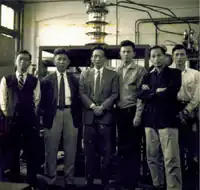

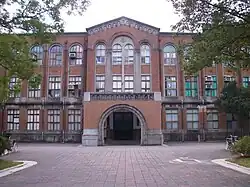
Following the end of World War II, Hsu worked under the leadership of Yoritsune Ota and Hsu Yun-Ki, together with Suetsugu Kawada, Chou Mu-chun, Lin Sung-yun, and others, to reconstruct the Cockcroft–Walton generator[b][8][9]: 21 [10] originally built by Bunsaku Arakatsu and his colleagues. The original accelerator was used in 1934 at Taihoku Imperial University(1928) to conduct the second successful artificial nuclear transmutation experiment in the world. Hsu was responsible for fabricating all of the glass apparatus required for the reconstruction project.[11]: 8 The reconstruction project began in October 1946. After nearly two years of work, the team successfully conducted an artificial nuclear-collision experiment at 8:35 p.m. on 13 May 1948. The experiment was the first artificial nuclear collision experiment conducted in the Republic of China and the first such experiment in postwar Asia.[3]: 161–162 [9]: 4 [12]
Under the direction of Yun-ki Hsu, the group later constructed a Cloud chamber for observing the trajectories of alpha particles.[3]: 167 The accelerator was subsequently modified to achieve higher-energy nuclear reactions, and high-energy neutrons generated through reactions involving helium-4 were used to investigate secondary nuclear reactions.[13] To obtain heavy water for these experiments, Hsu constructed a Mercury-arc valve using Pyrex beakers and electrodes salvaged from discarded high-power vacuum tubes formerly used by the Broadcasting Corporation of China. Unable to locate suitable glass tubing matching the original design specifications, he melted and fused five glass beakers together, designed a supporting frame, and attached three flasks to create the apparatus.[2][13] The most difficult aspect of the construction was embedding a nickel wire approximately five centimeters in diameter into the bottom of the device without breaking the glass. Hsu consulted numerous Japanese-language technical manuals before successfully solving the problem.[2] After approximately 1 year of effort, the team succeeded in producing heavy water with a concentration of 98%.[13]
In 1982, Taipei Veterans General Hospital received support from the Y. S. Sun Scientific Research Center at National Taiwan University to establish a laser surgery program. Rather than purchasing equipment from overseas, the project leaders decided to develop the system domestically in cooperation with the National Taiwan University Departments of Physics and Electrical Engineering.[2] In 1985, the team successfully completed the first domestically produced medical laser scalpel in Taiwan and the first self-developed laser surgical system in Southeast Asia. Hsu fabricated the laser vacuum tube, one of the device's core components.[10]: 151 [12] When Yun-ki Hsu retired from the Department of Physics in 1985, the Cockcroft–Walton generator was dismantled due to space constraints. Reluctant to see the historic equipment lost, Hsu and technician Lin Sung-yun secretly preserved its components by storing them in various locations for nearly two decades. Components were hidden in warehouses, basements, and even above bathroom ceilings.[14][15]: 100–101 In 2004, the Department of Physics at National Taiwan University initiated a project to reconstruct the accelerator. Under the leadership of Yun-ki Hsu, Hsu Yu-chuan, and Lin Sung-yun, the scattered components were recovered, and the original nuclear physics laboratory was rebuilt, becoming the NTU Physics Heritage Hall.[10]: 151 [12][14] The museum officially opened on 21 November 2005. The restoration process was documented in the film 'Breaking Through the Atomic Nucleus'.[9]: 9,21
According to a 1987 survey, only three university technicians specializing in scientific glassblowing remained in Taiwan, and the other two had been trained by Hsu. He retired from the Department of Physics at National Taiwan University in January 1994.[2] Hsu’s life and career were later documented in the film 'The Physical World of an Old Technician' (Chinese: 老技師的物理世界),[c][6] which premiered on 20 October 2005. Following his retirement, the Department of Physics temporarily incorporated scientific glassblowing into its required curriculum to preserve the craft,[4] though the course has since been discontinued.
Personal life
While serving as a technical instructor at a pharmaceutical glass bottle factory, Hsu met his future wife, Liu Pao-hsiu, and the two later married.[2] According to Liu, Hsu tended to become withdrawn whenever he was preoccupied with a technical problem. She recalled that he would eat less, sleep poorly, and sit quietly after returning home from work. This behavior was most pronounced in 1951, when he spent more than a month working on a Mercury-arc valve used in the electrolytic production of heavy water.[2]
During his career as a technician in the Department of Physics at National Taiwan University, Hsu earned approximately NT$20,000 per month. At one point, a scientific glassware company offered him a position with a monthly salary of NT$50,000, but he declined, stating that he found greater meaning in conducting research alongside university professors.[2] Outside his professional work, Hsu enjoyed mountaineering and stream fishing. He frequently fished in the Liugongju and in the mountain areas. Most of the fish he caught were released, although he occasionally kept particularly attractive or easy-to-raise fish as pets.[16] Because scientific glassblowing required continuous concentration, Hsu rarely answered telephone calls while working. He explained that interruptions could ruin an entire piece of work. As a result, colleagues usually visited his workshop in person and knocked on the glass door to get his attention. According to Lin Sung-yun, the door was knocked on so frequently that it often seemed as though it might break.[2]
Selected publications
- Low Background Counter for Carbon-14 Dating (1965).[17]
- Carbon-14 Dating. I (1965).[18]
- Wilson Cloud Chamber for the Study of the (n, α) Reaction (1968).[19]
- 12C(n, α)^9Be Reaction at 14.1 MeV (1969).[20]
- 20Ne(n, α)^17O Reaction Induced by 14.1 MeV Neutrons (1972).[21]
- 40Ca(n, α)^37Ar Reaction at 14.1 MeV (1973).[22]
- Counter Telescope for Studying 14 MeV Neutron-induced Reactions (1975).[23]
- Surface Treatment of the Al Cold Cathode for He-Ne Laser (1975).[24]
- Investigation of the 32S(n, α)^29Si Reaction at 14.1 MeV (1976).[25]
- 150 keV Heavy Ion Generator for Sputtering Studies (1978).[26]
See also
- Fumi-saku Arakatsu
- Hsu Yun-Ki
- Department of Physics, National Taiwan University
- NTU Physics Heritage Hall
Notes
- ↑ At the time, Tetsuo Nozoe was primarily engaged in research on essential oils derived from Taiwan's alpine plants. His work on hinoki cypress oil led to the development of what was then the only treatment for tuberculosis available in Taiwan. He later became the first Japanese scientist to be nominated for the Nobel Prize in Chemistry.
- ↑ See Bunsaku Arakatsu for details of the experiment.
- ↑ The film premiered on 20 October 2005.
References
- 1 2 3 "人物歷史 許玉釧". web.phys.ntu.edu.tw. Archived from the original on 2 March 2016. Retrieved 9 June 2026.
- 1 2 3 4 5 6 7 8 9 10 11 12 13 Lin, Li-hsueh (March 1987). "A "National Treasure"-Level Master Glass Craftsman" [「國寶級」的玻璃師傅]. Taiwan Panorama (in Traditional Chinese). 12 (3). Government Information Office, Republic of China. Retrieved 2 March 2016.
- 1 2 3 "臺灣博碩士論文知識加值系統:自由的博碩士學位論文全文資料庫". ndltd.ncl.edu.tw. Retrieved 9 June 2026.
- 1 2 Kao, Hsiu-fen (21 October 2005). "NTU films documentary on a national-treasure technician; physics department calls him a "walking ancestral tablet"" [台大拍國寶技師紀錄片 物理系戲稱「會走動的神主牌」]. Apple Daily (in Chinese (Taiwan)). Archived from the original on 2 March 2016. Retrieved 2 March 2016.
- ↑ Chang, Hsing-chen (20 October 2005). "From Behind the Scenes to Center Stage: The Role of Technicians and Technology in the Development of Science (Supplementary Press Release)" [「幕後英雄走到幕前:談技師與技術在科學發展中的角色」座談會新聞稿(補充稿)]. Department of Physics, National Taiwan University (in Traditional Chinese).
- 1 2 3 4 自由時報電子報 (2005-10-21). "國寶許玉釧 吹出台大物理名聲 - 焦點 - 自由時報電子報". 自由時報電子報 (in Chinese (Taiwan)). Archived from the original on 20 January 2025. Retrieved 9 June 2026.
- ↑ "Chronology of National Taiwan University History" [國立臺灣大學校史紀事] (PDF) (in Traditional Chinese). NTU History Gallery. 13 November 2012. Archived (PDF) from the original on 3 September 2014. Retrieved 26 February 2015.
- ↑ Liu, Kuang-ting (March 2009). "Reexamining the Historical Facts: The First Nuclear Fission Experiment in the Republic of China Conducted at National Taiwan University Sixty Years Ago" [史實再探──六十年前臺灣大學完成的我國第一個核分裂實驗] (PDF). Bulletin of the History of Science (in Traditional Chinese) (32). Archived from the original (PDF) on 22 January 2015. Retrieved 2 November 2014.
- 1 2 3 Digital Archives Project for the History of Physics in Taiwan [臺灣物理史數位典藏計畫] (PDF) (Report) (in Traditional Chinese). National Science Council, Executive Yuan. 29 March 2007. Archived from the original (PDF) on 27 January 2015. Retrieved 27 January 2015.
- 1 2 3 劉子銘、楊松翰、蔡明達、劉建甫著 (2010-01-01). Hi! NTU 解讀臺大的82個密碼 (in Chinese). 國立臺灣大學出版中心. ISBN 978-986-02-2869-4.
- ↑ Liu, Kuang-ting (December 2006). "A Preliminary Study of Chinese Nuclear Science, 1945–1948" [初探民國34~37年的中國核子科學]. Bulletin of the Chinese Society for the History of Science and Technology (in Traditional Chinese) (10): 7–10. Archived from the original on 2 April 2015. Retrieved 26 January 2015.
- 1 2 3 "原子核物理實驗室 « 物理文物廳". web.phys.ntu.edu.tw (in Chinese (Taiwan)). Archived from the original on 4 June 2015. Retrieved 9 June 2026.
- 1 2 3 "臺大校友雙月刊 » 歷史的腳蹤2". www.alum.ntu.edu.tw (in Chinese (Taiwan)). Archived from the original on 18 July 2015. Retrieved 9 June 2026.
- 1 2 "Nuclear Physics: Historical Figures" [原子核物理-人物歷史]. NTU Physics Heritage Hall (in Traditional Chinese). National Taiwan University. Archived from the original on 4 June 2015. Retrieved 24 August 2015.
- ↑ Chang, Hsing-chen (July 2005). "Walking with the Atomic Grandfathers: Behind the Filming of the NTU Nuclear Laboratory Restoration Documentary" [與原子阿公們偕行的日子:台大原子核實驗室復原紀錄片拍攝側記] (PDF). New Bloom Magazine (in Traditional Chinese) (1). National Cultural Association of Taiwan: 98–101. Archived from the original (PDF) on 24 September 2015. Retrieved 2 March 2016.
- ↑ Liu, I-hsuan; Tsai, Chung-hung (September 1994). "Interview with Mr. Hsu Yu-chuan of the Glass Processing Laboratory" [訪問玻璃加工室 許玉釧先生]. Space-Time (in Traditional Chinese) (27). Student Society of the Department of Physics, National Taiwan University: 121–123. Retrieved 2 March 2016.
- ↑ 許雲基; 黃家裕; 林松雲; 許玉釧; 周木春; 呂世宗; 戴運軌 (1965-04-01). "Low Background Counter for Carbon-14 Dating". Chinese Journal of Physics. 3 (1): 1–9.
- ↑ 許雲基; 黃家裕; 許玉釧 (1965-10-01). "Carbon-14 Dating. I". Chinese Journal of Physics. 3 (2): 120–122.
- ↑ 許雲基; 黃家裕; 林松雲; 周木春; 許玉釧 (1968-10-01). "Wilson Cloud Chamber for the Study of the (n, α) Reaction". Chinese Journal of Physics. 6 (2): 119–122.
- ↑ 許雲基; 黃家裕; 林松雲; 許玉釧; 周木春 (1969-04-01). "12C(n,α)^9Be Reaction at 14.1 MeV". Chinese Journal of Physics. 7 (1): 1–6.
- ↑ 林松雲; 許玉釧; 周木春; 黃家裕; 黃振麟; 許雲基 (1972-10-01). "20Ne(n, α)17O Reaction Induced by 14.1 MeV Neutrons". Chinese Journal of Physics. 10 (2): 69–75.
- ↑ 彭忠朝; 林松雲; 周木春; 許玉釧; 黃振麟; 許雲基 (1973-10-01). "40Ca(n, α)37Ar Reaction at 14.1 MeV". Chinese Journal of Physics. 11 (2): 119–129.
- ↑ 彭忠朝; 林松雲; 許玉釧; 許雲基 (1975-04-01). "Counter Telescope for Studying 14 MeV Neutron-induced Reactions". Chinese Journal of Physics. 13 (1): 26–33.
- ↑ 彭忠朝; 許玉釧; Lin, Song-Yung; 周木春; 崔伯銓; 許雲基 (1975-04-01). "Surface Treatment of the Al Cold Cathode for He-Ne Laser". Chinese Journal of Physics. 13 (1): 127–129.
- ↑ 彭忠朝; 林松雲; 周木春; 許玉釧; 許雲基 (1976-04-01). "Investigation of the 32S(n, α)29Si Reaction at 14.1 MeV". Chinese Journal of Physics. 14 (1): 62–66.
- ↑ Peng, Chung-chao; Lin, Sung-yun; Hsu, Yu-chuan (1978-02-22). "150 keV Heavy Ion Generator for Sputtering Studies". Chinese Journal of Physics. 16 (1). Physical Society of the Republic of China: 20–23. doi:10.6122/CJP. Archived from the original on 2 March 2016. Retrieved 2 March 2016.