How to Analyze People on Sight
 | |
| Author | Elsie Lincoln Benedict and Ralph Paine Benedict |
|---|---|
| Illustrator | Raymond Haskell Lufkin |
| Cover artist | Raymond Haskell Lufkin |
| Language | English |
| Subject | pseudoscience about relation of psychology and physiology, Psychoanalysis |
| Publisher | Roycrofters |
| Publication date | June, 1921 |
| Publication place | East Aurora, New York, Northeastern United States |
| Pages | 382 |
| Text | How to Analyze People on Sight at Wikisource |
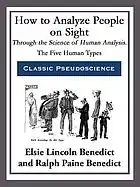
How to Analyze People on Sight or How to Analyze People on Sight Through the Science of Human Analysis: The Five Human Types is a 1921 book by Elsie Lincoln Benedict and Ralph Paine Benedict.[1] The book is published and bound by the Roycrofters in East Aurora, New York, remains as 7th of the top downloads on Project Gutenberg.[2] It is written version of public lecture of the same name.[3]
Content
In the book, the authors divided all people into five categories based on fat, chest size and the inner lungs and heart, muscles, bones and thinking part of the brain and gave their own description of their mentality and work,[4] and also gave their own research-based advice on social and business deal with them and about their profession and marriage.[5]
References
- ↑ Green, Don M. (21 April 2026). Self-Help Pioneers: The Visionaries Behind the Success Principles of the Personal Growth Movement. Sound Wisdom. ISBN 978-1-64095-715-2. Retrieved 27 May 2026.
Benedict's most famous book was How to Analyze People on Sight Through the Science of Human Analysis: The Five Human Types, which she coauthored with her husband, Ralph Paine Benedict.
- ↑ Kozlowski, Michael (30 August 2011). "The 25 Most downloaded eBooks on Project Gutenberg - Good e-Reader". goodeeader.com. Retrieved 27 May 2026.
- ↑ "how to analyse people on sight book by Elsie lincoln Benedict :Historical Newspapers from 1700s-2000s - Newspapers.com™". Newspapers.com. Retrieved 27 May 2026.
- ↑ Reed, Karin M. (20 March 2017). On-Camera Coach: Tools and Techniques for Business Professionals in a Video-Driven World. John Wiley & Sons. p. 138. ISBN 978-1-119-31603-9. Retrieved 27 May 2026.
- ↑ Congress, Library of; Subcommittee, American Library Association Committee on Resources of American Libraries National Union Catalog (1969). The National Union Catalog, Pre-1956 Imprints: A Cumulative Author List Representing Library of Congress Printed Cards and Titles Reported by Other American Libraries. Mansell. pp. 186, 212. ISBN 978-0-7201-0003-7. Retrieved 27 May 2026.
External links
