Methyl isobutyl ketone
 | |
 | |
| Names | |
|---|---|
| Preferred IUPAC name
4-Methylpentan-2-one | |
Other names
| |
| Identifiers | |
3D model (JSmol) |
|
| Abbreviations | MIBK |
| ChEBI | |
| ChEMBL | |
| ChemSpider | |
| ECHA InfoCard | 100.003.228 |
| EC Number |
|
| KEGG | |
PubChem CID |
|
| RTECS number |
|
| UNII | |
| UN number | 1245 |
CompTox Dashboard (EPA) |
|
| |
| |
| Properties[1] | |
| C6H12O | |
| Molar mass | 100.161 g·mol−1 |
| Appearance | colorless liquid |
| Density | 0.7965 g/mL |
| Melting point | −85 °C (−121 °F; 188 K) |
| Boiling point | 115.7 °C (240.3 °F; 388.8 K) |
| Critical point (T, P) | 575.4 K, 3.4 MPa |
| 1.91 g/100 mL (20.0 °C (68.0 °F; 293.1 K)) | |
| Solubility |
|
| log P | 1.31 |
| Vapor pressure | 2.64 kPa |
| −69.7×10⁻⁶ cm3/mol | |
Refractive index (nD) |
1.3962 |
| Viscosity | 0.545 cP |
| Thermochemistry[1] | |
Heat capacity (C) |
213.3 J⋅mol−1·K-1 |
Enthalpy of vaporization (ΔfHvap) |
40.61 kJ⋅mol−1 |
| Hazards | |
| GHS labelling:[2] | |
   | |
| Danger | |
| H225, H319, H332, H336, H351 | |
| P201, P202, P210, P233, P240, P241, P242, P243, P261, P264, P271, P280, P303+P361+P353, P304+P340+P312, P305+P351+P338, P308+P313, P337+P313, P370+P378, P403+P233, P403+P235, P405, P501 | |
| NFPA 704 (fire diamond) | |
| Flash point | 18 °C (64 °F; 291 K)[1] |
| 448 °C (838 °F; 721 K)[1] | |
| Explosive limits | 1.2%–8.0%[1] |
Threshold limit value (TLV) |
20 ppm (TWA), 75 ppm[1] (STEL) |
| Lethal dose or concentration (LD, LC): | |
LD50 (median dose) |
2080 mg/kg (oral, rat)[2] |
LC50 (median concentration) |
11.6 mg/L (4h, rat, vapor)[2] |
| NIOSH (US health exposure limits):[4] | |
PEL (Permissible) |
TWA 100 ppm (410 mg/m3) |
REL (Recommended) |
|
IDLH (Immediate danger) |
500 ppm |
| Related compounds | |
Related ketones |
|
Except where otherwise noted, data are given for materials in their standard state (at 25 °C [77 °F], 100 kPa).
Infobox references | |


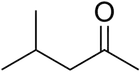
Methyl isobutyl ketone (MIBK, 4-methylpentan-2-one) is an organic compound with the condensed chemical formula (CH3)2CHCH2C(O)CH3. This ketone is a colourless liquid that is used as a solvent for gums, resins, paints, varnishes, lacquers, and nitrocellulose.[5]
Production
At laboratory scale, MIBK can be produced via a three-step process using acetone as the starting material. Self-condensation, a type of aldol reaction, produces diacetone alcohol, which readily dehydrates to give 4-methylpent-3-en-2-one (commonly, mesityl oxide).[6][7] Mesityl oxide is then hydrogenated to give MIBK.

Industrially, these three steps are combined. Acetone is treated with a strongly acidic, palladium catalyst-doped cation exchange resin under medium pressure of hydrogen.[8] Several million kilograms are produced annually.
Uses

MIBK is used as a solvent for nitrocellulose, lacquers, and certain polymers and resins.
Precursor to 6PPD
Another major use is as a precursor to N-(1,3-dimethylbutyl)-N′-phenyl-p-phenylene diamine (6PPD), an antiozonant used in tires. 6PPD is prepared by reductive coupling of MIBK with 4-aminodiphenylamine.[9]
Solvent and niche applications
Unlike the other common ketone solvents, acetone and MEK, MIBK has quite low solubility in water, making it useful for liquid-liquid extraction. For example, the purification of tantalum from its ores often relies on MIBK extractions.[10] It has a similar polarity to ethyl acetate, but greater stability towards aqueous acids and bases.
It can be used to extract gold, silver and other precious metals from cyanide solutions, such as those used in gold mines, to determine the levels of those dissolved metals.
When mixed with water or isopropyl alcohol MIBK serves as a developer for PMMA electron beam lithography resist. MIBK is used as a solvent for CS in the preparation of the CS spray used currently by American and British police forces.[11][12]
References
- 1 2 3 4 5 6 Haynes, William M., ed. (2016). CRC Handbook of Chemistry and Physics (97th ed.). Boca Raton, Florida: CRC Press. pp. 3–386, 5–28, 5–158, 5–175, 6–77, 6–148, 6–246, 15–18. ISBN 9781498754293.
- 1 2 3 Sigma-Aldrich Co., Methyl isobutyl ketone.
- ↑ "Methyl isobutyl ketone". www.fishersci.com. ThermoFisher Scientific. Retrieved 13 May 2026.
- ↑ "NIOSH Pocket Guide to Chemical Hazards".
- ↑ United States Environmental Protection Agency (January 2000). "Methyl Isobutyl Ketone (Hexone)" (PDF). Retrieved 13 May 2026.
- ↑ Conant, J. B.; Tuttle, N. (1921). "Diacetone Alcohol". Organic Syntheses. 1: 45. doi:10.15227/orgsyn.001.0045.
- ↑ Conant, J. B.; Tuttle, N. (1921). "Mesityl Oxide". Organic Syntheses. 1: 53. doi:10.15227/orgsyn.001.0053.
- ↑ Uhde GmbH (2005). "Uhde Technology Profile: MIBK" (PDF). Archived from the original (PDF) on 2013-12-03. Retrieved 18 October 2021.
- ↑ Engels, H.-W.; Weidenhaupt, H.-J.; Pieroth, M.; Hofmann, W.; Menting, K.-H.; Mergenhagen, T.; Schmoll, R.; Uhrlandt, S. (2007). "Rubber, 4. Chemicals and Additives". Ullmann's Encyclopedia of Industrial Chemistry. Weinheim: Wiley-VCH. doi:10.1002/14356007.a23_365.pub2. ISBN 978-3-527-30673-2.
- ↑ Shikika, A.; Sethurajan, M.; Muvundja, F.; Mugumaoderha, M.C.; Gaydardzhiev, St. (2020). "A review on extractive metallurgy of tantalum and niobium". Hydrometallurgy. 198 105496. doi:10.1016/j.hydromet.2020.105496.
- ↑ Peter J Gray; Stark, MM; Gray, P. J; Jones, G R. N (2000). "Is CS spray dangerous? : CS is a particulate spray, not a gas" (Response to editorial). BMJ. 321 (7252): 26. doi:10.1136/bmj.321.7252.46. PMC 1127688. PMID 10939811.
- ↑ Roger Eardley-Pryor (2017). "A Tear Gas Tale". Science History Institute. Retrieved 2021-02-22.