Heronswood, Victoria
| Heronswood | |
|---|---|
 Heronswood, in 2008 | |
  Location of the house in Greater Metropolitan Melbourne | |
Interactive map of the Heronswood area | |
General information | |
| Status | Completed |
| Type | House, garden, and cottage |
Architectural style | Gothic Revival (house) |
| Location | 105 Latrobe Parade, Dromana, Mornington Peninsula, Melbourne, Victoria, Australia |
| Coordinates | 38°20′39″S 144°56′38″E / 38.3441°S 144.9440°E |
| Years built |
|
Completed |
|
| Renovated | 2017 (cottage) |
| Client | William Hearn |
| Owner |
|
| Technical details | |
| Structural system | Cottage: Drop slab |
| Material |
|
| Grounds |
|
| Design and construction | |
Architecture firm | Joseph Reed and Bates |
| Other designers |
|
| Known for | Extensive gardens |
| Website | |
| diggers | |
Official name | Heronswood |
| Type | Registered place |
| Designated | 11 November 1987 |
| Reference no. | H0664 |
| HO114 | |
Categories |
|
Official name | Heronswood Main House and Cottage |
| Type | Defunct register |
| Designated | 21 March 1978 |
| Reference no. | 5799; 5800 |
Heronswood is a house, extensive garden, and cottage, located at 105 Latrobe Parade, Dromana, on the Mornington Peninsula, a south-eastern suburb of Melbourne, in Victoria, Australia. Located on the traditional lands of the Bunurong people, the house is located directly above the beach where Captain Matthew Flinders landed on 27 April 1802.
The house was built in 1871 and was added to the Victorian Heritage Register on 11 November 1987;[1] and was also added to non-statutory lists by the Victorian branch of the National Trust on 29 October 1959[2] and the now defunct Register of the National Estate on 21 March 1978.[3] An 1864 drop slab cottage was also added to the defunct Register on the same date.[4]
Since the 1980s, the garden at Heronswood has been open to the public.[5]
History
- Hearn
In 1864, William Hearn purchased 14 hectares (35 acres) from Dr Godfrey Howitt,[3] the owner of Barragunda (built c. 1866). Hearn built Heronswood between 1871 and 1876.[6]: 31 Hearn was one of the first professors at the University of Melbourne, a political economist, jurist, conservative politician, and lecturer, and had a well-established reputation in British academic circles. He taught and strongly influenced both Sutherland and Higgins – two of the subsequent owners of Heronswood.[1]
- Sutherland
Alexander Sutherland, the second owner, was a poet and philosopher, notable as a journalist, educator, and university administrator.[1][7][8]
- Higgins
In 1903,[9] Heronswood was sold to H. B. Higgins, a close friend of Sutherland and a former pupil of Hearn, a lawyer, a radical politician, and one of the most controversial jurists in Australian history. He remains best known for his famous Harvester Judgement which conceived the concept of the basic wage and as a founder of the arbitration system. Higgins was a highly influential politician, served briefly as the Federal Attorney General,[1] and was a justice of the High Court of Australia from 1906 until his death in 1929.[9]
On 5 February 1912, The Argus newspaper reported a bushfire in the vicinity of Arthurs Seat. Several residences in Dromana were destroyed.
"Last evening, at about half-past 5 o'clock, a bush fire swept a portion of the country between Dromana and Rosebud. It swept away the residences of Mrs. Coburn, Springbank, and the summer residence of Mr. Frank Cornell, despite the efforts of a large number of workers. Miss Burrell's house was saved after great exertions. The township of Rosebud is safe, and the fire is now burning in the direction of Boneo. Portion of the same fire swept towards Heronswood, the seaside residence of Mr. Justice Higgins. The fate of the residence was for some hours uncertain, but the flames were finally beaten off. Fires are still burning at Arthurs Seat and towards Mount Martha."[10]
On 13 January 1929 at Heronswood, Higgins took his regular morning walk to Arthurs Seat. As was his habit he then read on the porch. In the early evening he collapsed and died. The Trades Hall in Melbourne flew the Australian flag at half mast. Higgins was buried in Dromana cemetery, with Anglican rites, under the Celtic cross which he had built to commemorate his son. He was survived by his wife, Mary Alice Higgins.[9]
- Subsequent owners
In 1932, W. A. and J. A. Farey, owners of a bakery in Hawthorn, purchased Heronswood for A£4,000 and continued the tradition of using the property as a retreat.[11] In 1957, Jack and Ada Wilson, bought Heronswood and made it their permanent residence, and subdivided the property in 1964. In 1973, Heronswood was purchased by T. Shugg, later to S. Moffat, and, in 1983, to Clive Blazey AM and his wife, Penny,[3] set on 1.4 hectares (3.5 acres).[12][13] The Blazey family founded Hortico,[14] that later merged with Yates, a subsidiary of the Dulux group.
Description
Buildings
- Mian house
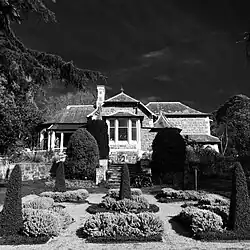
The two-storey five-bedroom house was constructed of bluestone, with limestone dressings, and bell-cast slate roof in the Gothic Revival style. The single storey north-east wing, with varied windows and roof shapes, verandahs and loggia, contrasts with the two-storey south-west wings.[3][14]
The authorship of Heronswood's design is unclear.[a] Joseph Reed may have been involved as with the similar house, Barragunda, at Cape Schanck. Edward La Trobe Bateman (1815?-1897) was involved in the designs of Barragunda, principally the gardens. Bateman's grand nephew was Charles Latrobe, and emigrated in 1852 as a gold digger. In Victoria, Bateman worked as an illustrator, draughtsman, architectural decorator and landscape designer. He worked with Reed and Barnes who were Melbourne's leading architects.[1][15]
There are also similarities with Kolor at Penshurst in the Western District which Reed and Barnes designed for Joseph Twomey in 1868. The design of Kolor is more coherent which suggests the master's hand. Bateman designed the garden at nearby Chatsworth house in 1867 for John Moffat. All these houses form an important expression of the Picturesque movement in Victoria. They parallel the work of the Geelong architects A. Davidson and G. Henderson and follow the theories of Eugène Viollet-le-Duc.[1]
- Cottage
In addition to the main dwelling, located on the site, is a diagonally-fitted drop slab cottage, originally constructed with unsawn timber posts, in c. 1864. The cottage has a triple-curved hipped shingled roof and one large stone chimney. The bay window is post framed, as is the covered way to the main house and the gabled south-west extension. The cottage is a rare surviving example of drop slab construction and the use of slabs laid diagonally is unique in Victoria. Stylistically this first building is a very rare example of the Picturesque cottage orne and has no relationship to contemporary Australian practice.[4] The cottage was restored in 2017.[12]
Garden
The garden of Heronswood laid out by Bateman is also significant. Initially set on 14 hectares (35 acres), when the property was sold in 1983, the size had reduced, via subdivision, to 1.4 hectares (3.5 acres).[14] The original orchard remains on adjacent land.[1]
Hearn employed William Moat to develop spacious lawns and gardens. Rare oriental and occidental trees were planted, many of which survive to this day. A cape chestnut is one of the most impressive trees today that survived from these early plantings. Moat also developed an orchard and fenced Hearn's property. He planted many pine trees, some of which are still standing.[16]
The garden was listed in the Oxford Companion to Gardens as one of only four entries for the state of Victoria, along with the Melbourne Botanical Gardens, Mawallock and Ripponlea. The Oxford Companion is an encyclopedia of the art of garden design from the earliest known gardens to contemporary times.[17] In 2020, the garden at Heronswood was listed as one of the world’s best gardens in the book, The Gardener’s Garden.[18]
See also
Notes
- ↑ The National Trust of Australia (Victoria) states that it is "…the only known complete house… of La Trobe Bateman…"[2] However, the Register of the National Estate states "…to designs probably by Edward La Trobe Bateman…";[3] and both the Victorian Heritage Register and the heritage report by Graeme Butler and Associates cast doubts on Bateman's sole authorship, replicating the partnership between Bateman with Reed and Barnes that occurred at Barragunda and elsewhere.[1][6]: 109
References
- 1 2 3 4 5 6 7 8 "Heronswood, Victorian Heritage Register (VHR) Number H0664, Heritage Overlay HO114". Victorian Heritage Database. Heritage Victoria. Retrieved 27 July 2026.
- 1 2 "Heronswood House & Garden (NTA-V list: Property No B0048)". Victorian Heritage Database. Heritage Victoria. Retrieved 27 July 2026.
- 1 2 3 4 5 "Heronswood Main House (Place ID 5799)". Australian Heritage Database. Australian Government. 21 March 1978. Retrieved 27 July 2026.
- 1 2 "Heronswood, the Cottage (Place ID 5800)". Australian Heritage Database. Australian Government. 21 March 1978. Retrieved 27 July 2026.
- ↑ "Visit Heronswood". The Diggers Club. n.d. Retrieved 1 August 2026.
- 1 2 Graeme Butler & Associates (July 2013). Mornington Peninsula Shire Thematic History (PDF). Shire of Mornington Peninsula (Report). p. 30. Retrieved 1 August 2026.
- ↑ Northcott, P. H. (2006). "Alexander Sutherland (1852–1902)". Australian Dictionary of Biography. National Centre of Biography, Australian National University. ISBN 978-0-522-84459-7. ISSN 1833-7538. OCLC 70677943. Retrieved 29 May 2024.
- ↑ Serle, Percival (1949). "Sutherland, Alexander". Dictionary of Australian Biography. Sydney: Angus & Robertson.
- 1 2 3 Rickard, John (2006) [1983]. "Henry Bournes Higgins (1851–1929)". Australian Dictionary of Biography. Vol. 9. National Centre of Biography, Australian National University. ISBN 978-0-522-84459-7. ISSN 1833-7538. OCLC 70677943. Retrieved 1 August 2026.
- ↑ "Dromana Residences Lost". The Argus. Melbourne. 5 February 1912. p. 8. Retrieved 28 August 2011 – via Trove. National Library of Australia.
- ↑ "HISTORIC HOME SOLD FOR £4000". The Sun News-pictorial. No. 2925. Melbourne. 30 January 1932. p. 4. Retrieved 5 August 2026 – via Trove.. National Library of Australia.
- 1 2 Blazey, Clive; Blazey, Penny (2017). "About us". The Diggers Club. Retrieved 1 August 2026.
- ↑ Edmanson, Jane (7 September 2018). "Summer colour" (streaming video). Gardening Australia. Series 29. Episode 33. ABCTV. Retrieved 1 August 2026.
- 1 2 3 Walsh, Melissa (April 2017). "From little things, big things grow". Peninsula Essence. Retrieved 1 August 2026.
- ↑ Thomas, Daniel (2006) [1969]. "Bateman, Edward La Trobe (1815–1897)". Australian Dictionary of Biography. Vol. 3. National Centre of Biography, Australian National University. ISBN 978-0-522-84459-7. ISSN 1833-7538. OCLC 70677943. Retrieved 13 July 2021.
- ↑ McClear, Colin (March 2006). A Dreamtime of Dromana. A History of Dromana through the eyes of a pioneering family. Dromana Historical Society. p. 50. ISBN 0-9757127-6-4.
- ↑ Goode, Patrick; Lancaster, Michael; Jellicoe, Susan; Jellicoe, Geoffrey. The Oxford Companion to Gardens. London, England: Oxford University Press. Archived from the original on 22 February 2009. Retrieved 21 June 2025 – via Amazon Books.
- ↑ Blazey, Clive; Blazey, Penny (29 November 2021). "Heronswood". The Diggers Club. Retrieved 1 August 2026.
External links
 Media related to Heronswood, Victoria at Wikimedia Commons
- "About Heronswood". The Diggers Club. n.d. Retrieved 1 August 2026.
- Reid, Georgina (12 November 2018). "Clive and Penny Blazey are Melbourne's heirloom seed heroes". Assemble Papers. Retrieved 1 August 2026.
- Reid, Georgina (1 March 2018). "Heronswood House + Garden Celebrates A Milestone". The Design Files. Retrieved 1 August 2026.
- 1876 establishments in Australia
- Bluestone houses in Australia
- Buildings and structures in the Shire of Mornington Peninsula
- Gardens in Victoria (state)
- Gothic Revival architecture in Melbourne
- Houses completed in 1864
- Houses completed in 1876
- Houses in Melbourne
- Places on the Victorian Heritage Register in the Shire of Mornington Peninsula
- Victorian places listed on the defunct Register of the National Estate
- Wooden buildings and structures in Australia