Hemaris diffinis
| Snowberry clearwing | |
|---|---|
 | |
| Hemaris diffinis in Augusta, Michigan | |
Scientific classification  | |
| Kingdom: | Animalia |
| Phylum: | Arthropoda |
| Clade: | Pancrustacea |
| Class: | Insecta |
| Order: | Lepidoptera |
| Family: | Sphingidae |
| Genus: | Hemaris |
| Species: | H. diffinis |
| Binomial name | |
| Hemaris diffinis | |
| Synonyms | |
| |

Hemaris diffinis, the snowberry clearwing, is a moth of the family Sphingidae. This moth is sometimes called "hummingbird moth" or "flying lobster". This moth should not be confused with the hummingbird hawk-moth of Europe.
Adults
It is about 32–51 millimetres (1.25–2 in). The moth's abdomen has yellow and black segments much like those of the bumblebee, for which it might be mistaken due to its color and flight pattern similarities. The moth's wings lack the large amount of scales found in most other lepidopterans, particularly in the centralized regions, making them appear clear. It loses the scales on its wings early after the pupa stage due to its highly active flight tendencies.
 Male dorsal
 Male ventral
 Female dorsal
 Female ventral
Biology
It flies during the daylight much like the other hummingbird moths, but it may also continue flight into the evening, particularly if it has found a good source of nectar.
Distribution
The moth is found in the Northwest Territories, British Columbia (including the Cariboo region), southern Ontario, eastern Manitoba, and western Quebec in Canada. In the United States, this species has been located in southern California and Baja California Norte, Illinois, and east through most of the United States from Maine to West Virginia to Florida.
Food plants
The larvae feed on plants including dogbane (Apocynum), Lonicera, Viburnum, Amsonia, Triosteum, Diervilla,[3] and Symphoricarpos.
Regional names
Hemaris diffinis is notable for its colorful nicknames. In certain parts of Appalachia, including West Virginia, Hemaris diffinis is known as the "hummingbird moth" or "flying lobster". These nicknames are derived from its supposed physical resemblance to other (genetically unrelated) animals.
Gallery
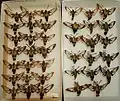 Hemaris diffinis variation
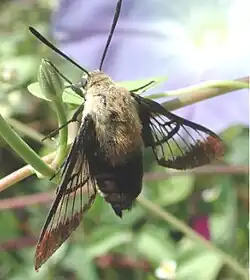 Snowberry clearwing (Hemaris diffinis), Lake Junaluska, North Carolina
 Snowberry clearwing in Elizabethtown, Kentucky
 Hemaris diffinis on cosmos
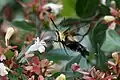 Hemaris diffinis nectaring on abelia
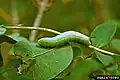 Caterpillar
 Feeding at Buddleja flower
References
- ↑ NatureServe. "Hemaris diffinis". NatureServe Explorer. Arlington, Virginia. Retrieved July 13, 2026.
- ↑ "CATE Creating a Taxonomic eScience - Sphingidae". Cate-sphingidae.org. Archived from the original on November 10, 2012. Retrieved October 19, 2011.
- ↑ Schoen, Daniel J. (1977). "Floral Biology of Diervilla lonicera (Caprifoliaceae)". Bulletin of the Torrey Botanical Club. 104 (3): 234–240. doi:10.2307/2484303. ISSN 0040-9618.
External links
