Helvetiafjellet formation
| Helvetiafjellet formation | |
|---|---|
| Stratigraphic range: Lower Cretaceous, ~ | |
 Figure based on[1] | |
| Type | Geological formation |
| Unit of | Adventdalen Group |
| Sub-units | Festningen member
Glitrefjellet member |
| Underlies | Carolinefjellet Formation |
| Overlies | Rurikfjellet Formation
Agardhfjellet Formation |
| Thickness | up to 40–155 metres (130–510 ft) |
| Lithology | |
| Primary | Sandstone |
| Location | |
| Region | Svalbard Norway |
The Helvetiafjellet formation is a sequence of early Cretaceous sandstone-dominated rock found in Svalbard, Norway[2] belonging to the Adventdalen group.[3] The formation is 40-155m thick and has two known members: the sandstone-dominated Festningen member and the heterolithic and coal-bearing Glitrefjellet member.[4] It has an overall transgressive development, as it shows an upward increase in marine influence. There is also evidence of a large-scale retrogradational stacking pattern, which is concluded from the presence of delta front deposits on the uppermost Glitrefjellet member.[4]
Geology
An increase in tectonic activity produced enhanced differential uplift of the Svalbard platform in the Barremian, prompting the formation of a subaerial unconformity across Svalbard. The differential uplift was also associated with widespread igneous activity, which resulted in the High Arctic Large Igenous Province (HALIP).[4] As the result of the Paleogene development of the NNW to SSE trending West Spitsbergen Fold Belt, the Lower Cretaceous strata along the western coast of the island were affected by the syncline that formed in the fold belt's foreland basin, and are steeply dipping to the east. On the eastern part of the island and the rest of Svalbard, they are more horizontal.[5]
The Festningen Sandstone member is the earliest member of the Helvetiafjellet Formation, with almost vertically inclined strata.[6] The member consists of two cross-bedded sandstone bodies that is around 20m thick. The cross-bedding and the lateral extent suggest a fluvial braidplain setting.[3] The Festningen member is followed by the Glitrefjellet member which better records the transgressive setting. The lower portion of the member is characterized by the alternation of floodplain, fluvial distributary channel and crevasse splay facies and are topped by delta front and delta plain deposits, indicating the transgression. Sandstone and mudstone beds interbedded with plant debris, silty shale and coal seams are the prominent rock types present.[5]
Dinosaurs
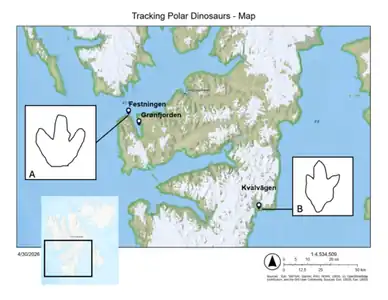
The dinosaurs of the Helvetiafjellet Formation are not normally found as fossils in the limestones; rather, they are discovered as remarkably preserved tracks and footprints. The trackways belong to possible ornithopods and theropods, and are dated to the Cretaceous period, from 145 to 66 million years ago. The trackways were first found in 1960.[6] One species found is the genus Caririchnium; possibly the species C. billsarjeanti and C. burreyi.[8] These are small to medium sized ornithopods, and have been found in North America and Eurasia, and mainly are known from their tracks. These tracks were found in Barremian-layer sandstone caused by the dinosaurs crossing the formation on the Barents Shelf during the Hauterivian-Barremian period (a period in geologic time between 125.77 Ma (million years ago) and 121.4 ± 0.6 Ma), when the formation acted as a land bridge between North America and Eurasia.[8] Another set of tracks, measuring 50-60 centimeters long and with equal width, were found in 2006,[9] and while no proper identification has been named, the tracks used to be thought to belong to Iguanadon for a time. However, actual fossils of other organisms have been found, including marine lizard and fish remains, fossils of plants that show they lived in a humid, warm-temperate climate, and a rare femur from a prehistoric bird has been found, measuring 0.4 cm wide and 4 cm long, was found on Schønrockfjellet on the east coast of Spitsbergen.[10]
Economic implication
In the Early Cretaceous, Svalbard was situated around 63°-66° N as part of a large circum-arctic platform. Fossil records of coniferous trees, dinosaur tracks, ginko trees and bitumenous coal seams suggest warm climate.[4] However, arctic belemnites, glendonite layers and possibly ice rafted debris have been found in the formation which indicate that at least periodically, polar waters intruded the shallow seas covering the archipelago.[5] The strata represent periodic warming and cooling periods that generated eustatic sea-level variations which affected global circulation patters as the shallow seaways were periodically exposed. One episode of cooling was due to the Aptian ocean anoxic event, that was most likely triggered by LIP volcanism of the Ontong Java Plateau and the High Arctic Large Igneous Province. These events caused significant perturbation in the carbon cycle, influencing climatic conditions.[11]
Coal and coaly shale layers are found in the mudstone and siltstone beds of floodplain and interdisciplinary bay deposits. Coal seams were briefly mined at Advent City and Hiorthhamn in Adventfjorden and at Bohemanneser at the Northern shore of Isfjorden (Svalbard) during the early 1900s. Sandstones of the Festningen Member were evaluated to have CO2 reservoir and aquifer potential, but the idea was abandoned because the formation is directly connected to the land surface and to fjords. Vitrine reflective analysis of the coal layers yield R% values up to 1.1, with mostly Type III kerogen as the source organism, making the shales a potential source rock. However, there is no current economic interest in mining the coal and shale content of the formation.[4]
References
- ↑ Midtkandal, I.; Nystuen, J. P. (September 19, 2009). "Depositional architecture of a low-gradient ramp shelf in an epicontinental sea: the lower Cretaceous of Svalbard". Basin Research. 21 (5): 655–675. doi:10.1111/j.1365-2117.2009.00399 (inactive 25 May 2026).
{{cite journal}}: CS1 maint: DOI inactive as of May 2026 (link) - ↑ Zhang, Yang; Ogg, James G.; Minguez, Daniel; Hounslow, Mark W.; Olaussen, Snorre; Gradstein, Felix M.; Esmeray-Senlet, Selen (2021-06-01). "Magnetostratigraphy of U-Pb–dated boreholes in Svalbard, Norway, implies that magnetochron M0r (a proposed Barremian-Aptian boundary marker) begins at 121.2 ± 0.4 Ma". Geology. 49 (6): 733–737. Bibcode:2021Geo....49..733Z. doi:10.1130/G48591.1. ISSN 0091-7613.
- 1 2 Mørk, Atle; Grundvåg, Sten-Andrea (2020). "Festningen" (PDF). Norsk Geologisk Forening: 36.
- 1 2 3 4 5 Grundvåg, Sten-Andreas; Jelby, Mads Engholm; Sliwinska, Kasia Kamila; Nøhr-Hansen, Henrik; Aadland, Tore; Sandvik, Sara Elvelund; Tennvassås, Ingrid; Engen, Thea; Olaussen, Snorre (2019-06-27). "Sedimentology and palynology of the Lower Cretaceous succession of central Spitsbergen: integration of subsurface and outcrop data". Norwegian Journal of Geology. doi:10.17850/njg006.
- 1 2 3 Engen, T. M., 2018, Master Thesis: A sedimentological study of the Lower Cretaceous Glitrefjellet Member, Svalbard: Tromsø, The Arctic University of Norway, p. 139, https://hdl.handle.net/10037/12826
- 1 2 3 4 Jørn H. Hurum, Jesper Milàn, Øyvind Hammer, Ivar Midtkandal, Hans Amundsen & Bjørn Sæther. Tracking polar dinosaurs - New finds from the Lower Cretaceous of Svalbard. Norwegian Journal of Geology, Vol. 86, pp. 397-402. Trondheim 2006, ISSN 029-196X.
- ↑ Xing, L., Peng, G., Ye, Y., Lockley, M. G., Klein, H., Persons, W. S., Zhang, J., Shu, C., Hao, B. (2014). Sauropod and Small Theropod Tracks from the Lower Jurassic Ziliujing Formation of Zigong City, Sichuan, China, with an Overview of Triassic–Jurassic Dinosaur Fossils and Footprints of the Sichuan Basin. Ichnos, 21(2), 119–130. https://doi.org/10.1080/10420940.2014.909352
- 1 2 Hurum, Jørn H.; Druckenmiller, Patrick S.; Hammer, Øyvind; Nakrem, Hans A.; Olaussen, Snorre (January 2016). "The theropod that wasn't: an ornithopod tracksite from the Helvetiafjellet Formation (Lower Cretaceous) of Boltodden, Svalbard". Geological Society, London, Special Publications. 434 (1): 189–206. Bibcode:2016GSLSP.434..189H. doi:10.1144/SP434.10. ISSN 0305-8719.
- ↑ Smelror, M., 2007, Dinosaurs on Svalbard.: ResearchGate, https://www.researchgate.net/publication/264007702_Dinosaurs_on_Svalbard.
- ↑ Snorre Olaussen, Back when the dinosaurs were ash-stranded, UNIS; 2021, Sten Andreas Grundvåg, The Arctic University of Norway, Tromsø; Jørn Hurum, Natural History Museum, University of Oslo and Kim Senger, UNIS. https://www.unis.no/news/back-when-the-dinosaurs-were-ash-stranded/
- ↑ Smyrak-Sikora, Aleksandra; Betlem, Peter; Engelschiøn, Victoria S.; Foster, William J.; Grundvåg, Sten-Andreas; Jelby, Mads E.; Jones, Morgan T.; Shephard, Grace E.; Śliwińska, Kasia K.; Vickers, Madeleine L.; Zuchuat, Valentin; Augland, Lars Eivind; Faleide, Jan Inge; Galloway, Jennifer M.; Helland-Hansen, William (2025-11-12). "Phanerozoic paleoenvironmental and paleoclimatic evolution in Svalbard". Climate of the Past. 21 (11): 2133–2187. Bibcode:2025CliPa..21.2133S. doi:10.5194/cp-21-2133-2025. ISSN 1814-9324.