Helen Lewis (choreographer)
Helen Lewis | |
|---|---|
 | |
| Born | Helena Katz 22 June 1916[1] |
| Died | 31 December 2009 (aged 93) Belfast, Northern Ireland |
| Other name | Helena Hermann |
| Occupations | dance teacher, choreographer |
| Known for | A Time to Speak, autobiography |
| Spouse(s) | Paul Hermann (1938–1945; his death) Harry Lewis (1947–1991; his death) |
| Children | Two sons: Michael Lewis Robin Lewis |
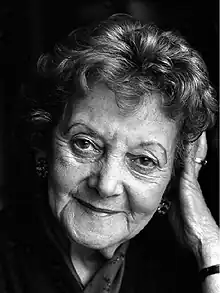
Helen Lewis MBE (née Helena Katz; 22 June 1916 – 31 December 2009) was a pioneer of modern dance in Northern Ireland, and made her name as a dance teacher and choreographer. A survivor of the Holocaust, she was also known for her memoir of her experiences during the Second World War.
Early life
Helena Katz was born in 1916 into a German-speaking Jewish family in Trutnov in Bohemia, Austria-Hungary (now in the Czech Republic). After she completed study at the Realgymnasium of Trutnov in 1935, she and her mother, an accomplished singer and pianist, moved to Prague; her father had died in the previous year.[2]
In Prague, she studied dance with Milča Mayerová, who had trained with Rudolf Laban. Katz also studied philosophy at the German University of Prague, and took private lessons in French. In about 1936 she met Paul Hermann, a Czech from a Jewish family, and in 1938, after she had finished her dance training and her university exams, they were married. She taught as an assistant at Mayerová's dance school, and experimented with choreography.[2]
War years
In what became, following the German occupation in March 1939, the Protectorate of Bohemia and Moravia, the Hermanns experienced a progressive exclusion of Jews from public life. Italy's entry into the war in June 1940, dashed their hopes of an escape via Trieste for the refuge offered in Shanghai.[3]
Theresienstadt Ghetto
Deportations of Jewish families began in August 1941. Preceded by their parents, the Hermanns were sent in August 1942 to Theresienstadt/Terezín ghetto and concentration camp. Helen found work in a children's home where, with the rest of the staff, she "deliberately and actively disobeyed the 'no schooling' orders".[4]
She also participated, including as a dancer, in the "rich and varied cultural life" in the ghetto which "flourished in the face of starvation, disease and the constant threat of deportation to the east". This, she recalls was first resisted by authorities but then used for propaganda[5] (toward the end of 1944, plays, concerts and other cultural activities were staged under the close supervision of the SS to deceive visitors from the International Red Cross and were documented in a film depicting the camp as a spa town).[6]
Stutthof KZ
In May 1944, the Hermanns were transferred to the family camp at Auschwitz-Birkenau and separated. In August, Helen, who survived two "selections" by Josef Mengele,[7] was sent in a group of three hundred women to Stutthof concentration camp in northern Poland.[8]
They were assigned to a satellite camp outside Praust/Pruszcz Gdański where they had been preceded by a group of five hundred women from Poland, the Baltic states, Hungary and Romania. These women spoke Yiddish, rather than German, and "bitterly resented" both the newcomers' "lack of religious ardour" and the privilege they had enjoyed in retaining their unshaven hair. The gulf between the two groups was bridged when, in "battle of wills" with their SS overseer (Oberaufseherin), they held to fast in honour of Yom Kippur. Perversely, they were rewarded with a post-fast meal complete with sweet pudding[9]
Unexpected rations were again available two months later when the Oberaufseherin encouraged Helen and fellow inmates to stage Christmas and New Year reviews featuring dramatic sketches, music, singing, and, with Helen as choreographer and performer (the valse from Delibes's Coppelia), dancing. The "quirky" indulgences came to an end when on 27 January 1945 when the camp was evacuated.[10]
After liberation
With those surviving prisoners able to walk, Helen was driven west toward Lauenburg. It was a death march from which on 11 March 1945, having been abandoned, wracked with typhoid fever, in the snow, she escaped into the care of the advancing Soviet forces.[11] After a period of hospitalisation, she returned to Prague where she learned, first of the death of her husband Paul on a forced march from the Sachsenhausen sub-camp Schwarzheide, and then of her mother's fate, deported early in 1942, and murdered at Sobibór extermination camp.[8]
Helen began to correspond with Harry Lewis (Lewy), a former beau from Trutnov who, now in Belfast, Northern Ireland, had seen her name on a Red Cross list of survivors.[12] They married in June 1947 in the Old Town Hall in Prague.[13]
Belfast

In October 1947, the Lewises joined Harry's parents in Belfast. From July 1939, Northern Ireland had taken in Jewish children who had arrived in the United Kingdom through the Kindertransport scheme. But entry to the province for Jewish refugees had otherwise been restricted to those few judged to have the capital or skills that would employ local people.[14] However, no barrier had been encountered by Harry's family as his father had been awarded British citizenship for service in the Boer War.[12]
After the birth of her two sons, Michael and Robin, in 1949 and 1954,[2] Helen began to work as a choreographer.[8] In 1956, she created the choreography for the productions The Bartered Bride of Smetana at Grosvenor High School in Belfast, for a performance of Dvořák's The Golden Spinning Wheel at the Belfast Ballet Club, and for a Macbeth at the Lyric Theatre, Belfast.[8] She later became choreographer in residence at the Lyric,[8] where she worked alongside, and became a close friend of, the set designer and artist, Alice Berger Hammerschlag.[12]
In 1962, Helen started the Belfast Modern Dance Group for which she devised and choreographed original ballets. These included the "Dance of Anne Frank’" (1995), which she asked to recreate in Germany.[15] In Northern Ireland, which had known only Irish dance and classical ballet, she introduced an "experimental European style of contemporary dance never before seen".[16] At same time, she did so while collaborating with Irish artists: with composers Raymond Warren, Havelock Nelson, and Alan Tongue, and, in a short ballet based on his poem "A Lough Neagh Sequence", with Nobel Laureate, Seamus Heaney.[17]
During the Northern Ireland Troubles, Helen worked with the Corrymeela Community, and with other peace and reconciliation initiatives, speaking out against bigotry and ethnic cleansing, and bringing theater and dance to schools.[18] For her contributions to contemporary dance, Helen was recognised with honorary doctorates by Queen's University Belfast and by Ulster University,[8] and, in 2001, with her appointment as MBE.[16]
Encouraged by her friends, the writers Michael Longley and Jennifer Johnson, in 1992 she published a memoir, Time to Speak, about her experiences before and during the war,[19] and was translated into several languages, including Czech, and was serialised by the Irish broadcaster RTÉ and the British broadcaster, BBC.[20] A month before her death, a one-woman show adapted from her story by Sam McCready was performed at the Lyric Theatre during the 2009 Belfast International Arts Festival.[21]
Helen Lewis died at her home in Belfast on 31 December 2009, aged 93.[22][23]
Commemoration
To mark Holocaust Memorial Day 2024, writer and dancer Maddy Tongue presented her book, Helen Lewis: Shadows Behind the Dance[24] at the Linen Hall Library in Belfast. It takes up Helen's story from her arrival in Belfast, and includes a suite of poems in her memory by Michael Longley, also a close friend of Helen, who read from his work.[25]
In 2025, the Northern Ireland War Memorial organised a Holocaust Memorial Day event that included an illustrated online presentation, "Dance Saved My Life",, by her grandson, Dan Lewis.[26]
In 2026, in the dance studio at the Crescent Arts Centre in Belfast that has been named in Helen's honour,[27] funds were raised on Holocaust Memorial for the Helen Lewis Bursaries, a new grants scheme for dance artists in Northern Ireland, in an occasion that included the presentation of a triptych that the artist Sarah Longley had created in response to her late father's poem, "Ghetto".[28]
Further reading
- Keogh, Dermot (1998). Jews in Twentieth-Century Ireland: Refugees, Anti-Semitism and the Holocaust. Cork University Press, 336 pp. ISBN 1-85918-150-3
- Lewis, Helen (1992). A Time To Speak. Belfast: Blackstaff Press, 132 pp. ISBN 978-0-8564-0491-7
- Jaffe, Steven (2022). "First Lady of Dance and Survivor: Helen Lewis". Jewish History in Northern Ireland. Retrieved 21 March 2022.
- Tongue, Maddy (2023). Helen Lewis: Shadows Behind The Dance. Belfast: Irish Pages Press, 184 pp. ISBN 978-1-8382018-9-0
External links
- Helen Lewis Items From The Linen Hall Theatre and Performing Arts Archive, YouTube, 27 August 2020. Retrieved 21 March 2022.
- Helen Lewis. I Remember the Holocaust (video made in 2000 by MediaAble Productions). Northern Visions Archive
- For educators: A Time to Speak – Helen Lewis. Holocaust Memorial Day Trust Archived 27 August 2017 at the Wayback Machine
- Maddy Tongue and Michael Longley, Helen Lewis: Shadows Behind the Dance, You Tube Holocaust Memorial Day presentation, 2 February 2024, Linen Hall Library Belfast.
- Dan Lewis. 'Dance Saved My Life' The Story of Helen Lewis, MBE, You Tube, Holocaust Memorial Day presentation, 27 January 2025, Northern Ireland War Memorial
References
- ↑ "Obituary: Helen Lewis". The Daily Telegraph. London. 15 January 2010. Retrieved 23 January 2013.
- 1 2 3 Lewis, Helen (2002). An Irish Epilogue. Irish Pages 1 (1): 25–30. (subscription required)
- ↑ Lewis, Helen (1992). A Time to Speak. Belfast: The Blackstaff Press. pp. 74–75, 81–82. ISBN 0856404918.
- ↑ Lewis (1991), pp. 42-43
- ↑ Lewis (1991), pp. 44-45
- ↑ "Theresienstadt: A Documentary Film, 1944". perspectives.ushmm.org. Archived from the original on 10 February 2025. Retrieved 21 March 2026.
- ↑ Henry, Lesley-Anne (2 January 2010). "Survivor of Auschwitz death camp Helen Lewis dies at 93". Belfast Telegraph. Retrieved 7 January 2016.
- 1 2 3 4 5 6 Johnston, Philip (17 March 2010). "Helen Lewis obituary". The Guardian. Retrieved 22 April 2015.
- ↑ Lewis (1991), pp. 74-75, 81-82
- ↑ Lewis (1991), pp. 90-96
- ↑ Lewis (1991), pp. 102-107
- 1 2 3 Lewis, Helen (2002). "An Irish Epilogue". Irish Pages. 1 (1): 25–30. ISSN 1477-6162.
- ↑ Lewis (1991), p. 131
- ↑ Russell, Noel (2024). The Saved and the Spurned: Northern Ireland, Vienna and the Holocaust. Dunlin: New Ireland. p. 219. ISBN 9781848409392.
- ↑ Rittner, Carol (1998), "A fifth place behind fear: an interview with Helen Lewis" in Anne Frank in the world: essays and reflections Carol Rittner ed., 19–38; New York: Routledge, ISBN 978-1-315-50377-6
- 1 2 Linenhall Library. "Search Collections / Theatre and Performing Arts: Helen Lewis". extraordinarywomenni.com. Retrieved 22 March 2026.
- ↑ Johnston, Philip (4 April 2010). "Helen Lewis (1916-2009)". Dance Magazine.
- ↑ Tongue, Maddy (2023). Helen Lewis: Shadows Behind The Dance. Belfast: Irish Pages Press. ISBN 978-1-8382018-9-0
- ↑ Lewis, Helen (1992). A Time To Speak. Belfast: Blackstaff Press. ISBN 978-0-8564-0491-7.
- ↑ "Helen Lewis, 1916–2009". Culture Northern Ireland. January 2010. Archived from the original on 2 March 2016. Retrieved 20 February 2016.
- ↑ Coyle, Jane (8 September 2009). "Belfast Festival: A Time To Speak". Performing Arts. Culture Northern Ireland. Archived from the original on 9 April 2015. Retrieved 22 April 2015.
- ↑ Coyle, Jane (11 January 2010). "Helen Lewis". The Stage. Archived from the original on 21 April 2016. Retrieved 10 April 2016.
- ↑ "Belfast Auschwitz survivor Helen Lewis dies aged 93". BBC News. 1 January 2010. Retrieved 23 January 2013.
- ↑ Tongue, Maddy (2023). Helen Lewis: Shadows Behind The Dance. Belfast: Irish Pages Press. ISBN 9781838201890.
- ↑ TheLinenHall (2 February 2024). Helen Lewis: Shadows Behind the Dance. Retrieved 23 March 2026 – via YouTube.
- ↑ Northern Ireland War Memorial Museum (10 February 2025). "Dance saved my life" - The story of Helen Lewis MBE (1916-2009) by Dan Lewis - HMD2025. Retrieved 23 March 2026 – via YouTube.
- ↑ "Helen Lewis Dance Studio". Room hire. Crescent Arts Centre. Archived from the original on 9 August 2016. Retrieved 15 September 2016.
- ↑ "Holocaust Memorial Day Trust | Crescent Arts Centre – Arts event – HMD 2026". Holocaust Memorial Day Trust. Retrieved 23 March 2026.
- 1916 births
- 2009 deaths
- 20th-century British Jews
- 20th-century memoirists from Northern Ireland
- 21st-century British Jews
- Artists from Belfast
- Auschwitz concentration camp survivors
- Charles University alumni
- Choreographers from Northern Ireland
- Contemporary dance choreographers
- Contemporary dance in the United Kingdom
- Czech choreographers
- Czech female dancers
- Czech dancers
- Czech Jews
- Czech women choreographers
- Czechoslovak emigrants to the United Kingdom
- Czechoslovak Holocaust survivors
- Dance teachers
- Female dancers from Northern Ireland
- Jewish concentration camp survivors
- Members of the Order of the British Empire
- Modern dancers
- People associated with Queen's University Belfast
- People associated with Ulster University
- People from Trutnov
- Stutthof concentration camp survivors
- Theresienstadt Ghetto survivors
- Women choreographers from Northern Ireland
- Women memoirists from Northern Ireland