An important special case of the Cantor theorem is that every continuous function from a closed bounded interval to the real numbers is uniformly continuous.
Proof of Heine–Cantor theorem
Suppose that  and
 are two metric spaces with metrics
 and
 , respectively. Suppose further that a function
 is continuous and is compact. We want to show that
 is uniformly continuous, that is, for every positive real number
 there exists a positive real number
 such that for all points
 in the function domain ,
 implies that
 .
Consider some positive real number . By continuity, for any point  in the domain , there exists some positive real number
 such that
 when
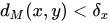 , i.e., a fact that
 is within
 of implies that
 is within
 of
 .
Let  be the open
 -neighborhood of , i.e. the set

Since each point is contained in its own , we find that the collection  is an open cover of . Since is compact, this cover has a finite subcover
 where
 . Each of these open sets has an associated radius
 . Let us now define
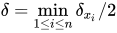 , i.e. the minimum radius of these open sets. Since we have a finite number of positive radii, this minimum
 is well-defined and positive. We now show that this works for the definition of uniform continuity.
Suppose that for any two in . Since the sets  form an open (sub)cover of our space , we know that must lie within one of them, say . Then we have that
 . The triangle inequality then implies that

implying that and are both at most  away from
 . By definition of , this implies that
 and
 are both less than . Applying the triangle inequality then yields the desired

∎

