Proof
The layer cake representation[1][2] allows us to write the general functions  and
 in the form
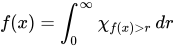 and

where  equals
 for
 and
 otherwise.
Analogously,
 equals for
 and otherwise.
Now the proof can be obtained by first using Fubini's theorem to interchange the order of integration. When integrating with respect to  the conditions
 and
 the indicator functions
 and
 appear with the superlevel sets
 and
 as introduced above:


Denoting by  the
 -dimensional Lebesgue measure we continue by estimating the volume of the intersection by the minimum of the volumes of the two sets. Then, we can use the equality of the volumes of the superlevel sets for the rearrangements:



Now, we use that the superlevel sets  and
 are balls in
 centered at
 , which implies that
 is exactly the smaller one of the two balls:


The last identity follows by reversing the initial five steps that even work for general functions. This finishes the proof.


