Hanover Trust Company
The Hanover Trust Company was a private American bank located in Boston, Massachusetts that was in operation from 1916 until 1920. It was closed by the state bank commissioner due to its connection to fraudster Charles Ponzi.
Early years
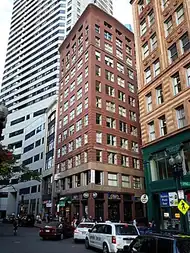
The Hanover Trust Company opened on May 1, 1916 in a new building on the corner of Hanover and Union Streets. The bank's first officers included Gabriel Stabile (president), William S. McNary (chairman), and Henry Chmielinski (treasurer). The bank stayed open until 11 pm on Saturdays to allow merchants to make late deposits.[1]
In 1918, the company moved its headquarters to the first floor of the former Boston Journal Building in order to accommodate its expanded foreign exchange department. The Hanover Street location remained open as a branch of the bank.[2][3] In 1919, the Hanover Trust Company expanded its space in the Journal Building and rebuilt its storefront.[4]
Later that year, Henry Chmielinski was elevated to the presidency. At 37, he was the youngest bank president in Boston.[5] By 1920, the bank had 8,780 depositors, many of whom were Polish immigrants who lived in South Boston.[6]
Ponzi and collapse
In 1919, the Hanover Trust Company turned down Charles Ponzi for a loan of $2,000 for his International reply coupon scheme.[7] At its June 1919 meeting, he was introduced to the bank's officers by "leading Italians of Boston", according to McNary. He opened an account and began acquiring shares in the bank.[8] According to McNary, Ponzi attempted to purchase a controlling interest in the bank, but was rebuffed.[9]
On July 26, 1920, The Boston Post started a series of articles critical of Ponzi's scheme that caused a panic run on his businesses. Towards the end of the run, he began paying with checks drawn on the Hanover Trust Company.[8] He ran up an overdraft of $441,000.[10] On August 9, 1920, Massachusetts Bank Commissioner Joseph C. Allen ordered the bank not to honor any more checks drawn by Ponzi.[8] Two days later, he seized control of the bank on the grounds that many of its loans were "excessive and beyond the legal limit" and of "bad or of very doubtful value".[11] He told reporters that he feared the bank's capital was "very badly impaired and is probably wiped out completely".[6] On September 15, 1920, the Massachusetts Governor's Council voted to drop the Hanover Trust Company from the list of state depositories.[12]
Massachusetts Attorney General J. Weston Allen personally conducted a grand jury investigation into the Hanover Trust Company. The investigation was dropped after Allen alleged that the jury had been tampered with.[13] McNary, Chmielinski, and Walter G. Conway, a New York clothier whose business McNary and Chmielinski was involved in, were found to be in contempt of court for sending letters to members of the special grand jury.[14]
The liquidation of the bank's assets was overseen by the bank commissioner and Fitz-Henry Smith Jr. The Boston Journal Building was sold Charles M. Storey for $640,000.[15] A 50% dividend was paid out to savings depositors on December 19, 1921.[16] The remaining 50% as well as 100% of Christmas club savings were paid on September 25, 1922.[17] Commercial depositors received 68.4%. Their first dividend was paid in June 1922 and the final dividend was paid on December 22, 1930.[18][19]
References
- ↑ "New Bank Starts Today". The Boston Globe. May 1, 1916.
- ↑ "Hanover Trust Company In New Home Tomorrow". The Boston Globe. March 25, 1918.
- ↑ "Opns New Banking Rooms". The Boston Globe. March 26, 1918.
- ↑ "Hanover Trust Co To Open New Rooms". The Boston Globe. April 30, 1919.
- ↑ "Youthful President For Hanover Trust". The Boston Globe. June 11, 1919.
- 1 2 "Hanover Trust Has 8,780 Depositors". The Boston Globe. August 13, 1920.
- ↑ Robert Palestini (2 December 2011). Leadership with a Conscience: Educational Leadership as a Moral Science. R&L Education. p. 101. ISBN 978-1-61048-395-7.
- 1 2 3 "Ponzi Says He "Did Time" To Shield His Employer". The Lewiston Daily Sun. August 11, 1920. Retrieved 23 August 2026.
- ↑ "Futher Details Of Ponzi's Deals". The Toronto World. September 1, 1920. Retrieved 23 August 2026.
- ↑ "Exit Ponzi: Final Payment to Depositors--Total Distribution About $1,500,000, or 37½% of Claims". Barron's. December 29, 1930.
- ↑ "Commissioner Says He Found Bad Loans". The Boston Globe. August 12, 1920.
- ↑ "Only Hanover and Prudential Dropped". The Boston Globe. September 16, 1920.
- ↑ "Drops Grand Jury That Got Letters". The New York Times. October 5, 1922.
- ↑ "In Contempt In Bank Case". The New York Times. November 17, 1922.
- ↑ "Boston Journal Building To Be Sold For $640,000". The Boston Globe. May 2, 1922.
- ↑ "Drops Dead As He Gets Hanover Check". The Boston Globe. December 20, 1921.
- ↑ "To Pay Hanover Trust Depositors On Sept 25". The Boston Globe. September 1, 1922.
- ↑ "Another Hanover Trust Company Dividend". The Boston Globe. March 16, 1923.
- ↑ "Hanover Trust Unclaimed Deposits Are Transferred". The Boston Globe. December 23, 1931.