Han Fuju
Han Fuju | |
|---|---|
韓復榘 | |
 Han Fuju in 1929 | |
| Governor of Shandong | |
| In office September 1930 – January 1938 | |
| Preceded by | Chen Diaoyuan |
| Succeeded by | Shen Honglie |
| Governor of Henan | |
| In office December 1928 – October 1930 | |
| Preceded by | Feng Yuxiang |
| Succeeded by | Liu Zhi |
| Personal details | |
| Born | 1890 |
| Died | 24 January, 1938 |
| Party | Kuomintang (1929–1938) |
| Nickname(s) | Flying General King of Shandong |
| Military service | |
| Allegiance |  Qing China   Republic of China |
| Branch/service |  Beiyang Army  National Revolutionary Army |
| Commands | 3rd Army Group, National Revolutionary Army |
| Battles/wars |
|

Han Fuju or Han Fu-chü (simplified Chinese: 韩复榘; traditional Chinese: 韓復榘; pinyin: Hán Fùjǔ; Wade–Giles: Han Fu-chü; 1890 – 24 January 1938), courtesy name Xiangfang (向方), was a Chinese warlord who ruled Shandong from 1930 to 1937. A protégé of Feng Yuxiang in the Guominjun (Northwest Army), he twice betrayed his mentor before being rewarded with the governorship of Shandong after siding with Chiang Kai-shek's Kuomintang in the 1930 Central Plains War.
During his seven-year rule, Han implemented administrative reforms, suppressed bandits and communists, built infrastructure, and promoted education. He maintained an uneasy autonomy from the Nationalist government, balancing between Chiang and Japan. He refused to fully commit to the Nationalist war effort, prioritizing the preservation of his own army over national defense. Han is mainly known today for his failure to defend Shandong against the Japanese invasion, which led to his execution by Chiang Kai-shek.
Opinions on Han are divided. He has been stereotyped as an ignorant and illiterate warlord on account of his rural background, as well as a pro-Japanese traitor. However, revisionist views place Han as an able administrator who fought against the Japanese before his unauthorized retreat.
Early life and career
Childhood and early years
Han Fuju was born in 1890 into a well-off landowning family in Dongshantai Village (Chinese: 东山台村; pinyin: Dōngshāntái Cūn), Ba County, Zhili Province. Han's family owned around 30 mu of land along the Zhongting River, which ensured they were self-sufficient.[1]
In 1900, the Boxer Rebellion broke out. Han Fuju's family residence was a target for the Boxers, who burned it down and forced Han to flee. In the chaos, the Boxers also killed Han's grandmother and uncle. Afterwards, the Han family's financial situation declined precipitously, forcing Han Fuju to do farm work. Despite this newfound poverty, Han's father insisted on sending him to school.[2]
According to writer Frank Dorn, Han had "little aptitude for schooling,"[3] and soon dropped out; however, he did manage to acquire literacy. Nevertheless, the stereotype of Han being an illiterate, rural boor would remain in the popular imagination.[4]
Han began accumulating heavy debts from gambling, even pawning off his wife's clothes and jewelry for more gambling money.[2] His family resolved to provide him stable employment, and in 1905 he began work as a scribe in the Ba County household registration office.[5] After around two years,[5] he had relapsed into gambling, which his meager salary could ill-afford.[5] In 1909, he fell deep into debt and fled his hometown the next year, resolving to move to Manchuria.[6]
Joining Feng Yuxiang
Han had hoped to find his elder brother, whom he had heard had also moved to Manchuria. However, after around a month of searching, Han once again ended up penniless in Xinmin, Fengtian.[7] On the verge of destitution, he met with a fortune-teller, who suggested he join the Qing army and offered to introduce him. Han Fuju thus joined the 20th Division of the 3rd Regiment of the Beiyang Army. The 3rd Regiment was then under the command of Feng Yuxiang, who took a liking to Han and appointed him as a clerk.[7]
In 1911, the Xinhai Revolution broke out.[8] Feng, who had already been secretly forming anti-Qing organizations, launched an uprising in Luanzhou which was suppressed by Yuan Shikai and Wang Huaiqing.[8] Due to Han's participation in this uprising, he was sent back to his home county.[9]

After the revolution ended and the monarchy was deposed, Yuan Shikai became President. He again reorganized the army, reappointing Feng as a battalion commander.[8] Upon hearing of this, Han went to Nanyuan to rejoin the Beiyang Army. soon ranking up to quartermaster sergeant.[10] In August 1913, when Feng was promoted to regimental commander, Han was also promoted to a platoon leader, thus beginning his formal military career.[10]
Over the next few years, as China collapsed into the Warlord Era, Han accompanied Feng on several military campaigns. He took part in the suppression of the 1914 Bai Lang Rebellion, but Feng's regiment refused to fight for Yuan Shikai when he proclaimed himself Emperor and the National Protection War began.[11] During the 1917 Manchu Restoration, Han and Feng fought against and defeated the forces of royalist general Zhang Xun.[12] Around this time, he had been stationed in Langfang, bringing his wife with him.[11]
In 1918, during the Constitutional Protection War against Sun Yat-sen's Guangzhou junta, Feng's army reluctantly[12] captured Changde, and Han was stationed here. By now, he had become a battalion commander in Feng's artillery regiments, and was known as one of Feng's "thirteen guardians/protectors" (十三太保), or Feng's most trusted subordinates.[12][note 1]
China had by then fractured into various warlord cliques; the two most powerful of which were the Zhili and Anhui cliques. Feng and Han were affiliated with the Zhili Clique, and played a role in the defeat of the Anhui in the 1920 Zhili–Anhui War.[13] He continued fighting for the Zhili throughout the early 1920s, helping depose Chen Shufan in 1921 and then defeating the Fengtian clique in the 1922 Zhili–Fengtian War. By October 1922, Han Fuju had become a regimental commander in the 11th Division.[13]
With the Guominjun: two defections
Beijing Coup and first defection
In 1924, another war broke out between the Zhili and Fengtian cliques. Feng, by now resentful of the Zhili, organized a coup in Beijing instead of fighting against Fengtian. The coup succeeded and President Cao-kun was placed under arrest, with Feng and his allies forming the Guominjun (National People's Army). Han had participated in this coup, and was promoted to brigade commander of the 1st Division for his services.[14] In December 1925, he fought against Li Jinglin of the Fengtian army, capturing Tianjin and forcing Li to flee the province.[15] Because of this, he was once again promoted to commander of the 1st Division.[15]
By now, the Anti-Fengtian War had begun in earnest. Despite its name, the main feature of the war was a coalition of Northern warlords—Zhang Zuolin, Wu Peifu, and Yan Xishan—forming an alliance to oppose the Guominjun.[16] Feng was soundly defeated and fled to the Soviet Union, leaving Zhang Zhijiang to rule in his stead.[17] Facing attacks from all sides, the Guominjun retreated to Nankou. It was in this situation that Han had finally been promoted to the commander of the Guominjun's Sixth Army, stationed at the strategic Juyong Pass,[18] but he had been dissatisfied by Zhang's leadership and the poor conditions of his army; they had run low on ammunition and supplies, and Zhang had informed him that there were no reinforcements available.[18] Nevertheless, the Sixth Army was ordered to attack Datong in Shanxi. When the assault predictably failed due to lack of supplies, the morale of Han's army further collapsed.[19] It was then that Shi Yousan, another Guominjun general, urged Han to surrender and defect to Yan Xishan's Shanxi clique, an offer which Han took.[20]
Yan Xishan appointed Han Fuju as the commander of the 13th Shanxi Army Division, stationed at Baotou and Guisui.[21]
Return to Feng Yuxiang and second defection
In November 1926, during the Northern Expedition, Feng Yuxiang, now back in China and affiliated with the Kuomintang (KMT), went to Shanxi to win back the generals who had defected. Feng was reportedly understanding, saying that defecting officers' actions were forced by necessity and that they had had no other choice.[22] The two reconciled in Baotou, and Feng named Han as commander of the Sixth Route of the Guominjun. Yan Xishan's army attempted to stop this defection, but Han threatened to fire on them, and they backed down.[23] Around this time, Sun Tongxuan became a division commander in Han's army;[24] he would later become one of Han's most loyal subordinates.

Han fought in several campaigns during the Northern Expedition, initially against Zhili-aligned warlords in Shaanxi and Gansu.[24] Later, in 1927, his army attacked into Henan, capturing Luoyang and Zhengzhou.[25] Having linked up with the rest of the National Revolutionary Army (NRA), Han pressed his advantage by advancing further into eastern Henan and Jiangsu.[26] At a battle at Lanfeng, Han executed a flanking maneuver, capturing 30,000 Zhili troops.[27] After this triumph, he continued attacking, advancing further to the gates of Xuzhou over Feng Yuxiang's recommendations; consequently, he ended up encircled and had to be rescued by Liu Ruming's forces.[27] Of this incident, Feng reportedly commented that Han's military achievements were undone by his greed.[27] Only in December 1927 was Xuzhou finally captured for the Northern Expedition.[28]
Race to Beijing: growing disloyalty
In February 1928, the second phase of the Northern Expedition was launched against Zhang Zuolin's Fengtian clique. By now, Han Fuju had become commander of the Third Route of the Guominjun, which had been reorganized into the Second Collective Army under the NRA.[29] The joint offensive of the NRA, Guominjun, and Shanxi (whcih had also joined the KMT's cause) quickly overrun Shandong. Feng Yuxiang's army was attacked by Fengtian troops in a battle at the Zhang River, and Feng ordered Han to join the battle.[30] However, Han retreated after incurring heavy losses against the Fengtian forces, prompting Feng Yuxiang to institute a no-retreat order, on pain of death.[30]
After repeated failed assaults on the Fengtian lines, Han reportedly threw himself to the ground and said: "Our only option now is to advance: otherwise, the Commander-in-Chief (Feng) will surely execute me. If I'm going to be shot anyway, I'd rather die here!"[31][note 2] Another account of this event has a similarly desperate Han threatening to jump into a river, only to be dissuaded by his own officers.[32] In either case, this incident boosted the morale of his forces enough to break through the Fengtian defenses, which had collapsed by May. Han's armies subsequently advanced deep into Zhili, capturing Puyang, Xingtai, Daming, and Shimen.[31]

Feng Yuxiang resolved to reach Beijing before Yan Xishan or any other NRA force.[33] By June 6, Han Fuju's army had reached Nanyuan, entering the city two days before Yan Xishan and earning him the nickname of the "Flying General" (飞将军). He thus became the first NRA commander to enter Beijing during the Northern Expedition.[34][32]
However, Chiang Kai-shek of the Nanjing government had already entrusted the area to Yan Xishan, which meant that the Guominjun would have to leave Beijing.[34] Han and Feng were both humiliated by this,[34] but Feng ordered Han not to make his displeasure public.[35]
In the spring of 1928, an international incident occurred in Beijing, when Han Fuju conducted an unauthorized disarmament of a brigade belonging to former Fengtian commander Bao Yulin, which had been withdrawing to Manchuria before being surrounded by Han's troops.[35] This went against an agreement that the Nanjing government had conducted with foreign powers, assuring a peaceful and orderly withdrawal of Fengtian forces from Beijing.[35] When envoys from Britain, the United States, Japan, and France attempted to negotiate the matter with Han, he refused all discussion, stating simply that the disarmament of the Fengtian army was an internal Chinese affair.[35] During this incident, Han was also reportedly shirtless.[35] Feng Yuxiang sent an urgent telegram to Nanjing, claiming that the disarmament happened before orders arrived and that it was not an intentional act of defiance on Han's part.[36][37] Han was forced to release Bao Yulin's brigade and return the seized weapons, although not before incorporating some of its men into his army.[38]
Han's growing ambitions were left unsatisfied by the Nationalists. Earlier in 1927, he had aimed to become the governor of Henan, but was displeased when Feng Yuxiang took the title and delegated it to other officers instead of him.[28] He had also aimed to become Shandong governor, but once again, Feng Yuxiang nominated Sun Liangcheng, passing over Han. Han's biography asserts that both of these incidents increased his resentment towards Feng and belief that his career would stagnate under him.[39]
In 1928, he aimed to become governor of his home province of Hebei,[note 3] believing his military exploits would be sufficient to secure him high office.[40] To Han's greatest disappointment, Nanjing instead gave the post to Shang Zhen of the Shanxi clique, while Han was appointed as a member of the provincial government.[41] He was reportedly so displeased by this position that he failed to appear on 4 July when the provincial government was officially established and its members took oaths of office.[40]
The Nationalists had pursued a general demobilization and reorganization the army after the strain of the Northern Expedition and the warlord era. As part of this reform, the Guominjun was reduced in size, and Han Fuju became the commander of the 20th Division, with Sun Tongxuan serving under him.[42] Feng Yuxiang attended the demobilization conference in Nanjing and called on all division commanders to join him: however, Han did not, instead sending Sun with a letter asking for soldiers' back pay.[43] Feng angrily rejected Han's appeal, further deteriorating relations between the two warlords.[44]
Rule in Henan under Feng

On 12 December 1928, Feng Yuxiang appointed Han as chairman of Henan, taking office on 21 December.[45] Although Han had attained high office, his government consisted mainly of Feng's allies, including the civil affairs minister Deng Zhexi.[45] In addition, Han was stripped of his command over the 20th Division, which was given to another Feng ally Shi Jingting. Shi replaced all of Han's appointed officers and publicly criticized Han's leadership of the division.[46] Although Shi Jingting was later transferred away from that command, Han Fuju would later cite this incident as the main factor that caused him to defect from Feng Yuxiang.[47]
Han's initial governance plan was elucidated on 31 December, which featured political inspection teams to evaluate and audit provincial officials for corruption.[48] He also issued a slate of fiscal reforms; these included the abolishment of many miscellaneous taxes, a halt to the practice of collecting taxes in advance and a general standardization of financial records. To replace the abolished levies (especially the likin), Han introduced a special production tax and a business tax. He also introduced a sales tax, which was effectively a tariff on goods entering Henan.[49] Several of Han's measures remained unimplemented due to the ensuing Central Plains War.[50]
Han's continuing resentment of his situation as a powerless governor without a military command led to him neglecting administration.[47] By early 1929, Han's many vices, including drinking, gambling, and womanizing, began to resuface as the governor staged 'inspection' trips to indulge in personal pleasure.[51] This caught the attention of the disciplinarian Feng, who in February publicly criticized "high-ranking officials"[52] for their decadence, also alluding to Han's concubinal relationship with an opera singer.[51] According to Han's biography, this further heightened his feelings of embarrassment and humiliation.[52] Another incident was when Feng reportedly ordered Han to stand guard for him in Luoyang for two hours.[52]
Second defection

In March 1929, upon the outbreak of the Chiang–Gui War, the Nanjing government offered far-reaching concessions to the Guominjun, including control over Qingdao, a premiership for Feng Yuxiang, and the choice of either Anhui or Hubei as territory.[53] Feng agreed to send a force of 130,000 soldiers to help Chiang, with Han Fuju as commander-in-chief; on 30 March Nanjing promptly appointed Han as commander of the 3rd Route Army of the NRA.[53] Feng attempted to play both sides by ordering Han's army to advance at an extremely slow rate, such that by the time the war had ended, the army had only reached Xiaogan in Hubei. Because of Chiang's quick victory and Feng's nonexistent contribution, Nanjing rescinded all its agreed concessions to Feng's clique.[54] However, Chiang launched a campaign to win over Han Fuju, inviting him to a meeting in Hankou on 11 April. Chiang employed several methods of flattery; calling Han the "Ever-Victorious General",[note 4] hosting a private banquet for him, and even offering him a cheque of several hundreds of thousands of yuan and a house in Shanghai.[55] Later in April, Chiang and Han held a clandestine meeting at a location along the Beijing-Hankou Railway, where Chiang offered more gifts to Han and members of his staff.[56]
Han's biography suggests that this was a calculated strategy by Chiang Kai-shek to break apart the Guominjun in preparation for a campaign against Feng.[57] In mid-May, Feng convened his own conference in Huayin in order to prepare a defensive strategy for the coming war.[58] When Feng proposed to withdraw all armies from Henan back into Shaanxi, Han refused to do so, leading Feng to angrily reprimand him in front of his entire general staff.[58] This represented another humiliation, and once Han returned to Henan, he informed Liu Ruming of his intentions to desert.[58]
Han secretly convened the officers of the 20th Division in Shanzhou, convincing them to march east from Gantang to Luoyang and claiming that it was other Feng's orders.[58] In addition, Han also forced several Feng loyalists to board a train with him to Luoyang and sign a circular telegram officially announcing his break with Feng.[59] On 22 May, Han declared his intention to maintain peace in Henan and his allegiance to the central government. Joining Han in his defection would be Shi Yousan, whom he had contacted beforehand.[60] Also on 22 May, Chiang declared the beginning of the attack on Feng; he expelled Feng from the Kuomintang a day later and order Feng's arrest a day after that.[61] For his defection, Han gained a sum of five million yuan from Chiang.[61]
Han's defection did not go smoothly. In a series of confrontations at Heishiguan with the forces of general Pang Bingxun (who had stayed loyal to Feng), most of Han's 20th Division was wiped out.[62] Nevertheless, he and the remnants of his army (around 2,000 men)[63] had managed to enter Kaifeng, and was able to continue serving in his position of provincial governor under Chiang Kai-shek's government.[64] There, he met with Soong Mei-ling, who once again bestowed Han with gifts and promised to grant equipment and money to rebuild his army. She also continued calling him the 'Ever-Victorious General', which was reportedly much to Han's liking.[64] After a few months, Han's army had rebounded to about 30,000 men.[63]
With the Kuomintang
Rule in Henan under Chiang
Having joined Chiang Kai-shek's central government, Han now had a measure of freedom to rule in Henan. He removed Feng Yuxiang's men from their posts, instead staffing them with his own allies; for example, Li Shuchun, one of his trusted advisors, became civil affairs minister.[65] Despite this, Han's biography notes that he largely continue following, implementing, and expanding on Feng's prior policies.[66]
Han focused on building up an administrative cadre, tasking Li Shuchun to direct a training institute in Kaifeng.[67] He adopted a Confucian, virtue-focused administrative style, which he explicitly stated was adopted from that of the Qing statesman and general Zeng Guofan.[68] In this vein, Han called for increased discipline amongst the provincial government; in December 1929, Han ordered that all officials must wear uniforms, and in 1930, he issued a decree banning all New Year's celebrations amongst his staff.[67] He discouraged smoking, gambling, and concubinage within the administration.[69] He established a meritocratic system, punishing and rewarding officials based on their performance.[70] Han's slogans for his officials, which he made mandatory to adhere to, were to "work tirelessly without complaint, maintain vitality, dedicate oneself to the people, and care not for money."[67][note 5]
The province's financial situation had become even more strained, and Han endeavored to increase his revenue. He frequently issued orders to collect more taxes from the people, causing considerable unrest.[70] He also established a government oversight committee to force the Zhongyuan Company, the largest coal-mining enterprise in Henan, to produce a daily quota of 20 tons of coal. Through these measures, he managed to earn 200,000 yuan within two months.[70]
A program of infrastructure construction was also started. Because Henan was prone to droughts and floods, Han focused on water conservancy and flood control projects, including afforestation, canal construction and well digging.[71] In the winter of 1929, he ordered the dredging of the Huiji and Jialu rivers.[72] This had the added benefit of improving agriculture, which was another focus of Han's government. Han had encouraged farmers to adopt increased agricultural mechanization using machines produced by the provincial administration.[72] Han also encouraged private industry, and for the Chinese diaspora to return and invest in his province.[71] He supported the sericulture industry in Henan by purchasing 240,000 silkworm eggs and distributing them to several silk-producing areas in Nanyang.[71] Han established the "Henan Gongji Automobile Company" as a government transportation service, ordering the construction of roads and telephone lines.[72] Han's biography notes that although these were far-sighted measures, his government's capacity to implement them were limited.[72] A report by the Provincial Construction Department in November 1929 also stated mixed results; several counties had not started construction works, and others had neglected rural areas.[72]
Han maintained Feng Yuxiang's modernist and moralist social policies.[73] This included a strict ban on opium production; if opium was found growing in a county, its officials were executed.[69] He launched a campaign against foot-binding, ordering committees to unbind women's feet and cut hair he found to be too long.[69] To increase control and administration over the countryside, Han invited Liang Shuming, a politician associated with the Rural Reconstruction Movement, to establish a Village Governance Academy in Huixian.[74] Han's biography, written later in communist China, frames this in severely negative terms, claiming Liang's policies advocated reformism and were beneficial only to the landlord class.[74] Nevertheless, Liang and many others in his team would subsuquently follow Han to Shandong and implement rural reconstruction there.[75]
Han created a militia system to suppress banditry and pacify rural areas of the province.[76] This included the formation of landlord militias to counter peasant unrest.[74] In cooperation with the central government, he fought against the influence of the Communist Party by establishing rehabilitation centers for criminals, including many communists.[77] Han issued arrest warrants for several communist leaders believed to be in the area, including Xu Xiangqian and Wang Shusheng.[77]
Central Plains War
Han had attempted to form a bloc to counterbalance Chiang Kai-shek's influence, involving Shi Yousan and Ma Hongkui, but Chiang appointed the commanders to different areas to divide them.[78] He also attempted contacts with Yan Xishan, Zhang Xueliang, Chen Diaoyuan, and Shang Zhen to diversify away from Chiang.[78]
Han's strategy during the volatile political conflicts of 1929-30 between Chiang Kai-shek and various warlord coalitions was to attempt to wait them out without committing his forces to major combat. However, he soon found this balancing act impossible to maintain as war spread across more and more areas of China. When conflict again broke out between Feng Yuxiang and Chiang in October 1929, Han stayed neutral and refused to fight against his old boss. Then, in December, Shi Yousan and Tang Shengzhi launched a rebellion; Han was initially sympathetic to the rebels, but later sided with Chiang after Ma Hongkui and Yan Xishan did the same. Han then attempted to invite Yan, who by now had gained much power in northern China, to a meeting to arrest him, but Yan realized these plans and instead formed his own coalition against Chiang, involving Li Zongren, Feng Yuxiang, and several other warlords. This began the main stage of the Central Plains War.[79]
Han Fuju and Shi Yousan had made a secret pact wherein they would join opposing sides of the war, so that they could help each other no matter who won. Shi would go over to Yan, who promised him governorship of Shandong.[80] Han Fuju, fearful that his soldiers would defect back to Feng's side, asked Chiang to be transferred to Shandong to fight against Yan Xishan's forces, which was accepted in late March of 1930.[80]
Setbacks in Shandong
Han's forces had been reorganized into the First Army Corps, responsible for the entire Shandong region. Initially based in Jining, Han's command now included the 21st Division of Liu Zhennian in the Jiaodong area, but Liu was known to be an unreliable commander.[81] On 18 April, Han moved his headquarters to the capital Jinan.[82]

Han's basic orders were to hold the south bank of the Yellow River and prevent the Shanxi forces from advancing along the Tianjin-Pukou Railway.[82] The Shanxi forces, led by Yan Xishan and later Fu Zuoyi, started the assault down the railway in early May. Because Han's army had exhausted itself from the march into Shandong, its performance struggled.[83] Chiang gave persmission for Han to retreat across the Yellow River and dismantle the bridge to slow the Shanxi advance. However, by then, Yan's forces had already begun crossing the Yellow River at Dong'e to threaten Han's rear.[84] On 2 June, as the Jinan bridge was being dismantled, enemy artillery bombardment led to the Jinan Arsenal exploding.[83] This threw Han's troops further into disarray, and he resolved to retreat east into Jiaodong.[83] On 24 June, facing a major attack and receiving no reinforcement, Han decided to abandon his base in Jinan; by then, Shanxi had managed to cut it off from Tai'an, thereby threatening an encirclement.[83]
Han's biography states that Han decided to retreat eastward rather than southward (to the bulk of the NRA lines) to preserve his military strength.[84] If Han had retreated southward, he would have been forced to fight, losing the bulk of his army (and thus, power). Conversely, retreating eastward meant freedom of movement and action.[84] After retreating, Han made the excuse that fighting for Jinan would have exposed foreign consulates to damage, potentially leading to a new international incident much like what had happened during the Northern Expedition.[85]
Han moved his headquarters to Weixian, establishing a new defensive line on the east bank of the Zihe River.[86] His situation was still precarious: although he had managed to defend against the Shanxi army, Liu Zhennian in his rear was rumored to have contacts with Yan Xishan, and Shanxi had already hired bandits to disrupt him, essentially surrounding Han's forces on all sides.[87] Han had already told his staff that if they were unable to fight Shanxi directly, they could instead become bandits in the Yimeng Mountains.[88] Han decided, with the consent of Chiang's advisors, to contact Shi Yousan and Feng Yuxiang and pretend to join their side; in reality, this was a delaying tactic to relieve the pressure on his army.[88] However, he was attacked by the army of Zhang Yinwu and forced to retreat again. On 28 July, Han announced his resignation, withdrawing further east across the Weihe River and again moving his headquarters to Gaomi.[89]
Han seriously considered the plan to fight guerrilla warfare in the Yimeng Mountains before his division commanders convinced him to stand ground; Han's resignation already having significantly deteriorated morale.[90] Because Yan Xishan had devoted so many forces to containing Han Fuju, his offensive along the Tianjin-Pukou Railway stalled, allowing Chiang to build up forces for a counteroffensive. This included the 16th Army of general Li Yunheng (李韞珩), which landed at Qingdao on 3 August via sea from Shanghai to reinforce Han's flagging lines.[91]
Counteroffensive and appointment as chairman

Chiang's counterattack began on 1 August; on that same day, his liaisons managed to convince Han to rescind his resignation.[92] After that, Liu Zhennian also agreed to follow Han's command.[92] Han's own counterattack began on 7 August, with him personally supervising the battle.[92] By 10 August, Weixian had been recaptured and the Shanxi forces were in full retreat. Zichuan was retaken on 12 August.[92] Although Han had hoped to reach Jinan before Chiang's main force, the 19th Route Army of Jiang Guangnai and Cai Tingkai had already captured it by 15 August, two days before he arrived.[93]
On 21 August, Chiang arrived in Jinan to convene his generals; despite Han's preparations to cross the Yellow River, Chiang ordered no offensive, as heavy fighting was still ongoing in Henan.[94] The anti-Chiang coalition completely collapsed in September, when Zhang Xueliang in Manchuria declared his support for the central government.[94] This set off a chain reaction; Shi Yousan stopped fighting, and Ma Hongkui defected.[94] By November, the Guominjun had been defeated and dissolved, with Han Fuju integrating some of its remnants. Due to Han's mediation, Shi Yousan was able to keep his army.[95]
On 5 September 1930, the Nationalist government appointed Han Fuju as governor of Shandong. He assumed office on 9 September.[96]
Rule in Shandong

Although Chiang Kai-shek had been reluctant to appoint Han Fuju on account of his behavior during the Shandong campaign, general Cao Haosen convinced him to keep his word, as Chiang had already promised the province to Han.[97]
Government
Han's new government included many of his previous allies and advisors; this included Li Shuchun maintaining the role of civil affairs minister from his time in Henan.[96] The only Shandong native was He Siyuan, who maintained his role as education minister. Although Han wanted to remove him, He had good relations with Chiang Kai-shek, who refused Han's requests for removal. He eventually also built up ties with Han, and would help consolidate Han's rule over the province.[98]
Several of Han's ministers were deeply corrupt and sycophantic; this included secretary-general Zhang Shaotang (张绍堂) and Finance Commissioner Wang Xiangrong (王向荣), who was both economically illiterate and as greedy as Zhang.[99] Even Zhang Honglie, Han's construction director, was known to be corrupt at times.[100]
Han also put together an advisory council consisting of former Guominjun officers and landed gentry, which he essentially used as a think tank. Another major ally of Han was Liang Shuming, who became his senior political advisor.[101]
Consolidating power
Dealing with Chiang and Zhang
Han's initial position in Shandong was precarious, as Chiang Kai-Shek, Zhang Xueliang, and Liu Zhennian all coveted his province; thus, Han needed to deal with all three factions to consolidate his rule over the region.[102] Zhang's Fengtian clique owned the major port of Qingdao, Liu controlled the Jiaodong area, and the central government sought to replace Han with a more pliant candidate.[102]
Han's first crisis came in January 1931, when Chiang ordered the transfer of Han's Third Route Army (as well as some other armies) south in preparation for an encirclement campaign against the Jiangxi Soviet.[103] To replace the Third Route Army's garrisons, forces from Zhang Xueliang's Northeastern Army would be brought in, and according to Han's biography, Northeast Army general Wang Shuchang would have become Shandong governor in such an eventuality.[103] Han managed to defuse this immediate threat by convincing the reluctant general Sun Lianzhong to go to Jiangxi instead. To pacify Chiang, he executed several Communist prisoners on 5 April, including Deng Enming, a founding member of the Communist Party. This pleased the central government enough to abandon the plan of transferring Han, and he was instead promoted to head of a bandit suppression headquarters in Shandong on 7 July.[103]
In June 1931, Zhang Xueliang moved several of the Northeast Army's assets from Manchuria to Hebei. Han, interpreting it as a threat to his domain, sent thirty to forty thousand troops under Ma Hongkui's 15th Army north of the Yellow River. No invasion occurred.[104] In September 1931, the Japanese staged the Mukden Incident and Japan's Kwantung Army invaded Manchuria. This crippled Zhang Xueliang's power, and in November, a major mutiny against the Fengtian clique broke out in Qingdao.[105] Although the mutiny (and Han's attempt to support it) was unsuccessful, a new government under Fengtian admiral Shen Honglie took power in the city after difficult negotiations.[105] Shen's administration was compliant towards Han, and the city's tax revenue was split 50-50 with the Shandong government. Han and Zhang Xueliang's relations would later improve on the mutual basis of maintaining power and resisting the central government's attempts to assert control, with Zhang even granting Han a residence in Beiping.[105] Therefore, Han had managed to subdue two out of three main foreign threats to his rule without direct combat.[105]
Zhang Zongchang incident

Han Fuju has been implicated in the assassination of past Shandong governor Zhang Zongchang by multiple contemporary and retrospective sources.[106][107][108][109][110] The basic narrative of Zhang's assassination is that Zhang returned to China intending to organize resistance against Japan, although he had previously been supported by the Japanese. On 3 September, Zhang met with Han Fuju and Shi Yousan, and would later be fatally shot at the Jinan railway station by Zheng Jicheng, the nephew of a Guominjun general whom Zhang had executed.[110]
Han's biography asserts that Han feared Zhang's residual influence, as Zhang was a Shandong native with a power base in the province and a history of attempting a return through armed rebellion. In addition, as several of Zhang's old subordinates were now serving in the NRA, Zhang's potential comeback could pose a threat to Chiang Kai-shek as well. Han supposedly coordinated with Chiang's advisors to carry out the plot of luring Zhang back to Jinan where he could then be assassinated.[111]
Han reportedly managed to convince Zhang to return to Shandong through contacting one of Zhang's old associates, who met with Zhang and informed the former warlord that Han admired Zhang and desired his cooperation.[112] Han and Shi Yousan arrived at Beiping in 24 July and made several promises to Zhang, including help rebuilding Zhang's army and the appointment of Zhang as "Commander-in-Chief of Bandit Suppression in Shandong"[113] After the meeting, Zhang agreed to come to Shandong.[113]
Han allegedly wrote to Feng Yuxiang for advice: as Zhang had fought the Guominjun in the past, Feng agreed to join the plot and suggested utilizing Zheng Jicheng to assassinate him.[113] Feng has also been implicated in the plot by multiple other sources.[107][110][114] On 29 August, Shi and Han sent another telegram to Zhang urging him to come to Jinan, which he did on 2 September.[115] Shi and Han hosted a lavish banquet for Zhang, flattering him and lowering his guard with prostitutes and card games, while also diverting Zhang's staff with opium to keep them from investigating. Han censored press reports regarding Zhang's arrival and spread the rumor that he had gone to his ancestral home in Ye County to attend to filial matters, drawing attention away from Jinan.[116] Han also instructed Shi to take away Zhang's pistol, which he did.[117][110]
On 3 September, Han informed Zhang to return to Beiping and wait for an official appointment from the central government. Han then gave the order to Zheng Jicheng and stationed a contingent of troops surrounding the Jinan station in case the plan failed.[118] The assassination went smoothly, and Han would later lobby to Nanjing for Zheng's release from custody, which was achieved in January 1933.[119]
Han-Liu War

Road to war
By late September 1932, Han had managed to eliminate most of his rivals, except for Liu Zhennian's independent domain in the Shandong Peninsula.[105] Known as the "King of Eastern Shandong", Liu and his 21st Division had around 20–30,000 men,[108] organized into four brigades, four regiments, and two battalions based in the port of Yantai (Chefoo).[120] Liu's lands, totalling twelve counties, were also productive, with a monthly revenue of around 1 million yuan. Liu collected this independently, sending a portion of these funds to Nanjing and nothing to the provincial government.[121]
Another major dispute occurred over military funding: after initial maximalist demands, Han's final offer to Liu was 120,000 yuan monthly to pay his 21st Division, but Liu insisted on the figure of 145,000 yuan.[122] Sometime in the lead-up to war, Liu had also attempted to assassinate Han, but this plot was discovered.[121] As both sides readied their forces, Liu began levying more and more exorbitant taxes, including raising the quarterly land tax and implementing a "special military supply tax". In January 1931, the Shandong branch of the Communist Party claimed that the taxes in Liu's domain had become even higher than they were under Zhang Zongchang.[121] These incidents gave Han a liberatory pretext, and in several telegrams to Nanjing in September 1932, he claimed to be relieving the people from crushing tax burdens.[123]
Han's biography asserts that Han had always intended to unify the province, and Liu's presence was a major obstacle in this goal; therefore, Han launched a campaign to remove him.[122]
On 20 September, while the war was already underway, Han sent Liu an ultimatum containing three major demands: to pay Han's government 500,000 yuan monthly; to turn over control of five to six counties to Han; and to turn over control of the area's tax bureaus to Han. Liu ignored these demands.[121]
Course of the war
In August 1932, Han received reports of a major uprising against Liu planned for September; when Han attempted to move troops into Liu's territories to counter this supposed threat, Liu rejected entry and mobilized his forces. War broke out on 17 September, when Liu attacked Han's troops at Changyi.[124] By 19 September, Han had seized Pingdu and Liu's army was in full retreat.[125] On that same day, Chiang Kai-shek and He Yingqin learned of the war's outbreak and ordered both sides to stop fighting; however, Han ignored the telegram.[125]
After this rebuff, Chiang attempted to attack Han by ordering two armies to launch a joint offensive against him: Liu Zhi northwards from Xuzhou and Shang Zhen southwards from Hebei.[125] However, Zhang Xueliang intervened by declaring his support for Han and sending an artillery regiment to bolster Han's forces, leading Chiang to abort his planned assault.[125] Nanjing then attempted to mediate peace, but Han stalled the negotiations long enough to capture Liu's base at Yantai on 24 September, forcing Liu to retreat to Qixia.[126] By October, Liu only had control of four counties in Shandong.[127]
On 19 October, He Yingqin issued the central government's four-point peace plan. It stipulated that Han withdraw west of the Weihe River, Liu's forces remain in control of five Shandong counties, and local militias administer the other seven in dispute anticipating a final mediation by Nanjing.[128] Han vehemently rejected this and publicly threatened resignation as Governor on 21 October.[128] He also maintained military pressure by besieging Liu in Qixian and Laiyang.[129]
It was feared by many in China that Han's resignation could lead to an escalation of conflict in Shandong, even causing a Japanese intervention.[108] Han's threat caused an outpouring of support for him, including senior Kuomintang officials and generals Zhang Qun, Liu Zhi, Zhang Xueliang, and Song Zheyuan urging him to stay.[130] Kuomintang elder Ding Weifen and Green Gang leader Zhang Renkui, backed by the gentry and merchants, spoke in favor of peace in Shandong, causing more pressure on Chiang.[130]
On 25 October, Liu telegraphed Nanjing and offered to leave Shandong.[131] Han accepted peace on 29 October and rescinded his resignation; his troops subsequently withdrew west of the Weihe River to allow Liu and his men to evacuate from Yantai on 22 November. Liu's exit from Shandong meant that Han could now appoint loyal magistrates, collect taxes, and organize militias in Jiaodong, effectively unifying the province.[132][108] With all of the threats to Han's rule subdued, he could thus focus on internal governance.[133]
Relations with Nanjing
In May 1931, controversy over Chiang's arrest of Hu Hanmin led to the Guangdong and Guangxi cliques of Chen Jitang and Li Zongren establishing a rival Nationalist government in Guangzhou.[134] In July 1931, Shi Yousan, Han's longtime friend, staged a rebellion in Hebei on the side of the Guangzhou government, but was quickly defeated by a combined Nationalist force. During this rebellion, Han sided with the central government and urged Shit o back down and end his rebellion; Shi subsequently told his advisors to stop receiving messages from Han Fuju. Nevertheless, after Shi's defeat, he fled to Shandong, and the remnants of his army (around 3,000 men) were surrounded and absorbed by Han at Dezhou. Shi would eventually leave to Tianjin in 1933—again against Han's advice—to work with the Japanese.[135]
Governance
As governor, Han was a stern disciplinarian with the civil servants and the military. He had virtually wiped out banditry and traffic in narcotics in campaigns of suppression. By commercial operations, principally in cotton, tobacco, and real estate, he grew rich and gave generously to schools, hospitals, and civic improvements.[136]

In the mid-1930s, he was the target of Japanese attempts to get him to incorporate his province of Shandong into one of the North China puppet states that they were attempting to construct. After the onset of the Second Sino-Japanese War, he commanded the 3rd Army Group and in 1937 was made Deputy Commander in Chief of the 5th War Area defending the lower Yellow River valley. During the Xi'an Incident in December 1936, he openly praised the actions of Zhang Xueliang in kidnapping Chiang Kai-shek and forcing him into forming the Second United Front, but was successfully urged by Song Zheyuan, Chairman of the Hebei-Chahar Political Council, to retract his statements and support a political solution to the crisis.[137]
Downfall
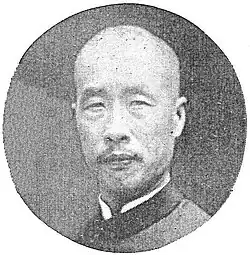
Han was suspected of having conducted secret negotiations with the Japanese to spare his province and his position of power. When the Japanese crossed the Yellow River, he abandoned his base in Jinan, which endangered the fifth warzone located between northern China and the Yangzi River.[138] Han abandoned his army on January 6 and fled to Kaifeng, where he was arrested on 11th and brought to Wuchang and was later executed by Chiang Kai-shek for disobeying orders from superior commanders and for retreating on his own accord.[139]
Chiang did so to set an example for those not following his orders. According to one account, Han was executed in the sanctuary of the Changchun Temple (长春观), a Taoist temple at the outskirts of Wuchang (now, almost in the center of modern Wuhan) by a single pistol bullet that was fired into the back of his head by Chiang's chief of staff, General Hu Zongnan.[140][141] There are only second-hand accounts of the execution.[107]
Career
- 1928-1930: Chairman of the Government of Henan Province
- 1930-1938: Governor of Shandong
- 1937: General Officer Commanding 3rd Route Army
- 1937-1938: Commander-in-Chief 3rd Army Group
- 1938: Deputy Commander-in-Chief 5th War Area
- 1938 Arrested and executed at a military conference in Hankou for failing to defend Shandong
Personal life
Besides for his execution as a traitor, Han Fuju is remembered for his jokes and poetry.[142] According to historian Diana Lary, one of his best known poems was about the Daming Lake in Jinan,[107] though the same poem has also been attributed to Zhang Zongchang by newspapers such as the Beijing Evening News and People's Daily.[143]
Han had one wife, two concubines, and four sons. His first marriage was arranged to Gao Yizhen, when she was 14 years old. Han's biography does not record how old he was around that time, but he was around the same age.[2] When Han ran away from his mounting debts in 1910, Gao reportedly assented to this, and even gave him jewelry for use as an escape fund.[6]
In 1928, when Han was stationed in Luohe, Han took on a concubine, Ji Ganqing.[44] Ji was a singer of zhuizishu (坠子书), and Han had reportedly fallen for her at first sight,[44] which went against Feng Yuxiang's rules forbidding concubinage.[44]
Sources
Citations
- ↑ Lü 1997, p. 1–2.
- 1 2 3 Lü 1997, p. 2–3.
- ↑ Frank Dorn, The Sino-Japanese War, 1937-41: From Marco Polo Bridge to Pearl Harbor (New York: Macmillan, 1974), pp. 81-82
- ↑ Lü 1997, p. 3.
- 1 2 3 Lü 1997, p. 4.
- 1 2 Lü 1997, p. 4–5.
- 1 2 Lü 1997, p. 6.
- 1 2 3 Lü 1997, p. 7.
- ↑ Lü 1997, p. 8.
- 1 2 Lü 1997, p. 8–9.
- 1 2 Lü 1997, p. 9.
- 1 2 3 Lü 1997, p. 9–10.
- 1 2 Lü 1997, p. 10–11.
- ↑ Lü 1997, p. 11–12.
- 1 2 Lü 1997, p. 14.
- ↑ Lü 1997, p. 14–15.
- ↑ Lü 1997, p. 15.
- 1 2 Lü 1997, p. 16.
- ↑ Lü 1997, p. 16–18.
- ↑ Lü 1997, p. 18–19.
- ↑ Lü 1997, p. 20.
- ↑ Lü 1997, p. 21.
- ↑ Lü 1997, p. 22–23.
- 1 2 Lü 1997, p. 23.
- ↑ Lü 1997, p. 23–24.
- ↑ Lü 1997, p. 25–27.
- 1 2 3 Lü 1997, p. 27.
- 1 2 Lü 1997, p. 30.
- ↑ Lü 1997, p. 30–31.
- 1 2 Lü 1997, p. 31–32.
- 1 2 Lü 1997, p. 32.
- 1 2 "彰德大战中的韩复榘--党史频道-人民网". dangshi.people.com.cn. People's Daily. Retrieved 2026-08-26.
- ↑ Lü 1997, p. 32–33.
- 1 2 3 Lü 1997, p. 33.
- 1 2 3 4 5 Lü 1997, p. 34.
- ↑ "Revolutionary Documents — Settling Beijing and Tianjin". 數位典藏與數位學習聯合目錄. Xindian, Taiwan: Academia Historica Office.
- ↑ Lü 1997, p. 34–35.
- ↑ Lü 1997, p. 35.
- ↑ Lü 1997, p. 32–36.
- 1 2 Lü 1997, p. 35–36.
- ↑ Lü 1997, p. 36.
- ↑ Lü 1997, p. 35–37.
- ↑ Lü 1997, p. 37–38.
- 1 2 3 4 Lü 1997, p. 38.
- 1 2 Lü 1997, p. 39.
- ↑ Lü 1997, p. 42–44.
- 1 2 Lü 1997, p. 44.
- ↑ Lü 1997, p. 40.
- ↑ Lü 1997, p. 40–42.
- ↑ Lü 1997, p. 42.
- 1 2 Lü 1997, p. 44–45.
- 1 2 3 Lü 1997, p. 45.
- 1 2 Lü 1997, p. 46.
- ↑ Lü 1997, p. 46–47.
- ↑ Lü 1997, p. 46–48.
- ↑ Lü 1997, p. 48.
- ↑ Lü 1997, p. 47–48.
- 1 2 3 4 Lü 1997, p. 49.
- ↑ Lü 1997, p. 49–51.
- ↑ Lü 1997, p. 51–52.
- 1 2 Lü 1997, p. 52.
- ↑ Lü 1997, p. 52–56.
- 1 2 Lü 1997, p. 57.
- 1 2 Lü 1997, p. 56.
- ↑ Lü 1997, p. 56–57.
- ↑ Lü 1997, p. 58.
- 1 2 3 Lü 1997, p. 59.
- ↑ Lü 1997, p. 58–59.
- 1 2 3 Lü 1997, p. 63.
- 1 2 3 Lü 1997, p. 60.
- 1 2 3 Lü 1997, p. 61–62.
- 1 2 3 4 5 Lü 1997, p. 62.
- ↑ Lü 1997, p. 62–63.
- 1 2 3 Lü 1997, p. 63–64.
- ↑ Lü 1997, p. 64.
- ↑ Lü 1997, p. 60–61.
- 1 2 Lü 1997, p. 64–65.
- 1 2 Lü 1997, p. 65.
- ↑ Lü 1997, p. 65–69.
- 1 2 Lü 1997, p. 68–69.
- ↑ Lü 1997, p. 70–71.
- 1 2 Lü 1997, p. 71.
- 1 2 3 4 Lü 1997, p. 72–73.
- 1 2 3 Lü 1997, p. 73.
- ↑ Lü 1997, p. 73–74.
- ↑ Lü 1997, p. 74.
- ↑ Lü 1997, p. 74–75.
- 1 2 Lü 1997, p. 75.
- ↑ Lü 1997, p. 75–76.
- ↑ Lü 1997, p. 76.
- ↑ Lü 1997, p. 76–77.
- 1 2 3 4 Lü 1997, p. 77.
- ↑ Lü 1997, p. 77–78.
- 1 2 3 Lü 1997, p. 78.
- ↑ Lü 1997, p. 78–79.
- 1 2 Lü 1997, p. 80.
- ↑ Lü 1997, p. 79.
- ↑ Lü 1997, p. 82–83.
- ↑ Lü 1997, p. 81–82.
- ↑ Lü 1997, p. 82.
- ↑ Lü 1997, p. 83.
- 1 2 Lü 1997, p. 84.
- 1 2 3 Lü 1997, p. 85.
- ↑ Lü 1997, p. 84–86.
- 1 2 3 4 5 Lü 1997, p. 88.
- ↑ Lü 1997, p. 96–104.
- 1 2 3 4 Diana Lary, "Treachery, Disgrace and Death: Han Fuju and China's Resistance to Japan", War in History, 2006
- 1 2 3 4 Jowett, Philip S. (2017). The bitter peace: conflict in China 1928-37. Gloucester, UK: Amberley. ISBN 978-1-4456-5192-7.
- ↑ Bonavia, David (1995). China's warlords. Hong Kong, New York: Oxford University Press. ISBN 978-0-19-586179-2. OCLC 31970740.
- 1 2 3 4 Zheng, Jicheng (1983) [5 June 1936]. 我殺死國賊張宗昌之經過詳情 (in Chinese).
- ↑ Lü 1997, p. 96–97.
- ↑ Lü 1997, p. 97.
- 1 2 3 Lü 1997, p. 97–98.
- ↑ Portwood, Matthew R.; Dunn, John P. (2014). "A Tale of Two Warlords: Republican China During the 1920s" (PDF). Education about Asia. 19 (3): 20. Archived from the original (PDF) on 16 January 2021 – via Association for Asian Studies.
- ↑ Lü 1997, p. 99–100.
- ↑ Lü 1997, p. 100–101.
- ↑ Lü 1997, p. 101.
- ↑ Lü 1997, p. 101–102.
- ↑ Lü 1997, p. 102–104.
- ↑ Lü 1997, p. 88–89.
- 1 2 3 4 Lü 1997, p. 89.
- 1 2 Lü 1997, p. 90.
- ↑ Lü 1997, p. 90–91.
- ↑ Lü 1997, p. 91–92.
- 1 2 3 4 Lü 1997, p. 92.
- ↑ Lü 1997, p. 92–93.
- ↑ Lü 1997, p. 93.
- 1 2 Lü 1997, p. 94.
- ↑ Lü 1997, p. 94–95.
- 1 2 Lü 1997, p. 95.
- ↑ Lü 1997, p. 95–96.
- ↑ Lü 1997, p. 96.
- ↑ Lü 1997, p. 104.
- ↑ Lü 1997, p. 86.
- ↑ Lü 1997, p. 86–87.
- ↑ Dorn, pg. 81-82
- ↑ Marjorie Dryburgh, Regional Office and the National Interest: Song Zheyuan in North China, 1933-1937 (Stanford University Press, 2001), p.51
- ↑ van de Ven, Hans (2017). China at War (First Harvard University Press ed.). Great Britain: Profile Books Ltd. p. 100. ISBN 978-0-674-98350-2.
- ↑ Dorn, pg. 82
- ↑ MacKinnon, Stephen R.; Capa, Robert (2008). Wuhan, 1938: War, Refugees, and the Making of Modern China. University of California Press. p. 18. ISBN 978-0-520-25445-9.
- ↑ Stephen MacKinnon, "The Tragedy of Wuhan, 1938", Modern Asian Studies, Vol. 30, No. 4, Special Issue: War in Modern China (October 1996), pp. 931-943
- ↑ Lary, Diana (2007). "China's Republic". Cambridge University Press. Archived from the original on 2010-06-10. Retrieved 2025-11-08.
- ↑ Guang Zijian; Wang Xing (3 February 2016). "古代奇葩"诗人":乾隆酷爱卖弄 张宗昌粗话连篇" [Ancient wonderful "poet": Qianlong loves to show off Zhang Zongchang's swearing]. Beijing Evening News, People's Daily. Archived from the original on 2 February 2019. Retrieved 2 February 2019.
- ↑ The other Thirteen Protectors were: Sun Liangcheng, Sun Lianzhong, Tong Linge, Liu Ruming, Shi Yousan, Zhang Weixi, Guo Zhigang, Wen Chenglie, Cheng Xixian, Ge Jinzhang, Zhao Xiping, and Han Duofeng.
- ↑ (in Chinese: 我们现在的情形是只有前进,否则总司令必定枪毙我,我与其被枪毙而死,不如即死在此处!)
- ↑ After the Northern Expedition, the Nationalists renamed Zhili to Hebei, and Beijing to Beiping.
- ↑ (In Chinese: 常胜将军)
- ↑ (In Chinese: 任劳任怨,朝气在先,拚命为民,我不爱钱)
References
Lü, Weijun (1997). 韩复榘传 [Biography of Han Fuju] (in Chinese) (2nd ed.). Jinan: Shandong People's Publishing House. ISBN 9787209020930.
- Republic of China warlords from Hebei
- Executed military personnel
- People executed by the Republic of China (1912–1949) by firearm
- Executed people from the Republic of China (1912–1949)
- 1890 births
- 1938 deaths
- Politicians from Langfang
- Governors of Shandong
- 20th-century executions by China
- Executed Chinese people
- Executed people from Hebei
- People from Bazhou, Hebei