Define the Hadamard canonical factors 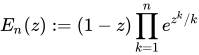 Entire functions of finite order
 have Hadamard's canonical representation:[1]
 where
 are those roots of
 that are not zero (
 ),
 is the order of the zero of at
 (the case
 being taken to mean
 ),
 a polynomial (whose degree we shall call
 ), and
 is the smallest non-negative integer such that the series
 converges. The non-negative integer
 is called the genus of the entire function . In this notation,
 In other words: If the order is not an integer, then
 is the integer part of . If the order is a positive integer, then there are two possibilities:
 or
 .
For example,  ,
 and
 are entire functions of genus
 .
Convergence exponent
Define the convergence exponent of the roots of as the following:[2] :=\limsup _{r\to \infty }{\frac {\log N(f,r)}{\log r}}}
 where
 is the number of roots with modulus
 . In other words, we have an asymptotic bound on the growth behavior of the number of roots of the function:
 It's clear that
 .
Theorem:[3] If is an entire function with infinitely many roots, then :\sum _{k}|a_{k}|^{-\beta }<\infty \right\}=\limsup _{k\to \infty }{\frac {\log k}{\log |a_{k}|}}}
 Note: These two equalities are purely about the limit behaviors of a real number sequence
 that diverges to infinity. It does not involve complex analysis.
Proposition:[2]  , by Jensen's formula.
Applications
With Hadamard factorization we can prove some special cases of Picard's little theorem.
Theorem:[4] If is entire, nonconstant, and has finite order, then it assumes either the whole complex plane or the plane minus a single point.
Proof: If does not assume value  , then by Hadamard factorization,
 for a nonconstant polynomial . By the fundamental theorem of algebra, assumes all values, so
 assumes all nonzero values.
Theorem:[4] If is entire, nonconstant, and has finite, non-integer order , then it assumes the whole complex plane infinitely many times.
Proof: For any  , it suffices to prove
 has infinitely many roots. Expand to its Hadamard representation
 . If the product is finite, then
 is an integer.
Proof
The proof below follows Conway's treatment of Hadamard's factorization theorem.
Let be an entire function of finite order . If has a zero of order at the origin, write

where  is entire and
 . Multiplying by a nonzero constant does not affect the order, so it is enough to prove the theorem under the normalization
 . The factor
 can then be restored at the end.
Let  be the nonzero zeros of , repeated according to multiplicity and ordered so that

Let  . The first step is to show that the zero sequence has exponent of convergence at most , and in particular that

Indeed, let  denote the number of zeros of in
 , counted with multiplicity. By Jensen's formula, one obtains an estimate of the form

where
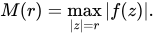
Since has order , for every  and all sufficiently large
 ,

Choosing so small that  , it follows that

Since  , this gives

for all sufficiently large  and some constant
 . Therefore

and the exponent on the right is greater than  . Hence
Consequently the canonical product

converges locally uniformly and defines an entire function whose zeros are precisely the zeros  , with the same multiplicities. Thus

is a zero-free entire function. Since the complex plane is simply connected, there is an entire function  such that

Hence

It remains to prove that is a polynomial of degree at most . For this Conway uses the following logarithmic-derivative lemma.
Lemma. If is an entire function of finite order , , and is an integer with  , then, away from the zeros of ,

In the present case , so . Applying the lemma to gives
On the other hand, since  ,

For a single elementary factor,

After differentiating times, the polynomial part vanishes, and hence

Comparing the two formulas gives

Therefore is a polynomial of degree at most .
Restoring the zero at the origin, one obtains

where is a polynomial of degree at most . Thus the genus of is finite and is at most . This is Hadamard's factorization theorem.
References
- ↑ Conway, J. B. (1995), Functions of One Complex Variable I (2nd ed.), springer.com: Springer, ISBN 0-387-90328-3
- 1 2 Levin, B. Ya (1996). Lectures on entire functions. Yurii Lyubarskii, M. Sodin, Vadim Tkachenko. Providence, Rhode Island: American Mathematical Society. ISBN 978-0-8218-3316-2.
- ↑ Markushevich, Aleksei Ivanovich (1965), Theory of Functions of a Complex Variable. Volume II, Prentice-Hall, ISBN 9780139138140
- 1 2 Conway, John B. (1978). Functions of One Complex Variable I. Graduate Texts in Mathematics. Vol. 11. New York, NY: Springer New York. doi:10.1007/978-1-4612-6313-5. ISBN 978-0-387-94234-6. Chapter 11, Theorems 3.6, 3.7.