HIP 17453
| Observation data Epoch J2000 Equinox ICRS | |
|---|---|
| Constellation | Taurus[1] |
| Right ascension | 03h 44m 28.2038s[2] |
| Declination | +20° 55′ 43.449″[2] |
| Apparent magnitude (V) | +6.074±0.010[3] |
| Characteristics | |
| Evolutionary stage | main sequence[4] |
| Spectral type | A0Vp (λ Boo)[5] + L2±1[6] |
| B−V color index | +0.028±0.025[1] |
| Astrometry | |
| Radial velocity (Rv) | +19±1[2] km/s |
| Proper motion (μ) | RA: +26.616 mas/yr[2] Dec.: −14.545 mas/yr[2] |
| Parallax (π) | 12.3772±0.0490 mas[2] |
| Distance | 264 ± 1 ly (80.8 ± 0.3 pc) |
| Absolute magnitude (MV) | +1.63[1] |
| Orbit[6] | |
| Period (P) | 3,340+4,190 −1,270 yr |
| Semi-major axis (a) | 287+206 −78 au |
| Eccentricity (e) | 0.79+0.16 −0.27 |
| Inclination (i) | 106.8+26.0 −9.6° |
| Longitude of the node (Ω) | 59+12 −8° |
| Periastron epoch (T) | 0.12+0.04 −0.06 |
| Argument of periastron (ω) (secondary) | 159+32 −40° |
| Details[6] | |
| A | |
| Mass | 2.08±0.09 M☉ |
| Radius | 1.780±0.049[7] R☉ |
| Luminosity | 23±1[7] L☉ |
| Surface gravity (log g) | 4.32±0.06[7] cgs |
| Temperature | 9,400±250 K |
| Metallicity | = −0.06±0.10 |
| Rotational velocity (v sin i) | 124±12 km/s |
| Age | 280±125 Myr |
| B | |
| Mass | 53+10 −8 MJup |
| Radius | 0.11 ± 0.01[a] R☉ |
| Luminosity | 1.62+0.24 −0.21×10⁻⁴ L☉ |
| Surface gravity (log g) | 5.0–5.5 cgs |
| Temperature | 1,953+84 −78 K |
| Age | 280±125 Myr |
| Other designations | |
| BD+20°621, HD 23258, HIP 17453, HR 1137, TYC 1260-1427-1[8] | |
| Database references | |
| SIMBAD | data |

HIP 17453 is a star in the constellation Taurus. At an apparent magnitude of +6.074, it is faintly visible to the naked eye in locations far from light pollution. Parallax measurements give a distance of 264 light-years (80.8 parsecs).
Characteristics
The spectrum of this star matches a spectral class of A0Vp (λ Boo),[5] with the luminosity class V indicating it is a main sequence star fusing atoms of hydrogen into helium at its core. The spectrum also indicates that it is a Lambda Boötis star.[5] These stars are characterized by the underabundance of iron peak metals and solar abundances of volatile elements such as carbon, nitrogen, oxygen and sulfur.[6]
HIP 17453 is an estimated 280±125 million years old, with 2.08 times the mass of the Sun[6] and 1.78 times the Sun's radius. It radiates 23 times the Sun's luminosity from its photosphere[7] at an effective temperature of 9,400 K.[6] This temperature gives it the white hue typical of an A-type star.[9]
Brown dwarf
In 2026, a brown dwarf, named HIP 17453 B, was reported around the primary star by the C-BASS survey, which aims to detect companions around B and A-type stars. It was the first detection of the survey. The detection was made using the Near-Infrared Camera 2 adaptive optics instrument aboard the Keck 2 Telescope. Using medium-resolution spectral observations of the GNIRS spectograph aboard the Gemini North Telescope, the team obtained a spectral type of L2±1.[6]
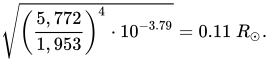
HIP 17453 B has a luminosity of 1.6×10⁻⁴ L☉ and an age of 280±125 Myr. Evolutionary models predict a mass of 53 MJ and a temperature of 1,950 K for its luminosity and age. The Stefan–Boltzmann law implies a radius of 0.11 ± 0.01 R☉ for the given luminosity and temperature.[6][a]
The orbital motion of the brown dwarf has been tracked with a timescale of 10 years, making it possible to compute an orbit. However, since only a small portion of the full orbital path is known, the orbital elements are uncertain. The brown dwarfs orbits with a period of 3,340+4,190
−1,270 years, with a semi-major axis of 287+206
−78 au and an eccentricity of 0.79+0.16
−0.27. The inclination is close to edge-on, at 106.8°+26.0°
−9.6°.[6]
Notes
- 1 2 Calculated, using the Stefan-Boltzmann law and the star's effective temperature and luminosity, with respect to the solar nominal effective temperature of 5,772 K:
References
- 1 2 3 Anderson, E.; Francis, Ch. (2012). "XHIP: An extended hipparcos compilation". Astronomy Letters. 38 (5): 331. arXiv:1108.4971. Bibcode:2012AstL...38..331A. doi:10.1134/S1063773712050015. XHIP record for this object at VizieR.
- 1 2 3 4 5 6 Vallenari, A.; et al. (Gaia collaboration) (2023). "Gaia Data Release 3. Summary of the content and survey properties". Astronomy and Astrophysics. 674: A1. arXiv:2208.00211. Bibcode:2023A&A...674A...1G. doi:10.1051/0004-6361/202243940. S2CID 244398875. Gaia DR3 record for this source at VizieR.
- ↑ Høg, E.; et al. (2000). "The Tycho-2 catalogue of the 2.5 million brightest stars". Astronomy and Astrophysics. 355: L27–L30. Bibcode:2000A&A...355L..27H.
- ↑ Zorec, J.; Royer, F. (2012). "Rotational velocities of A-type stars". Astronomy & Astrophysics. 537: A120. arXiv:1201.2052. Bibcode:2012A&A...537A.120Z. doi:10.1051/0004-6361/201117691. S2CID 55586789.
- 1 2 3 Abt, Helmut A.; Morrell, Nidia I. (1995). "The Relation between Rotational Velocities and Spectral Peculiarities among A-Type Stars". The Astrophysical Journal Supplement Series. 99: 135. Bibcode:1995ApJS...99..135A. doi:10.1086/192182.
- 1 2 3 4 5 6 7 8 9 Brinjikji, Marah; Smith, Adam J. R. W.; Patience, Jenny; Nielsen, Eric L.; Ware, Austin; Sanchez, Jorge A.; De Rosa, Robert; Garani, Jasmine; Softich, Emma; Liu, Michael C.; Macintosh, Bruce A.; Esposito, Thomas M.; Bowler, Brendan P.; Best, William M. J.; Blunt, Sarah (2026-07-24). "The Companions to B and A Stars Snapshot (C-BASS) Survey. I. Discovery of a Young Brown Dwarf Companion to HIP 17453". The Astronomical Journal. 172 (2): 114. doi:10.3847/1538-3881/ae82f2. ISSN 0004-6256.
- 1 2 3 4 Stassun, Keivan G.; Oelkers, Ryan J.; Paegert, Martin; Torres, Guillermo; Pepper, Joshua; De Lee, Nathan; Collins, Kevin; Latham, David W.; Muirhead, Philip S.; Chittidi, Jay; Rojas-Ayala, Bárbara; Fleming, Scott W.; Rose, Mark E.; Tenenbaum, Peter; Ting, Eric B. (2019-10-01). "The Revised TESS Input Catalog and Candidate Target List". The Astronomical Journal. 158 (4): 138. arXiv:1905.10694. Bibcode:2019AJ....158..138S. doi:10.3847/1538-3881/ab3467. ISSN 0004-6256.
- ↑ "HIP 17453". SIMBAD. Centre de données astronomiques de Strasbourg.
- ↑ "The Colour of Stars". Australia Telescope, Outreach and Education. Commonwealth Scientific and Industrial Research Organisation. December 21, 2004. Archived from the original on 2013-12-03. Retrieved 2012-01-16.
