Huttonella
| Huttonella | |
|---|---|
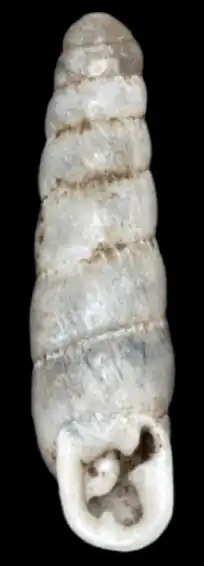 | |
Scientific classification  | |
| Kingdom: | Animalia |
| Phylum: | Mollusca |
| Class: | Gastropoda |
| Order: | Stylommatophora |
| Family: | Streptaxidae |
| Genus: | Huttonella |
| Species: | H. bicolor |
| Binomial name | |
| Huttonella bicolor (Hutton, 1834)[1] | |
| Synonyms | |
| |
Huttonella is a genus of land snails in the family Streptaxidae.[2] It has one species: Huttonella bicolor, known commonly as the two-toned gulella.[3][4]
Description
The snail has an elongated shell up to 7.5 millimeters long by 2 millimeters wide. In life the shell is orange because the orange color of the body shows through; empty shells are white or pale brown. The shell is smooth with slight ribs at the sutures and larger ribs at the aperture. The aperture also has four teeth.[4]
Distribution
Huttonella was originally distributed in Africa and southwestern Asia.[5] Today it is a tropical cosmopolitan genus.[2]
The original native range of the snail is unclear, but it may have come from Asia or southern Africa.[4] Today it has a broader distribution, having been widely introduced to other regions. It is known in the Caribbean, the southeastern United States, Central and South America, some Pacific Islands, and the Northern Territory in Australia.[4]
Recent records include:
Ecology
This carnivorous snail eats other snails, such as Subulina octona and species of the family Pupillidae.[4]
Taxonomy
The genus has been described as "an artificial, non-monophyletic assemblage of pupiform, elongated streptaxids".[5]
References
- ↑ Hutton T. (1834). On the land shells of India. Journal of the Asiatic Society of Bengal Calcutta 3(26): 86 (description); 93 (name).
- 1 2 Sutcharit, C., et al. (2010). The new family Diapheridae, a new species of Diaphera Albers from Thailand, and the position of the Diapheridae within a molecular phylogeny of the Streptaxoidea (Pulmonata: Stylommatophora)". Zoological Journal of the Linnean Society 160: 1-16. doi:10.1111/j.1096-3642.2009.00598.x.
- ↑ Gulella bicolor(T. Hutton, 1834). 16 June 2025. Retrieved through: World Register of Marine Species.
- 1 2 3 4 5 Auffenberg, K. and L. A. Strange. Snail-eating snails of Florida. EENY-251. University of Florida IFAS. Published 2001, revised 2011.
- 1 2 Simone, L. R. L. (2013). Anatomy of predator snail Huttonella bicolor, an invasive species in Amazon rainforest, Brazil (Pulmonata, Streptaxidae). Papéis Avulsos de Zoologia 53(3), 47-58.
- ↑ Robinson D. G., et al. (July 2009). The land Mollusca of Dominica (Lesser Antilles), with notes on some enigmatic or rare species. Zoologische Mededelingen, 83.
- ↑ dos Santos, S. B., et al. (2008). First record of the micro-predator Huttonella bicolor (Hutton, 1834) (Gastropoda, Streptaxidae) on Rio de Janeiro City, Brazil. Biociências 16(2), 145-48.
- ↑ (in Spanish) Pérez, A. M., et al. (2008). Diversidad de moluscos gasterópodos terrestres en la región del Pacífico de Nicaragua y sus preferencias de hábitat. Rev. Biol. Trop. 56(1), 317-32.
- ↑ Sanisic, J. (1981). The carnivorous land snail Gulella (Huttonella) bicolor (Hutton, 1834) in Australia. (Pulmonata: Streptaxidae). Journal of the Malacological Society of Australia 5, 84-86.
- 1 2 Gerlach, J. and A. C. van Bruggen. (1999). Streptaxidae Mollusca: Gastropoda: Pulmonata) of the Seychelles Islands, western Indian Ocean. Zoologische Verhandelingen 328, 1-60.
Further reading

- Naggs, F. (1989). Gulella bicolor (Hutton) and its implications for the taxonomy of streptaxids. Journal of Conchology 33, 165–68.
- Stoliczka, F. (1871). J. Asiat. Soc. Beng. 40, 143–77.