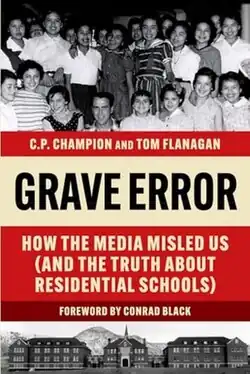
Grave Error: How The Media Misled Us (and the Truth about Residential Schools)
 | |
| Editors | C.P. Champion Tom Flanagan |
|---|---|
| Language | English |
| Genre | History |
| Publisher | True North and Dorchester Books |
| Publication date | 2023 |
| Publication place | Canada |
| Pages | 343 |
| ISBN | 979-8867599317 |
Grave Error: How The Media Misled Us (and the Truth about Residential Schools) is a book published in 2023 by C.P. Champion and Tom Flanagan.
The book contains 18 essays by various contributors, and critically examines the narrative surrounding reports of unmarked graves found around Canadian residential schools. The book has been criticized for promoting residential school denialism.
The book reached number one on the Canadian Literature bestseller list from Amazon.[1]
Contents
The book contains a Preface by Conrad Black, an introduction by the editors, eighteen essays authored by various contributors, and a postscript.[2]
The introduction states:
Canada...is already very far down the path not just of accepting, but of legally entrenching, a narrative for which no serious evidence has been proffered...This book is an attempt to appeal for rationality and truth amid a moral panic of stories about Canada that are so implausible that they should not be believed without convincing evidence.[3]
The chapters are as follows:
- In Kamloops, Not One Body Has Been Found[4]
- Graves in the Apple Orchard[5]
- Digging for the Truth about Canada’s Residential School Graves[6]
- Mass Graves and Other Fake Atrocities on the Blue Quills Indian Reserve[7]
- Billy Remembers[8]
- A Media-Fuelled Social Panic Over Unmarked Graves[9]
- Canada’s Descent into Collective Guilt
- The Banality of Genocide, Made in Canada
- We Had a "Knowing": The False Narrative of IRS Burials
- Neither Truth Nor Reconciliation
- Asking for Evidence Now Counts as "Denialism"
- Integration, Forced Assimilation, or Genocide?
- Everybody’s Favourite Dead White Male[10]
- Were the Residential Schools Agents of Genocide?
- Myths About Attendance at Indian Residential Schools
- The Tainted Milk Murder Mystery
- Did Indian Residential Schools Cause Intergenerational Trauma?[11]
- My Life in Two Indian Residential Schools[12]
- Postscript: Reconciliation and Truth
Reception
The book has been widely criticized for promoting residential school denialism.[13][14][15][16]
The Union of British Columbia Indian Chiefs said the book “essentially questions the very existence of residential schools and their well-documented harms against Indigenous peoples.”[17]
The Coast Reporter described the book as a "collection of essays...which accuses the media of perpetuating a false narrative of residential schools and questions the findings of the Truth and Reconciliation Commission".[18]
The Vancouver Sun stated the book "severely downplays the history and harms of residential schools in Canada."[19]
Frontier Centre for Public Policy stated the book "continues the lengthy process of unravelling the falsehoods about residential schools perpetrated against the Canadian people by our elites and telling the much more truthful and balanced story."[20]
Sequel
Dead Wrong: How Canada Got the Residential School Story So Wrong (published late 2025) is the follow-up.[21]
References
- ↑ Father de Souza, Raymond J. (June 2, 2024). "The record corrects on 'unmarked graves' hysteria". National Post.
- ↑ Champion, C. P.; Tom Flanagan (2023). Grave Error: How the Media Misled Us (and the Truth about Residential Schools). True North and Dorchester Books. ISBN 9798867599317.
- ↑ Butler, Richard (July 2, 2024). "This is a worrying book". The British Columbia Review.
- ↑ Rouillard, Professor Jacques (January 1, 1970). "In Kamloops, Not One Body Has Been Found". The Dorchester Review. Retrieved March 16, 2026.
- ↑ "Graves in the Apple Orchard". Graves in the Apple Orchard. Retrieved March 16, 2026.
- ↑ Rubenstein, Hymie (August 7, 2021). "Digging for the Truth about Canada's Residential School Graves". C2C Journal. Retrieved March 16, 2026.
- ↑ "Mass Graves & Other Fake Atrocities". The Dorchester Review. 2023. Retrieved March 16, 2026.
- ↑ Widdowson, Frances (July 28, 2023). "Billy Remembers". IRSRG. Retrieved March 16, 2026.
- ↑ "A Media-Fueled Social Panic Over Unmarked Graves". Quillette. July 22, 2022. Retrieved March 16, 2026.
- ↑ Piasetzki, Greg (November 12, 2021). "Everybody's Favourite Dead White Male: The Mysterious Resurrection and Celebration of Dr. Peter Henderson Bryce". C2C Journal. Retrieved March 16, 2026.
- ↑ Flanagan, Tom (January 1, 1970). "Did Indian Residential Schools Cause Intergenerational Trauma?". The Dorchester Review. Retrieved March 16, 2026.
- ↑ Clifton, Rodney A. (September 5, 2022). "My Life in Two Indian Residential Schools". C2C Journal. Retrieved March 16, 2026.
- ↑ Miles, J., & Gibson, L. (2026). Truth telling in history classrooms: pedagogical responses to denialism and pseudohistory. Globalisation, Societies and Education, 1–14. https://doi.org/10.1080/14767724.2025.2608674. Quotations:
- "Experts have harshly critiqued and dismissed the Grave Error book for presenting denialist views"
- "Books like Grave Error [...] are part of a wider transnational network of individuals who deny the negative consequences of colonialism"
- "Grave Error [...] meets the criteria for pseudohistory."
- "the book has been widely scorned by historians"
- ↑ Exposing Residential School Denialism’s Transnational Network, 10 December 2024, Sean Carleton, Alan Lester, Adele Perry, and Omeasoo Wahpasiw, https://activehistory.ca/blog/2024/12/10/exposing-residential-school-denialisms-transnational-network/#67ab4b7b-6fae-4bfe-a80e-86bf48ea8d10. Quotations:
- "in Canada, Grave Error has been discredited by experts as right-wing propaganda. Among many falsehoods, the book promotes the debunked “mass grave hoax” conspiracy theory. Grave Error is not a peer-reviewed book; the majority of authors are not scholars; there are no residential school historians; and there is not a single Indigenous author included."
- "Self-published works such as Grave Error find an audience all too willing to consume denialism as legitimate – and comforting – discourse."
- ↑ Hier, S. P. (2026). Moral panics, conservative contrarianism, and the polarizing debate about missing children, unmarked burials, and residential school denialism in Canada. Crime, Media, Culture: An International Journal, 0(0). https://journals.sagepub.com/doi/full/10.1177/17416590251407986
- ↑ Richard Butler, “This is a Worrying Book,” The British Columbia Review, July 2, 2024, https://thebcreview.ca/2024/07/02/2216-butler-champion-flanagan/. Quotation: "this book is riddled with innuendo. The general thrust is that unmarked graves are a knowing falsehood and a money grab by Indigenous people."
- ↑ Martens, Kathleen (April 5, 2024). "Lhatko Dene Nation won't work with Quesnel mayor over ties to residential school book". APTN.
- ↑ Beairsto, Bronwyn (September 9, 2024). "Sechelt council endorses resolution rejecting residential school denialism, without mayor's support". Coast Reporter.
- ↑ Summer, Tom (March 21, 2024). "Quesnel to address harm caused by mayor's wife denying residential school history". Vancouver Sun.
- ↑ Best, Peter (May 20, 2024). "The Betrayal of Canadians by Their Elites". Frontier Centre for Public Policy.
- ↑ "Claims about 'unmarked graves' don't withstand scrutiny". Fraser Institute. December 11, 2025. Retrieved March 17, 2026.