Gödel logic
In mathematical logic, Gödel logics, sometimes referred to as Dummett logics or Gödel–Dummett logics,[1] is a family of finite- or infinite-valued logics in which the sets of truth values V are closed subsets of the unit interval [0,1] containing both 0 and 1. Different such sets V in general determine different Gödel logics.
Gödel logics have several alternative definitions. Specifically, Gödel logics are:
- logics of linearly-ordered Heyting algebras[2]
- logics of (classes of) linearly ordered and countable intuitionistic Kripke structures with constant domains[3]
- logics of relative comparison, in contrast to Łukasiewicz logic, which is a logic of absolute comparison or metric comparison
The concept is named after Kurt Gödel and Michael Dummett.[4][2]
Semantics
Propositional
Given a propositional Gödel logic, an interpretation of it is defined as follows:
- Each propositional variable is assigned a truth value .
- .
- .


For this logic, there is usually also another unary logical connective , such that a model of it must satisfyand a binary logical connective defined by , which impliesNote that for this, we do not need to be a closed set, only that contain .





First-order
Given a first-order logic, it corresponds to a first-order Gödel logic. An interpretation of it is defined essentially the same as the first-order logic:
- There is a nonempty set , the universe of the interpretation.
- For each variable symbol , there is an element .
- For each k-ary function symbol , there is a function .
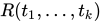
- For each k-ary relation symbol , there is a function .
- For each term , its interpretation is .
- For each atomic formula , its interpreted truth value is .
- The propositional logic connectives works the same as before.
- For each , its interpreted truth value is , where is defined as the interpretation generated by setting to instead.
- For each , its interpreted truth value is ,




}](./_assets_/eb734a37dd21ce173a46342d1cc64c92/12a05aa811c8d5929ad676cdd600f0e78be7b1d1.svg)


}](./_assets_/eb734a37dd21ce173a46342d1cc64c92/bb4ea4cac089257a7aedcdab35a508acc74eedf6.svg)
Note that for this, we do need to be a closed set, since otherwise the quantified formulas is not guaranteed to have a truth value.
Entailment
For any set of formulas, and any interpretation , define , with the special case that .


We say that iff for any interpretation into , . In particular, iff for any interpretation into , .


Syntax
In 1959, Michael Dummett showed that infinite-valued propositional Gödel logic can be axiomatised by adding the axiom schema

See also
References
- 1 2 von Plato, Jan (2003). "Skolem's Discovery of Gödel-Dummett Logic". Studia Logica. 73 (1): 153–157. doi:10.1023/A:1022997524909.
- 1 2 Preining, Norbert (2010). "Gödel Logics – A Survey". Logic for Programming, Artificial Intelligence, and Reasoning. Lecture Notes in Computer Science. Vol. 6397. pp. 30–51. doi:10.1007/978-3-642-16242-8_4. ISBN 978-3-642-16241-1. Retrieved 2 March 2022.
- ↑ Beckmann, Arnold; Preining, Norbert (March 2007). "Linear Kripke frames and Gödel logics". The Journal of Symbolic Logic. 72 (1): 26–44. doi:10.2178/jsl/1174668382. ISSN 0022-4812.
- ↑ Baaz, Matthias; Preining, Norbert; Zach, Richard (2007-06-01). "First-order Gödel logics". Annals of Pure and Applied Logic. 147 (1): 23–47. arXiv:math/0601147. doi:10.1016/j.apal.2007.03.001. ISSN 0168-0072.
- ↑ Dummett, Michael (1959). "A propositional calculus with denumerable matrix". The Journal of Symbolic Logic. 24 (2): 97–106. doi:10.2307/2964753. ISSN 0022-4812. JSTOR 2964753.
| Overview |  | |
|---|---|---|
| Axioms | ||
| Operations |
| |
| ||
| Set types | ||
| Theories | ||
| ||
| Set theorists | ||
| Major fields |
| ||||
|---|---|---|---|---|---|
| Foundations | |||||
| Lists |
| ||||


