Fundamental theorem of Hilbert spaces
In mathematics, specifically in functional analysis and Hilbert space theory, the fundamental theorem of Hilbert spaces gives a necessary and sufficient condition for a Hausdorff pre-Hilbert space to be a Hilbert space in terms of the canonical isometry of a pre-Hilbert space into its anti-dual.
Preliminaries
Antilinear functionals and the anti-dual
Suppose that is a topological vector space (TVS). A function is called semilinear or antilinear[1] if for all and all scalars ,


- is additive: ;
- is conjugate homogeneous: .



The vector space of all continuous antilinear functions on is called the anti-dual space or complex conjugate dual space of and is denoted by . (In contrast, the continuous dual space of is denoted by ), which we make into a normed space by endowing it with the canonical norm (defined in the same way as the canonical norm on the continuous dual space of .)[1]


Pre-Hilbert spaces and sesquilinear forms
A sesquilinear form is a map such that for all , the map defined by is linear, and for all , the map defined by is antilinear.[1] Note that in Physics, the convention is that a sesquilinear form is linear in its second coordinate and antilinear in its first coordinate.


A sesquilinear form on is called positive definite if for all non-0 ; it is called non-negative if for all .[1] A sesquilinear form on is called a Hermitian form if in addition it has the property that for all .[1]


Pre-Hilbert and Hilbert spaces
A pre-Hilbert space is a pair consisting of a vector space and a non-negative sesquilinear form on ; if in addition this sesquilinear form is positive definite then is called a Hausdorff pre-Hilbert space.[1] If is non-negative then it induces a canonical seminorm on , denoted by , defined by , where if is also positive definite then this map is a norm.[1] This canonical semi-norm makes every pre-Hilbert space into a seminormed space and every Hausdorff pre-Hilbert space into a normed space. The sesquilinear form is separately uniformly continuous in each of its two arguments and hence can be extended to a separately continuous sesquilinear form on the completion of ; if is Hausdorff then this completion is a Hilbert space.[1] A Hausdorff pre-Hilbert space that is complete is called a Hilbert space.


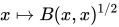
Canonical map into the anti-dual
Suppose is a pre-Hilbert space. If , we define the canonical maps:


The canonical map[1] from into its anti-dual is the map


If is a pre-Hilbert space then this canonical map is linear and continuous; this map is an isometry onto a vector subspace of the anti-dual if and only if is a Hausdorff pre-Hilbert.[1]
There is of course a canonical antilinear surjective isometry that sends a continuous linear functional on to the continuous antilinear functional denoted by and defined by .


Fundamental theorem
Fundamental theorem of Hilbert spaces[1]—Suppose that is a Hausdorff pre-Hilbert space where is a sesquilinear form that is linear in its first coordinate and antilinear in its second coordinate. Then the canonical linear mapping from into the anti-dual space of is surjective if and only if is a Hilbert space, in which case the canonical map is a surjective isometry of onto its anti-dual.
See also
References
- Narici, Lawrence; Beckenstein, Edward (2011). Topological Vector Spaces. Pure and applied mathematics (Second ed.). Boca Raton, FL: CRC Press. ISBN 978-1584888666. OCLC 144216834.
- Schaefer, Helmut H.; Wolff, Manfred P. (1999). Topological Vector Spaces. GTM. Vol. 8 (Second ed.). New York, NY: Springer New York Imprint Springer. ISBN 978-1-4612-7155-0. OCLC 840278135.
- Trèves, François (2006) [1967]. Topological Vector Spaces, Distributions and Kernels. Mineola, N.Y.: Dover Publications. ISBN 978-0-486-45352-1. OCLC 853623322.
| Spaces |
| ||||
|---|---|---|---|---|---|
| Theorems | |||||
| Operators | |||||
| Algebras | |||||
| Open problems | |||||
| Applications | |||||
| Advanced topics | |||||
