Fundamental resolution equation
The fundamental resolution equation or Purnell equation is used in chromatography to help relate adjustable chromatographic parameters to resolution.[1][2]
Equation

where,
= Number of theoretical plates

= Selectivity Term =


The term is the column factor, the term is the thermodynamic factor, and the term is the retention factor. The 3 factors are not completely independent, but can be treated as such.


Intervention
To increase resolution of two peaks on a chromatogram, one of the three terms of the equation need to be modified.
- N can be increased by lengthening the column (least effective, as doubling the column will get a or 1.44x increase in resolution).
- Increasing also helps. This can be done by lowering the column temperature in G.C., or by choosing a weaker mobile phase in L.C. (moderately effective)
- Changing α is the most effective way of increasing resolution. This can be done by choosing a stationary phase that has a greater difference between and . It can also be done in L.C. by using pH to invoke secondary equilibria (if applicable).


Resolution
The fundamental resolution equation is derived as follows:
For two closely spaced peaks, , and ,


so,

Where and are the retention times of two separate peaks.


Since , then
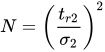

Using substitution, .

Now using the following equations and solving for and


Substituting again and you get:

And finally substituting once more and you get the Fundamental Resolution Equation:

References
- ↑ Purnell, J.H. (1960). "The correlation of separating power and efficiency of gas-chromatographic columns". J. Chem. Soc.: 1268–1274. doi:10.1039/JR9600001268.
- ↑ Skoog, D.A.; Holler, F.J.; Nieman, T.A. (1998). Principles of instrumental analysis. Belmont, CA: Brooks/Cole. p. 689.
Bibliography
- Spring 2009 Class Notes, CHM 5154, Chemical Separations taught by Dr. John Dorsey, Ph.D, Florida State University
- "Fundamental Resolution Equation". Chemistry LibreTexts. LibreTexts. 29 December 2016. Retrieved 1 December 2023.
- "Appendix 1: Derivation of the Fundamental Resolution Equation". Chemistry LibreTexts. LibreTexts. 30 December 2016. Retrieved 1 December 2023.